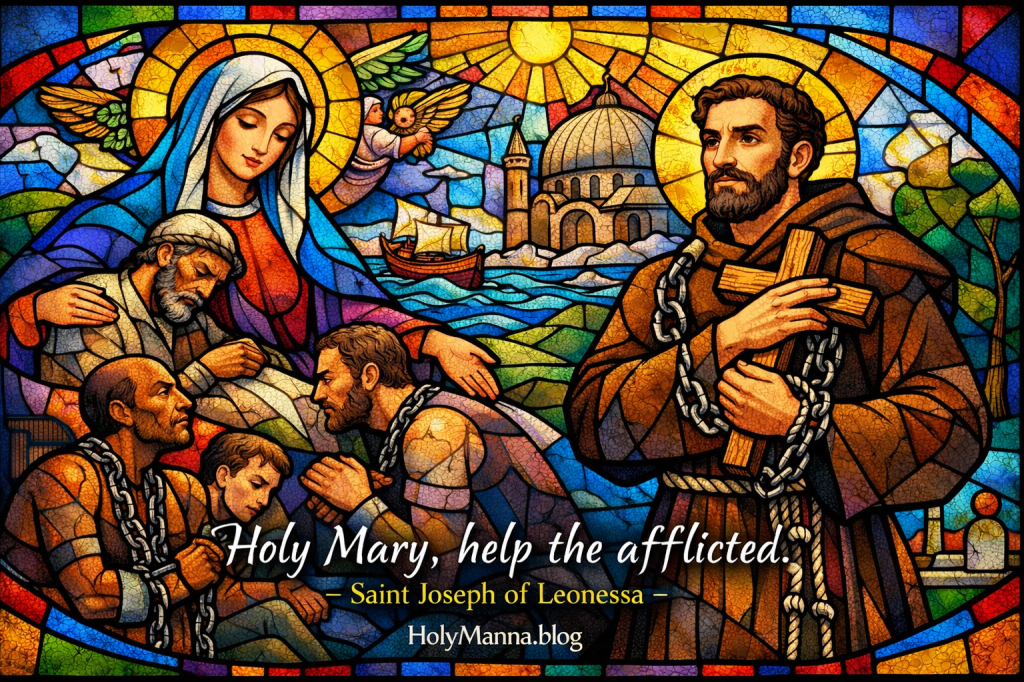
A Capuchin Who Loved the Forgotten
Saint Joseph of Leonessa is one of those saints who makes comfortable Christianity feel impossible. He was a Capuchin Franciscan priest who burned with love for Jesus and proved it by running toward the people everyone else avoided. He preached conversion with a father’s seriousness, lived penance with a Franciscan simplicity, and poured himself out for the poor, the sick, and enslaved Christians far from home. The Church reveres him because his life is a living reminder that the Gospel is not a hobby. It is a mission that reshapes every priority, especially when it comes to mercy.
This saint’s story matters today because it reveals what Christian love looks like when it stops being theoretical. Mercy is not just a feeling, and faith is not just a private opinion. Saint Joseph lived the kind of Catholic life that The Catechism describes when it speaks about conversion, penance, and the works of mercy as real and necessary expressions of discipleship. He was not trying to be extreme for the sake of being extreme. He was trying to belong totally to Christ, and that kind of belonging changes everything.
A Boy Who Built Altars
He was born in 1556 in Leonessa, a rugged mountain town in central Italy, and his baptismal name was Eufranio. Catholic tradition remembers him as a boy drawn to prayer with a seriousness that did not match his age. Stories describe him setting up little altars and trying to lead other children into devotion, as if he already sensed that life is meant to be offered back to God. This early piety was not sentimental. It was a steady hunger for holiness that only grows stronger when tested.
He lost his parents young, and relatives took responsibility for shaping his future. The plan was stability, education, and eventually marriage. It was the normal path, the kind of path families choose because it appears safe and reasonable. Then a serious illness interrupted everything. After recovering, he made a decision that shocked those around him, because he chose the religious life decisively as a response to grace, not as an emotional phase.
He entered the Capuchin Franciscans and took the name Joseph. He embraced penance early and intensely, but Catholic faith does not treat penance as self-hatred. It treats it as love’s discipline. The Catechism teaches that conversion expresses itself through acts like fasting and self-denial, not because God enjoys suffering, but because the heart needs purification and freedom. Saint Joseph lived that kind of penance with a clear purpose, because he wanted his whole life to say yes to Jesus.
A Missionary Preacher
Once his superiors recognized his gifts, he was formally sent out to preach and conduct missions. His preaching was not entertainment, and it was not vague inspiration. It was the kind of preaching that calls sin what it is, and then announces mercy as something real and available. He urged people toward confession and conversion because he understood that sin destroys peace, and forgiveness restores it. His style was direct, but his goal was always restoration, not humiliation.
He also took catechesis seriously, especially for families and children. Catholic tradition remembers him using practical methods to gather children for instruction, because he knew that if the next generation does not learn the faith, the Church in that town will become a shell. That instinct fits perfectly with the Church’s own teaching, because The Catechism insists that passing on the faith is a serious duty, not an optional hobby. Saint Joseph treated it as spiritual emergency work, because he cared about souls the way a good father does.
His love for the poor was just as intense as his preaching. He served needy pilgrims with humility, offering food and care, and taking on tasks most people would avoid. He cared for the sick and the neglected because he believed what Jesus teaches in The Gospel of Matthew, that the way a person treats the least is the way a person treats Christ. That is not sentimental language. That is judgment-day truth. The Church teaches the same reality when it emphasizes the works of mercy, because mercy is one of the clearest marks of authentic discipleship.
The Courage to Love Captives
Then came the mission that made him unforgettable. He was sent to Constantinople to minister to Christian captives, including men forced into brutal labor and treated like property. This was not a comfortable assignment. It was a spiritual battlefield, and Joseph walked into it with the confidence of a man who believed that Jesus is Lord in every empire and every prison.
Catholic tradition describes him serving thousands of enslaved Christians, bringing encouragement, prayer, and pastoral care. When plague spread, he stayed near the suffering and served at great personal risk. He even fell ill but survived, and his survival became part of his reputation because people recognized that his life was being preserved for more work. There is also a powerful story remembered in Catholic tradition, that he offered himself in exchange for dying slaves, willing to take another man’s place. Those offers were not accepted, but the gesture reveals the interior logic of a saint. He had learned from Jesus that love is measured by sacrifice, not convenience.
His zeal became even bolder. Accounts describe him attempting to reach the Sultan’s court to plead for the protection of Christians and for freedom of conscience for those returning to the faith. He was arrested and condemned, and the torture that followed is one of the most shocking episodes in his story. He was suspended by hooks through his hand and foot for days, a punishment meant to break the body and silence the witness. Catholic tradition holds that he did not die, and that he was released in a way understood as miraculous, then expelled. Whether someone focuses on the physical horror or the spiritual courage, the meaning is the same. He was willing to be a martyr, and God preserved him as a living sign of endurance.
The Cross Without Compromise
Saint Joseph endured hardships that were dramatic and ordinary. The torture in Constantinople was public and brutal, but the daily cross of his life was also heavy. He traveled constantly, preached relentlessly, and carried the burdens of the poor and the spiritually lost like a man who refused to abandon his people. He lived with austerity, but Catholic tradition insists he was not bitter. True penance does not produce darkness. True penance produces freedom, because it teaches the heart to seek God first.
A famous saying attributed to him captures his Franciscan toughness and his refusal to pamper himself. He spoke to his own body with blunt humor and firm discipline, saying “Brother Ass… you must be content to be a poor ass.” The language is earthy, but the wisdom is clear. The body is a servant, not a master, and desires must be trained, not obeyed. That is not a rejection of the body, because Catholic faith teaches the dignity of the body. It is a refusal to let the body become an idol.
He was not executed, so he is not a martyr in the strict sense, but he lived in the posture of martyrdom. He was ready to die for Christ, and he endured persecution and suffering without compromise. The Church teaches that Christian suffering can become participation in Christ’s sacrifice when it is united to love. The Catechism speaks about this union with Christ and the call to take up the cross with Him. Saint Joseph did that in chains, in illness, and in exhaustion, and then he kept preaching anyway.
Mary’s Mercy at the End
He died in 1612 in Amatrice, worn down by labor and love. Catholic tradition remembers his final days as the completion of a life spent for others. One detail from his last moments reveals his heart with remarkable clarity, because he loved a short prayer to the Mother of God that sounds like it was forged in the presence of real suffering. He repeated “Sancta Maria, succurre miseris.” This means, “Holy Mary, help the afflicted.” A man does not cling to that prayer unless he has walked among the afflicted and learned to rely on heaven.
After his death, devotion grew around his memory, especially in the region of his birth. His relics became a focus of veneration, and his body was later transferred back to Leonessa, where a sanctuary became closely associated with his presence and intercession. His canonization in the eighteenth century confirmed what the faithful already sensed, that his holiness was not local folklore. It was grace recognized by the Church. Catholic tradition attributes miracles and favors to his intercession after death, including significant healings connected to prayer for his help. Pilgrims have continued to seek his intercession, especially in places tied to his relics, because the saints remain active members of the Church in heaven.
A Road Map for Ordinary Catholics Today
Saint Joseph of Leonessa is the kind of saint who does not let anyone stay lukewarm. His life presses a simple question into the heart, and it is a question that can change a person’s entire spiritual direction. What does faith look like when it is real? The answer is not complicated, but it is demanding, because it requires a Catholic to live with integrity.
His first lesson is courage rooted in truth. He feared God more than man, and he valued salvation more than reputation. The modern world often treats conviction as harshness, but Catholic faith knows the difference between cruelty and clarity. Saint Joseph preached conversion because he believed mercy is real and sin is deadly. That kind of preaching is not popular, but it is deeply loving because it refuses to let people drift into spiritual danger without warning.
His second lesson is mercy that gets practical. He did not only speak about love for the poor. He organized help, served with his hands, and defended the vulnerable from exploitation. The Catechism teaches that the works of mercy are central to Christian life, and he lived them like a man who expects to meet Christ in every suffering face. His third lesson is penance as freedom. His discipline was not a personality quirk. It was spiritual training. When Catholics fast, deny themselves, and practice custody of the eyes and tongue, they are not becoming less human. They are becoming more free, because they are no longer ruled by appetite.
His final lesson is Marian trust. That dying prayer to Our Lady is a blueprint for daily life. Catholics do not honor Mary because they are sentimental. Catholics honor her because she is a mother, and mothers help their children. Saint Joseph leaned on her because he knew the afflicted need more than human strength. They need grace, and grace is never far from those who ask.
Engage with Us!
Share your thoughts and reflections in the comments below. Saint Joseph of Leonessa has a way of challenging comfortable faith, but he also shows how close God is to the suffering and the poor.
- Where does fear most often silence witness, and what would it look like to speak with charity and courage this week?
- Which work of mercy feels most urgent right now, and how can it be done in a concrete, realistic way?
- What kind of penance would actually help grow in freedom, such as fasting, custody of the eyes, resisting gossip, or giving up unnecessary comfort?
- How can devotion to Our Lady become more than a habit and become a real reliance, like Saint Joseph’s cry for Mary to help the afflicted?
May Saint Joseph of Leonessa teach hearts to love the Cross without fear and love the poor without excuses. Keep walking in faith, keep choosing repentance over compromise, and keep doing everything with the love and mercy Jesus taught us.
Saint Joseph of Leonessa, pray for us!
Follow us on YouTube, Instagram and Facebook for more insights and reflections on living a faith-filled life.

 Holy Manna!
Leave a comment