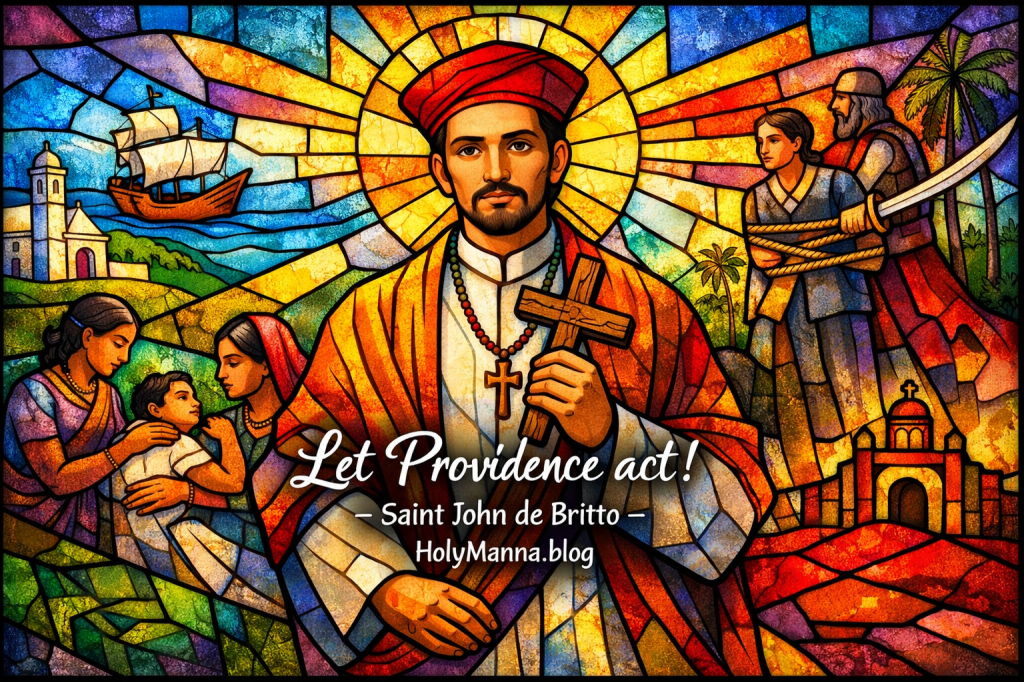
Crossing Oceans for Christ
Saint John de Britto was a Portuguese Jesuit priest who became one of the great missionary martyrs of the Church in South India. He is remembered for a rare blend of courage and tenderness because he preached Jesus Christ with clarity, and he loved the people enough to learn their language, embrace poverty, and live with real cultural humility. In Tamil Catholic devotion he is honored as Arul Anandar, a name that carries the memory of a holy man who walked dusty roads, formed Christian communities, and refused to soften the Gospel when it became costly. His witness still matters because it proves that the Catholic faith is not a Western possession. It is the good news for every nation, every language, and every generation, just as The Catechism teaches about the Church’s missionary nature (CCC 849–856).
A Noble Beginning Marked by Grace
John de Britto was born in Lisbon in 1647 into a noble family, and his early years placed him close to the world of courts and power. Catholic tradition remembers a serious childhood illness that became a spiritual turning point, because his mother begged for the intercession of Saint Francis Xavier and promised that if her son recovered, he would be offered to God’s service. He lived, and the story followed him like a quiet prophecy as he grew into a young man surrounded by privileges that could have easily shaped his ambitions. Instead, he chose the Society of Jesus, entering the Jesuits as a teenager and embracing the long road of formation with prayer, discipline, study, and obedience. Everything about his background suggested an easy path forward, but his heart wanted something harder and holier. He did not join to collect religious achievements, because he wanted to belong completely to Christ and to be sent where the Gospel was most needed.
The Roman Sannyasi and the Dust of the Road
When John de Britto arrived in India, he stepped into a world that demanded humility from the start. Mission territory meant heat, language barriers, suspicion, and real danger, and it would have been easy to remain in safer places. Instead, he pushed toward the most difficult regions of the south, especially the Madurai mission fields connected with the Marava people, where the faith required patience and the missionary needed courage. Catholic accounts describe him embracing an austere lifestyle recognizable to the people around him, because he learned local languages and lived with simplicity that did not feel imported. This was not an attempt to blend religions, because it was a missionary decision to remove unnecessary cultural obstacles so that people could hear the Gospel without confusing it for European custom. He traveled constantly, often on foot, preaching, catechizing, baptizing, hearing confessions, and forming small communities that could endure even when a priest could not stay long. Tradition preserves a line that captures his intention with directness and reverence: “I came to India not to seek laurels of science but martyrdom.”
A Mission of Mercy
Saint John de Britto’s life was filled with the kind of holiness that rarely makes headlines but transforms souls. He preached, listened, reconciled sinners, strengthened marriages, and built up the Church in places where being Christian could cost a family everything. His mission produced converts who were willing to face consequences, and that is a quiet miracle that the world rarely celebrates. Catholic tradition also remembers extraordinary favors associated with his ministry, including healings and interventions that strengthened new believers and drew seekers toward God. One commonly repeated account describes a baptized child struck during a violent storm and then restored, remembered as a sign of God’s protection and a testimony to the power of prayer. In a Catholic perspective, signs and wonders are never about the ego of the saint, because they point to Christ, stir repentance, and confirm that the Gospel is real.
When the Gospel Confronts Power
The heaviest suffering of Saint John de Britto came not only from travel and climate, but from the fact that the Gospel confronts sin and reshapes life. This became especially explosive when influential people converted, because the Christian life is never meant to be private or hidden, and it touches family, morality, justice, and worship. Catholic accounts often connect the final crisis to marriage, because Christian teaching insists on the unity and fidelity of marriage, reflecting Christ’s faithful love for His Church, as taught in The Catechism (CCC 1644). When a high status convert was challenged to live that truth, backlash formed, and what began as a moral conflict became a political one. The saint was arrested more than once and endured humiliations, beatings, and pressure to abandon the faith. From imprisonment he wrote words that reveal how he interpreted suffering through grace and trust: “We are happy and we bless the Divine Will that deigns to grant us the grace to shed our blood for His holy Law.”
The Martyr’s Peace
Saint John de Britto did not cling to control when his life entered danger, because he clung to God. Tradition remembers moments when escape or rescue was possible, yet he refused to save himself if it would expose Christians to retaliation. His surrender was steady and simple, and Catholic memory preserves a line that captures the heart of his trust: “Let Providence act!” Eventually he was condemned and executed by beheading at Oriyur in early February 1693, and the Church commemorates him on February 4. His death is significant not because Christians love tragedy, but because the Church sees martyrdom as the supreme witness to the truth of the faith, as The Catechism teaches (CCC 2473). Catholic memory preserves his calm readiness in his final days, including this message of hope from a man looking past the blade and toward eternity: “I was brought to Oriyur to be beheaded… I await the day of happiness.”
Red Sand and a Living Devotion
After his martyrdom, devotion to Saint John de Britto only grew stronger. Oriyur became a place of pilgrimage, penance, and prayer, and Catholics in the region began to speak of the red sand connected with his martyrdom, a tradition that still draws the faithful. Many pilgrims have testified to favors received, including healings and blessings for families, and this devotion is not treated as superstition in Catholic life when it is rooted in prayer, conversion, and trust in God. The Church encourages the faithful to ask the saints for intercession, because the saints are alive in Christ and remain members of His Body, and their prayers lead souls back to Jesus rather than away from Him. His canonization confirmed that this was not only a local hero, because the universal Church held him up as a saint for everyone, and his witness continues to shape Catholic identity in the region where he poured out his life.
A Saint for Everyday Courage
Saint John de Britto challenges modern Catholic life in a healthy way, because his story shows that the faith cannot be reduced to private inspiration or occasional religious feelings. The Gospel is a full life, and it calls for obedience that is both merciful and truthful. His example invites deeper prayer, frequent confession, and a serious love for the Mass, because saints do not run on willpower alone. His witness also calls Catholics to courage in moral life, especially when the culture pushes back, and to trust in Providence when obedience becomes costly. What would change if trust in God became concrete this week through prayer, confession, Mass, and a deliberate act of sacrificial love? Saint John de Britto shows that surrender is not weakness, because it is strength placed in the hands of the Father.
Engage with Us!
Share thoughts and reflections in the comments below. Saint John de Britto’s story has a way of stirring the heart, especially for anyone who feels torn between comfort and conviction.
- Where is God asking for courage to live the faith more openly and consistently, even if it costs social approval?
- What is one part of Catholic teaching that feels challenging to live right now, and what practical step could help bring real obedience and peace?
- Who in everyday life needs patient, humble evangelization, meaning a listener’s heart, clear truth, and real charity, rather than arguments and pressure?
- How can trust in Providence become concrete this week through prayer, confession, Mass, and a deliberate act of sacrificial love?
May Saint John de Britto intercede for every reader to love Jesus with a fearless heart, to choose truth over convenience, and to do everything with the love and mercy Jesus taught us.
Saint John de Britto, pray for us!
Follow us on YouTube, Instagram and Facebook for more insights and reflections on living a faith-filled life.

 Holy Manna!
Leave a comment