Crossed Candles and a Church That Believes in Healing
Every winter, the Church keeps a small appointment with hope. People line up with scratchy throats, lingering coughs, and that quiet worry that shows up when sickness makes the rounds. Then two candles are crossed at the throat and the prayer is spoken. It feels simple, almost too simple, until it hits the heart that Catholic faith has never been embarrassed to ask God for healing.
Saint Blaise was a bishop of Sebaste in the early fourth century, and he is honored as a martyr who refused to deny Jesus Christ. He is loved in both East and West, which is a sign that his witness mattered far beyond one city or one century. He is especially known as an intercessor for those suffering from throat illnesses and dangers of choking, and he is remembered among the Fourteen Holy Helpers, saints often invoked in times of sickness and public fear. His story has been handed on through the Church’s liturgical memory and Christian devotion, and that is why his name still feels familiar in parishes that have never heard of Sebaste.
A Healer Becomes a Shepherd of Souls
Not every detail of Saint Blaise’s early biography is preserved with the same clarity as saints who left writings or whose lives were recorded close to their own time. Still, the Church’s steady memory holds the essentials clearly: he was a bishop, he lived as a faithful witness, and he died a martyr. Around those essentials, Catholic tradition has long pictured him as a physician, a man trained to notice suffering and respond with compassion.
That background fits the way Christians later spoke about him, because he is remembered as someone who cared for the sick and did not flinch at human weakness. Tradition also holds that he was chosen as bishop by the people, which suggests he inspired trust and stability in a fearful time. A bishop is meant to guard the truth, teach the faith, and shepherd souls like a spiritual father, and Saint Blaise is remembered because he embraced that calling when it could cost him everything.
His conversion is not usually told as a sudden change from one religion to another. It is remembered more like a deepening of faith that shaped everything, including his work, his leadership, and his willingness to suffer for Christ. That kind of conversion is often the most challenging, because it means letting the Lord take over not just Sundays, but the whole life.
A Cave of Prayer
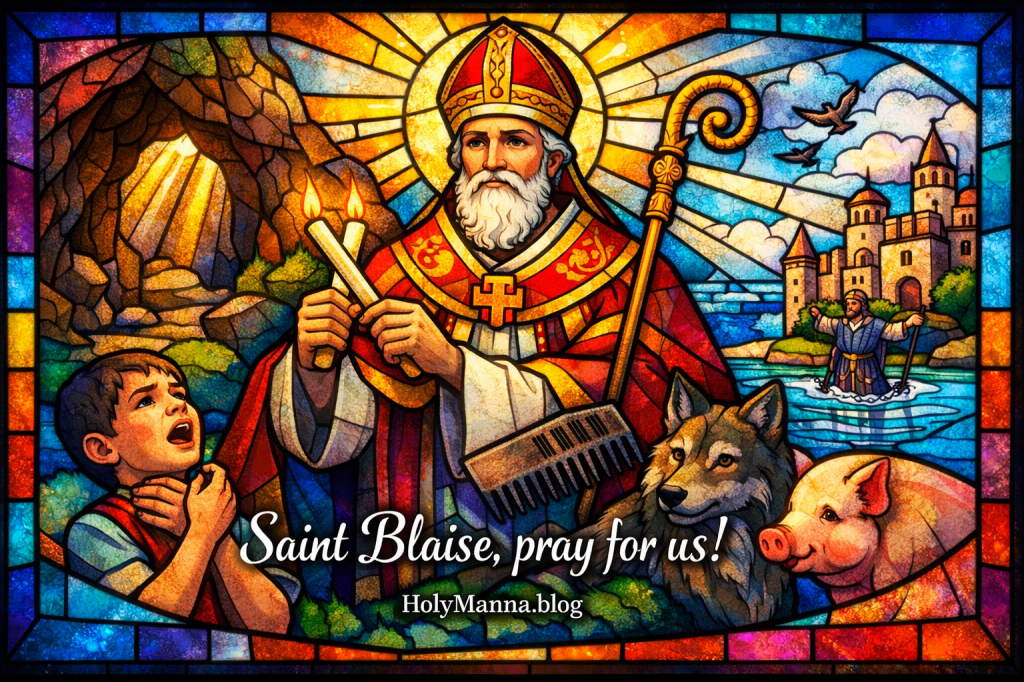
One of the most loved strands of Catholic tradition says that when persecution intensified, Saint Blaise withdrew to a cave. That detail is remembered not to turn him into a romantic hermit, but to show what Christians have always known. When the world becomes hostile, the soul has to become more rooted in prayer, not less rooted in charity.
In these traditions, even the cave becomes a place of mercy. Saint Blaise is often shown with wild animals, because he was remembered as someone whose holiness brought peace even to creation. Some stories describe animals coming to him for help or healing, and while these accounts belong to devotional tradition, they underline a Catholic truth that is easy to forget. Grace restores what sin disrupts, and holiness brings order where fear once ruled.
The best known miracle from his life is the one that shaped Catholic practice for centuries. A child was choking on a fish bone lodged in his throat, and Saint Blaise intervened through prayer, and the child was saved. That is why Catholics still call on him when a throat swells, when breathing feels tight, or when anxiety rises because someone cannot swallow. The story is remembered because it shows the tenderness of God, and because it reveals the saints as real friends who intercede with urgency.
Another traditional story often told alongside the throat miracle speaks of a poor woman whose only pig was carried off by a wolf. She begged Saint Blaise for help, and the animal was returned. Later, the same woman is remembered as bringing food and candles to him in prison, which helps explain why candles became linked to his blessing. It is a very Catholic kind of detail, because it connects prayer to gratitude and devotion to concrete charity. Miracles are never meant to end in entertainment. Miracles are meant to lead to love.
The Peace of a Martyr
Saint Blaise’s end was not gentle, and the Church does not pretend it was. Catholic tradition remembers that he was arrested, interrogated, and pressured to compromise. The demand underneath persecution is always the same, even in modern times. It is the demand to keep faith private, to stop speaking clearly, and to offer a small gesture that makes everyone else comfortable.
The accounts handed on in the Church’s memory include severe tortures, especially being lacerated with iron combs, instruments associated with the processing of wool. This is why Saint Blaise is sometimes shown in sacred art with comb like tools, and why he became connected in devotion with those who worked in wool and textiles. Traditions also speak of him being cast into water and preserved, and then finally condemned to beheading. Some accounts add that others suffered with him, including children, which only highlights how cruel persecution could be.
What matters most is not the creativity of torture, but the clarity of witness. The Catechism teaches that martyrdom is not a performance or a tragedy without meaning. It is the supreme witness to truth and the clearest proof that Christ is worth everything. “Martyrdom is the supreme witness given to the truth of the faith.” CCC 2473.
Saint Blaise endured because he believed what the Church still believes. Jesus Christ is risen, death is not the end, and obedience to God is never wasted. A martyr does not die clinging to despair. A martyr dies clinging to the promise of eternal life.
A Blessing That Traveled the World
After Saint Blaise’s death, devotion to him did not fade into a local memory. It spread across regions and centuries, until it became part of the ordinary rhythm of Catholic life. The most familiar legacy is the Blessing of Throats, traditionally offered on February 3. The prayer used in many places is direct and confident, because it asks God for a real gift through the saint’s intercession. “Through the intercession of Saint Blaise, bishop and martyr, may God deliver you from every disease of the throat and from every other illness.”
This devotion also teaches good Catholic theology without turning it into a classroom lecture. The blessing is a sacramental, meaning it is a sacred sign that disposes hearts to receive grace and to trust God more deeply. The Catechism explains, “Sacramentals are sacred signs which bear a resemblance to the sacraments.” CCC 1667. Catholic faith is never embarrassed to pray with the body, because the Lord created the body, redeemed the body, and promises the resurrection of the body.
Saint Blaise’s posthumous influence also shows up in local customs that kept his memory close to everyday life. Some Catholic communities developed traditions of blessing and sharing bread on his feast, tying charity to prayer in a way that feels very much like the early Church. In other places, devotion grew so strong that entire cities became known for honoring him with processions and solemn celebrations. Whether someone travels to a shrine or simply steps forward in a parish line, the heart of the devotion stays the same. The saints are alive in Christ, and the Church is one family across heaven and earth. The Catechism teaches this plainly: “They do not cease to intercede with the Father for us.” CCC 956.
As for famous personal quotations, no widely accepted, historically secure sayings from Saint Blaise have been preserved in a way that can be confidently attributed to him. His voice reaches Catholics most clearly through the Church’s living prayer and the faithful memory of his witness.
Living Saint Blaise’s Courage
Saint Blaise is easy to reduce to a quick blessing and a charming tradition, but his life asks for something deeper. He shows what it looks like when compassion and courage live in the same heart. He cared about healing, and he also cared about truth. He prayed in hiddenness, and he did not run from witness when the hour came.
There is a practical lesson here for ordinary life. The world still pressures Christians to soften convictions, to keep religion private, and to avoid any clear statement that Jesus is Lord. Saint Blaise reminds believers that clarity does not have to be rude, but it does have to be real. He also reminds believers that prayer is not a last resort for weak people. Prayer is strength for those who want to love well and stay faithful.
His story also helps people approach sickness with faith instead of panic. God sometimes heals quickly, and sometimes He strengthens the soul to endure, and sometimes He uses suffering to purify love. In every case, Catholics are not meant to face illness alone. The communion of saints is not a slogan. It is a living reality. When the Church asks for intercession, she is acting like a family, carrying burdens together and trusting God to provide what is needed. The Catechism teaches that intercession is a prayer that participates in Christ’s own intercession and expresses the communion of saints. CCC 2635.
So Saint Blaise can be honored in very ordinary ways. Pray for the sick with perseverance. Ask for the grace to be brave about the faith in conversations that matter. Let sacramentals become reminders to go deeper, not substitutes for deeper conversion. Live with steady confidence that Jesus does not abandon His people, and that love is stronger than fear.
Engage with Us!
Share your thoughts and reflections in the comments below, because the saints are not meant to stay on stained glass. They are meant to shape real lives in real families and real parishes.
- When have you experienced God’s closeness through a simple Catholic devotion, like a blessing or a candle, and how did it strengthen your faith?
- What does Saint Blaise’s courage under persecution reveal about where fear still has too much space in the heart today?
- Who in your life needs intercession right now, and what concrete step can you take this week to pray for them with perseverance?
- How can Saint Blaise’s compassion for the suffering inspire a more patient, more generous love in ordinary routines and relationships?
Keep walking forward in faith. Keep asking the saints to pray, and keep trusting Jesus to act, because a life lived with the love and mercy Jesus taught always becomes a light for someone else.
Saint Blaise, pray for us!
Follow us on YouTube, Instagram and Facebook for more insights and reflections on living a faith-filled life.

 Holy Manna!
Leave a comment