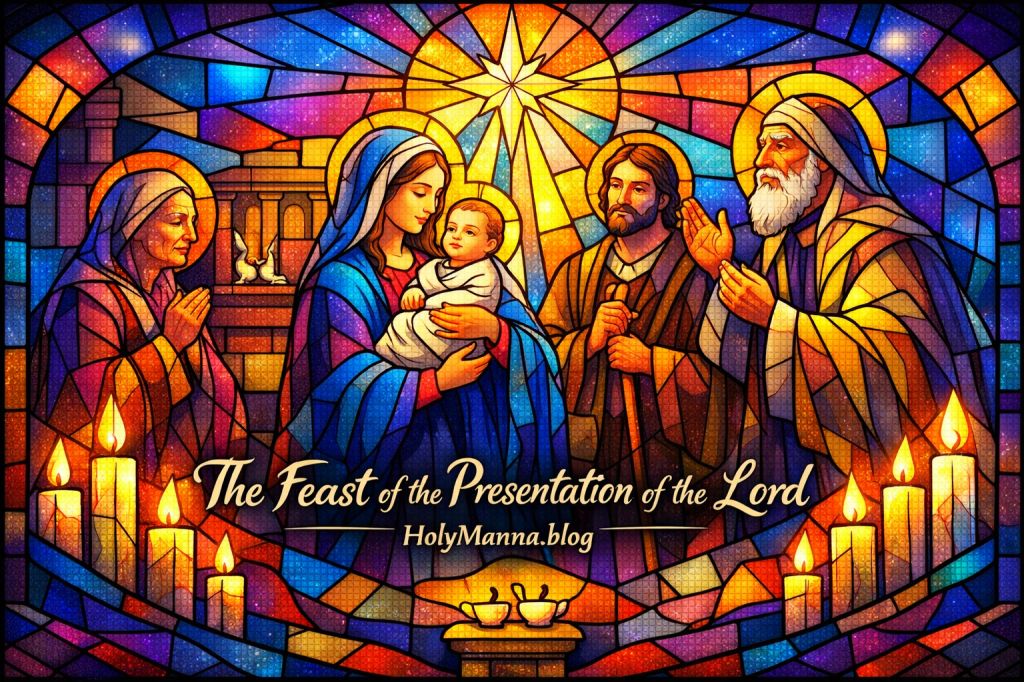
Candlelight at the Turning Point
The Feast of the Presentation of the Lord, celebrated on February 2, lands at a beautiful moment in the Church’s year. It arrives forty days after Christmas, when most of the world has already packed away the lights, yet the Church insists that the Light is still shining. This feast is not sentimental nostalgia for the Nativity. It is the Church proclaiming that the Child of Bethlehem is the Lord of the Temple, the Savior promised to Israel, and the Light meant for every nation. Catholics have called this day by several names across history, and each one highlights a different angle of the same mystery. The modern title, the Presentation of the Lord, keeps the focus on Christ being offered to the Father. The older Western title, the Purification of Mary, draws attention to Mary’s humility and obedience to the Law. The popular name Candlemas points to the candle procession that announces what Simeon proclaimed, that Christ is the Light that pushes back the darkness. In the East, the feast has been called the Meeting, because it is the moment when the long waiting of Israel finally meets the Messiah face to face.
Forty Days After Christmas
The story comes from The Gospel of Luke 2:22-40, and it unfolds with the steady faith of people who take God seriously. Mary and Joseph go up to Jerusalem because the Law commanded certain actions after childbirth and because the firstborn son belonged to the Lord in a special way, as seen in Leviticus 12 and Exodus 13. This was not superstition or social pressure. It was covenant obedience. Their journey is not long, but it is holy, because the biggest movements of salvation history often happen through ordinary people doing the next faithful thing with a sincere heart.
They arrive carrying the Child and bringing an offering, the sacrifice of the poor, which reveals their humility without embarrassment. The Savior enters His Temple not with worldly pageantry but with poverty, simplicity, and worship. This is not just a family tradition being checked off a list. The Child is being presented to the Father, and in that simple ritual the Church sees a prophecy of the Cross. The One who will later offer Himself completely is being offered here in seed form, in a way that only faith can recognize.
Then comes Simeon. He is described as righteous and devout, waiting for the consolation of Israel, and led by the Holy Spirit. He is not a man chasing novelty. He is a man who has learned how to wait. When he sees Jesus, he knows immediately what the powerful missed and what the clever could not calculate. He takes the Child into his arms and prays words the Church loves so much that she places them on the lips of believers again and again in the prayer of the Church. Simeon says “Now, Master, you may let your servant go in peace” in Luke 2:29, and those words sound like the prayer of someone who finally feels safe because salvation is real. Simeon calls Jesus “a light for revelation to the Gentiles” and “glory for your people Israel” in Luke 2:32, and he is not speaking in poetry alone. He is confessing the mission of the Messiah.
Simeon also speaks the hard truth, because genuine faith does not hide from reality. He tells Mary that this Child will be a sign of contradiction, and that a sword will pierce her soul. The joy is real, but it is not shallow. Anna the prophetess is there too, an elderly widow devoted to prayer and fasting. She recognizes the Child, gives thanks to God, and speaks about Him to those who were waiting for redemption. The Gospel quietly shows that the Messiah is recognized not by the proud and the busy, but by the faithful who pray, worship, and watch for God.
Light and Sacrifice
This feast reveals Christ as the fulfillment of Israel’s hope and the Savior of the nations. Simeon’s canticle is not a private opinion. It is a prophecy that the Church has treated as a true interpretation of who Jesus is. The Light in Simeon’s arms is not a vague moral inspiration. It is the Incarnate Son, God made man, the One who will illuminate every human life and expose every false darkness. The feast teaches that the Light of Christ is not only comforting. It is also purifying, because truth always cleanses what it reveals.
This feast also reveals that salvation comes through sacrifice. The Child is presented to the Father according to the Law, and the Church reads this as a foreshadowing of the perfect offering of Christ on the Cross. That is why the liturgy pairs this mystery with Malachi 3:1-4, where the Lord comes to His Temple to purify, and with Hebrews 2:14-18, which teaches that Christ shared our flesh and blood to redeem us and become a merciful high priest. The Presentation is a bridge between Bethlehem and Calvary, and it teaches that love is not proven by feelings but by self-gift that remains faithful under pressure.
Mary’s role shines here with quiet force. She submits to the Law in humility and solidarity. She does not demand special treatment. She obeys, worships, and offers. Then she receives Simeon’s prophecy about the sword, and the Church understands that Mary’s motherhood will include suffering, not as defeat but as participation in her Son’s saving mission. The Catechism highlights the Presentation as a mystery where Jesus is offered as the firstborn, and where Simeon and Anna represent Israel’s expectation meeting the Messiah, which is why this feast is never just a pretty day of candles. It is a day that teaches what it means to belong to God in truth, as taught in CCC 529.
Candlemas
The most recognizable tradition of this feast is the blessing of candles and the candlelight procession. This is not a sentimental add-on. It is a Catholic way of preaching with the whole body. The Church literally carries light through the church to proclaim that Christ is the Light of the world. The faithful are not only remembering Simeon’s words. They are stepping into them, and they are teaching their children what it looks like to confess faith without embarrassment.
There is something beautifully straightforward about a candle. It is small, it is fragile, and it is stubborn. It shines because it is consumed, and that is why the candle has always been a fitting symbol for Christian discipleship. The baptized do not shine by self-invention. They shine by belonging to Christ and being spent in love. Candlemas becomes a yearly reminder that real light is not loud. It is faithful, steady, and willing to burn even when the room stays dark for a while.
Many Catholic families keep blessed candles with reverence and use them during prayer, during illness, or during moments of fear and uncertainty. This practice fits Catholic life because Catholic faith is not just mental agreement. It is embodied worship. The Church blesses material things to help the faithful lift their hearts to God and live with spiritual alertness in everyday life, as explained in CCC 1667-1670. When a candle is lit at home during prayer, it gently teaches that the domestic life of a family is meant to be ordered toward God, not toward noise and distraction, and that Christ’s light is meant to be welcomed, not postponed.
Shrines of Light and Roads of Prayer
The Presentation is rooted in the Temple of Jerusalem, and that historical setting matters. It reminds believers that Christianity is not a myth floating in the clouds. It happened in real places with real people. Because of that, Catholics have always loved pilgrimage as a way to say with the body what the soul believes. Pilgrimage is not tourism with religious language. It is a school of conversion, where time, effort, and discomfort are offered to God in a spirit of prayer.
This feast also has devotional life connected to Marian titles associated with Candlemas, especially in the Spanish-speaking Catholic world under the name Our Lady of Candelaria. These cultural devotions can be lived beautifully when they keep Christ at the center and honor Mary as the humble Mother who presents her Son and leads people to Him. They often include processions, communal prayer, and celebrations that emphasize Christ’s light and Mary’s faithful obedience, and they remind families that faith is not meant to stay private.
Religious communities often celebrate this feast with special reverence because it reflects their vocation so clearly. The Child is presented, offered, and given back. That rhythm of belonging is at the heart of consecrated life. The Church celebrates the World Day of Consecrated Life on this date, placing consecrated men and women before the faithful as living reminders that God is worth a total offering. This does not turn the feast into a niche celebration. It makes the feast more concrete, because it shows that the Gospel can still be lived with full surrender today.
A Feast That Shaped the Christian Imagination
Candlemas has shaped Catholic culture for centuries because it sits at a hinge point in the year. It is close enough to Christmas to still feel the warmth of the Incarnation, but far enough to introduce the sharper clarity of prophecy and sacrifice. It tells the truth that the Child is not only to be adored but also to be followed. It tells the truth that salvation is not only comfort but also conversion, and that anyone who truly welcomes the Light must allow that Light to reveal what needs to change.
Around the world, Catholic communities celebrate this day with solemn liturgy, hymns, and processions. In many places, the candle procession is the most memorable part because it is so visually striking, but the meaning behind it is what gives it power. The Church processes with candles because she believes Christ truly came into the world, and she believes the world still needs His light. That is why this feast never becomes outdated. Darkness does not go out of style, and neither does the Light.
In some cultures, February 2 also gathered folk customs and seasonal observations. Catholics can acknowledge those cultural layers without letting them steal the feast. The Church does not build her feasts on superstition. She builds them on Christ. If a culture has added extra traditions to the date, believers can keep what is wholesome and discard what is foolish, always protecting the feast’s real meaning. The heart of the day is not a shadow on the ground. The heart of the day is the Light of the world carried into the Temple and proclaimed by saints who waited in faith.
The Meeting That Still Happens at Every Mass
The Presentation of the Lord is not only a historical moment. It is a pattern for the Christian life. Mary and Joseph offer Jesus to the Father in the Temple. The Church does something mysteriously similar at every Mass. Christ is made present sacramentally and offered to the Father, and the faithful are invited to offer themselves with Him. The Presentation teaches what it means to worship. It teaches that a Catholic does not come to Mass as a spectator. A Catholic comes to be part of an offering.
Simeon and Anna give another pattern that is desperately needed in modern life. They recognize Christ in humility and prayer, not in spectacle. That challenges a world that trains people to crave constant stimulation. This feast teaches that the soul becomes sharp when it becomes faithful. If someone wants to recognize Christ, that person has to make room for silence, prayer, and worship. The Church does not ask for a perfect personality or a dramatic conversion story. The Church asks for faithfulness that keeps showing up.
Simeon’s canticle teaches a Christian how to live with peace. The world teaches people to grasp for control. Simeon teaches surrender. He teaches that once Christ is received, fear no longer needs to dominate, because the heart can finally say that it has seen salvation. How would daily life change if the day ended with Simeon’s peace instead of anxiety? How would relationships change if Christ’s light was welcomed not only when it comforts, but also when it corrects? The Presentation teaches that the best way to carry Christ’s light is to carry it through daily faithfulness, even when it is inconvenient, even when it is misunderstood, and even when it hints at suffering ahead.
Engage with Us!
Drop a comment below with what stands out most from the Presentation of the Lord and how this feast has been lived in your parish or family. It is always encouraging to see how Catholics across different places keep the same light burning.
- Where has God been asking for quiet obedience instead of dramatic gestures?
- What part of Simeon’s prophecy hits hardest: Christ as light, Christ as contradiction, or Mary’s pierced heart?
- How can the home become a small “temple” this week through prayer, reverence, and fidelity?
- What does it look like to offer daily life to God in a real way, not just in words?
- Who in your life needs someone to bring them Christ’s light through patience, truth, and mercy?
Keep walking in faith, keep the light of Christ close, and keep doing everything with the love and mercy Jesus taught us, especially when it costs something, because that is where the Gospel becomes real.
Holy Family, pray for us!
Saint Simeon, pray for us!
Saint Anna, pray for us!
Follow us on YouTube, Instagram and Facebook for more insights and reflections on living a faith-filled life.

 Holy Manna!
Leave a comment