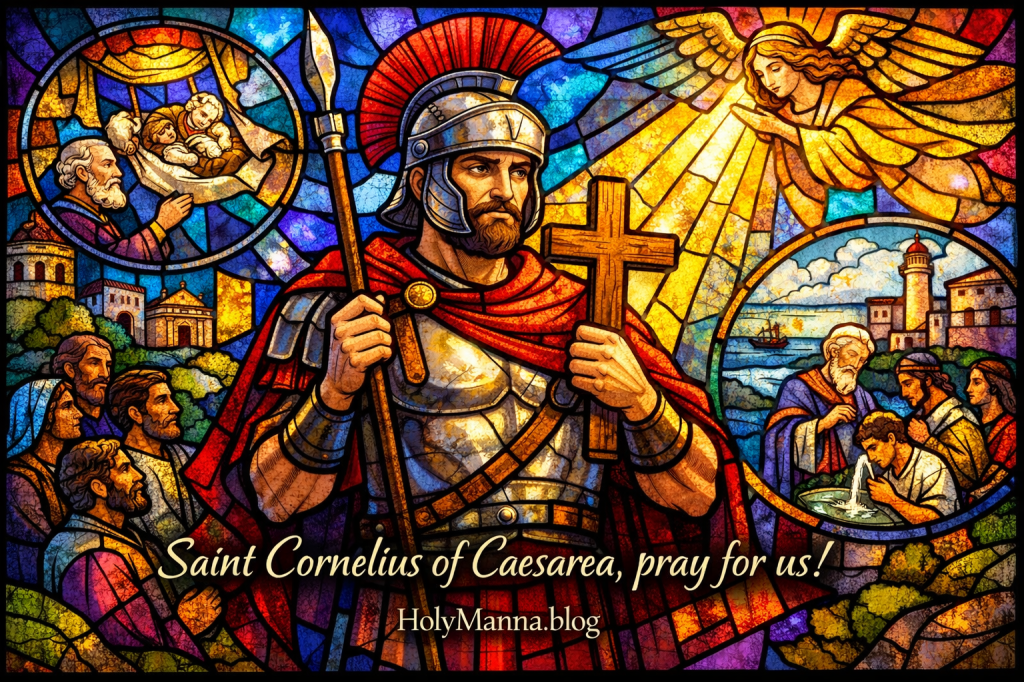
The Centurion Who Welcomed the Whole World
Saint Cornelius of Caesarea stands at the center of one of the most important turning points in the New Testament. He was a Roman centurion, an officer trained to lead soldiers and keep order in a tense province, yet Scripture introduces him first as a man of reverence, prayer, and generous charity. In The Acts of the Apostles, God chooses Cornelius’ home as the place where the Church learns, in a clear and unmistakable way, that Jesus Christ did not come only for one people. The Gospel is for every nation, and the life of the Church is meant to spread outward until it reaches the ends of the earth.
Cornelius is revered because his story shows how grace often works long before someone knows the full name of what they are seeking. He was already praying, already giving alms, and already trying to live under God’s gaze. When the Lord finally sends the apostolic preaching of Saint Peter, Cornelius responds with humility and urgency, and his whole household steps into the saving life of Christ. His conversion is not only personal. It becomes a public moment of clarity for the early Church, revealing the truly universal mission Christ gave His people.
A Roman Officer with a Seeking Heart
Scripture does not give Cornelius a childhood biography, and the Church does not pretend it does. Instead, the Holy Spirit highlights what matters most: Cornelius’ posture before God. He lived in Caesarea, a major coastal city and administrative center of Roman authority. He served as a centurion in the cohort called the Italica, meaning he belonged to a real military unit within the empire’s structure. His daily life would have included discipline, command, and public responsibility, but his inner life was marked by something far more surprising.
Cornelius is described as devout and God-fearing, a Gentile who worshiped the one true God and practiced prayer and charity, even though he had not become Jewish through circumcision. His faith was not vague spirituality. It had shape, it had discipline, and it had moral weight. Scripture even emphasizes that his household shared this posture, which is one of the most striking details in the story. Cornelius did not treat faith as a private hobby. He led those closest to him toward reverence and goodness, even before he knew the fullness of the Gospel.
Then the moment arrives when seeking turns into finding. Cornelius is praying around the ninth hour, a traditional hour of prayer, when an angel appears and calls him by name. Heaven addresses him personally, and the angel declares that his prayers and almsgiving have risen before God like a memorial offering. This is a stunning affirmation that God sees the sincere heart, and that acts of mercy done in faith are not ignored by the Lord. Cornelius responds with humble attention and immediate obedience, sending trusted men to summon Simon Peter, just as the angel commands.
Two Visions and One Astonishing Grace
Cornelius’ story becomes unforgettable because God orchestrates a double miracle of guidance. While Cornelius receives instruction from an angel, God is also preparing Peter through a separate vision, the famous scene of the sheet and the animals. The lesson is not simply about food. God is teaching Peter that he must not treat the Gentiles as unclean and unreachable. Cornelius is being prepared to receive the apostolic message, and Peter is being prepared to deliver it without hesitation.
When Peter arrives, Cornelius has already gathered relatives and close friends. That detail reveals the kind of man he was. Cornelius did not receive a message from God and keep it to himself. He gathered his people as if preparing a room for grace, because he knew God was about to speak. In his reverence, Cornelius falls at Peter’s feet, and Peter corrects him at once, refusing to accept worship and insisting that he is only a man. This moment purifies Cornelius’ zeal, teaching him that adoration belongs to God alone, while the apostle is a servant sent with a message.
Cornelius then speaks words that sound like a perfect description of the posture a Christian should have when the Word of God is proclaimed, especially at Mass. He tells Peter that everyone is gathered in the presence of God, ready to hear everything the Lord has commanded him to say. Cornelius does not want vague inspiration or a friendly lecture. He wants the truth of God, the kind that calls for real conversion.
His most memorable line captures that posture of reverent readiness: “Now therefore we are all here in the presence of God to listen to all that you have been commanded by the Lord.” Acts 10:33.
Peter preaches Jesus Christ crucified and risen, and then the miracle arrives in a way that shocks everyone present. While Peter is still speaking, the Holy Spirit falls upon the Gentiles in Cornelius’ home. They glorify God and speak in tongues, and the Jewish believers with Peter are astonished because they can see the Spirit has been poured out beyond the boundaries they assumed were fixed. Peter immediately insists that no one can withhold the water for baptism, and Cornelius and his household are baptized into Christ and into the Church.
This sequence teaches something deeply Catholic. God is free to act as He wills, and the Spirit can move ahead of human expectations. Yet Peter still commands baptism because baptism is the sacramental doorway Christ gave His Church. The Catechism teaches that baptism is the sacrament of new birth by water and the word, and that it is the gateway into life in the Spirit and entry into the Church, CCC 1213. Cornelius receives the Spirit’s gift and then receives baptism, showing the harmony between God’s initiative and the Church’s sacramental mission.
The Crisis that Clarified the Church
Saint Cornelius is not remembered chiefly as a martyr because Scripture does not record his death. Still, his conversion carries real hardship, especially the kind of hardship that comes when God expands the Church beyond familiar categories. Cornelius’ baptism immediately creates tension within the early Christian community. When Peter returns to Jerusalem, some believers confront him for entering the house of uncircumcised Gentiles and eating with them. The complaint shows how serious the cultural boundary was, and how scandalous this moment felt to those who assumed the Gospel must remain inside the old lines.
Peter responds by recounting the events carefully, explaining the visions, the Spirit’s command, and the outpouring of the Holy Spirit upon the Gentiles. The Church then recognizes the truth that God Himself has revealed through these events. This is not Peter pushing an agenda. This is the Lord opening a door, and the Church learning to walk through it with obedience and joy.
This is why Cornelius matters for Catholic identity. The Church is catholic, universal, sent to all nations, and Cornelius’ story becomes a decisive proof that the mercy of Christ cannot be restricted by ethnicity or culture. The Catechism teaches that the Church is catholic because Christ is present in her, and because she is sent out on mission to the whole human race, CCC 830-831. Cornelius’ household becomes an early, concrete sign of that catholicity becoming visible in history.
A Legacy Proclaimed in the Life of the Church
When it comes to miracles after death, the Church’s strongest and clearest testimony about Cornelius remains the miracle Scripture records: the outpouring of the Holy Spirit on Gentiles in his home and the Church’s recognition that God has granted repentance and life to the nations. Some later traditions suggest Cornelius went on to serve the Church in leadership, even as a bishop, but those details are held as tradition rather than presented as certain biography. The Church’s confidence about Cornelius rests firmly on the inspired witness of The Acts of the Apostles and the spiritual fruit his conversion produced in the Church’s mission.
Cornelius’ legacy after death is unmistakable because his story never stopped being proclaimed. The Church continues to read this passage because it reveals what the Resurrection means for the whole world. It also makes Cornelius a powerful model for catechumens, converts, and anyone who feels like they are still learning how to approach God. Cornelius shows that sincere seeking is not wasted time, and that God can lead a faithful heart from partial light into the full brightness of Christ.
His story also emphasizes that faith is meant to bless households, friendships, and entire networks of relationships. Cornelius gathered relatives and friends because he knew God’s word was meant to be heard together. His home became a threshold where the Church stepped forward into her universal mission, and that kind of legacy lasts longer than stone monuments.
Living Like Cornelius in a Modern World
Saint Cornelius teaches that faith often begins before a person realizes it has begun. He was already praying, already giving alms, and already trying to live righteously. This does not mean he already possessed the fullness of Christian life. It means grace was already drawing him, preparing his heart for the Gospel and for the sacraments.
Cornelius also teaches that seeking God should not remain vague forever. When God sends the apostolic message, Cornelius responds quickly and seriously. He gathers people. He listens attentively. He obeys. That is what discipleship looks like when it is real. It is not a slow drift. It is a steady surrender.
Cornelius also challenges the modern habit of treating charity as a side project. His almsgiving mattered, and heaven acknowledged it. That should encourage anyone who feels unseen in quiet acts of mercy. God sees, God remembers, and God uses those works to form a heart that can receive more grace. At the same time, Cornelius reminds every Catholic that personal devotion is not meant to replace the sacramental life of the Church. When the Spirit moved powerfully, Peter still insisted on baptism. The life of Christ is not only an idea. It is a covenant life lived in the Church, nourished by grace, and strengthened by obedience.
How is God calling the heart to listen more carefully to His Word and respond with quicker obedience today? Where can prayer become steadier and mercy become more concrete this week? These are not abstract questions. They are the practical path of holiness Saint Cornelius still teaches.
Engage with Us!
Share your thoughts and reflections in the comments below. Saint Cornelius has a way of showing people that God is already at work long before the full story becomes clear.
- Where has prayer become inconsistent, and what would it look like to rebuild a steady rhythm like Cornelius had?
- How can almsgiving become more intentional, so that charity is not occasional but truly part of discipleship?
- Is there any part of the faith that feels “for other people”, and how does Cornelius challenge that mindset?
- When the Lord has made something clear, what usually causes delay, and what would prompt quicker obedience?
- How can the household, friendships, and daily relationships be gathered around the Word of God the way Cornelius gathered his people?
May Saint Cornelius of Caesarea teach every heart to seek God with sincerity, to obey quickly when grace calls, and to live a faith that becomes a blessing for others. Keep moving forward with courage, and do everything with the love and mercy Jesus taught us.
Saint Cornelius of Caesarea, pray for us!
Follow us on YouTube, Instagram and Facebook for more insights and reflections on living a faith-filled life.

 Holy Manna!
Leave a comment