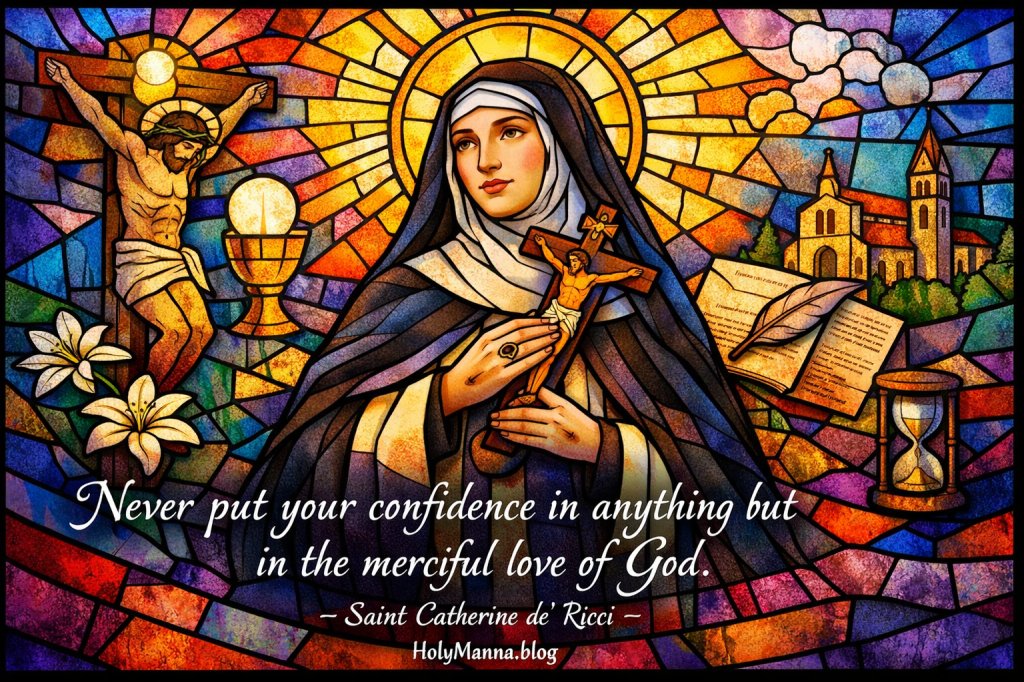
The Saint Who Lived Close to the Cross
Saint Catherine de’ Ricci was a Dominican nun who spent her entire adult life behind the walls of a cloister in Prato, Italy, and yet her holiness reached far beyond that quiet city. Catholics remember her for a burning love of Jesus crucified, a life of steady leadership as prioress, and extraordinary mystical signs associated with the Passion of Christ. Her story is not meant to make people chase mysteries, because the Church never builds faith on private revelations. The Catechism teaches that private revelations do not belong to the Deposit of Faith and are meant to help people live the Gospel more fully in a particular time and place, not replace Scripture or Tradition (CCC 67).
What makes Catherine unforgettable is how her life holds two realities together without confusion. She lived ordinary Dominican fidelity, day after day, in prayer, obedience, community life, and service. At the same time, Catholic tradition records extraordinary graces connected to her union with the suffering Christ. Even then, the center never changes, because the center is always Jesus.
A Noble Childhood and an Early Hunger for God
Catherine was born Alessandra de’ Ricci in Florence in 1522, into a noble family that carried both privilege and heavy expectations. Early sorrow entered her life through family losses and changes that shaped her upbringing. Even as a child, Catholic accounts describe her as unusually serious about prayer, modesty, and self-discipline, as if her heart already understood that real joy does not come from comfort alone. This is one of the first hints of her future: she was drawn not to attention, but to holiness.
As she grew, her desire for religious life became more focused, and it did not fade with time. She felt called to the Dominican convent of Saint Vincent in Prato, a community known for strong observance and reforming spirit. Tradition remembers that her entry was not simple, because family resistance and illness complicated the path. Still, she persevered with a steady resolve that suggests her vocation was not a phase, but a response to God.
The Cloister Door That Changed Everything
When she entered the convent as a young teenager, she took the name Catherine and began a life that looked small from the outside but demanded great courage within. The early years were marked by sickness and misunderstanding, and Catholic sources describe how some sisters were unsure what to make of unusual spiritual experiences that appeared in her life. That uncertainty became a real cross, because being misjudged in close quarters can grind down the soul. Catherine responded with humility, patience, and obedience, and that quiet consistency slowly revealed the truth of her character.
Over time, her community came to recognize not only her piety but her wisdom and stability. She was entrusted with responsibilities that required maturity, and eventually she served as prioress for many years. This matters because it shows she was not merely a woman with extraordinary experiences. She was a spiritual mother who formed her sisters, guarded the peace of the monastery, and kept the community faithful to its Dominican vocation.
Thursday to Friday With the Crucified Lord
In the 1540s, Catholic tradition records that Catherine began to experience a weekly mystical participation in the Passion of Christ, often described as unfolding from Thursday into Friday afternoon. Accounts say these experiences continued for about twelve years and were associated with visible signs connected to the Passion, including the stigmata and other sufferings that mirrored the Lord’s wounds. Such claims are always treated with sobriety in Catholic life, because sanctity is never proven by phenomena. Still, the tradition has consistently remembered these signs as pointing away from Catherine and toward Jesus, calling hearts back to the Cross.
These events also brought unwanted attention to the monastery, because crowds came to Prato out of devotion, curiosity, and skepticism. That attention disturbed the cloister’s peace and created real strain in community life, which is an important detail that often gets skipped. Catherine did not seek crowds, and she did not try to build a reputation. Tradition holds that the public phenomena eventually ceased, and the deeper point becomes clear: Catherine’s love was for Christ, not for attention.
Her mystical life is sometimes described using the language of spiritual espousal, including a tradition about a mystical ring. Whether readers focus on that detail or not, the meaning fits Catholic teaching on consecrated life. A consecrated virgin belongs to Christ with an undivided heart, and the purpose of that gift is always love, fidelity, and intercession for the Church.
Scripture Soaked Devotion and the Canticle of the Passion
Catherine’s legacy includes more than dramatic stories. Dominican tradition associates her with the Canticle of the Passion, a devotion formed from scriptural verses that guide the mind and heart through the sufferings of Christ, especially in Lent. This is a deeply Catholic pattern, because authentic devotion does not replace Scripture or the liturgy. It draws people deeper into them, teaching the heart to pray with the Church and to love what the Church loves.
This devotion also reveals how Catherine understood the Passion. The Cross was not an emotional spectacle for her. The Cross was the school of love, where sin is exposed and mercy shines brighter than shame. A Friday lived with intention, even in small ways, becomes a weekly reminder that the Christian life is shaped by Calvary and crowned by the Resurrection.
A Prioress With a Shepherd’s Heart
It is easy to get so focused on mystical phenomena that the most practical part of Catherine’s holiness gets overlooked. Catholic sources emphasize that she was a prudent and charitable superior, especially attentive to the sick and gentle with the weak. That kind of holiness is not flashy, but it builds strong communities and forms souls in lasting virtue. Her authority did not come from personality or control, but from the credibility of a life surrendered to God.
Her influence also reached beyond Prato through correspondence and counsel. Catholic tradition connects her spiritually to major saints of her era, including Saint Philip Neri and Saint Mary Magdalene de’ Pazzi, and it also remembers that notable Church leaders sought her prayers. Whether one looks at this as historical correspondence, spiritual friendship, or extraordinary communion among saints, the message remains consistent. Catherine’s cloister did not imprison her charity, because love in Christ always travels farther than walls.
Her spiritual counsel is often remembered in short, sharp lines that still hit home. She wrote, “Force yourself to detach your heart and your will from all love and affection for earthly things.” She also wrote, “Never put your confidence in anything but in the merciful love of God.” Those words sound simple, but they were forged in obedience, suffering, and long fidelity.
A Cross Without a Sword
Catherine did not die by martyrdom, but she lived a real share in the Cross. She endured years of illness, misunderstanding, scrutiny, and the burden of attention that disrupted monastic life. She also bore the weight of leadership, which meant daily decisions, correction with charity, patient formation of others, and constant intercession. This kind of suffering does not look dramatic, but it can be just as purifying, because it requires perseverance when feelings do not cooperate.
Her life also illuminates a core Catholic truth about redemptive suffering. The Christian does not seek pain, but when suffering arrives, it can be united to Christ and offered in love. The Catechism teaches that Christ invites His members to unite their sufferings to His redeeming Passion (CCC 618). Catherine’s story becomes a living illustration of that teaching, because her suffering was never a performance. It was prayer.
A Saint’s Intercession and a City That Remembers
Catherine died on February 2, 1590, and devotion to her remained strong in Prato, where her memory was guarded with affection and reverence. Over time, the Church recognized her sanctity formally, and she was beatified in 1732 and canonized in 1746. Those dates matter because they show the Church’s careful pace in discerning holiness and in weighing testimony. The Church does not rush canonizations, because saints are given to the faithful as reliable models of Christian life.
Her veneration remains rooted in place, because Catholic faith is incarnational and concrete. The faithful have long honored her relics in Prato and sought her intercession for spiritual and bodily needs, especially in connection with sickness and trials. Her feast is observed on different dates in different calendars, which is not unusual for saints with strong local devotion and older liturgical traditions. What stays consistent is the reason Catholics celebrate her: she teaches the Church to love the Crucified Lord with sincerity and courage.
Bringing Catherine’s Lesson into Daily Life
Saint Catherine de’ Ricci is not given to the Church so that people chase unusual spiritual experiences. She is given so that Catholics learn to take the Cross seriously and to trust God’s mercy more than their own strength. Her life teaches detachment, not as a rejection of good things, but as freedom from clinging to anything as if it were salvation. That freedom can be practiced through small acts of discipline, honest confession, guard over the eyes and imagination, and a willingness to choose duty over comfort.
She also teaches stability and obedience, because she became holy in one place, with the same people, through the same rhythms, year after year. That kind of faithfulness challenges a restless modern mindset that wants constant novelty. She shows that God forms saints through ordinary duties embraced with love, and that grace is not an escape hatch from real life. The Catechism teaches that charisms are given for the building up of the Church (CCC 799 to 801), and Catherine’s life shows that one of the greatest charisms is steady charity.
Most of all, she teaches confidence in mercy. Her counsel does not point inward to self reliance, and it does not collapse into despair. It points outward to the Heart of Christ, where every repentant sinner finds a home. How might daily life change if confidence were placed, not in mood or success, but in God’s merciful love alone?
Engage with Us!
Readers are invited to share thoughts and reflections in the comments below, because the saints are not museum pieces. They are family, and their stories are meant to stir real conversion. This story deserves a response, not just admiration, because the purpose of a saint’s life is to help the faithful follow Jesus more closely. The questions below are meant to spark honest prayer and practical action.
- What part of the Passion of Christ is hardest to sit with, and what might Jesus be inviting the heart to trust there?
- Where does attachment show up most strongly, whether it is comfort, control, reputation, or entertainment, and what would a small act of detachment look like this week?
- How can Friday become a more intentional day of prayer and gratitude for the Cross, even in a busy schedule?
- What kind of hidden suffering is being carried right now, and how can it be offered to Jesus with love instead of resentment?
Keep walking forward with faith, even when the path feels ordinary or heavy. Keep choosing prayer over panic, mercy over bitterness, and fidelity over comfort, because that is where real freedom is found. Every day is another chance to love like Jesus and to do everything with the love and mercy He taught us.
Saint Catherine de’ Ricci, pray for us!
Follow us on YouTube, Instagram and Facebook for more insights and reflections on living a faith-filled life.

 Holy Manna!
Leave a comment