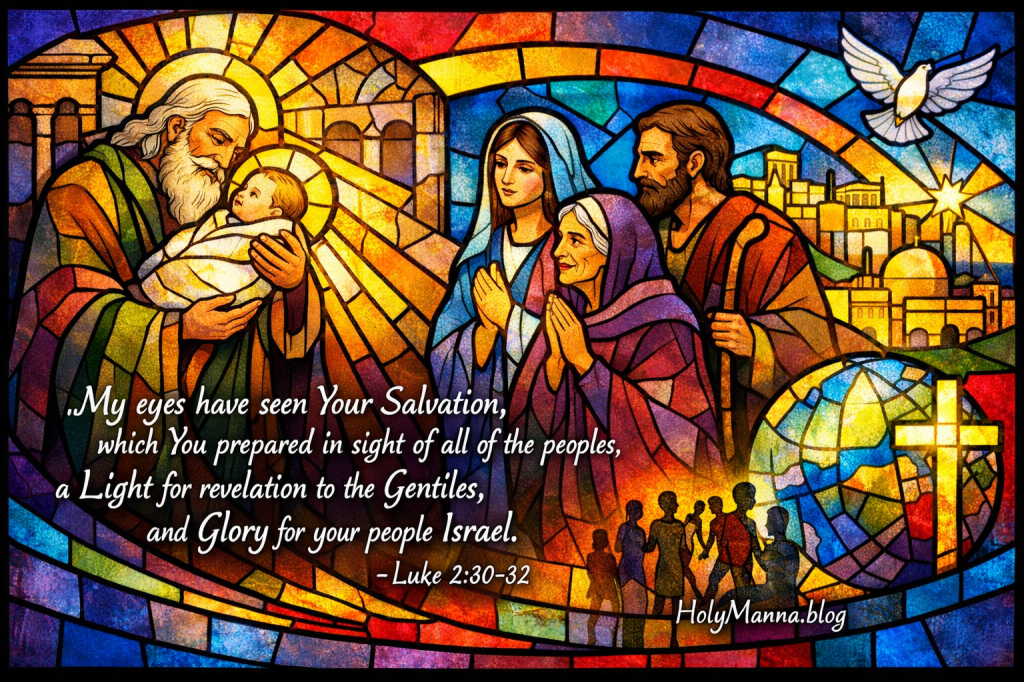
Feast of the Presentation of the Lord – Lectionary: 524
The Light Enters the Temple, and Nothing Stays Hidden
There are days when God feels far away, as if heaven is quiet and the world is loud, but today’s feast insists on the opposite. The Lord comes close, not in a vague spiritual feeling, but in a real place, at a real moment, under the weight of real obedience. The Feast of the Presentation of the Lord draws all four readings into one living scene: the long-awaited King steps into His Temple, not to admire it, but to claim it, purify it, and fill it with light.
The central theme tying today’s readings together is this: Christ enters His Temple as the Light and the High Priest who purifies hearts and frees His people from the slavery of fear. Malachi 3:1-4 announces the shocking promise that “the Lord whom you seek will come suddenly to his temple”, and it immediately asks the question every honest soul eventually faces: “who can endure the day of his coming?” The answer is not that God comes to crush the weak, but that He comes like a refiner who burns away what is false so that worship can become true, pure, and pleasing again. In the same breath, Psalm 24:7-10 hears the ancient doors groan open as if creation itself recognizes its rightful King, crying out “Lift up your heads, O gates… that the king of glory may enter”.
Then the mystery deepens, because the King does not enter as a distant ruler. Hebrews 2:14-18 reveals that He comes in “blood and flesh,” sharing the human condition all the way down to suffering and death, so that He can break the devil’s grip and liberate those trapped by the fear of dying. That is why the Gospel, Luke 2:22-40, feels so simple and yet so explosive. Mary and Joseph bring Jesus to Jerusalem in humble fidelity to the Law, offering the sacrifice of the poor, and in that ordinary act the extraordinary happens. Simeon recognizes the Child as salvation and dares to say what every anxious heart longs to say with honesty: “Now, Master, you may let your servant go in peace”. The same light that comforts Simeon also exposes the truth, because Jesus will be “a sign that will be contradicted”, and the prophecy of a sword pierces straight toward the Cross, where the true purification will be completed.
This feast is also soaked in the religious life of Israel, where the Temple was not a decoration but the center of worship and covenant identity. The Presentation echoes the Law’s language of consecration and offering, but it also signals that something new is happening inside the old forms. The Child is presented, yet He is the One presenting. The Infant is carried, yet He is the One leading. Simeon and Anna stand for all faithful Israel, waiting for “consolation” and “redemption,” and today they finally see that God’s answer is not an idea but a Person. That is the doorway into every reading today, because each passage is preparing the same encounter: the Lord comes to His Temple, and when He arrives, He brings light that heals and fire that purifies, so that hearts can become a dwelling place worthy of the King of Glory.
First Reading – Malachi 3:1-4
When the Lord Shows Up, He Comes to Purify
Malachi speaks into a moment of disappointment and religious fatigue. The people had returned from exile, the Temple had been rebuilt, and the routines of worship were back, but something was still off. The external structures stood, yet the interior fire of covenant fidelity had cooled. Priests and people alike were tempted to treat worship like a transaction, offering what was convenient instead of what was righteous. Into that spiritual dullness, the Lord makes a promise that sounds comforting at first and then suddenly feels like a warning: God is coming. Not as an abstract idea, but as a real visitation that will expose what is unclean and restore what is true.
This reading fits today’s theme with striking precision. On the Feast of the Presentation, the Lord enters His Temple as a Child carried in the arms of Mary and Joseph. He comes quietly, but He comes as King, Light, and High Priest. Malachi calls Him “the messenger of the covenant”, and that phrase lands like thunder, because a covenant is not sentimental. A covenant is holy, binding, and life-shaping. When the Lord draws near to His Temple, He draws near to purify it, and that purification is not meant to destroy but to make worship pleasing again. The refiner’s fire in this prophecy is not cruelty. It is mercy that refuses to leave a beloved people trapped in compromise.
Malachi 3:1-4 – New American Bible (Revised Edition)
The Messenger of the Covenant
1 Now I am sending my messenger—
he will prepare the way before me;
And the lord whom you seek will come suddenly to his temple;
The messenger of the covenant whom you desire—
see, he is coming! says the Lord of hosts.
2 But who can endure the day of his coming?
Who can stand firm when he appears?
For he will be like a refiner’s fire,
like fullers’ lye.
3 He will sit refining and purifying silver,
and he will purify the Levites,
Refining them like gold or silver,
that they may bring offerings to the Lord in righteousness.
4 Then the offering of Judah and Jerusalem
will please the Lord,
as in ancient days, as in years gone by.
Detailed Exegesis
Verse 1 “Now I am sending my messenger, he will prepare the way before me; And the Lord whom you seek will come suddenly to his temple; The messenger of the covenant whom you desire, see, he is coming! says the Lord of hosts.”
This verse opens with God taking the initiative. The “messenger” is a forerunner sent to prepare the people, because the human heart rarely recognizes God’s visitation without repentance and readiness. In Catholic tradition, this prepares the way for the mission of Saint John the Baptist, who calls Israel back to conversion so the Messiah can be received with faith. The prophecy also insists that the Lord comes “suddenly” to His Temple. God’s arrival is not scheduled by human comfort. It interrupts, it corrects, and it fulfills. In the light of today’s feast, the suddenness is almost ironic. The Lord arrives as an Infant, and many do not notice, yet the faithful, like Simeon and Anna, recognize that the Temple has finally received the One it was built for.
Verse 2 “But who can endure the day of his coming? Who can stand firm when he appears? For he will be like a refiner’s fire, like fullers’ lye.”
This is the moment the prophecy stops sounding like a cozy promise and starts sounding like a spiritual examination. The question is not whether God is good. The question is whether a compromised heart can endure the goodness of God without being changed. Fire and lye are both images of cleansing that can sting. A refiner’s fire heats metal until impurities rise and can be removed. A fuller’s lye was a strong cleansing agent used to whiten and purify cloth. The point is not violence but purification. God’s presence reveals what is real, and what is fake cannot stand comfortably in that light. This verse also guards against a soft, domesticated idea of God. The Lord’s love is gentle, but it is never passive.
Verse 3 “He will sit refining and purifying silver, and he will purify the Levites, Refining them like gold or silver, that they may bring offerings to the Lord in righteousness.”
The image becomes even more specific. The Lord “sits” like a craftsman who is patient, deliberate, and attentive. Refining is not rushed. God does not purify by accident or by impulse. He purifies with intention. The Levites represent the ministers of worship, those responsible for offerings and liturgy. When their worship is corrupted, the people suffer, because the entire spiritual culture begins to rot from the altar outward. The purification of the Levites is therefore an act of mercy for everyone, restoring integrity to worship so that offerings become righteous again. On this feast, this verse feels like a lamp turned on inside the Temple. The Child who is presented is the One who will one day offer the perfect sacrifice. He also begins, even now, the restoration of worship by bringing holiness back into the very heart of Israel’s liturgical life.
Verse 4 “Then the offering of Judah and Jerusalem will please the Lord, as in ancient days, as in years gone by.”
Purification has a goal. God is not interested in shaming His people. God is interested in pleasing worship that flows from covenant fidelity. This verse points to restoration, not nostalgia. “Ancient days” does not mean a childish longing for the past, but a return to genuine righteousness, when worship was not a performance but a covenant response. The prophecy envisions a people renewed from the inside out, so that what they bring to God matches what God deserves. In the context of today’s feast, this points forward to Christ Himself, who will make the definitive offering that truly pleases the Father, and then draw His people into that offering through grace.
Teachings
The Church reads this prophecy with Christ at the center, because Christ is the Lord who comes to His Temple, and Christ is also the One who prepares His people to meet Him. The Catechism teaches that salvation history is not random, because God prepares hearts and times with deliberate love. CCC 522 says, “The coming of God’s Son to earth is an event of such immensity that God willed to prepare for it over centuries. He makes everything converge on Christ.” This explains why a prophecy like Malachi is not merely ancient poetry. It is part of God’s long preparation so that, when the Lord arrives, the faithful can recognize Him.
That preparation includes the mission of the forerunner. CCC 718 says, “John is ‘Elijah [who] must come.’ The fire of the Spirit dwells in him and makes him the precursor of the coming Lord.” The “messenger” language in Malachi fits naturally with the Church’s understanding of John the Baptist, because John does not draw attention to himself. He prepares the way for the Lord by calling for repentance, which is exactly what the refiner’s fire demands.
The refiner’s fire also echoes the Holy Spirit’s work, because God purifies not only by confronting sin but by transforming the heart. CCC 696 teaches, “Fire symbolizes the transforming energy of the Holy Spirit’s actions.” This is crucial for reading Malachi correctly. The Lord’s purification is not merely moral cleaning. It is supernatural transformation, the kind that makes worship real because it makes the worshiper new.
Finally, the call to purification speaks directly to conversion, which is not a one-time mood but an ongoing posture of the baptized. CCC 1428 says, “Christ’s call to conversion continues to resound in the lives of Christians.” That is why Malachi still stings in the best way. God does not stop calling His people to be purified, because God does not stop wanting their worship to be righteous, joyful, and truly pleasing.
Reflection
This reading asks for honesty that does not flinch. It is easy to say that God is desired, but it is harder to welcome the kind of God who refines, purifies, and exposes. The Feast of the Presentation makes the moment even more personal, because the Lord enters the Temple in silence and humility, yet His presence is still fire and light. The same Christ who is gentle enough to be carried is holy enough to purify everything He touches.
In daily life, this prophecy becomes practical in a way that is hard to dodge. A refiner does not purify silver by giving it a compliment. A refiner purifies silver by applying heat until the impurities rise. When anxiety rises, when impatience rises, when a pattern of sin rises, it might not be proof that God is absent. It might be proof that God is near, drawing hidden things to the surface so they can finally be surrendered. That is how grace often works. God brings the issue into the light, not to humiliate, but to heal.
A concrete way to live this reading is to treat the next confession, the next act of penance, and the next honest prayer as an invitation to let the Lord “sit” with the soul like a craftsman. The goal is not self-improvement for its own sake. The goal is worship that becomes true again, which means a life that becomes consistent again.
What part of life feels most defensive when God gets close, and what might that defensiveness be protecting?
If the Lord is refining worship, what needs to change so that faith stops being a habit and becomes a real offering of the heart?
When the day feels heated with trials or temptation, what would it look like to trust that God is purifying rather than abandoning?
Responsorial Psalm – Psalm 24:7-10
Open the Doors Wide, Because the King of Glory Is Here
Psalm 24 sounds like a liturgical call and response echoing through the Temple courts of Jerusalem. It is easy to picture pilgrims approaching the holy place, the gates towering overhead, and voices rising as if the doors themselves must be commanded to make room for God. In Israel’s worship, the Temple was not merely a religious building. It was the visible sign of the Lord’s covenant presence among His people, the place where sacrifice and praise reached toward heaven. This psalm fits naturally with days of procession and solemn entrance, and that is exactly why the Church places it on the Feast of the Presentation of the Lord, a feast traditionally marked by candles and a holy procession.
Today’s theme is about the Lord entering His Temple as Light and High Priest, purifying hearts and freeing them from fear. Psalm 24 becomes the soundtrack of that moment. The gates lift, the King enters, and the question rings out twice like a drumbeat: “Who is this king of glory?” The answer is not vague or poetic. The answer is a name and a reality: “The Lord, strong and mighty.” When Mary and Joseph carry Jesus into the Temple in The Gospel of Luke, the scene looks ordinary to most eyes, but this psalm insists that something cosmic is happening. The King of Glory is entering, not in spectacle, but in humility, and the only proper response is to open wide.
Psalm 24:7-10 – New American Bible (Revised Edition)
7 Lift up your heads, O gates;
be lifted, you ancient portals,
that the king of glory may enter.
8 Who is this king of glory?
The Lord, strong and mighty,
the Lord, mighty in war.
9 Lift up your heads, O gates;
rise up, you ancient portals,
that the king of glory may enter.
10 Who is this king of glory?
The Lord of hosts, he is the king of glory.
Selah
Detailed Exegesis
Verse 7 “Lift up your heads, O gates; be lifted, you ancient portals, that the king of glory may enter.”
The psalm speaks to gates as if they are living beings, because the entrance of God is not treated like ordinary traffic. “Ancient portals” hints at the long history of Israel’s worship and God’s faithfulness across generations. The command to “lift up your heads” suggests that something greater than usual is arriving, something the doorway cannot contain unless it is raised. Spiritually, this becomes an image of the human heart. A heart can become low, cramped, and guarded by sin, distraction, or cynicism. The psalm calls for an opening that matches the dignity of the One who comes. On today’s feast, the King enters His Temple as an Infant, showing that God’s glory is not always loud, but it is always real.
Verse 8 “Who is this king of glory? The Lord, strong and mighty, the Lord, mighty in war.”
The question is not asked because Israel is unsure. It is asked because worship involves proclamation. The Temple liturgy trains the people to name who God is. The Lord is “strong and mighty,” not because He is insecure, but because He rescues. “Mighty in war” points to the Lord as divine warrior who fights for His people, especially in the Exodus and in Israel’s deliverance from enemies. For Christians, this takes on a deeper meaning in the light of Hebrews 2:14-18. Christ wages war not with swords but with obedience, suffering, and the Cross, defeating the devil and breaking the tyranny of death. The King of Glory enters to fight for His people, and His victory looks like self-giving love.
Verse 9 “Lift up your heads, O gates; rise up, you ancient portals, that the king of glory may enter.”
The repetition is not filler. It is insistence. Worship repeats because hearts forget, and because truth must be pressed into the soul again and again until it becomes lived. The second command feels stronger, because now it says “rise up.” This is more than opening a crack. It is opening fully. On the Feast of the Presentation, this repetition mirrors the rhythm of Simeon’s waiting and Anna’s persevering prayer. Faith keeps showing up at the gates, because the Lord’s timing is faithful even when it feels slow. When the King finally comes, the doors must be ready.
Verse 10 “Who is this king of glory? The Lord of hosts, he is the king of glory. Selah.”
The final answer goes even higher. “Lord of hosts” names God as the commander of heavenly armies, the sovereign over all powers visible and invisible. This is not a local deity. This is the Lord of all creation. The psalm ends with “Selah,” a pause that invites contemplation. In the liturgy, it is as if the proclamation needs a moment of silence to sink in. On today’s feast, that silence fits the Gospel perfectly. Jesus enters quietly, held in arms, yet Heaven’s hosts recognize their Lord. The psalm trains the Church to confess what the eyes might miss: the Child is the King of Glory.
Teachings
This psalm reveals something essential about Catholic worship. The liturgy is not private inspiration. It is a real meeting between God and His people, where the Church proclaims who God is and receives what God gives. The Catechism teaches, “In the liturgy of the Church, it is principally his own Paschal mystery that Christ signifies and makes present.” CCC 1085 This matters because the King of Glory does not merely “enter” in memory. He enters in mystery, making His saving work present to His people.
The psalm’s repeated call to open the gates also resonates with how the Church speaks about the heart’s response to grace. God never forces the door, but God does command the truth: the heart is made to open to Him. The Catechism describes prayer as a covenant relationship that requires a real human response, saying, “Prayer is the living relationship of the children of God with their Father who is good beyond measure.” CCC 2565 A living relationship involves welcome, not mere acknowledgement. The psalm’s liturgical shouting becomes a spiritual rule: make room for God.
The Church also reads the Kingship of Christ in a way that purifies modern assumptions. Christ reigns by truth and charity, not by manipulation. The Catechism teaches, “To reign is to serve him.” CCC 786 That line cuts through the world’s idea of power. The King of Glory enters not to be served like a tyrant, but to serve unto death, and then to draw His people into that same pattern of holy service.
Saint Augustine often preached the psalms as the voice of Christ and the voice of the Church. When this psalm speaks of the King’s entry, it naturally points forward to Christ’s definitive victory. In the Church’s memory, the “battle” language does not end in bloodshed but in redemption, because the Cross is the battlefield where love wins. That is why this psalm belongs on a feast where a tiny Child is carried into the Temple. The Church confesses what faith sees: this is the King, and His glory will be revealed through sacrifice.
Reflection
This psalm is simple enough for a child to memorize, but it can still unsettle a grown man, because it demands a decision. The gates must open. The question is whether the heart will cooperate or negotiate. Many people try to keep God at the edge, allowing Him into religious habits but not into schedules, relationships, money, entertainment, or private thought. Psalm 24 does not speak like that. It speaks like someone throwing open the doors for a King who has rightful claim.
A practical way to live this psalm is to identify the “gate” that stays most stubbornly closed. Sometimes it is an old resentment that feels justified. Sometimes it is a secret sin that feels too embarrassing to confess. Sometimes it is a fear about the future that has become a kind of idol. The psalm offers a direct spiritual practice: name the King, then open the door in His presence. That can look like honest prayer, a serious examination of conscience, a return to confession, or a deliberate change in what gets attention and time.
This psalm also speaks to the Church’s public faith. The Temple gates are not opened in private. They are opened with proclamation. When Christ is treated as the King of Glory, faith becomes steadier, less anxious, and more courageous, because the Lord of hosts does not lose control of His world.
What gate in the heart tends to stay guarded, even while the mouth still says the right religious words?
What would change this week if Christ was treated less like a helpful accessory and more like the King of Glory?
If the Lord is “mighty in war,” what fear needs to be surrendered so that His victory can be trusted rather than resisted?
Second Reading – Hebrews 2:14-18
The King of Glory Enters the Temple
The Letter to the Hebrews was written for believers who knew the Scriptures, loved the Temple tradition, and felt the pressure of suffering. Some were tired, some were afraid, and some were tempted to drift back into a safer, more socially acceptable religion. Hebrews answers that temptation by lifting the veil: everything Israel hoped for in priesthood, sacrifice, and covenant worship is fulfilled in Jesus Christ, not as a symbol, but as a living reality. That is why today’s feast and today’s second reading fit together so tightly. The Presentation shows the Child entering the Temple in humility. Hebrews explains what that humility means. The One carried into the Temple is already the true High Priest, coming to offer the sacrifice that will actually cleanse consciences and defeat death.
This reading locks into today’s central theme with force. Christ enters His Temple as Light, but also as the Priest who purifies hearts by sharing fully in human flesh. He does not save from a distance. He steps into blood and flesh, steps into suffering, and steps into death, so that fear no longer rules the interior life. This is not a motivational idea. This is the Gospel’s hard promise: the devil’s claim is broken, slavery to fear is shattered, and mercy is available for anyone being tested.
Hebrews 2:14-18 – New American Bible (Revised Edition)
14 Now since the children share in blood and flesh, he likewise shared in them, that through death he might destroy the one who has the power of death, that is, the devil, 15 and free those who through fear of death had been subject to slavery all their life. 16 Surely he did not help angels but rather the descendants of Abraham; 17 therefore, he had to become like his brothers in every way, that he might be a merciful and faithful high priest before God to expiate the sins of the people. 18 Because he himself was tested through what he suffered, he is able to help those who are being tested.
Detailed Exegesis
Verse 14 “Now since the children share in blood and flesh, he likewise shared in them, that through death he might destroy the one who has the power of death, that is, the devil,”
Hebrews begins with a blunt realism. Human beings share “blood and flesh,” meaning the full vulnerability of embodied life. Christ does not merely appear human. He “likewise shared” in what humans are. This is the Incarnation stated without sentimentality. The purpose is equally direct: “through death” He destroys the one who wields death as a weapon, “the devil.” Hebrews is not claiming the devil has ultimate authority over life and death as God does. It is claiming the devil exploits death through sin, accusation, and despair, holding people captive by fear and guilt. Christ enters the battlefield by accepting death freely, and in that very act He overturns the enemy’s leverage.
Verse 15 “and free those who through fear of death had been subject to slavery all their life.”
This verse names a quiet tyranny that shows up in every age. Fear of death can make a person frantic for control, addicted to distractions, or willing to compromise anything for a sense of safety. Hebrews calls that “slavery,” because fear does not simply visit. Fear rules. Christ frees by changing death from a final humiliation into a passage that can be lived in hope. This is why Simeon’s words in The Gospel of Luke are so striking. He can face death in peace because he has seen Christ. Freedom from fear is not a personality trait. Freedom from fear is a fruit of meeting Jesus.
Verse 16 “Surely he did not help angels but rather the descendants of Abraham;”
The Son’s mission is not aimed at angelic beings. It is aimed at the human family within God’s saving plan, “the descendants of Abraham.” Hebrews anchors salvation in covenant history. God did not abandon the promises made to Israel. God fulfills them. This also highlights the astonishing dignity of human nature. The Son does not redeem humanity by bypassing humanity. He redeems humanity by entering it. The descendants of Abraham represent not only ethnic lineage but the whole story of promise, faith, and fulfillment that reaches its summit in Christ.
Verse 17 “therefore, he had to become like his brothers in every way, that he might be a merciful and faithful high priest before God to expiate the sins of the people.”
This is the theological center of the passage. “He had to become like his brothers in every way” does not mean Jesus sinned. It means He truly took on human life with its hunger, fatigue, sorrow, temptation, and suffering. Why? So that He could be “merciful,” because He knows human weakness from the inside, and “faithful,” because He perfectly obeys the Father. Then Hebrews uses priestly language that would have hit Jewish Christians with full weight: “high priest” and “to expiate sins.” The Temple sacrifices pointed toward cleansing, but they could not fully heal the human heart. Christ is the High Priest whose offering truly removes sin’s barrier, because His sacrifice is His own life given in love.
Verse 18 “Because he himself was tested through what he suffered, he is able to help those who are being tested.”
Hebrews ends where ordinary life begins: in testing. Christ is not merely an example of endurance. Christ is help. His suffering was not theatrical. It was real, and because it was real, His mercy is not abstract. This verse promises that those who are tested are not left alone with their willpower. The tested are met by a Savior who has already walked the road and now actively assists His people with grace.
Teachings
Hebrews is preaching the heart of Catholic faith: the Son of God truly became man to save sinners by His priestly sacrifice. The Catechism speaks about the Incarnation with clarity and tenderness. CCC 456 says, “The Word became flesh for us in order to save us by reconciling us with God. God ‘loved us’ and sent his Son to be the expiation for our sins: ‘the Father has sent his Son as the Savior of the world.’ ‘He was revealed to take away sins.’” This matches Hebrews word for word in meaning. Christ becomes like His brothers to “expiate” sins, not by a mere decree, but by entering human life and offering Himself.
Hebrews also frames Christ’s death as liberation, and the Church teaches that Christ’s sacrifice is both loving and effective. CCC 609 says, “By embracing in his human heart the Father’s love for men, Jesus ‘loved them to the end,’ for ‘greater love has no man than this, that a man lay down his life for his friends.’ In his suffering and death his humanity became the free and perfect instrument of his divine love which desires the salvation of men.” Hebrews is not offering a cold theory. It is describing a High Priest whose heart is love, and whose sacrifice is freedom.
This passage also shines with a truth loved by the saints: God saves by assuming what He heals. Saint Gregory of Nazianzus is famous for stating the logic of redemption with sharp simplicity: “That which he has not assumed he has not healed.” Hebrews says Christ became like His brothers “in every way” precisely so that human weakness could be healed from the inside. Saint Athanasius presses the same mystery into a single line that has fed Christian faith for centuries: “He became man that we might become god.” That is not a claim that humans become divine by nature. It is a claim that grace makes believers share in God’s life, because the Son truly entered human life.
Finally, today’s feast makes Hebrews feel even more concrete. Christ enters the Temple in The Gospel of Luke as an Infant, but Hebrews reveals that His entire life is already priestly. His mission is ordered toward sacrifice, mercy, and assistance for the tested. The Presentation is not a sweet family scene. It is the first public step of the High Priest into the place of sacrifice, on the way to the Cross where purification becomes complete.
Reflection
This reading speaks to anyone who has ever felt trapped by fear, especially the fear that everything good can be taken away. Fear of death is not only fear of a funeral. It is fear of losing control, fear of failure, fear of suffering, and fear of being exposed. Hebrews calls that fear what it truly is: slavery. Then it offers the only real escape: Christ shared in blood and flesh, accepted suffering, and went through death to break the devil’s leverage.
In daily life, this changes the way temptation and trials are faced. A person being tested often feels isolated, as if God is disappointed and far away. Hebrews corrects that lie. Christ was tested through suffering, and therefore He is able to help those being tested now. That means prayer is not throwing words into the ceiling. Prayer is turning toward a High Priest who understands weakness, who is merciful, and who gives grace that actually strengthens the will.
A simple way to live this reading is to stop negotiating with fear and start naming it in Christ’s presence. When anxiety flares, when temptation presses, or when suffering seems unfair, it helps to bring the moment into the truth Hebrews proclaims: Jesus has already entered this territory, and He is not embarrassed by weakness. He is ready to help, but help is usually received by surrender rather than by self-reliance.
What fear has been quietly calling the shots lately, and how would life look different if that fear no longer ruled?
When testing comes, does the heart run toward distractions, or does it turn toward Christ the merciful High Priest who is able to help?
If Jesus truly shared in blood and flesh to free the enslaved, what step of trust needs to happen next so that freedom becomes real and not just theoretical?
Holy Gospel – Luke 2:22-40
The Child Who Reveals Every Heart
The scene opens in Jerusalem, in the Temple, at the very center of Israel’s worship. Mary and Joseph arrive not as celebrities, not as rebels, but as faithful Jews who love God’s Law and keep it with quiet consistency. The background matters, because this moment is loaded with Old Testament meaning. After childbirth, the Law prescribed days of purification, and the firstborn son was to be presented to the Lord as consecrated. The family’s offering, “a pair of turtledoves or two young pigeons”, signals humble poverty, the kind of poverty that knows how to depend on God and not on appearances. Into that ordinary obedience, the extraordinary happens. The Lord enters His Temple, not with trumpets, but as an Infant carried in arms.
This Gospel is the living heart of today’s theme. Malachi 3:1-4 promised that the Lord would come suddenly to His Temple to purify. Psalm 24:7-10 shouted for the gates to open for the King of Glory. Here, those gates open, and the King comes in small enough to be held. Yet the holiness is not reduced. Simeon calls Him salvation and light. Anna announces Him to everyone still waiting for redemption. Then Simeon speaks the hard truth that keeps this feast from becoming sentimental. The Light is also a sword. The Child is also a sign of contradiction. When Jesus is received, hearts are revealed, and nothing stays comfortably hidden.
Luke 2:22-40 – New American Bible (Revised Edition)
The Presentation in the Temple. 22 When the days were completed for their purification according to the law of Moses, they took him up to Jerusalem to present him to the Lord, 23 just as it is written in the law of the Lord, “Every male that opens the womb shall be consecrated to the Lord,” 24 and to offer the sacrifice of “a pair of turtledoves or two young pigeons,” in accordance with the dictate in the law of the Lord.
25 Now there was a man in Jerusalem whose name was Simeon. This man was righteous and devout, awaiting the consolation of Israel, and the holy Spirit was upon him. 26 It had been revealed to him by the holy Spirit that he should not see death before he had seen the Messiah of the Lord. 27 He came in the Spirit into the temple; and when the parents brought in the child Jesus to perform the custom of the law in regard to him, 28 he took him into his arms and blessed God, saying:
29 “Now, Master, you may let your servant go
in peace, according to your word,
30 for my eyes have seen your salvation,
31 which you prepared in sight of all the peoples,
32 a light for revelation to the Gentiles,
and glory for your people Israel.”33 The child’s father and mother were amazed at what was said about him; 34 and Simeon blessed them and said to Mary his mother, “Behold, this child is destined for the fall and rise of many in Israel, and to be a sign that will be contradicted 35 (and you yourself a sword will pierce) so that the thoughts of many hearts may be revealed.” 36 There was also a prophetess, Anna, the daughter of Phanuel, of the tribe of Asher. She was advanced in years, having lived seven years with her husband after her marriage, 37 and then as a widow until she was eighty-four. She never left the temple, but worshiped night and day with fasting and prayer. 38 And coming forward at that very time, she gave thanks to God and spoke about the child to all who were awaiting the redemption of Jerusalem.
The Return to Nazareth. 39 When they had fulfilled all the prescriptions of the law of the Lord, they returned to Galilee, to their own town of Nazareth. 40 The child grew and became strong, filled with wisdom; and the favor of God was upon him.
Detailed Exegesis
Verse 22 “When the days were completed for their purification according to the law of Moses, they took him up to Jerusalem to present him to the Lord,”
This verse shows the Holy Family living within Israel’s covenant life. The Law is not treated like dead paperwork. It is treated like a path of worship. The presentation is not because Jesus needs consecration as if He were ordinary. It is because He enters fully into the human condition and the life of His people. This is the King of Glory arriving under humility, already sanctifying obedience from the inside.
Verse 23 “just as it is written in the law of the Lord, ‘Every male that opens the womb shall be consecrated to the Lord,’”
The language of consecration echoes Israel’s memory of deliverance, especially the firstborn spared and claimed for God. This verse quietly proclaims ownership. The firstborn belongs to the Lord. In Christ, that truth becomes deeper. He is not only presented as belonging to God. He is God’s own Son, offered into the world to redeem it.
Verse 24 “and to offer the sacrifice of ‘a pair of turtledoves or two young pigeons,’ in accordance with the dictate in the law of the Lord.”
The offering reveals the family’s poverty. This is not a decorative detail. God’s Messiah enters His Temple embraced by the poor. The sacrifice also foreshadows something greater. The Temple receives a small offering in the hands of the poor, while unknowingly receiving the One whose future offering will be perfect and definitive.
Verse 25 “Now there was a man in Jerusalem whose name was Simeon. This man was righteous and devout, awaiting the consolation of Israel, and the holy Spirit was upon him.”
Simeon represents faithful Israel waiting for God’s promises. “Consolation of Israel” points to prophetic hope, the longing for God to comfort, restore, and save. Simeon is described as “righteous and devout,” not as trendy or impressive. The key detail is that the Holy Spirit is upon him. The Spirit trains a soul to recognize Christ when others miss Him.
Verse 26 “It had been revealed to him by the holy Spirit that he should not see death before he had seen the Messiah of the Lord.”
This is a promise aimed directly at fear of death. Simeon’s life is oriented toward encounter, not toward survival. The Spirit teaches him to wait with hope because God keeps His word. The Messiah is not a rumor for Simeon. The Messiah is an awaited meeting.
Verse 27 “He came in the Spirit into the temple; and when the parents brought in the child Jesus to perform the custom of the law in regard to him,”
Two obediences meet here. The parents obey the Law. Simeon obeys the Spirit. The convergence is not accidental. God’s providence often looks like ordinary faithfulness colliding at the right moment. The Temple becomes the place where humble obedience and spiritual readiness find the Savior.
Verse 28 “he took him into his arms and blessed God, saying:”
Simeon holds the Child, yet the deeper truth is that salvation is holding Simeon. The gesture is intensely human and deeply theological. God’s promise is not merely heard. God’s promise is embraced.
Verse 29 “Now, Master, you may let your servant go in peace, according to your word,”
Peace comes from fulfilled promise. Simeon can face death without panic because his life has reached its goal. This is not resignation. This is trust. It is the peace that flows from seeing that God has acted.
Verse 30 “for my eyes have seen your salvation,”
Salvation is not described as an idea, a program, or an escape plan. Salvation is a Person. Simeon’s eyes look at a Child and call Him salvation. The Church never moves away from this. Christianity is personal, because God’s saving work is personal.
Verse 31 “which you prepared in sight of all the peoples,”
God’s plan is not a private club. The salvation prepared in Israel is meant to be seen by “all the peoples.” Even inside the Jewish Temple, the horizon is universal. God is faithful to Israel, and God’s mercy spills outward to the nations.
Verse 32 “a light for revelation to the Gentiles, and glory for your people Israel.”
This is the candlelight heart of the feast. Jesus is light for the Gentiles and glory for Israel. The Gentiles receive revelation, meaning darkness is not the final word. Israel receives glory, meaning God’s promises are not cancelled but fulfilled. The Light does not erase Israel. The Light completes the story and opens it wide.
Verse 33 “The child’s father and mother were amazed at what was said about him;”
Their amazement does not suggest ignorance of Jesus’ identity as if the Annunciation never happened. It highlights the unfolding depth of the mystery. God’s work is so large that even the faithful keep discovering new dimensions of His plan.
Verse 34 “and Simeon blessed them and said to Mary his mother, ‘Behold, this child is destined for the fall and rise of many in Israel, and to be a sign that will be contradicted’”
Simeon blesses, and then he warns. Jesus forces a decision. Some will fall because pride refuses Him. Some will rise because humility receives Him. The “sign” language means Jesus will be God’s visible truth, and that truth will be contradicted by hearts that prefer darkness. This is already the refiner’s fire promised by Malachi. The Lord’s presence exposes what is real.
Verse 35 “‘and you yourself a sword will pierce’ so that the thoughts of many hearts may be revealed.”
Mary’s path will be a path of suffering, not because God is cruel, but because love is costly in a fallen world. The sword points forward to the Passion, where Mary’s motherhood is joined to Christ’s sacrifice by sorrow and faith. The purpose is revelation. Hearts are uncovered in the presence of Jesus. Some hearts worship. Some hearts argue. Some hearts flee. The Light shows what each heart truly loves.
Verse 36 “There was also a prophetess, Anna, the daughter of Phanuel, of the tribe of Asher. She was advanced in years, having lived seven years with her husband after her marriage,”
Anna’s details are not random. She has a name, a lineage, a history. She represents the faithful remnant that perseveres across decades. The mention of Asher, a northern tribe, hints at Israel’s wider story, as if the scattered hopes of the people are being gathered in this Child.
Verse 37 “and then as a widow until she was eighty four. She never left the temple, but worshiped night and day with fasting and prayer.”
Anna’s life is a quiet prophecy. She stays near God, not because life is easy, but because life is hard and God is faithful. Fasting and prayer are her language of hope. Her perseverance is a living argument against despair.
Verse 38 “And coming forward at that very time, she gave thanks to God and spoke about the child to all who were awaiting the redemption of Jerusalem.”
Anna becomes a witness. Gratitude turns outward into proclamation. She speaks to those who are waiting, meaning she knows what it is to wait. True evangelization often comes from someone who has suffered and still believes.
Verse 39 “When they had fulfilled all the prescriptions of the law of the Lord, they returned to Galilee, to their own town of Nazareth.”
The extraordinary encounter returns to ordinary life. That is how God often works. The Temple moment is real, but the mission continues in Nazareth, in hiddenness, routine, and daily fidelity. Holiness is not only found in dramatic moments. Holiness is found in obedience repeated.
Verse 40 “The child grew and became strong, filled with wisdom; and the favor of God was upon him.”
Jesus truly grows as man. The Incarnation is not a costume. He grows, learns, and lives a real human life, and God’s favor rests upon Him. The same Lord who enters the Temple as Light will later return to it as Teacher, and finally offer Himself as Priest and Victim, fulfilling everything foreshadowed here.
Teachings
This Gospel reveals the Feast of the Presentation as a meeting between promise and fulfillment, Temple and Messiah, waiting and joy. The Catechism gathers the entire scene into one clear paragraph that fits today’s liturgy perfectly. CCC 529 says, “The presentation of Jesus in the temple shows him to be the firstborn Son who belongs to the Lord. With Simeon and Anna, all Israel awaits its encounter with the Savior the ‘encounter’ with him is the theme of this feast. Jesus is recognized as the long expected Messiah, the ‘light to the nations’ and the ‘glory of Israel,’ but also ‘a sign of contradiction.’ The sword of sorrow predicted for Mary announces Christ’s perfect and unique offering on the cross that will impart the salvation God had ‘prepared in the sight of all the peoples.’”
That paragraph also shows why this feast is traditionally linked with light. Simeon’s proclamation is not decoration. It is doctrine. Christ is light because He reveals the Father and exposes sin, not to humiliate, but to save. The same light that consoles Simeon also announces contradiction, because truth always collides with pride. In that sense, the Presentation already points forward to Good Friday. The Child enters the Temple as an offering, and Simeon’s prophecy makes clear that the offering will be completed through suffering.
This Gospel also teaches something quietly countercultural about holiness. Mary and Joseph live holiness through obedience, poverty, and fidelity to the Law. Simeon and Anna live holiness through waiting, prayer, and a Spirit-trained readiness. None of them chase novelty. None of them worship comfort. They stay close to God, and that closeness gives them eyes that recognize Christ. It is a strong reminder that faith is not mainly about having religious opinions. Faith is about meeting Jesus when He comes, even when He comes small, hidden, and easy to overlook.
Reflection
This Gospel invites a simple but demanding question. If the King of Glory entered the Temple quietly, how often does He come quietly now and get ignored? Many people expect God to speak only through dramatic signs, while God is often working through ordinary obedience, daily prayer, a return to confession, fidelity to Sunday Mass, and the humble duties of family life. The Presentation teaches that the door into the mystery is not hype. The door into the mystery is faithfulness.
Simeon also models a kind of peace that modern life rarely knows. His peace is not built on health, comfort, or control. His peace is built on seeing Christ. That is why his words have become the Church’s prayer at night. The soul can rest when it has truly encountered the Savior. Anna, on the other hand, shows that long waiting does not have to produce bitterness. Waiting can produce worship, and worship can produce witness.
This Gospel also warns that Jesus will reveal hearts. A “sign of contradiction” means Christ will not fit neatly into anyone’s personal project. He will challenge, purify, and reorder. That can feel threatening until it is remembered that the One who reveals hearts is the same One who was carried into the Temple in poverty, and the same One who will lay down His life for sinners.
If Christ came close today in a quiet way, would there be enough interior silence to notice Him?
What habit of obedience needs to be restored so that the soul becomes more like Simeon, ready and receptive?
Where has faith been reduced to comfort, and what would change if Jesus was welcomed as both Light and sign of contradiction?
What fear about suffering or loss needs to be brought to Mary, who knows what it means to be pierced and still faithful?
Carry the Light Home, and Let the Fire Do Its Work
Today’s readings all converge on one moment that looks small and ordinary until faith sees what is really happening. The Lord enters His Temple. Malachi 3:1-4 warns that this coming is not a sentimental visit, because the Lord arrives like a refiner who purifies what is polluted so that worship can become righteous again. Psalm 24:7-10 answers with the shout of a procession, calling the ancient gates to open wide because the King of Glory is approaching. Then Hebrews 2:14-18 explains the kind of King this is. He does not save from a distance. He shares in blood and flesh, embraces suffering, enters death, and breaks the slavery of fear from the inside. Finally, The Gospel of Luke 2:22-40 shows the promise fulfilled in a way no one would have invented. The King comes as a Child, carried in humble obedience, recognized by two elders who spent their lives waiting, praying, and refusing to give up hope.
The key message is simple enough to remember and deep enough to change a life. Jesus Christ is the Light who enters the Temple to reveal hearts and the High Priest who purifies His people and frees them from fear. That means this feast is not only about what happened long ago in Jerusalem. It is also about what happens whenever Christ is welcomed into the inner temple of a human life. His light comforts, but it also exposes. His mercy heals, but it also refines. His presence brings peace like Simeon’s, but it also demands a decision because He remains a sign that will be contradicted.
A good response to today’s Word is not complicated, but it is serious. It means opening the gates instead of keeping God at arm’s length. It means letting the refiner’s fire touch the habits that have become excuses and the compromises that have become normal. It means choosing prayer over distraction when fear starts calling the shots. It means learning from Simeon and Anna, who did not chase novelty but stayed faithful until their eyes finally saw salvation.
Let this day end with a concrete act of faith that matches the feast. Bring Christ into the Temple again through a sincere examination of conscience, a real return to confession, and a steady recommitment to Mass and prayer. Ask for the grace to welcome Jesus not only as a comforting light but also as the purifying fire that makes worship true. Then carry that light home in daily choices, so the King of Glory is not only honored in church but enthroned in the heart.
Engage with Us!
Share reflections in the comments below, because God often uses another person’s insight to sharpen faith, strengthen hope, and make the Scriptures feel personal and real.
- First Reading, Malachi 3:1-4: Where does the heart most resist the Lord’s refining fire, and what practical step could be taken this week to surrender that area to His purification?
- Responsorial Psalm, Psalm 24:7-10: What “gate” in daily life stays most guarded, and what would it look like to open it wide to the King of Glory in a concrete, measurable way?
- Second Reading, Hebrews 2:14-18: What fear has been acting like a quiet form of slavery, and how can trust in Christ’s victory over death reshape the way that fear is faced today?
- Holy Gospel, Luke 2:22-40: If Christ often comes quietly, what needs to change so that the soul becomes more like Simeon and Anna, ready to recognize Jesus and speak about Him with courage?
Keep walking forward with steady faith, even when the day feels ordinary, because God loves to meet His people in humble obedience and hidden perseverance. Live with the kind of mercy Jesus teaches, and let every word, every choice, and every relationship be marked by the love that carries light into the world.
Sacred Heart of Jesus, we trust in You!
Immaculate Heart of Mary, pray for us!
Saint Michael the Archangel, defend us in battle!
Follow us on YouTube, Instagram and Facebook for more insights and reflections on living a faith-filled life.

 Holy Manna!
Leave a comment