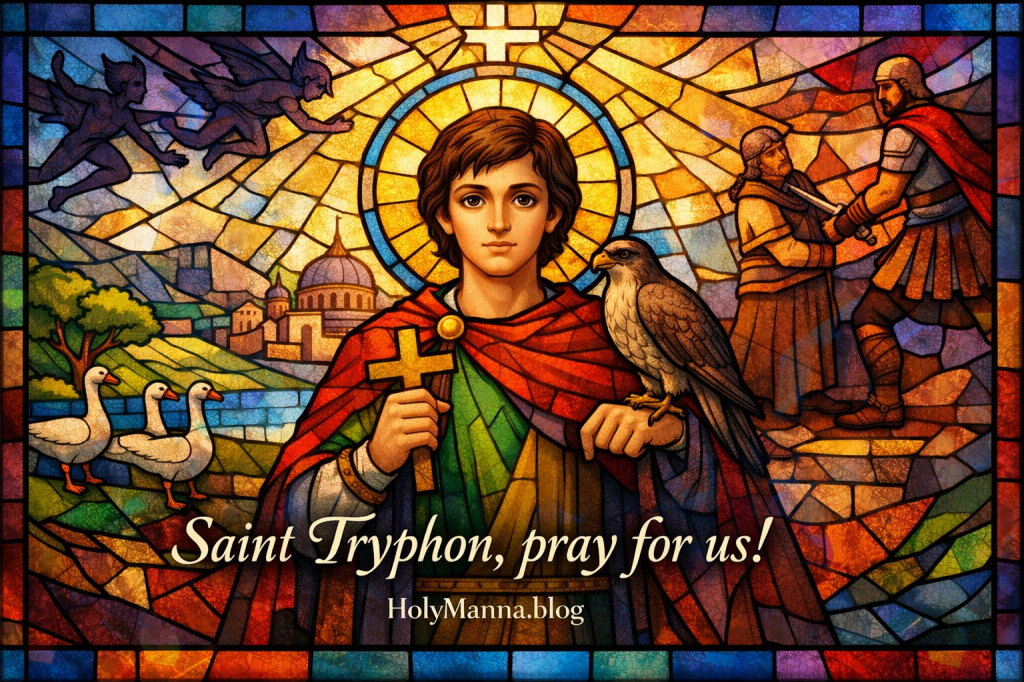
The Young Martyr Who Refused to Bow
Saint Tryphon is one of those early martyrs whose story feels almost hidden until the moment it matters most. The Church remembers him because he lived in a time when being Christian was not a hobby or a private preference. In the third century, confessing Jesus Christ could cost a reputation, a livelihood, and sometimes a life. Tryphon did not make a name for himself through influence or education. He became unforgettable because he refused to treat Christ like an accessory, and he chose fidelity when the world demanded compromise. That is why the Church venerates him as a martyr, and why Catholics still speak his name with reverence.
The Catechism teaches that martyrs bear the supreme witness to the truth of the faith, and their sacrifice reveals the power of grace when fear tries to rule the heart. The Catechism explains that martyrdom is the highest testimony given to the truth of the faith, because it means witnessing even unto death. This is not a celebration of suffering for its own sake. It is a proclamation that Jesus is worth everything, and that the Resurrection is more real than the threats of any empire.
A Faith That Held Firm
The traditions place Saint Tryphon in Phrygia, a region of Asia Minor where Christianity took root early. He is commonly remembered as poor, and some traditions describe him as a young boy who tended geese. That detail matters because it sets the tone for his whole story. Tryphon did not come from privilege or prestige. He did not have the kind of life that people assume produces saints. Yet Catholic memory keeps him close because the Gospel has always had a special love for the humble, and God delights in raising up the lowly.
Not much is preserved about his family in a way that reads like a modern biography, but the Church’s tradition emphasizes his early devotion and his steady fidelity. Holiness is often formed in hidden places before it is tested in public. A young Christian learns to pray, to obey, and to keep a clean conscience long before a courtroom demands a public confession. Tryphon’s early life is best understood as the slow schooling of a faithful heart, the kind of heart that belongs to Christ even when nobody is watching.
His story also reminds Catholics of a core truth: every person is called to holiness, not only the educated or the powerful. The Catechism teaches that all the faithful, whatever their condition or state, are called to the fullness of Christian life and to the perfection of charity, and that calling does not depend on social status. Saint Tryphon’s humble beginnings make that teaching feel real and close to home.
Healing in Christ’s Name
Catholic tradition remembers Saint Tryphon as a saint invoked for healing and deliverance, especially in the Christian East where his devotion is strong. It is important to understand the Catholic meaning here. Saints do not heal by their own power, and they are never replacements for Christ. God heals, and any healing connected to a saint is a sign that points back to the Lord’s mercy. The Church’s confidence in the saints rests on the Communion of Saints, which The Catechism describes as the spiritual solidarity of all who belong to Christ, including those already in glory.
Some traditions attribute to Tryphon a grace for casting out demons and healing various maladies, and they connect his compassion with the needs of ordinary people. There is also a tradition that he saved people from starvation, which fits the way many early saints were remembered. A saint who knows poverty and hard work often becomes beloved by people who live close to the struggles of daily survival. These traditions should be handled honestly, because the Church recognizes that some legendary details grew over time, yet the consistent theme remains that Tryphon’s life was marked by trust in God and a willingness to serve.
Tryphon is also commonly associated with agriculture and gardens, which makes sense given his humble background and the practical character of Christian devotion in many places. Catholics have never been shy about bringing real needs to God. They pray over sickness, drought, fear, temptation, and the struggles that feel too heavy to carry alone. This is not superstition when it is grounded in faith. It is a childlike confidence that the Lord who made the world still governs it, and that He listens when His children cry out for help.
A Trial at Nicaea and a Martyr’s Courage
The most defining part of Saint Tryphon’s story is his martyrdom, traditionally placed during the persecution associated with Emperor Decius around the middle of the third century. Christians were pressured to sacrifice to false gods and to prove loyalty to the state in ways that violated conscience. This was not a small request. It was an assault on the first commandment, because it demanded worship that belongs to God alone. Tryphon was arrested and brought for interrogation, traditionally at Nicaea, and the accounts describe suffering intended to force him to deny Christ.
The power of Tryphon’s witness is that he refused the logic of compromise. He could have saved himself by offering a small act of public compliance, but martyrdom always exposes the lie behind that move. The world always calls it a harmless gesture, and it always demands that conscience be kept quiet. Tryphon chose truth instead. His death is commonly remembered as beheading, and traditions remember him praying as he approached the end. The Church honors martyrs because they reveal what it looks like to love Christ more than life, and because their witness strengthens the whole Body of Christ.
The Catechism teaches that martyrdom is the supreme witness given to the truth of the faith, and it describes the martyr as someone who bears witness to Christ who died and rose, united with Him in charity. That is what makes Saint Tryphon’s death meaningful. It was not an act of political rebellion. It was an act of worship, because he refused to offer worship where it did not belong. His courage still challenges modern Catholics to stop treating faith like a private hobby, and to start living as if Christ is truly Lord.
The Feast That Shaped a City
Saint Tryphon’s legacy did not fade with his death. The early Church cherished the memory of martyrs because they embodied the Gospel with their bodies, their blood, and their unwavering confession. The veneration of relics grew from that conviction that the body matters, that the saints are real people, and that grace truly transforms human life. Honoring relics is not worship, and it is not superstition. It is reverence for what God has done in His friends and a sign of hope in the resurrection of the body. The Catechism grounds this kind of reverence in the Christian understanding of the body and the Church’s living tradition of honoring holy persons in a Christ-centered way.
In the Latin tradition, Saint Tryphon became linked with Saint Respicius and Saint Nympha. Saint Respicius is largely unknown in concrete historical detail, and Saint Nympha is remembered as a virgin associated with Sicily. Their association with Tryphon helps explain why older Western calendars sometimes list them together and why devotion to Tryphon traveled through different regions in different forms. His memory also reached into Rome through relic traditions connected to major churches, which again shows that he was not merely a local figure but a martyr honored across the wider Church.
One of the most striking Catholic strongholds of devotion to Saint Tryphon is Kotor on the Adriatic coast, where local tradition holds that his relics arrived in the early ninth century and became foundational for the city’s Catholic identity. A cathedral was built in his honor, and the community’s celebration of Saint Tryphon became both liturgical and cultural. The Tripundan season includes solemn worship and public expressions of gratitude, including processions and longstanding customs that keep the saint’s memory alive. It is a powerful example of what happens when Catholic faith is not treated as private sentiment but as a shared inheritance that shapes a people’s story.
What Saint Tryphon Teaches the Modern Catholic
Saint Tryphon’s life presses on modern Christians in a healthy way. The modern world often treats faith as something that should remain invisible and harmless, as if religion is acceptable only when it never asks anything. Saint Tryphon contradicts that assumption. His witness says that Jesus Christ is Lord in public as well as in private, and that conscience is not something to trade away for comfort. That message is not only for times of persecution. It is for everyday life, when compromise shows up in subtle forms.
His youth and simplicity are also a rebuke to the obsession with influence. A poor young believer from a rural region became a saint whose name is prayed across cultures and centuries. That is how the Kingdom of God works. God does not need a person to be impressive. God needs a person to be faithful. His reputation for healing and deliverance also invites renewed confidence in prayer. Catholics should not be ashamed to ask for help, and they should not try to carry burdens alone. The Church encourages the faithful to ask the saints to pray with them, because the saints are part of the family of God, and their intercession is a real expression of charity within the Body of Christ.
The Catechism teaches that the saints do not stop interceding for us, and that their concern helps the faithful on earth. That means Saint Tryphon is not only a figure from the past. He is a brother in Christ whose witness can strengthen courage, deepen prayer, and renew trust in God’s mercy. How would daily life change if faith was treated as the most real thing, instead of a weekend accessory? What would change if prayer became the first response rather than the last resort? What would happen if suffering was offered to Jesus instead of wasted in resentment?
Engage with Us!
Share your thoughts and reflections in the comments below. Saint Tryphon’s story may come from the early centuries, but it still challenges hearts today in a direct way.
- Where does pressure to compromise show up most strongly right now, and what would it look like to respond with calm courage instead of fear?
- What is one concrete way to make prayer a first response rather than a last resort when life feels heavy?
- How does Saint Tryphon’s humble background challenge modern ideas about success, status, and influence?
- Is there a physical, emotional, or spiritual need that should be brought to God more directly, asking for the intercession of the saints with trust?
Keep walking forward in faith. Keep choosing truth over comfort. Keep forgiving when it is hard. Keep praying when it feels dry. A life lived close to Jesus is never wasted, and everything should be done with the love and mercy Jesus taught us.
Saint Tryphon, pray for us!
Follow us on YouTube, Instagram and Facebook for more insights and reflections on living a faith-filled life.

 Holy Manna!
Leave a comment