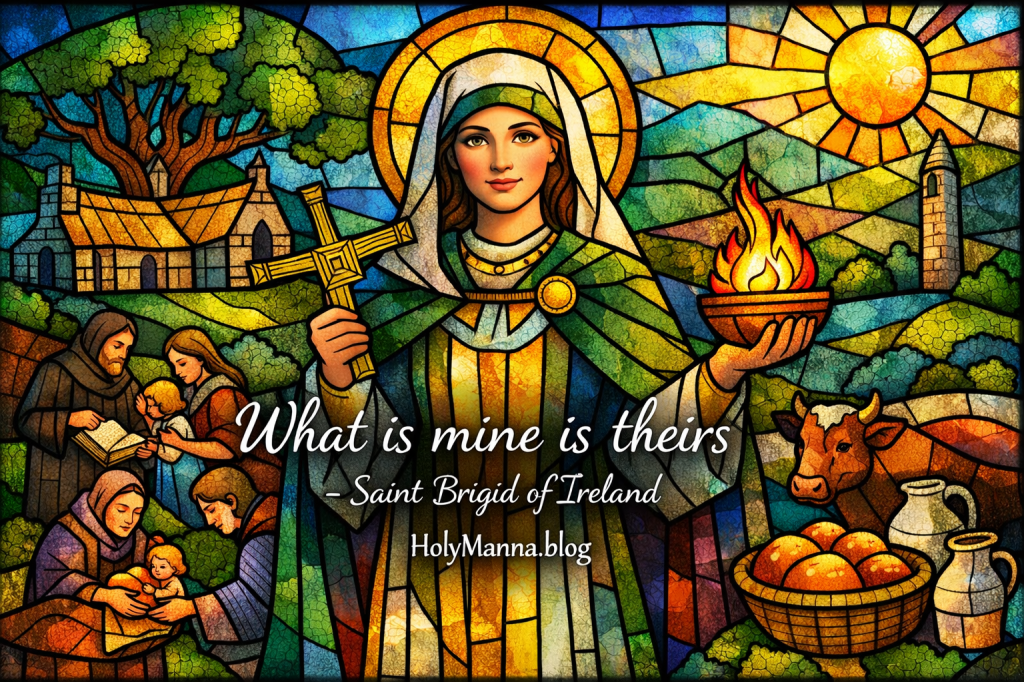
The Oak and the Flame of Mercy
Saint Brigid of Ireland, also called Brigid of Kildare, stands alongside Saint Patrick and Saint Columba as one of Ireland’s great patrons. Her feast is celebrated on February 1, and Catholic tradition remembers that date as the day she entered eternal life. She is honored as a consecrated virgin and abbess whose holiness helped shape the soul of a nation through prayer, courage, and mercy that never seemed to run dry. Her story matters because it shows how the Gospel becomes believable when it is lived with consistency. In Brigid’s wake, the hungry were fed, travelers were sheltered, the sick were cared for, and a young Church learned how to grow strong without growing cold.
The accounts of her life come from early Irish “Lives” that often blend history with holy storytelling. That is common in the way the early Church remembered her saints, and it does not weaken her witness. Brigid’s character comes through clearly across the centuries. She is remembered as a woman of fierce charity, spiritual authority, and steady leadership, and she remains a saint worth imitating today.
From Faughart to a Future of Holiness
Catholic sources place Brigid’s birth near Faughart, close to Dundalk, in the middle of the fifth century. Many traditions describe her father as a chieftain, often named Dubhthach, and her mother as a woman of low status, frequently described as a slave within his household. That origin story matters because it explains Brigid’s lifelong instinct to defend the lowly and treat the poor as family. She grew up in a world where status could decide someone’s future, and she learned early that the Lord sees deeper than rank or reputation.
As she matured, Brigid resisted pressure to marry and desired to belong wholly to Christ. Several traditions describe her doing everything possible to protect her vocation, even praying to be freed from vanity so she could live in peace for God. She also became known for a generosity that sometimes angered her household. A famous story says she gave away her father’s sword to a poor man so the man could sell it and feed his family. That kind of charity looks excessive until it is seen in the light of the Gospel, where love is not measured by what is safe but by what is faithful.
Different strands of tradition connect her reception of the veil to respected Irish clergy, including saints remembered in early Ireland’s Christian memory. The details vary, but the core does not change. Brigid embraced a consecrated life, and her yes to God became the seed of a spiritual movement that would bless thousands.
The Mantle That Kept Expanding
Brigid’s most famous foundation is Kildare, a place whose name is tied to an oak tree and the phrase “church of the oak.” Tradition remembers her gathering companions and establishing a community that became a strong center of worship, learning, hospitality, and works of mercy. Kildare is also associated with Saint Conleth, who is remembered as a bishop closely connected to the foundation’s pastoral care. Over time, Kildare developed in a way that was distinctive in Ireland, with a connected community life for women and men and with the abbess holding remarkable influence.
Some stories about Brigid’s leadership are occasionally misused today, so it is important to be clear. There is a tradition that speaks of an episcopal style blessing being read over her, emphasizing her spiritual stature. The Church’s doctrine on Holy Orders remains firm and is not altered by hagiographic episodes. The Catechism of the Catholic Church states with clarity in CCC 1598 that “Only a baptized man (vir) validly receives sacred ordination.” Brigid’s greatness does not require bending doctrine. Her greatness is that she became a saint through obedience, service, and spiritual motherhood.
Kildare’s founding is tied to one of the most famous stories about her, the cloak miracle. Brigid asked a local king for land, requesting only as much as her cloak could cover. Her cloak then spread beyond what anyone expected, securing far more land for the monastery than the king assumed he was granting. Whether this is received as literal miracle or sacred storytelling meant to teach faith, the meaning is unmistakable. God delights in blessing what is surrendered for His purposes, and Brigid’s life is a witness that generosity creates room for grace.
Miracles That Point to Christ
The miracles associated with Brigid repeatedly reflect one central theme: the Lord provides through a heart that refuses to close its hand. Many stories speak of food, dairy, and other necessities being supplied when they should have run out. Brigid’s monasteries became places where the poor could count on compassion and travelers could count on refuge. These accounts are not random wonders. They are meant to teach that Christian charity is not a mood but a way of life, and that God supports the work He commands.
One tradition says a young woman fled to Brigid for protection and was later falsely accused of theft. The missing item was then discovered inside a fish, clearing the woman’s name and highlighting Brigid as a defender of the vulnerable. Even in stories where the details feel dramatic, the spiritual point remains consistent. Brigid used her influence to protect the weak, and she trusted God to reveal the truth.
The Saint Brigid’s Cross is another enduring tradition. A classic legend says Brigid sat beside a dying chieftain, wove rushes into a cross, and explained the story of Jesus so clearly that the man asked for baptism before death. It is a powerful reminder that evangelization is often quiet and personal, and that a simple sign can open a heart when words alone would fail.
A saying often linked to her spirit of charity has been preserved in Catholic tradition as a motto: “What is mine is theirs.” That line captures the style of holiness that made her famous. It is not sentimental. It is practical. It is the kind of love that costs something.
Spiritual Battles and a Holy Death
Brigid is not remembered as a martyr who died by execution, but Catholic life recognizes another kind of martyrdom: the steady sacrifice of a life poured out in fidelity. To found and govern communities, form souls, and meet the needs of the poor required endurance. Brigid also faced resistance in her own household as she pursued consecrated life against social expectations. She lived at the edge of a cultural shift, in a time when Christian conversion and older customs existed side by side. Her holiness required clarity without cruelty, courage without pride, and mercy without compromise.
Tradition places her death around the year 525, and it preserves a memorable detail that reflects the love the faithful had for her. A cleric named Ninnidh attended her in her final moments and is remembered by the title “of the Clean Hand,” because he kept his right hand covered afterward out of reverence for having administered Holy Communion to Ireland’s beloved patroness. This is not a throwaway anecdote. It shows how Brigid’s sanctity shaped the imagination of a people who believed that the sacraments are holy, and that saints are not distant heroes but members of the family of the Church.
The Flame That Would Not Go Out
After her death, devotion to Brigid spread through Ireland and beyond. Catholic tradition associates her burial with Kildare and remembers the rise of pilgrimage to her shrine, especially on her feast day. Her relics also became part of the Church’s memory during times of danger. Tradition records translations of her relics during periods of upheaval and later veneration at major Christian sites connected with Ireland’s saints.
Her legacy is also connected to learning and sacred art. Medieval memory spoke in awe of the beauty of the “Book of Kildare,” a richly illuminated Gospel book that is now lost. Even without the physical book, the point remains important. Brigid’s world understood that worship and beauty belong together, and that the Church’s mission touches the imagination as well as the mind.
The flame of Kildare is another enduring symbol. Tradition remembers a flame tended by Brigid’s community as a sign of Christian light and hope. In modern times, this has been received as a spiritual symbol of prayer, peace, and steadfastness. It fits Brigid’s life because her charity was never merely social. It was rooted in worship, and it pointed beyond itself to the Lord who is the true Light.
The making and blessing of Saint Brigid’s Crosses remains a living Catholic practice. It is a way of bringing faith into the home, not as superstition, but as a visible reminder of the Cross of Christ and the communion of saints. Catholics honor relics and sacramentals because God truly works through matter. The Incarnation makes that clear, and the Church’s tradition continues to witness to it.
A Saint for the Modern Home
Saint Brigid’s story challenges the modern fear that generosity will leave someone empty. Her life insists on the opposite. When charity is rooted in Christ, it does not hollow a person out. It makes a person whole. Her witness also teaches that strength does not need to be harsh. Brigid’s influence was not built on intimidation. It was built on holiness that served, governed, and protected.
Her life also fits perfectly with the Church’s call to mercy. The Catechism of the Catholic Church teaches in CCC 2447 that “The works of mercy are charitable actions by which we come to the aid of our neighbor in his spiritual and bodily necessities.” Brigid is a living illustration of that teaching. She practiced mercy in ordinary ways until it became extraordinary.
Imitating Brigid does not require founding a monastery. It begins with smaller choices that are harder than they look. Hospitality starts when someone makes room for the inconvenient person. Almsgiving begins when someone stops keeping score. Charity becomes real when it costs time, attention, and patience. Beauty also belongs in this imitation, because Brigid’s legacy includes learning and sacred art, reminding Catholics that reverence and creativity can belong together under Christ.
Engage with Us!
Share thoughts and reflections in the comments below. Saint Brigid’s story still has a way of exposing where faith is real and where it has been domesticated.
- Where is God inviting more generosity, not only with money, but also with time, attention, and patience?
- What does hospitality look like in everyday life, especially toward people who cannot repay it or impress anyone?
- Is there a habit of fear or control that blocks mercy from flowing freely in the home, workplace, or parish?
- Which work of mercy can be practiced this week in a concrete and humble way, with no need for recognition?
- How can Saint Brigid’s example help build a home that feels more like a small monastery and less like a stressed out apartment?
May Saint Brigid pray for every household that feels stretched thin and every heart that wants to love with courage. Keep living a life of faith, and keep doing everything with the love and mercy Jesus taught
Saint Brigid of Ireland, pray for us!
Follow us on YouTube, Instagram and Facebook for more insights and reflections on living a faith-filled life.

 Holy Manna!
Leave a comment