Fourth Sunday in Ordinary Time – Lectionary: 70
When God Builds a Kingdom, He Starts with the Lowly
Some Sundays feel like a gentle correction, as if heaven is quietly asking what kind of life is being chased and what kind of life actually saves. Today’s readings all point to one central theme: God raises up the humble and makes them His true people, while the world’s boasting fades into nothing.
The prophet Zephaniah speaks to a nation that has grown careless, confident, and spiritually dull, and he warns about the coming “day of the Lord,” a moment of judgment that exposes what is real. Yet even there, God is not hunting for the impressive. He is preserving a remnant, the kind of people who are not full of themselves, the kind of people who know they need mercy. That is why the call is so simple and so piercing: “Seek the Lord… Seek justice, seek humility.” In the middle of upheaval, God promises to leave “a people humble and lowly” who take refuge in His Name and live without deceit.
The psalm then opens a window into the heart of that same God, not as an abstract idea, but as a Father who acts. He defends the oppressed, feeds the hungry, lifts up the bowed down, and protects the widow, the orphan, and the stranger. This is not soft sentiment. It is the steady justice of the Lord who reigns forever and refuses to forget the least.
Saint Paul brings the message right into the Church, into a community tempted to measure holiness the way the world measures success. He reminds the Corinthians that God loves to work through what looks small and unimpressive, so that grace, not ego, gets the final word. That is why Paul can say with holy clarity: “God chose the weak of the world to shame the strong” and “Whoever boasts, should boast in the Lord.”
Then, on the mountain in The Gospel of Matthew, Jesus speaks the Beatitudes, not as inspirational quotes, but as the Kingdom’s blueprint. The Lord calls blessed the poor in spirit, the meek, the merciful, the clean of heart, and the persecuted, because these are the people who have room for God. The Beatitudes reveal the face of Christ and the path of the disciple, and the Church calls them the heart of Jesus’ preaching in CCC 1716. At the center of it all stands the promise that still shocks the proud and consoles the contrite: “Blessed are the poor in spirit, for theirs is the kingdom of heaven.”
What if the life God calls “blessed” looks nothing like the life the world calls successful, and what if that is exactly the point?
First Reading – Zephaniah 2:3; 3:12-13
A Remnant Hidden in Plain Sight
Zephaniah is not writing from a calm, comfortable moment in Israel’s story. He is preaching in a time when God’s people have grown spiritually sleepy and morally divided, and when the nations around them are swelling with power and violence. The prophets often call this kind of moment “the day of the Lord,” not because God is suddenly angry like a man, but because God’s holiness finally exposes what has been hidden, both in nations and in hearts.
That is why Zephaniah’s message sounds like both a warning and an invitation. The Lord is not looking for a perfect people who can impress Him. He is gathering a remnant, a small and purified people, described with words that sound almost too ordinary to be the center of salvation history: humble, lowly, honest, peaceful, and resting in God. This fits today’s theme perfectly because the Church is about to hear Christ proclaim the Beatitudes in The Gospel of Matthew, and Zephaniah is already preparing the soil for that mountain teaching by naming the kind of heart God can truly bless.
Zephaniah 2:3; 3:12-13 – New American Bible (Revised Edition)
3 Seek the Lord,
all you humble of the land,
who have observed his law;
Seek justice,
seek humility;
Perhaps you will be sheltered
on the day of the Lord’s anger.12 But I will leave as a remnant in your midst
a people humble and lowly,
Who shall take refuge in the name of the Lord—
13 the remnant of Israel.
They shall do no wrong
and speak no lies;
Nor shall there be found in their mouths
a deceitful tongue;
They shall pasture and lie down
with none to disturb them.
Detailed Exegesis
Verse 3: “Seek the Lord, all you humble of the land, who have observed his law; Seek justice, seek humility; Perhaps you will be sheltered on the day of the Lord’s anger.”
Zephaniah begins with a summons that is meant to be lived, not merely admired. To “seek the Lord” is covenant language, meaning real conversion, real worship, and a real return to obedience. The prophet addresses “the humble of the land,” not as a compliment, but as a description of those who have stopped relying on themselves and have learned the posture of trust. He links seeking God to seeking justice and humility because true religion cannot be separated from the moral life. A heart that adores God but refuses justice is not yet a heart that has actually returned to Him.
That word “Perhaps” can sound uncertain, but it is meant to pierce presumption. Zephaniah is confronting the temptation to treat God like an insurance policy. The shelter promised here is not a guarantee of comfort; it is the safety of belonging to the Lord when judgment reveals what is true. Humility becomes refuge because humility stops arguing with God and starts taking refuge in His mercy.
Verse 12: “But I will leave as a remnant in your midst a people humble and lowly, Who shall take refuge in the name of the Lord, the remnant of Israel.”
This is one of the most hopeful sentences in the prophets. Even after discipline, God does not abandon His people. He purifies them. The “remnant” is not a random leftover. It is the faithful portion God preserves so His promises continue forward. Notice the center of gravity here: God does the saving work, and the remnant responds by taking refuge “in the name of the Lord.” In Scripture, God’s “name” is not a label. It signifies His real presence, His authority, His faithfulness, and His fatherly protection.
The remnant is described as “humble and lowly,” which is not weakness in the modern sense. It is spiritual realism. They know God is God, and they are not. That is why they can be led.
Verse 13: “They shall do no wrong and speak no lies; Nor shall there be found in their mouths a deceitful tongue; They shall pasture and lie down with none to disturb them.”
Zephaniah gives the moral profile of the remnant, and it is refreshingly concrete. They do not harm others, and they do not lie. Their speech is clean, their actions are clean, and their community becomes a place of peace. The image of pasturing and lying down echoes the calm of a flock safe with its shepherd. It is not sentimental. It is the fruit of a people whose inner life has been purified. When deception dies, fear loses oxygen. When injustice ends, peace becomes possible.
Teachings
Zephaniah’s remnant shows that humility is not a personality trait; it is a spiritual foundation. It is the posture that allows grace to enter and remain. This is why The Catechism speaks so directly about humility in the life of prayer: CCC 2559 teaches, “Humility is the foundation of prayer. Only when we humbly acknowledge that ‘we do not know how to pray as we ought,’ are we ready to receive freely the gift of prayer.” When Zephaniah commands the humble to seek the Lord, he is describing the only kind of heart that can truly receive God as God.
The reading also ties humility to justice, and that connection matters because it keeps humility from becoming an excuse for passivity. God is not forming a remnant that is timid about truth. He is forming a people who are righteous without being self-righteous. The Catechism defines justice in a way that fits Zephaniah’s call to “seek justice” with clarity and strength. CCC 1807 teaches, “Justice is the moral virtue that consists in the constant and firm will to give their due to God and neighbor.” Zephaniah’s remnant gives God His due through worship and obedience, and gives neighbor their due through truthfulness and nonviolence.
There is also a quiet but powerful anticipation of Christ here. When Zephaniah describes a people “humble and lowly” who take refuge in the Lord, it echoes the interior landscape of the Beatitudes. The poor in spirit, the meek, the merciful, and the clean of heart are not random moral categories. They are the description of a heart that has stopped trying to save itself and has started living in the shelter of God.
Historically, the prophetic idea of a remnant becomes crucial as Israel faces invasion, exile, and loss. The remnant is how God teaches His people that His plan does not depend on worldly size or strength. God saves through faithfulness, not through numbers. This same lesson will later shape the Church’s identity when Christians discover that the Gospel often grows most powerfully through what seems small, hidden, and unimpressive.
Reflection
Zephaniah is a gift for anyone who feels tired of pretending, tired of performing, and tired of trying to hold everything together by sheer willpower. The prophet is not offering a technique for success. He is offering a path into shelter. That shelter begins with humility, and humility begins with truth.
A good place to start is the part Zephaniah makes uncomfortably specific: speech. The remnant “speaks no lies” and has “no deceitful tongue.” That invites an examination that goes beyond obvious dishonesty. Deceit can hide in exaggeration, flattery used as manipulation, sarcasm used as a weapon, and the careful editing of the truth to protect pride. A practical step is to ask, with calm honesty, whether the words spoken this week made life safer for others or more stressful for them.
Zephaniah also pairs humility with justice, which means humility is not hiding from responsibility. Humility is doing the right thing without needing applause. A practical step is to choose one act of justice that costs something real, such as defending someone who is being mocked, owning a mistake without excuses, or making restitution where harm has been done.
Most of all, the reading asks where refuge is being sought. Zephaniah does not say the remnant takes refuge in intelligence, planning, influence, or image. He says they take refuge in the Lord’s name.
Where is refuge being sought when anxiety rises, when temptation knocks, or when pride feels threatened?
What would change this week if seeking the Lord became the first instinct instead of the last resort?
What is one concrete way humility could be practiced today, not as self-hatred, but as surrender to God’s truth and mercy?
Responsorial Psalm – Psalm 146:6-10
The Lord Reigns and the Lowly Are Not Forgotten
After Zephaniah speaks of a humble remnant sheltered in the Lord’s name, the Church responds the way she always does when God’s word cuts through noise and fear. She prays. The Responsorial Psalm is not a musical pause between readings, but a living reply from the heart of God’s people. This particular psalm comes from the final stretch of the Psalter where praise becomes intense and uncomplicated, almost like a bell that will not stop ringing until everyone remembers who truly reigns.
Psalm 146 is also honest about something every age struggles with. Human power looks impressive until it fails, and the vulnerable usually pay the price first. So the psalm praises the Lord not with vague optimism, but with a list of concrete works that reveal His character. The Creator is also the Defender. The King of heaven is also the One who stoops to feed the hungry and lift up the bowed down. This fits today’s theme because the Beatitudes announce the same upside-down kingdom, and St. Paul insists that God chooses the lowly so that boasting dies and grace is seen clearly. In short, this psalm sings what the other readings preach: God’s heart is set on the humble, and His reign is good news for anyone who knows they need Him.
Psalm 146:6-10 – New American Bible (Revised Edition)
6 The maker of heaven and earth,
the seas and all that is in them,
Who keeps faith forever,
7 secures justice for the oppressed,
who gives bread to the hungry.
The Lord sets prisoners free;
8 the Lord gives sight to the blind.
The Lord raises up those who are bowed down;
the Lord loves the righteous.
9 The Lord protects the resident alien,
comes to the aid of the orphan and the widow,
but thwarts the way of the wicked.
10 The Lord shall reign forever,
your God, Zion, through all generations!
Hallelujah!
Detailed Exegesis
Verse 6: “The maker of heaven and earth, the seas and all that is in them, Who keeps faith forever,”
The psalm begins by anchoring everything in the identity of God as Creator. This matters because if God made heaven and earth, then He is not one more force competing inside the universe. He is Lord over it. The line that follows is even more personal: He “keeps faith forever.” Human beings forget, change, and break promises, sometimes from weakness and sometimes from selfishness. God is different. His fidelity is not a mood. It is His nature. When the Church prays this verse, she is learning to rest in a God whose commitment does not expire.
Verse 7: “secures justice for the oppressed, who gives bread to the hungry. The Lord sets prisoners free;”
This verse moves from who God is to what God does. “Justice for the oppressed” is not revenge. It is God setting right what sin has twisted. The hungry are not treated as an abstract problem. They are fed. The prisoners are not treated as invisible. They are remembered and liberated. Even when the liberation is not immediate or political, the psalm is still teaching that God is never indifferent to captivity, whether it is social, moral, or spiritual. The Lord’s saving work always includes both truth and mercy, and it always leans toward freedom.
Verse 8: “the Lord gives sight to the blind. The Lord raises up those who are bowed down; the Lord loves the righteous.”
Blindness in Scripture can be physical, but it often points to a deeper need: the inability to perceive reality as God sees it. God gives sight, and that is a quiet promise that despair does not get the last word. The Lord also “raises up those who are bowed down,” which captures people bent by sorrow, anxiety, poverty, exhaustion, guilt, and humiliation. God’s love for the righteous is not favoritism toward perfect people. It is the steady delight of a Father in those who cling to Him and strive to walk in His ways, even when their strength is small.
Verse 9: “The Lord protects the resident alien, comes to the aid of the orphan and the widow, but thwarts the way of the wicked.”
The psalm names three groups who were especially vulnerable in the ancient world: the foreigner without protection, the orphan without family security, and the widow without social power. God does not just notice them. He protects and aids them. Then the verse adds a hard line that keeps mercy from becoming sentimental: God “thwarts the way of the wicked.” Love does not mean pretending evil is harmless. The Lord’s care for the vulnerable includes His resistance to the systems and choices that crush them. In the kingdom of God, wickedness is not allowed to be the final architect of society.
Verse 10: “The Lord shall reign forever, your God, Zion, through all generations! Hallelujah!”
The psalm ends where it began, with confidence in who God is. Empires rise and fall, and even the strongest rulers eventually disappear into history. The Lord reigns forever. “Zion” here is not merely a piece of land. It is the holy people gathered around God’s presence, which the Church recognizes as fulfilled and expanded in Christ. The final “Hallelujah” is not escapism. It is defiance against despair. It is praise that refuses to let suffering rewrite the truth about God.
Teachings
This psalm does something very Catholic. It refuses to separate worship from the moral life. Real praise of God produces real love of neighbor, especially neighbor in need. When the Church hears that the Lord gives bread to the hungry, frees prisoners, and lifts up the bowed down, she is being trained to recognize the face of Christ in the suffering.
The Catechism speaks plainly about this when it describes the works of mercy. In CCC 2447 it teaches: “The works of mercy are charitable actions by which we come to the aid of our neighbor in his spiritual and bodily necessities. Instructing, advising, consoling, comforting are spiritual works of mercy, as are forgiving and bearing wrongs patiently. The corporal works of mercy consist especially in feeding the hungry, sheltering the homeless, clothing the naked, visiting the sick and imprisoned, and burying the dead.” That is almost a direct echo of this psalm’s world. The Lord acts for the vulnerable, and the Lord forms His people to act the same way.
This also connects naturally to the Beatitudes in The Gospel of Matthew. The merciful are blessed because God is merciful. Those who hunger and thirst for righteousness are blessed because God “secures justice for the oppressed.” The poor in spirit are blessed because they know where help actually comes from. The psalm is not merely describing God’s resume. It is describing the kind of kingdom Christ is bringing, and the kind of disciple Christ is shaping.
Historically, Israel prayed the Psalms not as private poetry, but as communal worship. Over time, these songs formed the conscience of God’s people. They learned what God loves by repeating it, singing it, and handing it to the next generation. That is why the psalm insists that the Lord reigns “through all generations.” Faith is not meant to be reinvented every decade. It is meant to be received, lived, and passed on, especially when the world grows cynical.
Reflection
This psalm is a test of trust, because it quietly asks what is expected to save. When life feels unstable, it is tempting to grab whatever seems strong in the moment: money, influence, image, control, or the approval of the right crowd. Psalm 146 re-centers the soul by insisting that the only King who never fails is the Lord.
A practical way to live this psalm is to turn it into a pattern of prayer. It can be prayed slowly in the morning, not as a performance, but as a reset for the day. When anxiety rises, the line “Who keeps faith forever” can be repeated until the heart remembers that God is not fickle. Another practical step is to let the psalm choose the week’s act of charity. Feeding the hungry can look like a meal and a conversation with someone who is struggling. Visiting the sick or imprisoned can look like a call, a check-in, a letter, or showing up when it would be easier to stay comfortable.
This psalm also challenges speech and attention. The Lord sees the outsider, the orphan, and the widow, which means His people cannot treat them as invisible. A good spiritual exercise is to notice who gets ignored, who gets interrupted, and who gets dismissed, and then to act with deliberate care.
Where is hope being placed when pressure hits, and does that place actually keep faith forever?
Who in everyday life feels bowed down right now, and what would it look like to help lift that burden in a real way?
If the Lord protects the vulnerable, what kind of person should a disciple become when no one is watching and no applause is coming?
Second Reading – 1 Corinthians 1:26-31
God’s Favorite Materials
Corinth was a loud, ambitious city in the Roman world, known for commerce, status, and the kind of social climbing that makes people obsessed with image. When St. Paul preached Christ there, the Church that formed was real and alive, but it was also tempted to think like Corinth. Some believers began to boast in personalities, talent, eloquence, and social standing, as if the Gospel were one more badge to wear in public.
So Paul does something pastorally brilliant. He does not begin by shaming them into silence. He invites them to remember their own story. Most of them were not the cultural “winners” of Corinth, and that was not an accident. God deliberately chose the weak and the lowly so that grace would be unmistakable and boasting would die. This fits perfectly with today’s theme across all the readings. Zephaniah speaks of a humble remnant sheltered in the Lord’s name, Psalm 146 praises the God who lifts up the bowed down, and the Beatitudes in The Gospel of Matthew announce that the kingdom belongs to the poor in spirit, the meek, and the merciful. Paul is explaining the same kingdom logic from inside the Church: God saves in a way that leaves no room for self-congratulation and every room for worship.
1 Corinthians 1:26-31 – New American Bible (Revised Edition)
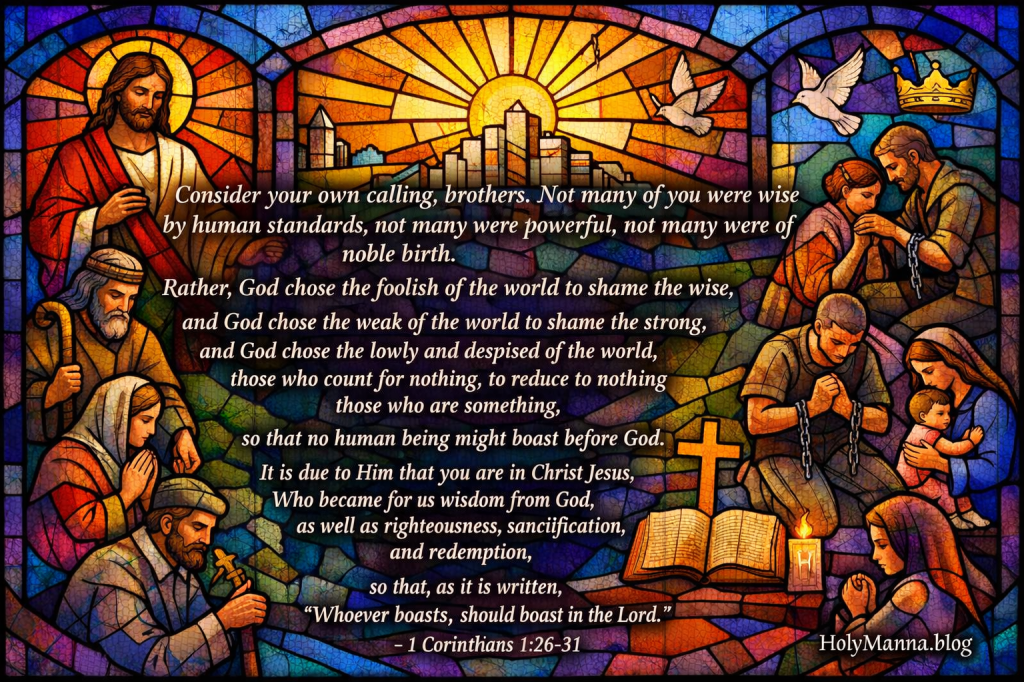
26 Consider your own calling, brothers. Not many of you were wise by human standards, not many were powerful, not many were of noble birth. 27 Rather, God chose the foolish of the world to shame the wise, and God chose the weak of the world to shame the strong, 28 and God chose the lowly and despised of the world, those who count for nothing, to reduce to nothing those who are something, 29 so that no human being might boast before God. 30 It is due to him that you are in Christ Jesus, who became for us wisdom from God, as well as righteousness, sanctification, and redemption, 31 so that, as it is written, “Whoever boasts, should boast in the Lord.”
Detailed Exegesis
Verse 26: “Consider your own calling, brothers. Not many of you were wise by human standards, not many were powerful, not many were of noble birth.”
Paul asks them to look at their vocation, meaning God’s personal initiative in calling them into Christ. He points out something obvious but easy to forget: the Church in Corinth was not built from the city’s elite. This is not an insult. It is a revelation. God is showing that salvation is not a prize earned by intelligence, influence, or family pedigree. The Gospel does not belong to a “type” of person. It belongs to anyone who will receive it with faith.
Verse 27: “Rather, God chose the foolish of the world to shame the wise, and God chose the weak of the world to shame the strong,”
This is classic biblical reversal. God is not mocking wisdom or strength in themselves. He is exposing pride that treats human ability as ultimate. “To shame” here means to reveal the limits of worldly metrics. The Cross looks foolish to a world addicted to control, yet it is the power of God. The Church grows most authentically when she remembers that her strength is not self-generated. It is given.
Verse 28: “and God chose the lowly and despised of the world, those who count for nothing, to reduce to nothing those who are something,”
Paul stacks the words on purpose. “Lowly,” “despised,” “count for nothing” describes how society labels people, not how God values them. The Lord chooses precisely those people to dismantle the illusion that status is real power. This is how God humbles the world’s false gods, including the idol of reputation. He exposes what “being something” often means in a fallen culture: being praised, being seen, being feared, being envied. God can strip all of that away in an instant, and still the one who belongs to Christ remains rich.
Verse 29: “so that no human being might boast before God.”
This is the reason behind the whole passage. Boasting is not merely annoying; it is spiritually dangerous because it steals glory from God and turns the heart inward. Paul is protecting the Church from a subtle corruption where people speak about Jesus but secretly worship themselves. Before God, no one can present a résumé. The only safe posture is gratitude and humility.
Verse 30: “It is due to him that you are in Christ Jesus, who became for us wisdom from God, as well as righteousness, sanctification, and redemption,”
Paul gives the antidote to boasting. Everything is “due to him.” The Christian life begins in gift. Then Paul names Christ in four titles that sum up salvation. Jesus is “wisdom from God,” meaning truth is not simply information but a Person to be known and followed. He is “righteousness,” meaning the believer is made right with God not by self-improvement but by grace. He is “sanctification,” meaning holiness is not a brand but a real transformation of the soul, lived out through prayer, virtue, and the sacramental life. He is “redemption,” meaning the price has been paid and the chains have been broken by the blood of Christ.
Verse 31: “so that, as it is written, ‘Whoever boasts, should boast in the Lord.’”
Paul ends with Scripture because this is not his private opinion. The proper “boast” of a Christian is worship. It is a life that points outward, saying with every choice that the Lord is the source of every good thing. This does not crush the human person. It frees the human person, because it removes the pressure to manufacture identity through performance.
Teachings
This reading is one of the Church’s clearest lessons on grace and humility. It teaches that God does not love people because they are impressive, and God does not call people because they have earned it. God calls because He is good. That is why the Christian life cannot be built on self-reliance. It must be built on grace.
The Catechism describes grace in a way that matches Paul’s insistence that everything is “due to him.” CCC 1996 teaches: “Grace is favor, the free and undeserved help that God gives us to respond to his call to become children of God, adoptive sons, partakers of the divine nature and of eternal life.”
If grace is free and undeserved help, then boasting collapses. The only honest response is thanksgiving.
Paul also insists that Christ becomes “sanctification” for believers, which means holiness is not a self-designed project. It is participation in Christ’s own life. The Catechism connects Christian merit to grace, so that even the good done by a disciple is never a reason to inflate the ego. CCC 2011 teaches: “The charity of Christ is the source in us of all our merits before God. Grace, by uniting us to Christ in active love, ensures the supernatural quality of our acts and consequently their merit before God and before men.”
This keeps the heart steady. Good works matter deeply, but they never become a reason to look down on others, because even the ability to love is first a gift.
Finally, Paul’s assault on boasting is really a defense of prayer. A proud heart struggles to pray because it prefers control. A humble heart can pray because it can receive. The Catechism puts this with unforgettable clarity. CCC 2559 teaches: “Humility is the foundation of prayer. Only when we humbly acknowledge that ‘we do not know how to pray as we ought,’ are we ready to receive freely the gift of prayer.”
Paul’s point is not to make anyone feel small in a bitter way. His point is to make the Church small enough to receive God’s life.
In the Church’s history, this passage has always been a quiet rebuke to every era that tries to turn Christianity into a status club. The saints repeatedly prove Paul right. God delights in taking unknown people, ordinary people, and even broken people, then making them radiant with holiness, so that the world is forced to admit that something supernatural is happening.
Reflection
This reading is a spiritual mirror, because it asks what the heart brags about when no one else can hear it. Some people boast in success. Others boast in being right. Others boast in being “good” compared to the chaos around them. Paul steps into that inner monologue and says, with fatherly firmness, that none of it belongs before God.
A practical step is to let this reading reshape self-talk. When pride begins to narrate life, it can be answered with Paul’s line: “It is due to him that you are in Christ Jesus.” That sentence breaks the spell of self-made identity. It also heals shame, because it reminds the weak that God chooses the weak. The goal is not to pretend weakness is strength. The goal is to let weakness become open space where Christ can act.
Another practical step is to examine how other people are treated. If God chose the lowly and despised, then a disciple cannot quietly adopt the world’s habit of ranking people. This reading calls for a different instinct: honoring the unnoticed, listening to the ignored, speaking with patience to the awkward, and refusing to treat anyone as disposable.
This passage also prepares the heart for the Beatitudes. The poor in spirit are blessed because they have stopped performing for approval and started living for God.
What is the most common thing the heart tries to boast in, and what fear is hiding underneath that boasting?
Where is the Lord inviting a shift from self-reliance to real dependence on grace, especially in prayer and in temptation?
Who in everyday life is treated as “counting for nothing,” and how could Christ be honored by choosing to see that person with reverence and patience?
Holy Gospel – The Gospel of Matthew 5:1-12
The Mountain Where Happiness Gets Rewritten
In Galilee, crowds followed Jesus because something about Him felt like real authority, the kind that does not crush people but restores them. Many were poor, many were burdened, and many were living under pressures they did not choose, including political occupation, economic instability, and religious leaders who too often turned God’s law into a heavy yoke. When Jesus “goes up the mountain” and sits to teach, it is not a random detail. Mountains in Scripture are places where God reveals Himself and forms His people. This moment echoes Moses receiving the Law, but now the Lawgiver Himself speaks, not merely to regulate behavior, but to reveal the path of blessedness and the inner shape of the Kingdom.
The Beatitudes are the Church’s doorway into the whole Sermon on the Mount. They do not flatter human ambition. They dismantle it. They fit today’s theme because Zephaniah foretells a humble remnant sheltered in the Lord’s name, Psalm 146 praises the God who lifts up the bowed down, and St. Paul insists that God chooses the weak and lowly so that no one boasts before Him. Now Jesus names, one by one, the people the world tends to overlook and calls them blessed, because God’s Kingdom belongs to the humble and the mercy-filled.
Matthew 5:1-12 – New American Bible (Revised Edition)
The Sermon on the Mount. 1 When he saw the crowds, he went up the mountain, and after he had sat down, his disciples came to him. 2 He began to teach them, saying:
The Beatitudes
3 “Blessed are the poor in spirit,
for theirs is the kingdom of heaven.
4 Blessed are they who mourn,
for they will be comforted.
5 Blessed are the meek,
for they will inherit the land.
6 Blessed are they who hunger and thirst for righteousness,
for they will be satisfied.
7 Blessed are the merciful,
for they will be shown mercy.
8 Blessed are the clean of heart,
for they will see God.
9 Blessed are the peacemakers,
for they will be called children of God.
10 Blessed are they who are persecuted for the sake of righteousness,
for theirs is the kingdom of heaven.11 Blessed are you when they insult you and persecute you and utter every kind of evil against you [falsely] because of me. 12 Rejoice and be glad, for your reward will be great in heaven. Thus they persecuted the prophets who were before you.
Detailed Exegesis
Verse 1: “When he saw the crowds, he went up the mountain, and after he had sat down, his disciples came to him.”
Jesus does not teach from a place of panic or performance. He sits, as a rabbi would, signaling deliberate instruction and lasting authority. The mountain points to revelation and covenant, and the disciples coming close shows that this teaching is meant to form a way of life, not merely inspire a moment.
Verse 2: “He began to teach them, saying:”
This is not casual advice. In The Gospel of Matthew, Jesus teaches as the fulfillment of Israel’s hope, and His words carry the weight of divine truth. The Beatitudes are the opening of a new horizon, showing what the Kingdom looks like from the inside.
Verse 3: “Blessed are the poor in spirit, for theirs is the kingdom of heaven.”
“Poor in spirit” is not self-hatred or weakness for its own sake. It is spiritual humility, the heart that knows it needs God and stops pretending otherwise. This beatitude stands first because it opens the door to everything else. A person who depends on God can receive the Kingdom, because the Kingdom is gift, not achievement.
Verse 4: “Blessed are they who mourn, for they will be comforted.”
This is not a celebration of sadness. It is a promise that grief, repentance, and sorrow that turns toward God will not be abandoned. Those who mourn can include those grieving loss, but also those who grieve sin and the brokenness of the world. The comfort promised is not a distraction. It is God’s own consolation, ultimately fulfilled in Christ’s victory over death.
Verse 5: “Blessed are the meek, for they will inherit the land.”
Meekness is not cowardice. It is strength under control, a heart that refuses to dominate. In a world where the aggressive often seize what they want, Jesus promises inheritance to the meek, meaning what God gives cannot be stolen. The “land” echoes God’s promise to Israel, but Christ expands it toward the lasting inheritance of the Kingdom.
Verse 6: “Blessed are they who hunger and thirst for righteousness, for they will be satisfied.”
Righteousness here is not merely personal morality, although it includes that. It is a deep longing for God’s will to be done, for truth to prevail, and for justice to be restored. Jesus promises satisfaction, but not in the shallow way of getting everything desired instantly. This is the fullness that comes from being aligned with God, and finally seeing His justice established.
Verse 7: “Blessed are the merciful, for they will be shown mercy.”
Mercy is love meeting misery. It is compassion that acts, and forgiveness that refuses revenge. Jesus ties mercy to receiving mercy because the heart that gives mercy is the heart that has truly understood its own need for God. This beatitude confronts a hard truth: a merciless heart cannot enjoy the mercy of God, because it resists becoming like God.
Verse 8: “Blessed are the clean of heart, for they will see God.”
Purity of heart is not a public image. It is an interior integrity where desire, thought, and intention are ordered toward God. “They will see God” is one of Scripture’s most daring promises. It points to a real communion with God that begins now through faith and grows in holiness, and is fulfilled perfectly in heaven.
Verse 9: “Blessed are the peacemakers, for they will be called children of God.”
Peacemakers are not people who avoid conflict at all costs. They are people who love truth enough to seek reconciliation and justice without hatred. They imitate God, who does not make peace by ignoring sin, but by healing it. Being called “children of God” means sharing in the family resemblance, reflecting the Father’s heart in a divided world.
Verse 10: “Blessed are they who are persecuted for the sake of righteousness, for theirs is the kingdom of heaven.”
Jesus does not romanticize persecution, but He prepares disciples to expect resistance. If a person truly lives righteousness, the world that loves darkness will push back. The promise repeats the first beatitude, “theirs is the kingdom of heaven,” showing that the Kingdom belongs to those who remain faithful when it costs them.
Verse 11: “Blessed are you when they insult you and persecute you and utter every kind of evil against you falsely because of me.”
Now Jesus becomes even more personal. This is not generic hardship; it is suffering “because of me.” The disciple shares in the Master’s rejection. The mention of false accusations shows that Christian endurance is not about winning arguments but about clinging to Christ when reputation is attacked unfairly.
Verse 12: “Rejoice and be glad, for your reward will be great in heaven. Thus they persecuted the prophets who were before you.”
Jesus commands joy, not because pain is pleasant, but because fidelity is never wasted. He places suffering disciples in the line of the prophets, reminding them that rejection can be a sign of real faithfulness. The reward is not payment for misery. It is the Father’s vindication and the final unveiling of the Kingdom.
Teachings
The Beatitudes are not a list of random virtues. They are the portrait of Christ and the blueprint of Christian holiness. The Church speaks about them with directness in The Catechism. CCC 1716 teaches: “The Beatitudes are at the heart of Jesus’ preaching. They take up the promises made to the chosen people since Abraham. The Beatitudes fulfill the promises by ordering them no longer merely to the possession of a territory, but to the Kingdom of heaven.”
This matters because it shows what Jesus is doing. He is fulfilling Israel’s hope, but lifting it beyond land and politics into the reign of God that transforms the heart and leads to eternal life.
The Beatitudes also describe the inner life of a disciple, not merely external behavior. CCC 1717 teaches: “The Beatitudes depict the countenance of Jesus Christ and portray his charity. They express the vocation of the faithful associated with the glory of his Passion and Resurrection; they shed light on the actions and attitudes characteristic of the Christian life; they are the paradoxical promises that sustain hope in the midst of tribulations; they proclaim the blessings and rewards already secured, however dimly, for Christ’s disciples; they have begun in the lives of the Virgin Mary and all the saints.”
That word “paradoxical” is important. The Beatitudes promise happiness through humility, mercy, purity, and endurance, which is the opposite of the world’s promise of happiness through control, indulgence, and applause.
Historically, the Beatitudes became a measuring rod for Christian life from the earliest centuries. They shaped the Church’s understanding of martyrdom, not as a death wish, but as faithful love. They also shaped the Church’s care for the poor and suffering, because the blessed are not only those who give, but also those who receive God in their need. When Christians built hospitals, cared for abandoned children, and honored widows and the forgotten, they were not inventing a new morality. They were taking Jesus seriously.
Reflection
The Beatitudes are gentle in tone, but they are not gentle on the ego. They ask what kind of happiness is being pursued and whether it can survive suffering, disappointment, and death. Jesus offers a happiness rooted in God, which means it is stable even when circumstances are not.
A practical step is to choose one beatitude as a rule for the week, not as a self-improvement project, but as a way of cooperating with grace. A person tempted to pride can practice being poor in spirit by making a sincere act of dependence on God in prayer each morning, admitting need without negotiation. A person carrying grief can bring mourning into the Lord’s presence instead of numbing it, asking for the comfort that does not lie. A person quick to anger can practice meekness by refusing to retaliate in speech, choosing restraint that protects others from harm. A person drifting into compromise can hunger and thirst for righteousness by making one clear choice for truth, even when it costs comfort. A person holding grudges can practice mercy by taking one step toward forgiveness, not pretending the wound did not happen, but refusing to keep feeding it. A person fighting impurity can pursue a clean heart by guarding what enters the imagination and by returning quickly to confession when falling. A person surrounded by conflict can become a peacemaker by speaking truth without contempt and seeking reconciliation without surrendering conviction. A person mocked for faith can endure persecution with steadiness, remembering that God sees what the world misreads.
The Beatitudes also invite a different way of seeing others. If Jesus calls the poor in spirit and the meek blessed, then the disciple cannot treat humble people as background noise. The hidden, the gentle, and the faithful are not secondary in the Kingdom. They are the Kingdom’s foundation.
Which beatitude feels most difficult right now, and what does that difficulty reveal about what the heart is clinging to?
Where is the Lord asking for a quieter humility, a cleaner heart, or a more courageous mercy in everyday life?
If the promise is that the Kingdom belongs to the humble, what would change this week if surrender to God became the first instinct instead of the last resort?
The Blessed Life Is the Hidden Life with God
By the time the Church reaches the end of today’s readings, a clear picture has formed. God is not building His Kingdom with the people who know how to impress a crowd. He is building it with the humble who know how to take refuge in His Name.
Zephaniah opens the day with a sober reminder that the “day of the Lord” exposes what is real, and then he offers a surprising hope. The Lord preserves a remnant, “a people humble and lowly” who speak no lies and live without deceit. They are not heroic because they are loud. They are faithful because they are surrendered.
Psalm 146 then teaches what kind of King shelters that remnant. The Lord is not distant. He keeps faith forever. He secures justice for the oppressed, feeds the hungry, raises up the bowed down, and protects the widow, the orphan, and the stranger. The psalm makes it impossible to pretend that worship is only private. If God’s heart leans toward the vulnerable, then a disciple’s heart must learn to lean the same way.
St. Paul brings the message into the Church’s everyday temptations. The Corinthians wanted to boast in strength and status, but Paul reminds them that God chose what the world calls weak and lowly so that grace would be unmistakable. Then he names the center of everything with steady clarity. Christ Himself becomes wisdom, righteousness, sanctification, and redemption. That means the Christian life is not built on self-reliance. It is built on receiving.
Finally, Jesus climbs the mountain and speaks the Beatitudes, and the whole story clicks into place. The blessed are the poor in spirit, the meek, the merciful, the clean of heart, the peacemakers, and those who endure persecution for righteousness. The world calls these people losers, but Jesus calls them heirs. He is not romanticizing suffering. He is revealing that God is closest to the ones who have stopped pretending they can save themselves.
The call to action is simple, but it is not small. Choose the path of the humble remnant this week. Seek the Lord before seeking control. Speak truthfully when deception would be easier. Practice mercy when bitterness feels justified. Protect purity of heart when the culture treats the soul like an object. Serve someone vulnerable in a concrete way, not to feel righteous, but to resemble the Father. Step into prayer with honesty, because humility is where grace lands.
What would change if the definition of success became faithfulness, and the definition of happiness became belonging to Christ?
Engage with Us!
Share reflections in the comments below, because God often uses another person’s insight to confirm, challenge, or strengthen what He is already doing in the heart.
- First Reading, Zephaniah 2:3; 3:12-13: What would it look like this week to “seek justice, seek humility” in a concrete way, especially in speech and honesty, so that refuge is taken in the Lord’s name instead of in control or image?
- Responsorial Psalm, Psalm 146:6-10: Where is trust being placed when life feels unstable, and what is one real act of mercy that can reflect the God who “gives bread to the hungry” and “raises up those who are bowed down”?
- Second Reading, 1 Corinthians 1:26-31: What is the most common form of boasting that shows up in the heart, and how can that be replaced with gratitude that says, with Paul, “It is due to him that you are in Christ Jesus”?
- Holy Gospel, Matthew 5:1-12: Which Beatitude feels most difficult right now, and what practical step can be taken this week to let Jesus reshape the heart into a life that is truly blessed?
Keep walking forward in faith, even when the path feels hidden or misunderstood, because the Lord never forgets the humble. Live these readings with courage, and do everything with the love, mercy, and truth Jesus taught, so the world can see what His Kingdom looks like in ordinary life.
Sacred Heart of Jesus, we trust in You!
Immaculate Heart of Mary, pray for us!
Saint Michael the Archangel, defend us in battle!
Follow us on YouTube, Instagram and Facebook for more insights and reflections on living a faith-filled life.

 Holy Manna!
Leave a comment