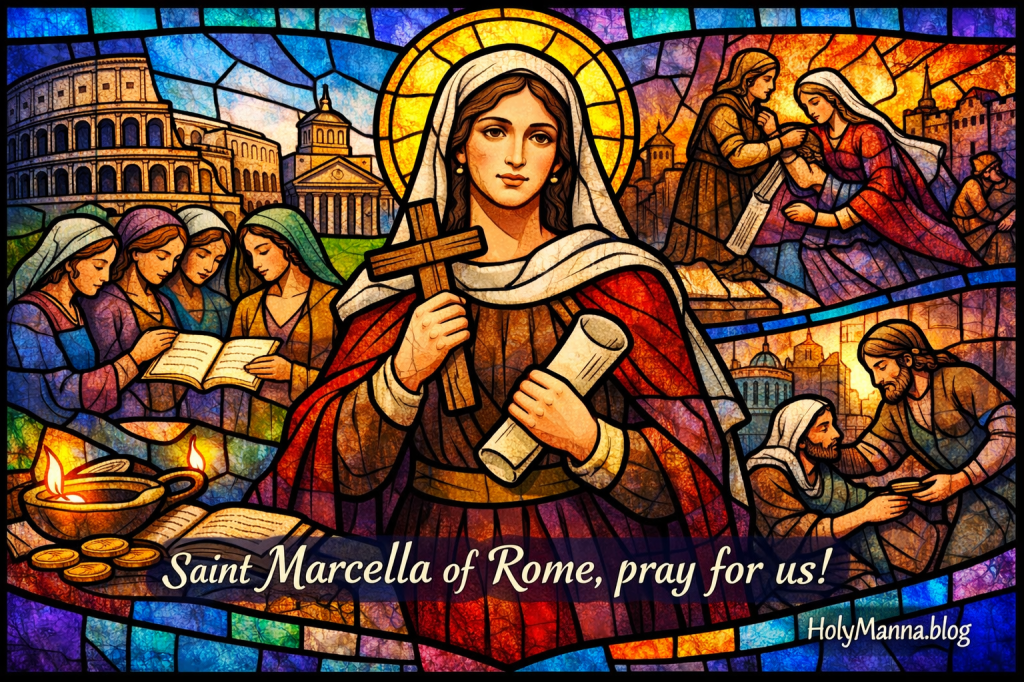
Rome’s Hidden Giant of Holiness
Saint Marcella of Rome proves the Gospel can conquer a culture from the inside. She was born into the Roman aristocracy, surrounded by wealth, influence, and the kind of social expectations that could swallow a person whole. In that world, a noblewoman was expected to secure the family name, protect the family fortune, and stay in the center of the social current. Marcella did something that looked almost unthinkable to her peers. She chose Christ over comfort, prayer over prestige, and mercy over applause.
The Church remembers her because she helped make the Aventine Hill a place where women pursued serious holiness through Scripture, fasting, worship, and charity. She also stood firm when doctrinal confusion threatened the Church in Rome, and she endured the violence of the Sack of Rome with a heart trained by years of detachment and trust. Her story fits the Church’s constant teaching that every Christian is called to holiness, and that holiness is not a private mood. Holiness becomes a real life, shaped by truth and poured out in love, as The Catechism teaches about the universal call to sanctity and the works of mercy.
Seven Months Married
Marcella’s early life carried heavy loss. Her father died, leaving her an orphan, and she entered marriage only to become a widow after a very short time. In the Roman world, a young widow was expected to remarry quickly, especially if she belonged to the nobility. A powerful older nobleman named Cerealis pursued her seriously, and the match promised security and immense wealth. Even Marcella’s mother, Albina, favored the arrangement, most likely believing it would protect her daughter and strengthen the family’s future.
Marcella refused, and the words she spoke became famous because Saint Jerome preserved them. She answered with the kind of clarity that cuts through excuses: “Had I a wish to marry and not rather to dedicate myself to perpetual chastity, I should look for a husband and not for an inheritance.” When he tried to persuade her by claiming old men sometimes outlive young men, she replied with blunt realism: “A young man may indeed die early, but an old man cannot live long.” Her refusal was not contempt for marriage. It was a deliberate choice of a different vocation, a life devoted to Christ with an undivided heart.
Saint Jerome even compares her to the prophetess Anna in The Gospel of Luke, but he insists Marcella’s devotion is all the more striking because it is lived in the full light of the Cross. Grief did not harden her. Grief opened a door, and she walked through it into a life of prayer and sacrifice that helped shape the spiritual landscape of Rome.
The Aventine School of Faith
Marcella did not simply become more religious. She rebuilt her entire way of living. She learned about the spirit of Eastern monasticism as it spread through the Church, and she embraced that discipline in the heart of the city. Her household became a kind of training ground for holiness, where women could learn a serious Christian life without the noise of elite Roman society. This mattered because, at the time, the very idea of a noble Roman woman embracing an ascetical life could be mocked as foolish or treated as scandalous.
Marcella’s love for Scripture was not sentimental. It was disciplined and demanding. Saint Jerome describes her praying and singing lines from Psalm 119 and Psalm 1, including the conviction that the Word must be hidden in the heart so the soul does not fall into sin, and the belief that meditation is meant to be lived, not merely discussed. In her mind, obedience came first, and understanding followed. That is a deeply Catholic instinct, because the Church does not treat Scripture as a puzzle to solve but as God’s living word meant to shape the conscience.
Her asceticism was real but steady, not dramatic or performative. She fasted with moderation, abstained from meat, and used wine only when health required it. She avoided the social circles that could tempt her back into vanity, and she spent time in the basilicas of the apostles and martyrs, seeking quiet prayer where the heart could listen. She also practiced charity in a way that actually cost something. Saint Jerome says she refused even small luxuries and chose instead to pour her resources into the poor, living what The Catechism teaches about the works of mercy as a concrete expression of love.
A Woman Who Made Even Jerome Work for His Answers
One of the most revealing parts of Marcella’s life is her relationship with Saint Jerome. It shows that serious biblical formation is not reserved for clergy. Jerome admits that when he arrived in Rome, he tried to avoid the attention of noblewomen, but Marcella would not let him fade into the background. She pressed him, persistently and respectfully, to teach her the Scriptures, and Jerome openly praises her sharp mind and her desire for truth.
He says she never came without questions, and she did not accept shallow answers. She would challenge an explanation, not to show off, but to learn how to respond when others raised objections. That is the mindset of a true disciple, and it is also the mindset that keeps Catholics from being tossed around by every new idea that sounds clever but lacks the mind of the Church.
After Jerome left Rome, Marcella’s influence did not fade. Jerome says that when disputes arose about how Scripture should be understood, people went to Marcella for guidance. She remained humble and careful, often presenting answers as something learned from others so she would not appear to set herself above anyone. Jerome notes she acted this way partly out of reverence for Saint Paul’s warning in 1 Timothy 2:12, and partly out of prudence, because even priests consulted her about difficult passages. Her gifts were real, and her humility made them fruitful.
Obedience That Saved Her Soul
Marcella’s holiness was not only expressed through big decisions like refusing remarriage. It was also expressed through hidden sacrifices, especially in family life. Saint Jerome records a painful situation involving her mother, Albina, and the handling of family property. Marcella desired to give generously to the poor, but she also did not want to wound her mother’s heart or fracture family peace.
So she chose an unexpected path. Jerome indicates that Marcella surrendered valuables and ornaments and accepted financial loss rather than allow conflict to grow. It is the kind of story that exposes modern spiritual fantasies. Holiness does not always look like a dramatic victory. Sometimes holiness looks like patience, restraint, and humility, offered quietly for the sake of charity. That is a very Catholic form of self-denial, because it protects love, not ego.
When Monastic Life Was an Insult
Another part of Marcella’s legacy is cultural as much as personal. Saint Jerome notes that in her day, it was socially humiliating for a highborn Roman woman to publicly embrace a monastic style of life. The title and lifestyle could be treated as degrading, as if a woman were stepping down from civilization into weakness. Marcella did not care. She learned of the desert fathers and the discipline of the monastic life, and she embraced that spirit with courage.
Jerome connects her closely with other holy women of Rome, including Paula and her daughter Eustochium, and he says Eustochium was formed in Marcella’s “cell,” meaning in her spiritual household and discipline. He also speaks of Marcella’s sister Asella, consecrated from youth, who became a model of intense asceticism and eventually led the women of Marcella’s community on the Aventine. Over time, Jerome says, their example helped transform Rome’s spiritual imagination so deeply that monastic life began to be honored rather than ridiculed. Marcella’s life did not just save her own soul. It helped carve out a place for serious discipleship in the heart of the West.
The Courage to Defend the Faith
Marcella was a woman of prayer, but she was not naïve about spiritual warfare. Saint Jerome describes a season when doctrinal confusion surged in Rome, tied to the Origenist controversies and the circulation of disputed teachings. He says Marcella held back at first because she did not want to be driven by faction or party spirit. That restraint shows wisdom. At the same time, Jerome says she refused to remain silent when she recognized the faith of the Church was being endangered.
He credits her with courage and initiative. She gathered testimony, identified suspect writings, and insisted that those promoting confusion be held accountable. Jerome’s praise is strong, and he portrays her as a major force behind a victory for orthodoxy in the city. It is not the kind of story people expect from a saintly widow, but it makes perfect sense in Catholic life. Love for Christ includes love for truth. The saints do not defend doctrine because they enjoy arguments. They defend doctrine because souls are at stake.
The Day Rome Fell
Marcella’s final trial came with the Sack of Rome in 410, a moment that shattered the illusion of Roman invincibility. Saint Jerome’s account is heartbreaking. Soldiers entered Marcella’s home demanding gold. Marcella pointed to her coarse clothing and her simple way of life as proof that she had already given her wealth away. The soldiers did not believe her. They beat her with brutal violence, hoping pain would reveal hidden treasure.
In that moment, Marcella’s spiritual motherhood rose to the surface. Jerome says she pleaded not for herself but for her companion Principia, fearing what a young woman might suffer in the hands of violent men. He presents what followed as providence, saying that Christ softened their hearts. The soldiers escorted Marcella and Principia to the Basilica of Saint Paul, where they could find safety or at least a place to die in peace.
Jerome then describes a scene that sounds almost impossible unless a soul has been trained for years in faith. Marcella thanked God that the catastrophe had found her poor rather than making her poor. She rejoiced that Christ had provided her daily bread, and she embraced the words of The Book of Job as her own: “Naked came I out of my mother’s womb, and naked shall I return there: the Lord gave and the Lord has taken away; blessed be the name of the Lord.” After a few days, she died from the suffering she endured. Jerome adds that she made Principia the heir of her poverty, meaning the poor would still be cared for through her spiritual daughter. Marcella left no earthly fortune behind, but she left a living legacy of mercy.
A Saint Without Flashy Stories
When it comes to miracles, the strongest early Catholic testimony about Saint Marcella does not present her as a wonderworker in the usual sense. There is no reliable early catalog of spectacular healings attributed to her during life or through relics after death. Instead, her sanctity is shown through heroic virtue, deep biblical faith, doctrinal steadiness, and courageous charity. The Church has never needed flashy legends to recognize holiness. The saints often shine brightest through fidelity that lasts for decades.
Marcella’s remembrance in the Church’s calendar and tradition keeps her close to Catholic imagination, especially on her feast day, traditionally observed on January 31. Her continuing “miracle” is the transformation she helped spark in Rome. She helped prove that a laywoman, living in the heart of a powerful society, could live the Gospel with seriousness and shape the Church’s life through Scripture, prayer, and mercy.
Building a Little Aventine
Saint Marcella’s life feels painfully relevant because modern culture still pressures people to build identity on status, comfort, and approval. Marcella shows another path, and it is not complicated even if it is demanding. She chose a stable rhythm of prayer. She grounded her mind in Scripture, especially the Psalms. She practiced real detachment from luxury. She served the poor in a way that actually cost her something. She defended Catholic truth when confusion threatened to harm souls, and she did it without turning the faith into a partisan sport.
What would change if Scripture were treated not as inspiration only, but as truth that must be obeyed? Marcella believed understanding follows obedience, and that is a message the modern mind needs. Her example suggests practical steps that are simple but serious, like praying a Psalm daily, fasting in a prudent way appropriate to one’s state in life, giving alms consistently, and refusing the kind of social vanity that weakens the soul. Marcella also shows that faith is not only for calm days. Faith is for collapse days. The city fell, the world shook, and she still trusted God, because her heart had been trained to cling to Christ.
Engage with Us!
Share thoughts and reflections in the comments below.
- What expectations or pressures feel most “Roman” in the modern world, and how can Saint Marcella’s example help resist them with peace?
- What would it look like to treat Scripture the way Marcella did, not as inspiration only, but as truth that shapes daily decisions?
- Where is God inviting a deeper detachment from comfort, status, or money so that charity toward the poor becomes more real and consistent?
- When hardship strikes, what practical habits of prayer can help the heart say with trust, “The Lord gave and the Lord has taken away; blessed be the name of the Lord.”?
May Saint Marcella of Rome teach every heart to love the Word of God enough to live it, to love the poor enough to sacrifice for them, and to stay faithful when life feels unstable. May everything be done with the love and mercy Jesus taught, so that even hardship becomes a place where faith shines with steady hope.
Saint Marcella of Rome, pray for us!
Follow us on YouTube, Instagram and Facebook for more insights and reflections on living a faith-filled life.

 Holy Manna!
Leave a comment