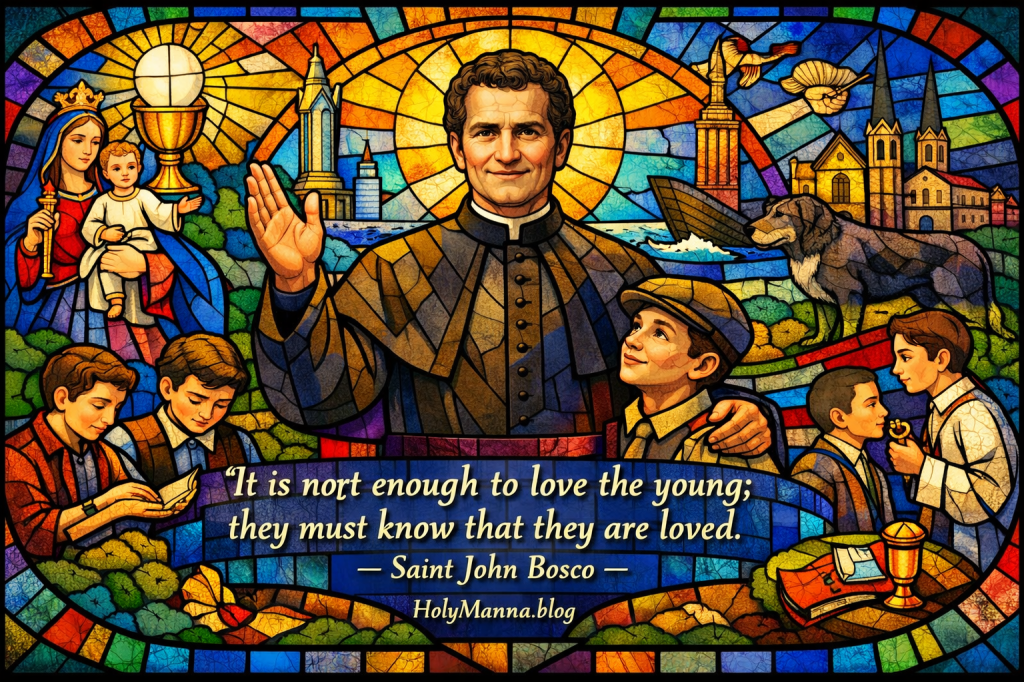
A Priest Who Refused to Lose the Young
Saint John Bosco, also known as Don Bosco, is one of those saints who makes Catholicism feel concrete and urgent. He did not build his legacy in comfort or prestige. He built it in crowded streets, noisy workshops, and rooms full of boys who had every reason to believe that nobody cared whether they became saints or became criminals. The Church reveres him because he proved that the Gospel can be lived in the real world, and that young people can be formed in holiness when they are surrounded by truth, fatherly love, and a sacramental life that is steady and strong.
His mission was not sentimental, and it was not naïve. It was intensely Catholic. He believed that grace heals and elevates nature, that virtue can be taught, and that the sacraments are not optional extras for spiritual people but the lifeline of the Christian life. This conviction fits perfectly with what The Catechism teaches about the dignity of the human person, the reality of sin, and the need for formation in virtue and faith, especially within the family and the community of the Church (CCC 2221–2231). Don Bosco is remembered because he lived all of that with sleeves rolled up and heart wide open, and because his work still shapes Catholic youth ministry across the world.
A Call That Would Not Let Go
John Bosco was born in 1815 in the countryside near Turin in northern Italy, and his early years were marked by hardship. His father died when John was still a child, which left the household vulnerable and forced his mother, Margherita, to carry the weight of raising her children with grit, faith, and steady moral clarity. That difficult beginning shaped his spiritual instincts. He learned early that life can be unfair, and that a child without a father needs more than food. A child needs love, guidance, discipline, and a home where faith is lived.
From childhood, Don Bosco’s life was also marked by a persistent sense of mission. Salesian tradition speaks about a formative dream from his youth that pointed him toward a vocation of gathering boys and leading them to Christ with patience and gentleness. Whether it was through that dream, through the harsh realities around him, or through the steady example of his mother, the direction became clear over time. He was meant to become a priest who would be a father to the fatherless, and a teacher to boys who had no one willing to invest in their souls.
He was ordained in 1841, and his priesthood quickly became defined by one burning priority: the salvation of souls, especially the souls of young people who were being swallowed up by poverty, sin, and neglect. He benefited early on from the guidance of Saint Joseph Cafasso, whose wise pastoral formation helped Don Bosco stay anchored in the Church while he worked in the messy margins of city life. This balance would become one of Don Bosco’s most recognizable strengths, because he never diluted Catholic truth, but he delivered it with charity that felt like fatherhood.
One of the best-known early moments in his mission took place on the Feast of the Immaculate Conception in 1841, when he encountered a poor young apprentice named Bartholomew Garelli. Don Bosco did not treat him like an interruption or a problem to solve. He treated him like a son, and that encounter is remembered as a spark that helped shape the Oratory, a home where boys could belong, pray, learn, and grow. Don Bosco’s life makes it hard to ignore a basic Catholic truth. Christ is often encountered through the way His priests, parents, and mentors choose to treat the ones the world overlooks.
Forming Boys into Men
Don Bosco’s Oratory eventually found stability at Valdocco, and what grew there was much more than a youth club. It became a full Catholic environment that combined prayer with play, catechism with companionship, and discipline with genuine affection. Don Bosco understood that boys do not become saints through lectures alone. They become saints through a life where the faith is lived, where adults are present, and where confession and the Eucharist are treated like the center of everything.
He encouraged frequent confession and frequent Holy Communion, not as a badge of pride, but as medicine for the soul. He trained boys to love the Mass, to pray with sincerity, and to rely on Our Lady as a real mother. His devotion to Mary, especially under the title Mary Help of Christians, was not a soft accessory to his work. It was a strategy of spiritual survival. He believed Mary protects the young, and he built his mission on that confidence by fostering Marian devotion and building a major basilica dedicated to her in Turin.
Don Bosco also understood that a hungry boy needs bread and a future. He worked hard to provide education and job training, and he pushed for apprenticeships that were not exploitative. He wanted boys to become honest workers, faithful Catholics, and responsible men, not temporary projects. In that sense, his mission was not only spiritual in content but also deeply incarnational. It recognized that real holiness takes root in real life, including work, discipline, and friendships that strengthen virtue.
One of the most compelling signs of Don Bosco’s impact is that he formed saints from the boys entrusted to him. Saint Dominic Savio stands as a striking example of youthful holiness nourished by confession, the Eucharist, and practical guidance in virtue. Don Bosco did not treat sanctity as something reserved for monks or mystics. He taught boys that holiness is possible in youth, in ordinary life, and in the daily struggle for purity and charity, especially when grace is received and lived.
As his mission grew, Don Bosco founded the Salesians, formally known as the Society of Saint Francis de Sales, so that this work would not end with his death. He later helped found the Daughters of Mary Help of Christians with Saint Mary Domenica Mazzarello, extending the same Catholic formation to girls and young women. He also established the Salesian Cooperators, a path for lay people to share in the mission, showing that this work belongs to the whole Church and not only to priests and religious.
His priorities are captured by the Salesian motto “Da mihi animas, caetera tolle.” This is commonly understood as “Give me souls, take away the rest,” and it explains why he could endure so much. Comfort was not his goal. Heaven was.
The Strengthening of a Mission
When people talk about miracles in Don Bosco’s life, it is important to speak carefully. The Church is sober in how it treats miraculous claims, and Don Bosco’s holiness does not depend on dramatic stories. Still, Salesian tradition preserves many accounts of extraordinary elements connected to his ministry, especially prophetic dreams that were shared to awaken conscience, encourage confession, warn against sin, and strengthen boys in virtue.
One famous dream often associated with his spiritual imagination is the vision sometimes called the two columns, where the Church is pictured like a ship under attack that finds safety when anchored between devotion to Jesus in the Eucharist and devotion to Mary. Even when such dreams are received as spiritual tradition rather than strict historical reporting, they reflect something unmistakably Catholic. The Church survives the storms of history by clinging to Christ and receiving Mary as a true mother.
There are also stories in Salesian memory about moments of protection when Don Bosco faced threats. Some accounts speak of a mysterious dog often called Grigio that appeared at key moments to defend him from danger and then vanished. These stories are best received with reverence and caution. They are typically presented as signs of providence rather than as facts that demand a certain kind of belief, and the most important point is the fruit of his life, which is visible and lasting.
The most consistent miracle in Don Bosco’s ministry was the transformation of souls. Boys who were drifting toward crime, impurity, and despair found confession, friendship, purpose, and faith. Don Bosco did not just rescue them from the street. He formed them into Catholics who could build families, live clean lives, and serve the Church. That kind of transformation is exactly what the Holy Spirit does when a shepherd cooperates with grace, and it remains the most persuasive sign of sanctity.
Don Bosco also understood that evangelization must be wise and personal. He used music, theatre, and wholesome entertainments to draw boys in, and then he steadily led them toward prayer and virtue. In a world that was happy to capture young minds for vice and cynicism, he chose to capture their hearts for Christ.
The Daily Cross of Charity
Don Bosco was not martyred by execution, but he endured a slow and steady martyrdom of daily charity. He lived in a time of political upheaval and growing hostility toward the Church, and he often faced suspicion, criticism, and misunderstanding even when his work was clearly aimed at saving souls and protecting youth. He had to fight for space, funding, and stability, and he often had to move his Oratory because secure places were hard to keep.
He also carried the relentless burden of spiritual fatherhood. A father suffers when his children suffer, and Don Bosco lived among boys who carried trauma, poverty, temptation, and loneliness. He dealt with fights, failures, and relapses into sin, and he endured the emotional weight of always being needed. He did not abandon boys when they became difficult. He stayed present, corrected them, and kept inviting them back to confession and the Eucharist, because he understood that conversion is often a process and not a single moment.
The weight of his mission demanded sacrifice. He was building schools, negotiating apprenticeships, guiding young vocations, writing for Catholic formation, and forming a religious congregation to continue the work. That kind of life requires constant surrender and a willingness to keep going even when exhaustion becomes familiar. His final years were marked by declining strength after decades of labor, and he died on January 31, 1888, having poured his life out in charity.
A Saint Still Working Today
After Don Bosco’s death, devotion spread quickly and the Salesian mission continued to expand. The Church beatified him in 1929 and canonized him in 1934, confirming the heroic virtue of his life and the enduring fruitfulness of his charism. In the process toward canonization, miracles attributed to his intercession were examined with the seriousness the Church requires, including a well-known healing associated with Caterina Lanfranchi Pilenga. Mentioning such a miracle is not meant to chase sensational stories. It is meant to remember that saints are alive in Christ and that the faithful can ask for their intercession with confidence.
His legacy after death has been immense. Salesian works spread through schools, parishes, youth centers, and technical training programs, and the Salesian Family includes priests, sisters, and lay faithful who share the same mission of bringing Christ to the young, especially the poor. The basilica dedicated to Mary Help of Christians in Turin remains a spiritual heart of this mission, and Don Bosco’s relics have been venerated as signs of communion with a saint whose life still bears fruit.
Don Bosco also had a significant cultural impact through Catholic publishing. He believed that the faithful needed accessible, faithful Catholic material, and he used writing and printing as a form of evangelization and protection. That commitment to the “good press” remains a powerful reminder that Catholics cannot ignore the formation of minds and imaginations. The Church celebrates his memorial on January 31, and across the Catholic world his feast becomes a rallying point for praying for youth, for holy educators, and for strong vocations.
Building an Oratory in Ordinary Life
Don Bosco’s life removes excuses. It is easy to complain that the culture is falling apart and that young people are getting worse. Don Bosco shows what a Catholic response looks like when it is rooted in love and truth together. It looks like presence that does not abandon. It looks like discipline that does not humiliate. It looks like warmth that does not compromise virtue. It looks like a sacramental life that is steady and strong.
A practical way to apply his example is to build an oratory wherever life happens. A home becomes an oratory when prayer is normal, Sunday Mass is protected, confession is treated like a gift, and joy is kept clean and ordered to God. A classroom becomes an oratory when students are treated as persons with souls, not as numbers. A parish becomes an oratory when young people are not treated like a nuisance but like the future of the Church, and when adults are willing to mentor, teach, and invite them into real friendship grounded in Christ.
Don Bosco also teaches that love must be felt, not just claimed. His famous line captures this pastoral wisdom with clarity: “It is not enough to love the young; they must know that they are loved.” That reflects a deeply Christian truth. Christ does not save from a distance. He draws near. When Catholics imitate that closeness with patience and clarity, young people begin to believe that God is not a theory but a Father.
Where are the young people in daily life that need a steady Catholic presence more than they need another lecture?
What would change if joy and holiness stopped being treated like enemies?
What would happen if confession and the Eucharist became the real center of a young person’s weekly rhythm?
Engage with Us!
Readers are invited to share thoughts and reflections in the comments below.
- Who was a “Don Bosco” figure in life, someone who helped faith grow through patience and real friendship?
- What is one practical way to make the home more like an “oratory” this week through prayer, good conversation, and clean joy?
- How can confession and the Eucharist become more central, not only for personal life, but also for the people being mentored or influenced?
- What is one concrete act of encouragement that can be offered to a young person who feels overlooked or discouraged?
- Which virtue from Don Bosco’s life feels most needed right now: patience, joyful discipline, fatherly charity, or trust in Mary’s help?
May Saint John Bosco pray for every young person, every parent, every teacher, and every priest who is trying to build a Catholic life in a difficult time. Keep choosing faith over fear, keep choosing virtue over compromise, and keep doing everything with the love and mercy Jesus taught us.
Saint John Bosco, pray for us!
Follow us on YouTube, Instagram and Facebook for more insights and reflections on living a faith-filled life.

 Holy Manna!
Leave a comment