Memorial of Saint John Bosco, Priest – Lectionary: 322
When Mercy Exposes the Storm and Faith Finds Its Voice
Sometimes God’s mercy feels less like a warm blanket and more like a bright light switched on in a dark room. That is the shared heartbeat of today’s readings. The central theme is this: God loves enough to reveal the truth about sin, and God stays close enough to calm the fear that truth can stir up. 2 Samuel 12:1-7, 10-17 shows a king confronted, not to be crushed, but to be converted. Psalm 51:12-17 gives the Church the words to pray when repentance stops being an idea and becomes a surrender. Mark 4:35-41 reveals the Lord who is not threatened by chaos, and who asks His disciples for faith rather than panic. Together, these passages teach that the path back to peace is not denial, but confession, humility, and trust in the presence of Christ.
There is important background behind this unity. David is not a random sinner in the crowd. He is the anointed king of Israel, the covenant leader whose choices ripple through the whole people. In the ancient world, a king’s sin was never private because his authority carried a spiritual and social weight that shaped the nation. That is why God sends Nathan, not as a political critic, but as a prophet. The prophet’s job is to speak God’s truth so that the covenant can be restored. When David finally says “I have sinned against the Lord”, the door opens to mercy, but it does not erase the real wounds sin leaves behind. That same realism shows up in the Church’s penitential prayer, Psalm 51, where the deepest request is not public reputation but interior re-creation, as David pleads, “A clean heart create for me, God”.
Then the Gospel brings that interior drama onto the sea. The disciples face a storm that feels like death, and their fear turns into a hard question for Jesus, “Teacher, do you not care that we are perishing?”. That line sounds ancient, but it is painfully modern, because fear still tries to convince hearts that God is absent. Jesus answers by commanding creation itself, “Quiet! Be still!”, and then He presses the deeper issue, “Do you not yet have faith?”. That is the bridge between all three readings. God does not expose sin to shame a soul, and God does not allow storms to mock a soul. God exposes what needs healing and then calls for the faith that receives healing. With the Memorial of Saint John Bosco, the Church quietly adds a living reminder that this mercy is meant to form real people, especially the young, into steady disciples who learn to repent quickly, trust deeply, and walk in peace even when the wind is loud.
First Reading – 2 Samuel 12:1-7, 10-17
When God’s Mercy Starts the Healing
Today’s first reading lands like a spiritual wake-up call. King David has already fallen hard through adultery and the arranged death of Uriah, and the danger now is not only the sin itself, but the self-deception that can settle in afterward. In the ancient world, a king’s choices were never “private,” because the king’s life shaped the moral and spiritual tone of the whole people. That is why the Lord sends Nathan, not as a political opponent, but as a prophet, a man charged with speaking God’s truth to protect the covenant. This reading fits today’s theme because it shows how God’s mercy exposes what is hidden, not to humiliate, but to bring a sinner back into the light where real peace becomes possible.
2 Samuel 12:1-7, 10-17 – New American Bible (Revised Edition)
Nathan’s Parable. 1 The Lord sent Nathan to David, and when he came to him, he said: “Tell me how you judge this case: In a certain town there were two men, one rich, the other poor. 2 The rich man had flocks and herds in great numbers. 3 But the poor man had nothing at all except one little ewe lamb that he had bought. He nourished her, and she grew up with him and his children. Of what little he had she ate; from his own cup she drank; in his bosom she slept; she was like a daughter to him. 4 Now, a visitor came to the rich man, but he spared his own flocks and herds to prepare a meal for the traveler who had come to him: he took the poor man’s ewe lamb and prepared it for the one who had come to him.” 5 David grew very angry with that man and said to Nathan: “As the Lord lives, the man who has done this deserves death! 6 He shall make fourfold restitution for the lamb because he has done this and was unsparing.” 7 Then Nathan said to David: “You are the man!
Nathan’s Indictment. “Thus says the Lord God of Israel: I anointed you king over Israel. I delivered you from the hand of Saul.
10 Now, therefore, the sword shall never depart from your house, because you have despised me and have taken the wife of Uriah the Hittite to be your wife. 11 Thus says the Lord: I will bring evil upon you out of your own house. I will take your wives before your very eyes, and will give them to your neighbor: he shall lie with your wives in broad daylight. 12 You have acted in secret, but I will do this in the presence of all Israel, in the presence of the sun itself.”
David’s Repentance. 13 Then David said to Nathan, “I have sinned against the Lord.” Nathan answered David: “For his part, the Lord has removed your sin. You shall not die, 14 but since you have utterly spurned the Lord by this deed, the child born to you will surely die.” 15 Then Nathan returned to his house.
The Lord struck the child that the wife of Uriah had borne to David, and it became desperately ill. 16 David pleaded with God on behalf of the child. He kept a total fast, and spent the night lying on the ground clothed in sackcloth. 17 The elders of his house stood beside him to get him to rise from the ground; but he would not, nor would he take food with them.
Detailed Exegesis
Verse 1: “The Lord sent Nathan to David, and when he came to him, he said: ‘Tell me how you judge this case: In a certain town there were two men, one rich, the other poor.’”
Nathan begins with a story because a hardened conscience often cannot hear a direct accusation. God’s mercy is already at work here, because David is still being pursued rather than abandoned. The prophet invites David to judge a “case” so David’s moral clarity can be exposed, and then turned inward.
Verse 2: “The rich man had flocks and herds in great numbers.”
This verse highlights excess and power. The rich man has every option available, which makes his eventual theft purely a choice, not a need. Sin often works the same way, because it is frequently not driven by necessity, but by entitlement.
Verse 3: “But the poor man had nothing at all except one little ewe lamb that he had bought. He nourished her, and she grew up with him and his children. Of what little he had she ate; from his own cup she drank; in his bosom she slept; she was like a daughter to him.”
Nathan makes the lamb personal and beloved, not just property. This is meant to awaken the heart, because David’s real crime was not only breaking a rule, but treating a person like an object. Sin always dehumanizes, first in the imagination and then in action.
Verse 4: “Now, a visitor came to the rich man, but he spared his own flocks and herds to prepare a meal for the traveler who had come to him: he took the poor man’s ewe lamb and prepared it for the one who had come to him.”
The rich man commits injustice while protecting his own comfort. The “visitor” becomes an excuse, which is a familiar tactic of sin: a convenient rationale that hides a selfish choice. David’s own pattern is being described without naming him yet.
Verse 5: “David grew very angry with that man and said to Nathan: ‘As the Lord lives, the man who has done this deserves death!’”
David’s anger shows that his conscience is still alive. The tragedy is that he can clearly see the evil in the parable while remaining blind to the same evil in his own actions. This is a warning for any disciple who can spot everyone else’s sins with perfect vision but cannot face his own.
Verse 6: “He shall make fourfold restitution for the lamb because he has done this and was unsparing.”
David’s sentence echoes the logic of justice found in Israel’s law regarding restitution. Even when God forgives, justice and reparation still matter, because love takes responsibility for the damage done. This sets up a key Catholic point: mercy does not cancel truth, and forgiveness does not pretend harm never happened.
Verse 7: “Then Nathan said to David: ‘You are the man!’”
This is the moment the mask falls. God’s word pierces David’s self-deception and forces reality into the open. Mercy sometimes sounds like this, because God would rather wound pride than lose a soul.
Verse 10: “Now, therefore, the sword shall never depart from your house, because you have despised me and have taken the wife of Uriah the Hittite to be your wife.”
Nathan names consequences that will ripple through David’s family. This is not God being petty. This is God revealing what sin naturally unleashes: disorder, division, and long shadows that touch others.
Verse 11: “Thus says the Lord: I will bring evil upon you out of your own house. I will take your wives before your very eyes, and will give them to your neighbor: he shall lie with your wives in broad daylight.”
The public nature of the consequence mirrors the secret nature of the sin. David used secrecy to cover evil, and now that cover will be torn away. Scripture is showing a principle that remains true: hidden sin does not stay hidden forever, and when it surfaces, it often brings wider pain than expected.
Verse 12: “You have acted in secret, but I will do this in the presence of all Israel, in the presence of the sun itself.”
This verse intensifies the contrast between private vice and public fallout. Sin loves darkness, but God brings truth into the light for the sake of healing. In a Catholic key, this points toward the honesty required for repentance, because grace is not given to the false self, but to the true self.
Verse 13: “Then David said to Nathan, ‘I have sinned against the Lord.’ Nathan answered David: ‘For his part, the Lord has removed your sin. You shall not die,’”
David’s confession is simple, direct, and unprotected. This is the hinge of the entire story, because repentance is not a mood, it is a surrender to truth. God’s forgiveness is real and immediate, and it shows that the goal is restoration, not destruction.
Verse 14: “‘but since you have utterly spurned the Lord by this deed, the child born to you will surely die.’”
This is one of the hardest verses in the Old Testament to hear. It must be read with sobriety: sin has real consequences that spread beyond the sinner, and Scripture refuses to romanticize that. At the same time, the text never calls David unforgiven here; it shows that forgiveness and consequences can coexist, because healing often includes painful purification and the rebuilding of what sin has shattered.
Verse 15: “Then Nathan returned to his house.”
Nathan exits because the word has been delivered. Now David must respond, not with arguments, but with repentance. God’s messenger leaves, but God’s mercy remains present in the call to conversion.
Verse 16: “The Lord struck the child that the wife of Uriah had borne to David, and it became desperately ill. David pleaded with God on behalf of the child. He kept a total fast, and spent the night lying on the ground clothed in sackcloth.”
David responds with intercession, fasting, and humility. His posture is bodily because repentance is never only mental in Scripture. This also reveals something deeply Catholic: prayer and penance are not theater, they are an embodied turning back to God.
Verse 17: “The elders of his house stood beside him to get him to rise from the ground; but he would not, nor would he take food with them.”
David refuses comfort because he knows this is not a time for distraction. He is learning to sit in the truth and cling to God rather than manage appearances. Repentance often requires this kind of holy seriousness, especially when the damage done is real.
Teachings
This reading is a masterclass in how God saves sinners. God does not ignore evil, because ignoring evil would mean abandoning the victim and abandoning the sinner to decay. Instead, God sends truth through Nathan, and that truth creates the possibility of real repentance. David’s words, “I have sinned against the Lord”, show what the Church means by contrition, because it is not self-pity and it is not vague regret. The Catechism puts it with precision in CCC 1451: “Contrition is sorrow of the soul and detestation for the sin committed, together with the resolution not to sin again.”
This passage also clarifies a truth that modern people often resist: forgiveness is not the same thing as erasing consequences. God’s mercy removes David’s guilt, but David’s choices still release disorder into his household. That is why Catholic life holds together both forgiveness and reparation. A real turning back to God includes owning what was done, making amends where possible, and accepting the purifying road that follows. This reading is one reason the Church takes confession seriously, because confession is not about being “a good person,” but about living in truth before God so grace can rebuild what sin has damaged.
Finally, David’s fasting and sackcloth remind Catholics that repentance has a body. The heart turns, and the life turns with it. That is why the Church pairs confession with penance, prayer, and acts of reparation, not to “earn” forgiveness, but to cooperate with healing. This is also where Saint John Bosco fits the day beautifully, because he trained souls, especially young souls, to stop hiding, tell the truth in confession, and start again with joy.
Reflection
This reading challenges a common habit: the temptation to get loud about other people’s sins while staying silent about personal sin. David can spot injustice with sharp clarity when it is someone else doing it, but God wants that same clarity applied inward, because honesty is the doorway to freedom. One practical step is to ask for the grace to stop excusing what is already known to be wrong, and then to name it plainly in prayer, using David’s own language, “I have sinned against the Lord.” Another practical step is to make repentance concrete by repairing what can be repaired, apologizing where an apology is owed, and cutting off the patterns that keep feeding the same sin.
This reading also speaks to anyone who fears consequences and therefore avoids confession. God’s mercy is not fragile, and it does not depend on perfect circumstances. It depends on humble truth. When the heart finally stops performing and starts repenting, God’s forgiveness becomes a real lifeline, even if the road of healing still includes hard moments.
Where has anger at someone else’s wrongdoing become a distraction from the need for personal conversion?
What would change if the conscience stopped negotiating and started speaking honestly to God this week?
Is there a concrete act of reparation that needs to happen, not to impress anyone, but to begin healing what sin has harmed?
What fear is keeping repentance at a distance, and what would it look like to bring that fear into the light and surrender it to the Lord?
Responsorial Psalm – Psalm 51:12-17
The Prayer God Loves to Hear
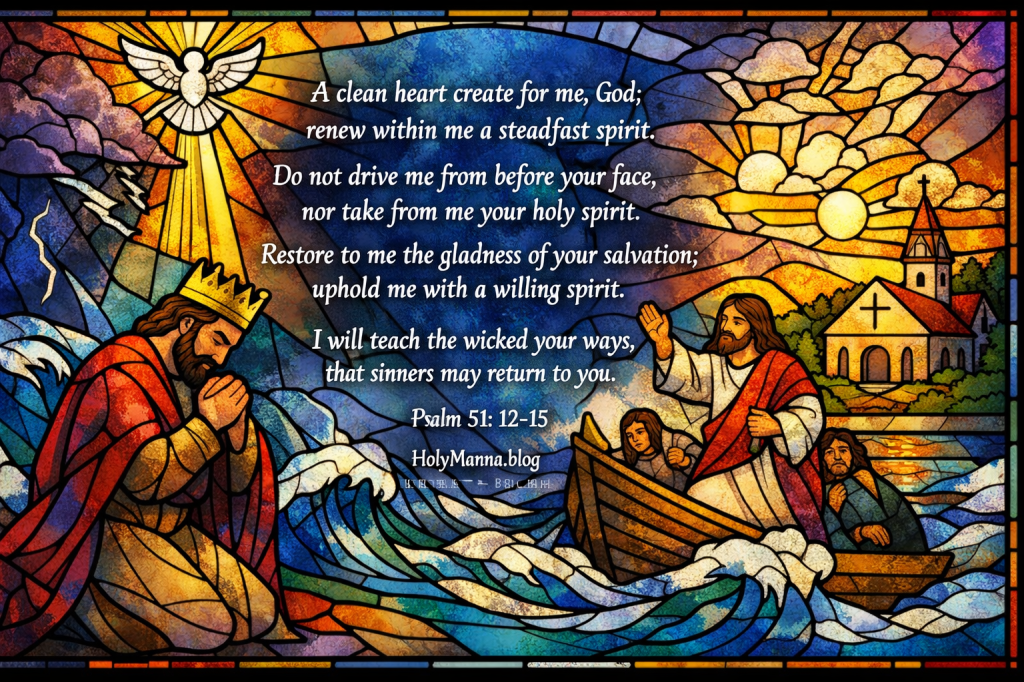
Psalm 51 is the Church’s most familiar penitential psalm, and it is traditionally tied to David’s repentance after Nathan’s confrontation. In Israel’s worship, the psalms were not private journal entries. They were sung prayer, forming the people’s conscience and teaching them how to approach the Lord with reverence, honesty, and hope. That is why this psalm fits perfectly into today’s theme. When God’s mercy exposes sin, the next question is simple: What does repentance sound like? Psalm 51 answers with a prayer that asks for more than a clean record. It asks for a clean heart, a renewed spirit, and a restored relationship with God.
Psalm 51:12-17 – New American Bible (Revised Edition)
12 A clean heart create for me, God;
renew within me a steadfast spirit.
13 Do not drive me from before your face,
nor take from me your holy spirit.
14 Restore to me the gladness of your salvation;
uphold me with a willing spirit.
15 I will teach the wicked your ways,
that sinners may return to you.
16 Rescue me from violent bloodshed, God, my saving God,
and my tongue will sing joyfully of your justice.
17 Lord, you will open my lips;
and my mouth will proclaim your praise.
Detailed Exegesis
Verse 12: “A clean heart create for me, God; renew within me a steadfast spirit.”
David does not ask for a fresh start through sheer willpower. He asks God to “create,” which is a strong word that points to divine action, like God’s creative work at the beginning. A “clean heart” in biblical language is not just clean behavior. It is an interior center restored to truth, love, and right worship. A “steadfast spirit” is the opposite of instability, excuses, and emotional chaos. It is the grace to stay faithful even when temptation or shame hits hard.
Verse 13: “Do not drive me from before your face, nor take from me your holy spirit.”
This is the cry of someone who realizes sin is not only breaking a rule, but risking communion with God. To be “before your face” means living in God’s presence without hiding. The mention of the “holy spirit” reflects an Old Testament awareness that God’s Spirit is a gift that can be resisted and grieved. This verse teaches holy fear, not panic. It is the fear of losing intimacy with God through stubbornness.
Verse 14: “Restore to me the gladness of your salvation; uphold me with a willing spirit.”
Sin steals joy and replaces it with counterfeit pleasure, numbness, or anxiety. David asks for gladness to be restored, which means he is not content with mere survival or avoidance of punishment. He wants communion again. The “willing spirit” is the grace to choose the good freely, not like a slave, but like a son who actually wants what the Father wants.
Verse 15: “I will teach the wicked your ways, that sinners may return to you.”
Repentance does not terminate in self-focus. When God heals a sinner, the healed sinner becomes a witness. David promises to teach, not as a performer showing off, but as someone who has been rescued and wants others rescued too. This verse hints at a missionary dimension of mercy: forgiven people become instruments of conversion.
Verse 16: “Rescue me from violent bloodshed, God, my saving God, and my tongue will sing joyfully of your justice.”
David names the gravity of what happened. His sin is not merely personal weakness. It spilled into violence and death. He begs to be rescued, which shows that guilt and shame can imprison, but God can liberate. When mercy is received, the tongue that once may have lied or manipulated can become a tongue that praises God’s justice, meaning God’s faithful rightness in setting things straight.
Verse 17: “Lord, you will open my lips; and my mouth will proclaim your praise.”
This verse is often used at the start of the Church’s daily prayer, because it admits a deep truth: praise itself is grace. Even prayer is not something the sinner can take for granted. God opens lips that have been shut by fear, pride, or despair. The goal of repentance is not endless self-hatred. The goal is restored worship.
Teachings
This psalm is one of the clearest biblical witnesses to what the Church means by interior conversion. It is not image management. It is a God-given renewal at the center of the person. The Catechism describes this kind of conversion in CCC 1431: “Interior repentance is a radical reorientation of our whole life, a return, a conversion to God with all our heart, an end of sin, a turning away from evil, with repugnance toward the evil actions we have committed. At the same time it entails the desire and resolution to change one’s life, with hope in God’s mercy and trust in the help of his grace.”
This psalm also shows why Catholic repentance is never only “between me and God” in a vague way. God restores the heart so the person can worship rightly and live rightly. That is why the Church teaches that conversion expresses itself through concrete practices like confession, penance, and a changed life. The Catechism emphasizes that conversion is carried by visible and real acts, not just feelings, in CCC 1430: “Jesus’ call to conversion and penance, like that of the prophets before him, does not aim first at outward works, ‘sackcloth and ashes,’ fasting and mortification, but at the conversion of the heart, interior conversion. Without this, such penances remain sterile and false; however, interior conversion urges expression in visible signs, gestures and works of penance.”
Historically and liturgically, Psalm 51 has shaped Christian prayer for centuries because it refuses two lies at the same time. It refuses the lie that sin is not serious, and it refuses the lie that mercy is not possible. It is the sober confidence of a sinner who knows God is holy and also knows God is saving. That is why the Church keeps putting these words on the lips of the faithful, especially when the readings expose the truth as sharply as Nathan did.
Reflection
This psalm gives a simple and strong plan for daily Catholic life. It teaches that repentance begins by asking God for what cannot be manufactured. A clean heart is not a self-improvement project. It is a gift. That is why a practical habit is to pray this psalm slowly, even in a single verse, when temptation hits or after a fall. The point is not to spiral into shame, but to turn quickly toward God with honest words. Another practical step is to stop treating joy as a reward for perfect performance. David asks for joy to be restored because salvation is God’s work, and a forgiven heart can breathe again.
This psalm also challenges the common habit of vague apology. It models clear prayer. It names what is needed, it asks boldly, and it trusts God to act. It also invites a shift from private regret to outward praise, because the end of repentance is not self-obsession. The end is worship, gratitude, and a new steadiness of life that looks like someone who belongs to God.
Is the heart asking God to create something new, or is it still trying to manage sin with excuses and willpower alone?
What steals the gladness of salvation most often, and what would change if that loss became a prompt to pray instead of a prompt to escape?
Is there a pattern of silence in prayer that really comes from shame, and what would it look like to ask the Lord, “You will open my lips”, and begin again with simplicity?
Who needs to see that God can restore a sinner, not because the sinner is impressive, but because the Lord is merciful and faithful?
Holy Gospel – Mark 4:35-41
When the Lord Seems Asleep
This Gospel takes place after a long day of preaching, when Jesus invites the disciples to cross to the other side of the sea. For first-century Jews, the sea was not just scenery. It often symbolized chaos, danger, and forces beyond human control. Fishermen knew storms could rise fast on the Sea of Galilee, especially when wind funneled down from surrounding heights. So when Mark describes waves breaking over the boat, the scene is not romantic. It is life-threatening. This fits perfectly with today’s theme because the disciples face an external storm while David and Psalm 51 expose an internal storm. In both cases, the Lord brings truth and peace. He reveals what is in the heart, and He reveals who He is. The question underneath the whole passage is the same question that rises in any crisis: Does God care, and can He be trusted when fear is loud?
Mark 4:35-41 – New American Bible (Revised Edition)
The Calming of a Storm at Sea. 35 On that day, as evening drew on, he said to them, “Let us cross to the other side.” 36 Leaving the crowd, they took him with them in the boat just as he was. And other boats were with him. 37 A violent squall came up and waves were breaking over the boat, so that it was already filling up. 38 Jesus was in the stern, asleep on a cushion. They woke him and said to him, “Teacher, do you not care that we are perishing?” 39 He woke up, rebuked the wind, and said to the sea, “Quiet! Be still!” The wind ceased and there was great calm. 40 Then he asked them, “Why are you terrified? Do you not yet have faith?” 41 They were filled with great awe and said to one another, “Who then is this whom even wind and sea obey?”
Detailed Exegesis
Verse 35: “On that day, as evening drew on, he said to them, ‘Let us cross to the other side.’”
Jesus initiates the crossing. This is important because it means the disciples are not in the storm because they disobeyed. Sometimes storms happen while doing exactly what the Lord asks. Evening also signals vulnerability, because darkness amplifies fear and limits human control.
Verse 36: “Leaving the crowd, they took him with them in the boat just as he was. And other boats were with him.”
The disciples take Jesus “just as he was,” suggesting no delay and no special preparation. The presence of other boats reminds readers that Jesus’ mission is not private. The Church will later cross seas, literal and spiritual, and others will be watching how disciples respond when trouble hits.
Verse 37: “A violent squall came up and waves were breaking over the boat, so that it was already filling up.”
Mark emphasizes danger. The boat is not gently rocking. It is taking on water. This is the moment when human competence stops being enough. Catholic faith never denies reality. It faces the reality, and then brings that reality to Jesus.
Verse 38: “Jesus was in the stern, asleep on a cushion. They woke him and said to him, ‘Teacher, do you not care that we are perishing?’”
Jesus sleeping is shocking. It reveals His true humanity, because He is tired, and it also tests the disciples’ trust. Their question is honest but accusatory. Fear pushes them to interpret His silence as indifference. This is a common spiritual temptation: when God feels quiet, the heart assumes God does not care.
Verse 39: “He woke up, rebuked the wind, and said to the sea, ‘Quiet! Be still!’ The wind ceased and there was great calm.”
Jesus does not negotiate with nature. He commands it. In Scripture, only God has authority over the waters, which often represent chaos. The rebuke is more than weather control. It is revelation. Jesus is showing that the Creator is present. The calm is immediate and complete, which points to divine authority rather than good luck.
Verse 40: “Then he asked them, ‘Why are you terrified? Do you not yet have faith?’”
Jesus corrects fear, not because fear is a moral failure in itself, but because fear can choke faith. The question “not yet” suggests faith is meant to grow through these moments. The disciples have seen His power in teaching and healing, but they have not fully trusted His identity and presence.
Verse 41: “They were filled with great awe and said to one another, ‘Who then is this whom even wind and sea obey?’”
Their fear shifts into awe, which is closer to worship. They finally ask the right question. The point is not simply that Jesus can do impressive things. The point is that He is not merely a teacher. He is Lord. This verse sets up the deeper journey of discipleship in Mark’s Gospel, where the disciples keep learning who Jesus is and what it means to trust Him.
Teachings
This passage reveals Christ’s divinity without using abstract arguments. Jesus does what the God of Israel does in the Old Testament, because He commands the sea and brings peace to chaos. The Church teaches that Jesus’ miracles are not random displays of power. They are signs that reveal the Kingdom and reveal His identity. The Catechism states in CCC 547: “Jesus accompanies his words with many ‘mighty works and wonders and signs’, which manifest that the kingdom is present in him and attest that he was the promised Messiah.”
This Gospel also gives a strong Catholic lesson about faith. Faith is not optimism, and it is not pretending danger is not real. Faith is trust in a Person, especially when circumstances look hostile. The disciples’ problem is not that they wake Jesus. Bringing needs to God is right. The problem is the accusation, “Do you not care?”, as if the Lord’s love can be measured only by immediate comfort. This is why the Church teaches that faith is a gift that calls for a human response. The Catechism says in CCC 153: “Faith is a gift of God, a supernatural virtue infused by him. ‘Before this faith can be exercised, man must have the grace of God to move and assist him; he must have the interior helps of the Holy Spirit, who moves the heart and converts it to God, who opens the eyes of the mind and gives “to everyone joy and ease in accepting and believing the truth.”’”
In light of today’s other readings, this Gospel completes the picture. 2 Samuel 12 shows God exposing sin so the heart can stop hiding. Psalm 51 gives the words of repentance. Mark 4 shows that after truth is faced, the next step is trust. God does not only forgive. God also steadies the heart. The Lord who confronts David through Nathan is the same Lord who confronts the disciples’ fear. He is not trying to crush them. He is trying to make them men of faith.
Reflection
This Gospel is for anyone who feels like life is taking on water. It speaks to the chaos of family stress, financial pressure, temptation, grief, anxiety, and the quiet dread that can hit late at night when everything feels heavier. The disciples show what people often do under pressure: they pray, but they pray with a knife in the words, as if God needs to be shamed into caring. Jesus responds with power and mercy, but He also asks for maturity in faith. He calls disciples to move from panic to trust.
A practical way to live this is to change the way prayer sounds during storms. Instead of, “Do you not care?”, prayer can become, “Lord, help faith grow right now, because fear is getting loud.” Another step is to remember that obedience does not guarantee comfort. Jesus told them to cross, and the storm still came. That means hardship is not automatic proof of failure. Sometimes the storm is the classroom where faith finally becomes real. It is also worth remembering that the Lord being asleep does not mean the Lord being absent. It means the disciples are being invited to trust His presence more than their feelings.
When life feels unstable, does prayer sound like trust, or does it sound like an accusation dressed up as prayer?
What storm is most likely to make fear take the wheel, and what would change if that storm became a prompt to cling to Christ instead of spiraling?
Is there a hidden interior storm, like guilt or shame, that needs the honesty of repentance so peace can actually settle in the heart?
What would it look like today to invite the Lord into the boat again, not as a last resort, but as the center of the journey?
Let Mercy Do Its Full Work
Today’s readings move like one unified story of conversion. The Lord first turns on the light in 2 Samuel 12:1-7, 10-17, where David learns that sin cannot be managed forever and that mercy sometimes arrives with a hard sentence: “You are the man!”. The point is not humiliation. The point is rescue. God exposes what is hidden so the heart can stop performing and start healing. Then the Church places Psalm 51:12-17 on the lips of every disciple as the right response to that exposure, because repentance is not vague regret. It is a pleading trust that says, “A clean heart create for me, God”, and it dares to ask for joy again, not because sin was small, but because God’s mercy is real. Finally, the Holy Gospel in Mark 4:35-41 shows what happens when fear surges and life feels like it is taking on water. Jesus does not only calm the sea. He confronts the deeper storm inside the disciples when He asks, “Why are you terrified? Do you not yet have faith?”. The Lord who reveals sin is the same Lord who restores peace, and He wants disciples who tell the truth, receive mercy, and then learn to trust Him when the wind gets loud.
This is the practical invitation for the day. Let the Lord name what needs to be named, because hidden sin and hidden fear both grow in the dark. Pray with the honesty of Psalm 51, because God can handle a real confession and He delights in rebuilding what sin has broken. Then bring every storm to Jesus without accusing Him of indifference, because His presence in the boat matters more than the size of the waves. Saint John Bosco’s memorial makes this even more concrete, because he proves that holiness is not reserved for perfect people. Holiness is for repentant people who keep returning to the Lord with humility, trust, and a willingness to start again.
Let today end with a clear decision. Choose one concrete act of repentance, even if it is simply bringing a hard truth into prayer without excuses. Choose one act of trust, even if it is simply replacing panic with a quiet surrender. Keep walking with the Church, because the Lord still speaks through His Word, still cleanses hearts, and still calms storms. What would change this week if the heart stopped hiding and started trusting that God’s mercy is stronger than sin and stronger than fear?
Engage with Us!
Readers are invited to share their reflections in the comments below, because God often uses someone else’s insight to confirm, challenge, or strengthen what He is doing in the heart. Here are a few questions for prayer and conversation that connect directly to each reading and help carry today’s message into real life.
- First Reading, 2 Samuel 12:1-7, 10-17: Where is it easiest to recognize wrongdoing in others while avoiding the honest words, “You are the man!”, spoken to the heart? What concrete step of repentance and reparation can be taken this week so conversion becomes real and not just emotional?
- Responsorial Psalm, Psalm 51:12-17: What would change if the heart prayed, “A clean heart create for me, God”, with patience and consistency each day, especially when shame or temptation shows up? Where is the Lord inviting trust that joy can be restored without pretending sin was small?
- Holy Gospel, Mark 4:35-41: When life feels like it is taking on water, does prayer sound more like trust or more like the accusation, “Do you not care that we are perishing?”? What would it look like to surrender the storm to Jesus and choose faith when fear tries to take the wheel?
Stay close to the Lord, speak the truth in prayer, and keep choosing repentance and trust like they matter, because they do. Let today’s Word shape tomorrow’s habits and let every decision be marked by the love and mercy Jesus taught, so faith becomes something lived with steadiness, courage, and joy.
Sacred Heart of Jesus, we trust in You!
Immaculate Heart of Mary, pray for us!
Saint Michael the Archangel, defend us in battle!
Follow us on YouTube, Instagram and Facebook for more insights and reflections on living a faith-filled life.

 Holy Manna!
Leave a comment