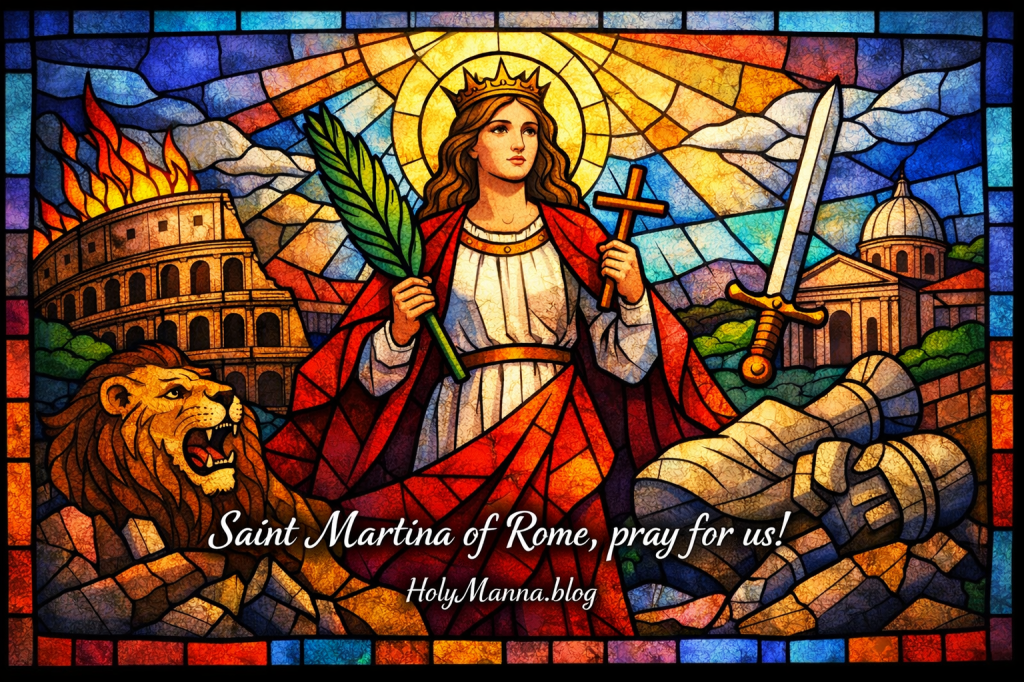
A Quiet Courage That Shook Rome
Saint Martina of Rome is honored by the Church as a virgin and martyr, and her feast is celebrated on January 30. Even though the Church does not preserve a detailed, historically reliable biography of her life, the Church does preserve something even more important: Martina’s name is held in public prayer, her veneration in Rome is ancient, and her witness is remembered as real. In the early Church, many martyrs were known locally long before anyone wrote polished narratives about them. Over time, later accounts sometimes added dramatic details meant to strengthen the faithful, and Catholic scholarship is honest about that.
This is why Saint Martina is such a powerful saint for modern Catholics. She teaches that holiness is not measured by how much personal backstory survives in history books. Holiness is measured by fidelity to Christ. Martina stands in that long line of Roman martyrs who prove what The Catechism teaches about the cost and glory of witness. “Martyrdom is the supreme witness given to the truth of the faith.” This is not a sentimental slogan. This is the Church speaking clearly about what the martyrs did with their lives.
There are no verified quotations preserved as Saint Martina’s own words. What is preserved is the Church’s voice praising her witness and teaching Rome how to honor her. A traditional hymn associated with her feast addresses the city directly, saying “Praise, O citizens of Rome, the illustrious name of Martina.” That line is not Martina speaking, but it shows how Rome learned to celebrate her as a daughter of the city and a daughter of the Church.
A Heart Given to Christ
Very little is known with certainty about Martina’s early years. Catholic tradition consistently places her in Rome and honors her as a consecrated virgin, but it does not give the kind of detailed family story people might hope for. Later devotional sources often describe her as coming from a noble household, yet this detail should be held lightly because the earliest reliable witness focuses on her title and her martyrdom rather than genealogy.
Even with limited details, the spiritual shape of her life is clear. Martina belonged to a Christian community that took baptism seriously and lived with real pressure from the surrounding culture. This was not casual religion that stayed safely indoors. Christians in Rome learned early how to resist the slow pull of compromise, and Martina’s “conversion” is best understood as a deepening commitment, a steady choice to live as if Jesus truly is Lord.
The title “virgin” is not about being fragile or sheltered. In the Church’s memory, consecrated virginity is a sign of total belonging, a public witness that the heart is made for God and will never be satisfied by idols. The Catechism speaks about consecrated life as a sign that points beyond the present age and reminds the world that Christ is worth everything. Martina’s identity as a virgin-martyr places her among saints who preached without microphones, using their choices and suffering to proclaim Christ.
A Faith That Outlives Empires
Saint Martina matters because she represents the spiritual backbone of Christian Rome. The Church does not venerate her because her story is dramatic or because every detail can be historically verified. The Church venerates her because she stood firm when it would have been easier to fold. Many traditional accounts describe her as generous to the poor, and that fits perfectly with the early Christian pattern in Rome, where love of neighbor flowed from love of God.
This is why Catholics should remember her today. The modern world constantly asks for little compromises and calls them “reasonable.” It calls them “normal.” Saint Martina challenges that language. A disciple of Christ does not negotiate with idols. A disciple of Christ learns to love God above everything and to love neighbor without fear, even when it costs comfort or popularity.
Martina also reminds Catholics that sanctity is not always loud. A saint can be almost invisible in the historical record and still be unforgettable in heaven. That truth is both humbling and freeing. It is humbling because it pulls ego out of the center. It is freeing because it shows that a faithful life, even when hidden, truly matters.
Signs of God’s Grace
Because the reliable historical record is brief, the miracle stories connected to Martina are largely preserved through later devotional tradition. These accounts commonly describe dramatic signs such as idols collapsing, temples shaking, and wild beasts refusing to harm her. Catholics can receive these stories as pious tradition that highlights God’s power and the saint’s steadfastness, while also remembering that not every vivid detail is historically verifiable in the strict modern sense.
Even so, these stories still teach something important. The Church has always told martyr stories in a way that forms courage in the faithful. The point is not entertainment. The point is conversion. These stories underline a theological truth: God is not absent when His people suffer, and creation itself remains under His authority.
The greatest miracle in a martyr’s story is often the one people forget to name. The greatest miracle is perseverance. The human heart does not naturally run toward suffering. Grace makes steadfast love possible. When a believer stands firm, it is not because of personality alone. It is because Christ strengthens the soul. Martina’s witness is proof that God can do powerful work in ordinary human beings who surrender to Him.
The Cost of Refusing the Idols
Saint Martina’s hardships follow the classic pattern of Roman persecution. She was pressured to offer worship to pagan gods, and she refused. Traditional narratives describe tortures and repeated attempts to break her resolve, yet the consistent Catholic memory is that she endured suffering for Christ and ultimately suffered death, commonly described as beheading. Some traditions connect her persecution to the time of Emperor Alexander Severus, though the exact historical circumstances are not preserved with certainty.
Martyrdom is not spiritual bravado. It is love that refuses to lie. Martina’s witness shows what happens when a Christian decides that truth is not negotiable. This matters today because modern life often treats religion as a private preference that should never affect public choices. The martyrs expose that as a falsehood. If Jesus is truly risen, then He is Lord of every part of life. If He is Lord, then worship belongs to Him alone.
This is where The Catechism gives clarity and comfort. “Martyrdom is the supreme witness given to the truth of the faith.” The martyrs did not love pain. They loved Christ more than fear. Martina’s death proclaims that eternity is real, that the human person is made for communion with God, and that even when the world looks strongest, it is still not God.
Rome Remembering Her Name
One of the most striking parts of Saint Martina’s legacy came long after her death. In 1634, relics identified with her were discovered, and her public veneration in Rome experienced a major renewal. This rediscovery helped restore her to the center of Roman devotion, and it became closely connected to the Church of Santi Luca e Martina near the Roman Forum. That church is not only a place of prayer. It also became associated with sacred art and the spiritual life of artists, which is a reminder that the Church evangelizes through beauty as well as preaching.
Devotional accounts also describe favors and healings connected to veneration of her relics after this rediscovery. Ancient saints do not usually have modern documentation in the way later canonizations do, so these accounts are best received as pious testimony rather than courtroom evidence. Still, the Catholic instinct here is solid and deeply traditional. The saints are alive in Christ and truly intercede. The Catechism teaches, “They do not cease to intercede with the Father for us.” This is not superstition. This is family life in the Church.
There is also a later tradition that connects Martina with nursing mothers, tied to an account that milk mingled with her blood at death. This detail belongs to later tradition, but it explains a real devotional pattern. Parents have long asked martyrs for courage, especially when daily life feels like a slow offering that demands patience and strength.
How to Live Saint Martina’s Courage
Saint Martina’s life is strong medicine for modern compromise. She reminds Catholics that faith is not a decorative label. Faith is a way of life. Her witness teaches that real freedom begins when worship is rightly ordered. When God is first, everything else finds its place. When something else is first, everything eventually collapses.
Martina also teaches a practical kind of courage. Most people will never face a public tribunal, but everyone faces private decisions and repeated temptations. Modern pressure often looks like social expectations, entertainment that normalizes sin, and a constant push to treat vice like it is harmless. Martina can be imitated by learning to say no quickly, by keeping a clean conscience, by going to Confession regularly, by guarding the eyes and the tongue, and by choosing truth even when it costs social comfort.
The communion of saints is also meant to be used, not merely admired. Asking a saint’s intercession is not strange. It is Catholic, and it is biblical in spirit because God loves to strengthen His people through His people. The Catechism teaches that the saints’ intercession continues, and their charity does not grow cold in heaven.
What would change if modern habits were treated like idols instead of harmless routines? How much peace could grow if the heart practiced steady fidelity in small things every day? Where is Christ calling for a clear decision instead of endless delay?
Engage with Us!
Share your thoughts and reflections in the comments below. Saint Martina’s story might be ancient, but it speaks straight into modern pressure, modern compromise, and modern fear.
- Where is the strongest pressure right now to go along to get along, even if it dulls the faith?
- What is one concrete idol that needs to be named and rejected this week, whether it is comfort, approval, lust, greed, or control?
- How can Saint Martina’s quiet courage be practiced in ordinary life, especially at home and at work?
- What is one simple way to lean into the communion of saints, such as asking for Martina’s intercession in a specific struggle?
Keep walking in faith and keep choosing the good when it costs something. Keep praying when it feels dry, because God is still working. Most of all, keep doing everything with the love and mercy Jesus taught, because that love is stronger than every idol and stronger than death.
Saint Martina of Rome, pray for us!
Follow us on YouTube, Instagram and Facebook for more insights and reflections on living a faith-filled life.

 Holy Manna!
Leave a comment