A Heart Remade by Grace
Saint Hyacintha Marescotti, also known as Giacinta Marescotti, is a saint who exposes a hard truth with a lot of hope. It is possible to be near holy things and still live for vanity, comfort, and approval. Her life also shows something even stronger. Jesus can step into a life that is spiritually lukewarm and make it burn with love, repentance, and mercy.
She is revered because her conversion was not a small adjustment. It became a total reorientation of her heart toward God and a steady offering of her life for others. After years of living like a noblewoman inside a monastery, she became known for deep penance, strong Eucharistic devotion, and organized charity to the poor, the sick, and those too ashamed to ask for help. Her story is a living example of what The Catechism teaches about conversion. It is not a mood or a phase. It is a real turning of the whole life back to God, and it bears fruit in concrete love.
When Pride Meets Mercy
Saint Hyacintha was born as Clarice Marescotti on March 16, 1585, in Vignanello near Viterbo, into a noble family. She received education and formation in a religious setting, yet her heart was still set on the kind of future her social world promised. She wanted a strong marriage and a respected position, and she carried herself with the confidence of nobility.
A painful humiliation marked her early adulthood when the man she desired, Marquis Capizucchi, married her younger sister, Ortensia. Catholic accounts describe this as a wound that fed resentment and pride. In 1605 her father sent her to the monastery of San Bernardino in Viterbo. There she took the name Giacinta, or Hyacintha, and entered religious life without yet surrendering her desire to live on her own terms.
For about fifteen years she lived a contradiction that feels very modern. She wore a religious name and lived in a monastery, but she clung to comforts and status. She maintained a lifestyle that looked more like a noble household than a life of poverty and humility. A remembered line captures her attitude with startling honesty: “Eccomi sono monaca ma voglio vivere da par mio.” | “Here I am, I am a nun, but I want to live my own way.” That line is uncomfortable because it reveals the temptation to keep the faith while keeping control.
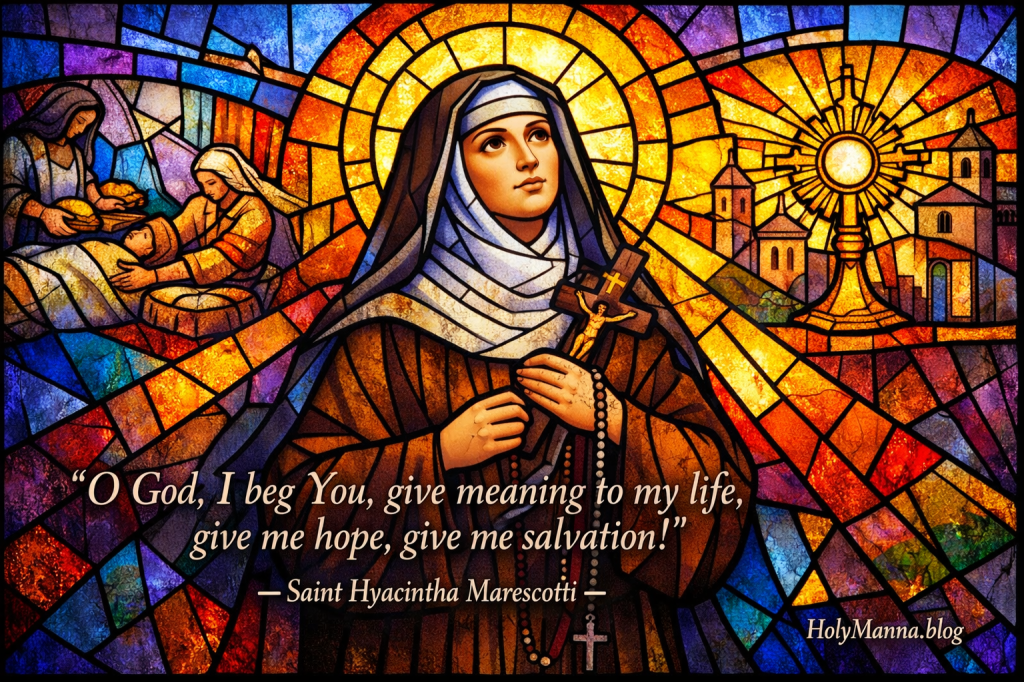
God used illness to break through that illusion. A serious sickness brought her face to face with mortality and the emptiness of vanity. Her conversion is remembered as a real surrender expressed in prayer. A prayer attributed to her captures the desperation that often accompanies true repentance: “O Dio, ti supplico, dai un senso alla mia vita, dammi la speranza, dammi la salvezza!” | “O God, I beg You, give meaning to my life, give me hope, give me salvation!” After she recovered, she publicly turned away from her former way of living, asked forgiveness, embraced humility, and dedicated the rest of her life to penance, prayer, and mercy.
This is deeply Catholic in its logic. The Catechism teaches that conversion is first the work of God’s grace and that interior repentance is a radical reorientation of the whole life toward Him. Her story makes that teaching concrete, because grace did not simply comfort her. Grace corrected her, healed her, and sent her into a new way of living.
Penance That Became Mercy
After her conversion, Saint Hyacintha’s life became a steady offering. Her penance was intense and her humility was unmistakable, but what stands out most is what those things produced. They produced mercy that took structure and consistency. Catholic life is never meant to stop at pious emotion. Real love of God spills into real love of neighbor, especially the neighbor who cannot repay.
In Viterbo she became strongly connected to works of mercy that served the sick and the poor, including those who were too ashamed to beg. She helped animate charitable efforts associated with the Sacconi, a group known for caring for the suffering and aiding those in distress, including prisoners and the hidden poor. She was also connected to works that cared for the elderly and abandoned. This kind of service is not glamorous. It is patient, repetitive, and often unseen, which is exactly why it looks like the love of Christ.
Her devotion to the Eucharist also shaped her legacy. She encouraged love for the Blessed Sacrament and a spirituality centered on worship and adoration, especially in an era when spiritual coldness could creep in under the appearance of strictness. The Church teaches that the Eucharist is the source and summit of the Christian life, and that authentic devotion to Jesus present in the Eucharist should shape the whole life. Her example shows how Eucharistic devotion becomes credible when it produces charity.
Catholic tradition also remembers her for extraordinary spiritual gifts and miracles during life, including mystical experiences such as ecstasies and a reputation for unusual insight into souls. The Church is careful with these accounts, but it also preserves them as signs that God was powerfully at work in her conversion and her mission. Even when the details of these gifts are not the center of her story, the fruit is unmistakable. She moved from vanity to humility, and from comfort to sacrificial love.
The Hidden Cross That Purified Her Love
Saint Hyacintha was not executed for the faith, but her life became a kind of living martyrdom through daily self-denial, obedience, and penance. The first hardship was interior. She had to face pride, resentment, and attachment to status. She had to accept the shame of years wasted and the scandal caused by living contrary to the spirit of religious life. That kind of repentance is not theoretical. It is painful, and it requires perseverance when excuses feel easier.
The second hardship was the austere discipline she embraced after conversion. Catholic sources describe her penances as severe, and her endurance became part of her reputation for holiness. In Catholic teaching, penance is not meant to glorify pain. It is meant to heal the heart, repair what sin damages, and train the will to love God above self. Still, this path involves real suffering, and she carried it with resolve.
Her life also reflects the Catholic understanding of redemptive suffering. The Christian does not chase suffering, but the Christian can unite it to Christ and allow it to purify the heart. Saint Hyacintha’s endurance shows that the cross can become a place of freedom when it is carried with repentance and love. Her transformation was not a quick burst of enthusiasm. It was a long obedience in the same direction, and that is one reason her witness remains credible.
Signs that God Works Through Her
Saint Hyacintha died on January 30, 1640, in Viterbo. After her death, devotion spread quickly. Catholic tradition records intense veneration at her wake, including the striking detail that her body had to be re-vested multiple times because people kept taking pieces of her clothing as relics. That intensity points to something simple. The people around her believed they had witnessed real holiness and they begged for her intercession.
Miracles were reported after her death through her intercession, including healings and signs of help in times of need. These reports belong to the broader Catholic tradition that eventually led to the Church formally recognizing her sanctity through beatification in 1726 and canonization in 1807. Her remains have been venerated in Viterbo, where her memory continues to be especially loved.
This is not superstition. It is the lived logic of the communion of saints. The saints are alive in Christ, and their intercession flows from their union with Him. When Catholics seek a saint’s prayers, it is not competition with Jesus. It is a family asking family for help, while trusting that every grace comes from God.
Her legacy also includes the long shadow of her charity. Works of mercy, once established and encouraged, often outlive the saint who inspired them. That is one of the quiet ways saints shape culture. They create patterns of love that become institutions, and those institutions become a witness to Christ for generations.
A Real Plan for Real Conversion
Saint Hyacintha’s life invites honest self-examination without despair. Her early years show that a person can keep religious appearances while clinging to vanity and control. That is a warning, because the most dangerous spiritual traps are often the ones that feel respectable. Her conversion also offers hope, because it shows how quickly grace can change direction when a heart finally surrenders.
The Catechism teaches that conversion is ongoing and that repentance is meant to reshape the whole life. Her story shows what that looks like in practice. It looks like humility that tells the truth. It looks like confession that is taken seriously. It looks like prayer that becomes consistent rather than occasional. It looks like penance that trains the will to choose God over comfort. It looks like Eucharistic devotion that stops being routine and becomes personal and transforming.
A practical way to live her example is to take inventory of attachments. Comfort is not always sin, but comfort can become an idol when it starts calling the shots. What part of life is being protected from Jesus because surrender feels too costly? Then choose something concrete. A well-prepared confession is a strong beginning, especially when it includes real resolve and accountability.
Her story also calls Catholics back to Eucharistic seriousness. When possible, spending time in adoration can become a weekly anchor that reshapes priorities. Holiness does not require complicated plans. It requires fidelity. Her life shows that love for Jesus in the Eucharist should naturally pour outward into love for the poor, the sick, and the forgotten.
Finally, her example demands that mercy become steady and concrete. Choose a work of mercy that fits real responsibilities and then commit to it consistently. Hidden charity forms the soul. It also keeps Catholic life from becoming a mere identity label.
Engage with Us!
Share thoughts and reflections in the comments below, because Saint Hyacintha’s story tends to hit people right where they live.
- Where has faith become more of a label than a transformation, and what would a real conversion look like in that area?
- What comfort, habit, or attachment is most likely to compete with love for God, and how can it be surrendered with humility this week?
- What is one concrete work of mercy that can be practiced consistently, even if it feels small or hidden?
- How can devotion to the Eucharist become more than routine and actually shape decisions, speech, and relationships?
Keep walking forward in faith and do not fear the moment of truth God brings. Keep choosing repentance over excuses, prayer over noise, and mercy over comfort. Do everything with the love and mercy Jesus taught us, and trust that He can turn any life, even a messy one, into something radiant.
Saint Hyacintha Marescotti, pray for us!
Follow us on YouTube, Instagram and Facebook for more insights and reflections on living a faith-filled life.

 Holy Manna!
Leave a comment