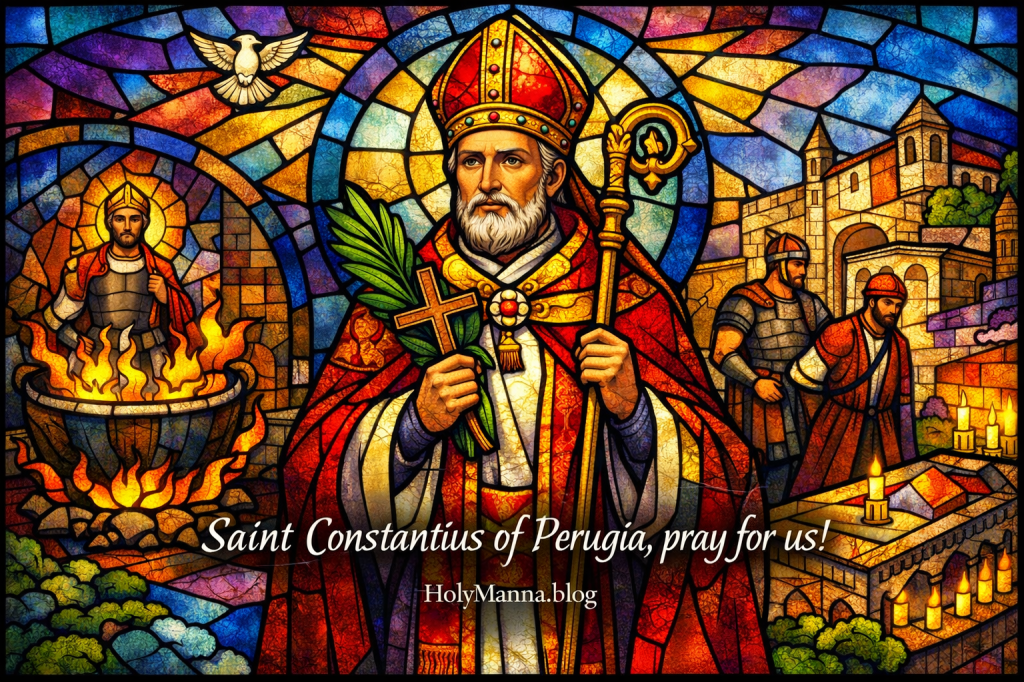
The Bishop Who Would Not Bend
Saint Constantius, known in Italy as San Costanzo, is honored by the Church as an early bishop and martyr closely tied to Perugia. His memorial is celebrated on January 29, and that date is not treated like trivia in Perugia. It is treated like a reminder that the faith was never built for comfort, but for fidelity. Even when the details of an early saint’s biography are not preserved in modern historical style, the Church still preserves the essentials that matter for salvation.
A bishop guarded the flock, preached Christ, and stayed faithful when the world demanded compromise. That is why he is remembered as a patron, because patron saints are not chosen for popularity. They are honored because their witness keeps teaching the faithful how to stand strong with humility. Saint Constantius remains a steady example of what it looks like to belong to Jesus Christ without making excuses.
Early Roots and a Faith Formed Under Pressure
Saint Constantius lived so early in Christian history that many personal details about his family, childhood, and education are not firmly recorded. Catholic tradition commonly connects him with the region around Foligno and holds that he became bishop of Perugia, likely among the earliest shepherds of that local Church. Because the sources are ancient and limited, the Church hands on what she reliably preserves while also recognizing that many narrative details come through later hagiographical tradition. This is not a weakness of the faith, because holiness does not require a complete scrapbook to be real.
Even without a detailed youth story, it is clear what kind of man he had to be. In the second century, bishops were not comfortable administrators, because Christianity could place a target on a shepherd’s back. A bishop had to teach the apostolic faith, strengthen families, and keep worship focused on God alone. That kind of leadership forms a soul over time, because it demands prayer, sacrifice, and daily courage.
A Bishop’s Mission Worth Imitating
Saint Constantius is important because he shows what spiritual leadership looks like when it is truly Christian. A bishop is meant to reflect Christ the Good Shepherd, not by chasing influence, but by protecting souls and speaking truth with charity. In a culture that pressured Christians to blend in, that pastoral work required a backbone that came from grace. It also required a heart that could suffer for others without turning bitter.
This witness fits perfectly with the Church’s teaching that holiness is the calling of every baptized person. The saint’s life shows that fidelity is not theoretical, because it must be lived in real decisions. It also shows that courage is not the same thing as pride, because real courage stays obedient to Christ. In a time when people often treat faith like something private and optional, this saint reminds the Church that discipleship is meant to be visible and sincere.
Miracles in the Fire of Persecution
Catholic tradition preserves striking signs associated with Saint Constantius’s witness, not as entertainment, but as testimony to God’s presence in suffering. The best-known episode in the traditional account describes him being beaten and then subjected to a torture involving boiling water, yet he is said to have emerged unharmed. This is remembered as a sign that earthly power has limits when it collides with divine providence. It also strengthens the faithful by showing that God can protect, even when circumstances look hopeless.
The tradition also holds that even in prison Saint Constantius continued to bear fruit, including the conversion of guards who witnessed his faith. That detail matters because it highlights how God works through a saint’s endurance, not only through dramatic escapes. Sometimes the miracle is deliverance, and sometimes the miracle is a changed heart. Either way, the story keeps pointing back to Christ, who remains Lord even in chains.
The Crown of Martyrdom
The tradition surrounding Saint Constantius places his persecution in the era associated with Emperor Marcus Aurelius, when Christians could be punished for refusing pagan worship and civic religious acts. In that environment, the conflict was not just social pressure. It was a direct demand for religious compromise, and believers could not pretend it was harmless. Worship belongs to God alone, and martyrs are the ones who prove they believe that.
The traditional story describes interrogation, beatings, imprisonment, and repeated attempts to force him to renounce Christ. Some accounts include a brief escape aided by converts, followed by re-arrest, and the account culminates in his beheading near Foligno at a place remembered as “il Trivio.” The Church honors this because martyrdom is the supreme witness to the truth of the faith, where a disciple holds to Christ even at the price of death. The Catechism teaches this clearly in CCC 2473-2474, reminding the faithful that the Gospel is worth more than safety.
A City That Never Forgot
Catholic tradition says Saint Constantius’s body was brought to Perugia and buried outside the city near Porta San Pietro, in a place remembered as Areola. Over time, devotion gathered around his tomb, and a church dedicated to him became a focal point of local Catholic life. Centuries later, the history of that church includes notable moments connected to his relics, including recognitions associated with the high altar and a solemn translation in the nineteenth century. This continuity matters because it shows how the Church remembers saints as family, not as museum artifacts.
Miracles have also been attributed to Saint Constantius’s intercession after his death, including traditional accounts of healings involving blindness and paralysis. In a Catholic worldview, these stories never compete with Christ, because every healing ultimately comes from God. The saints are honored as intercessors because the communion of saints is real, and the Church teaches that the saints do not stop caring for the Church after death. The Catechism explains this beautifully in CCC 956-957, teaching that their intercession supports the faithful as they continue the fight for holiness.
His cultural impact in Perugia is also unusually public and joyful. The city honors him with liturgical celebrations and the Luminaria connected to the vigil of his feast, and local traditions like the torcolo keep the memory of his martyrdom present in everyday life. Some customs are clearly cultural, but the center remains Catholic, because the celebration ultimately leads back to prayer, worship, and gratitude for a faithful witness. A church that continues to draw devotion across centuries shows that the saint is still speaking, even without written words.
Courage Built in Daily Life
Saint Constantius can feel far away because most people are not facing prisons or execution, but his lesson is surprisingly practical. Courage is built long before a major test arrives, because small compromises train the heart to surrender when pressure rises. This saint pushes the opposite habit, which is daily fidelity through ordinary decisions. When faith is practiced consistently, it becomes harder for fear to control the conscience.
A faithful life can look simple and still be heroic. It can mean showing up to Mass when the week feels heavy, refusing dishonest speech even when it would be convenient, and choosing purity when compromise is normalized. It can also mean refusing to become harsh, because truth without charity is not Christian strength. A martyr bishop teaches that love and truth belong together, and that the goal is always Christlike mercy without surrendering conviction.
The Gospel gives a clear measuring stick for daily faithfulness, especially in how the weak and overlooked are treated. Jesus speaks with a seriousness that cuts through excuses, and His words still demand a response. “Whatever you did for one of these least brothers of mine, you did for me.” (The Gospel of Matthew 25:40). Saint Constantius is remembered because he lived as if Jesus meant it, and he invites the faithful to do the same.
Engage with Us!
Share thoughts and reflections in the comments below.
- Where is faith being pressured into silence right now, at work, at home, or online?
- What is one concrete habit that can build courage before a major trial arrives?
- How can devotion to the saints become more than culture, and turn into real prayer and imitation?
- What does it look like to stay loyal to Jesus without becoming harsh or prideful?
- If martyrdom is the “supreme witness,” what are the smaller daily “witnesses” that should be offered this week?
Keep walking forward in faith with steady conviction and a clean conscience. Keep choosing what is true when it would be easier to perform for approval. Keep practicing mercy without surrendering to compromise, because real love is always rooted in truth. Do everything with the love and mercy Jesus taught, and trust that fidelity, not comfort, is the path to joy.
Saint Constantius of Perugia, pray for us!
Follow us on YouTube, Instagram and Facebook for more insights and reflections on living a faith-filled life.

 Holy Manna!
Leave a comment