Thursday of the Third Week in Ordinary Time – Lectionary: 320
When God Builds the House, the Light Has to Shine
There are days when Scripture feels like it is quietly asking a personal question, not in an accusatory way, but in a way that wakes the soul up. Who is really building the story of this life, and what is being done with the light that has been received? That is the thread running through today’s readings, and it pulls everything together into one clear theme: God makes covenant promises out of sheer mercy, and those promises are meant to become visible, lived, and shared.
The First Reading, 2 Sm 7:18-19, 24-29, drops into a decisive moment in Israel’s history, right after God makes a stunning covenant with King David. In the ancient world, kings built temples to prove power and secure legacy, but the God of Israel flips the script. David wants to build God a “house,” yet the Lord promises to build David a “house,” meaning a lasting dynasty. David responds the only sane way a believer can respond, by sitting in God’s presence in humility and gratitude, praying with reverence and confidence because God has spoken first. The Responsorial Psalm, Psalm 132:1-5, 11-14, echoes that covenant language and anchors it in Israel’s worship, recalling David’s zeal for the Lord’s dwelling and God’s oath to establish his line. Together, they set the stage for the Church’s deeper reading of the Davidic promise, because what began as a covenant with a king opens toward the Messiah, the true Son of David, whose kingdom is not temporary and whose reign is not symbolic.
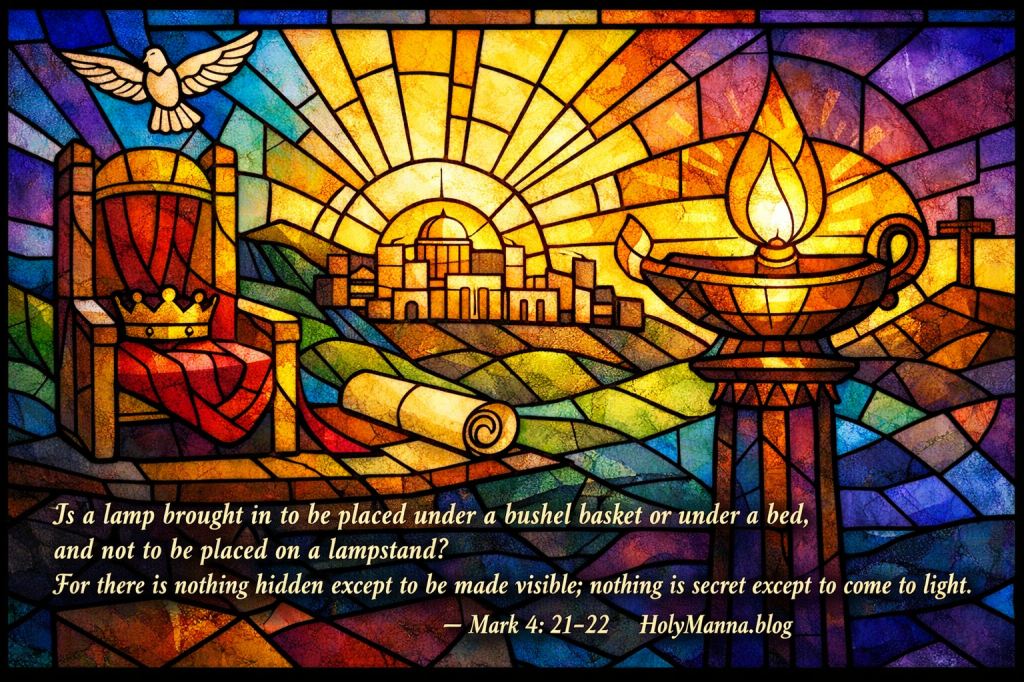
Then the Holy Gospel, Mk 4:21-25, brings the covenant theme into daily discipleship. Jesus teaches that what God reveals is not given to be hidden or treated like a private possession. The light of truth, the gift of faith, and the grace received are meant to be placed where they can actually illuminate, because “there is nothing hidden except to be made visible” and “nothing is secret except to come to light”. That is not only comforting, it is clarifying. God’s promises are not just meant to be admired, they are meant to form a people who live in the open, with integrity, gratitude, and courageous witness. Today’s readings prepare the heart to see that God is faithful to build His house, but He also expects His people to stop hiding the lamp and start living like the promise is real.
First Reading – Second Samuel 7:18-19, 24-29
When a King Learns to Kneel
This passage lands right after one of the most important covenant moments in the Old Testament. David had wanted to build a “house” for the Lord, meaning a temple, but the Lord reversed the plan and promised to build David a “house,” meaning a lasting dynasty. In the ancient Near East, kings built monuments to secure their name and their future, but Israel’s God makes it clear that blessing is not seized by human ambition. Blessing is received as gift. That is why David does not respond with pride or presumption. He goes into the Lord’s presence, sits, and prays with awe. He recognizes that the God of Israel is not like the idols of the nations. The Lord speaks, the Lord promises, and the Lord keeps covenant. This fits today’s theme perfectly because the covenant promise is meant to become visible and lived, not hidden. David’s prayer shows what happens when a heart truly believes God’s word is real. It becomes humble, grateful, and bold enough to ask God to fulfill what He has already promised.
2 Samuel 7:18-19, 24-29 – New American Bible (Revised Edition)
David’s Thanksgiving. 18 Then King David went in and sat in the Lord’s presence and said, “Who am I, Lord God, and what is my house, that you should have brought me so far? 19 And yet even this is too little in your sight, Lord God! For you have made a promise regarding your servant’s house reaching into the future, and giving guidance to the people, Lord God!
24 You have established for yourself your people Israel as your people forever, and you, Lord, have become their God. 25 Now, Lord God, confirm the promise that you have spoken concerning your servant and his house forever. Bring about what you have promised 26 so that your name may be forever great. People will say: ‘The Lord of hosts is God over Israel,’ when the house of your servant David is established in your presence. 27 Because you, Lord of hosts, God of Israel, have revealed to your servant, ‘I will build you a house,’ your servant now finds the courage to make this prayer before you. 28 Since you, Lord God, are truly God and your words are truth and you have made this generous promise to your servant, 29 do, then, bless the house of your servant, that it may be in your presence forever—since you, Lord God, have promised, and by your blessing the house of your servant shall be blessed forever.”
Detailed Exegesis
Verse 18: “Then King David went in and sat in the Lord’s presence and said, ‘Who am I, Lord God, and what is my house, that you should have brought me so far?’”
David’s posture matters. He “sat” in the Lord’s presence, which signals reverence, attentiveness, and a kind of quiet intimacy in prayer. The question “Who am I” is not self-hatred. It is humility. David is amazed that God lifted him from the pasture to the throne, and even more amazed that God would attach a forever promise to his household. This is the beginning of authentic prayer, because it starts with God’s greatness and God’s mercy, not with human ego.
Verse 19: “And yet even this is too little in your sight, Lord God! For you have made a promise regarding your servant’s house reaching into the future, and giving guidance to the people, Lord God!”
David realizes that God’s generosity keeps expanding. What God has already done is “too little” compared to what God now promises. The phrase about the future points beyond David’s lifetime. The Church has always read this as part of the Davidic covenant that ultimately opens toward the Messiah. This is not simply private blessing; it is guidance for God’s people. God’s covenant with David has a communal horizon. It is about Israel’s stability, worship, and hope.
Verse 24: “You have established for yourself your people Israel as your people forever, and you, Lord, have become their God.”
David roots everything in God’s prior action. Israel did not invent itself. God “established” Israel and claimed them as His own. This is classic covenant language, echoing the Lord’s self-gift in salvation history. It also shows that kingship in Israel is not ultimate. The true King is the Lord, and David’s throne only makes sense under God’s covenant lordship.
Verse 25: “Now, Lord God, confirm the promise that you have spoken concerning your servant and his house forever. Bring about what you have promised.”
This is bold prayer, but it is not entitlement. David is not asking God to create a new plan. He is asking God to do what God said He would do. This is one of the healthiest ways to pray: holding God’s word with trust and asking for its fulfillment. It teaches that prayer is not mainly about informing God. Prayer is communion and cooperation with God’s will.
Verse 26: “So that your name may be forever great. People will say: ‘The Lord of hosts is God over Israel,’ when the house of your servant David is established in your presence.”
David’s deepest desire is not his brand or reputation. He wants God’s name to be great. He sees that God’s blessings are meant to produce praise and faith among the people. When God establishes David’s house, it becomes a public sign that the Lord truly reigns over Israel. This already hints at today’s Gospel about the lamp on the lampstand. God’s work is meant to be seen so that God is glorified.
Verse 27: “Because you, Lord of hosts, God of Israel, have revealed to your servant, ‘I will build you a house,’ your servant now finds the courage to make this prayer before you.”
David admits something very human and very spiritual. God’s revelation gives courage. When God speaks, it creates faith. When faith is alive, it creates boldness in prayer. David is not courageous because he is naturally fearless. He is courageous because God has spoken. God’s promise becomes the foundation of David’s confidence.
Verse 28: “Since you, Lord God, are truly God and your words are truth and you have made this generous promise to your servant.”
This is a short creed tucked into a prayer. David confesses God’s identity and God’s reliability. God is “truly God,” not a tribal superstition. And God’s words are “truth,” not political spin. This is the bedrock of faith: trusting that God is who He says He is, and that what He says is trustworthy.
Verse 29: “Do, then, bless the house of your servant, that it may be in your presence forever since you, Lord God, have promised, and by your blessing the house of your servant shall be blessed forever.”
David’s final request is simple and profound. He wants his house to remain in God’s presence. Blessing, in the biblical sense, is not just comfort or success. It is being kept close to God, under God’s favor, within God’s covenant life. David ends where he began, not with self-congratulation, but with trust in God’s promise.
Teachings
This reading teaches that covenant is initiated by God, sustained by God, and received by faith. David’s prayer shows a pattern the Church recognizes as essential to Christian prayer: humble amazement at grace, gratitude for what God has done, and confident petition rooted in God’s promises. The heart of the lesson is that God does not love because He owes. God loves because He is good.
The Catechism describes prayer as a living relationship with God, and it highlights the Old Testament as a school of prayer that forms the heart through the words and experiences of God’s people. Here is a foundational line that fits David’s posture perfectly: CCC 2565 says, “In the New Covenant, prayer is the living relationship of the children of God with their Father who is good beyond measure, with his Son Jesus Christ and with the Holy Spirit.” David’s prayer is not yet the fullness of the New Covenant, but it already breathes that same relationship. It is personal, reverent, and rooted in God’s goodness.
The reading also points forward to Christ, because the promise to David becomes part of Israel’s messianic hope. The Catechism teaches plainly that the Messiah is linked to David’s line, and it explains why the Gospels emphasize Jesus as “Son of David.” CCC 439 says, “Many Jews and even certain Gentiles who shared their hope recognized in Jesus the basic attributes of the messianic ‘Son of David’ promised by God to Israel.” The covenant with David is not an isolated favor. It is one of the great roads that leads to Jesus Christ.
Saint Augustine helps sharpen the spiritual meaning of David’s humility by pointing out that true greatness is measured by dependence on God, not independence from Him. His constant theme is that pride is the root of sin, and humility is the beginning of salvation. David’s prayer is powerful because it is low to the ground. That is where grace grows.
Reflection
David’s prayer is a needed correction for modern instincts. Many people treat prayer like a customer service line, calling only when something breaks. David treats prayer like presence, worship, and relationship. He sits before the Lord and remembers what God has already done, then he asks for what God has promised, and he asks it for the glory of God’s name.
A practical way to live this reading is to begin daily prayer with gratitude before requests. Gratitude changes the temperature of the soul. It makes the heart calmer, more trusting, and less dramatic. Another concrete step is to pray with Scripture in hand, not just feelings in mind. David prays directly from what God revealed. That is a strong pattern for discipleship. When God’s word is taken seriously, prayer becomes steadier and more confident.
This reading also challenges the fear of being seen as “too religious.” David is a king, yet he kneels. He does not hide gratitude, and he does not hide dependence on God. That is the bridge into today’s Gospel, because covenant blessings are not meant to be kept private. God’s work is meant to be visible in a life marked by humility, honesty, and trust.
Where has God brought this life “so far,” in ways that could never be explained by personal talent alone?
Is prayer mostly a place to demand answers, or is it also a place to sit in God’s presence with gratitude?
If God’s word is truth, what promise from Scripture needs to be held onto and prayed back to Him with courage this week?
Responsorial Psalm – Psalm 132:1-5, 11-14
A Promise That Outlives the Storm
Psalm 132 is one of the great “covenant memory” psalms. It is not sentimental nostalgia. It is Israel doing what faithful people always do in worship: remembering what God has done, repeating what God has promised, and letting that memory shape the present. Historically, this psalm is tied to the Davidic covenant and to Zion, meaning Jerusalem as the place of God’s dwelling with His people. It echoes the king’s longing to honor the Lord with a dwelling place, and then it centers the bigger reality: God is the One who chooses, God is the One who swears the oath, and God is the One who establishes the future. That is why this psalm fits perfectly with today’s theme. God builds the “house” by covenant promise, and that covenant is meant to become visible, stable, and worshipful in the life of His people. The psalm also prepares the heart to hear the Gospel clearly, because a people who truly believe God “dwells” among them cannot live like the light is meant to be hidden.
Psalm 132:1-5, 11-14 – New American Bible (Revised Edition)
The Covenant Between David and God
1 A song of ascents.
Remember, O Lord, for David
all his hardships;
2 How he swore an oath to the Lord,
vowed to the Mighty One of Jacob:
3 “I will not enter the house where I live,
nor lie on the couch where I sleep;
4 I will give my eyes no sleep,
my eyelids no rest,
5 Till I find a place for the Lord,
a dwelling for the Mighty One of Jacob.”11 The Lord swore an oath to David in truth,
he will never turn back from it:
“Your own offspring I will set upon your throne.
12 If your sons observe my covenant,
and my decrees I shall teach them,
Their sons, in turn,
shall sit forever on your throne.”
13 Yes, the Lord has chosen Zion,
desired it for a dwelling:
14 “This is my resting place forever;
here I will dwell, for I desire it.
Detailed Exegesis
Verse 1: “Remember, O Lord, for David all his hardships.”
This is a plea rooted in covenant relationship, not in panic. In Scripture, asking God to “remember” is not implying God forgets. It is asking God to act in fidelity to His promises. David’s “hardships” are not being used as leverage, but as proof that his love for God was costly and real. The Church understands this kind of prayer as the language of covenant trust, where the believer appeals to God’s steadfast love.
Verse 2: “How he swore an oath to the Lord, vowed to the Mighty One of Jacob.”
David’s oath shows a heart that refuses to treat God casually. “The Mighty One of Jacob” is an ancient title that ties Israel’s worship back to the patriarchs and God’s saving acts. David’s vow is religious and communal, because the king’s devotion shapes the people’s devotion. Worship is never only private in Israel. It is the backbone of national identity and covenant faithfulness.
Verse 3: “I will not enter the house where I live, nor lie on the couch where I sleep.”
This is poetic intensity, not a literal rejection of rest forever. It expresses priority. David will not settle into comfort while God’s honor is neglected. Spiritually, this verse challenges the instinct to build personal security first and then give God whatever is left. It is an examination of priorities dressed as a vow.
Verse 4: “I will give my eyes no sleep, my eyelids no rest.”
The repetition strengthens the point. David’s zeal is total. In a culture where kings could indulge in luxury, this imagery presents a different kind of kingship, one marked by responsibility before God. It also echoes a truth the saints repeat constantly: love is proven by sacrifice, not by sentiment.
Verse 5: “Till I find a place for the Lord, a dwelling for the Mighty One of Jacob.”
This points toward the Ark, the sanctuary, and eventually the Temple tradition in Jerusalem. The deeper meaning is about presence. Israel’s identity is anchored in the Lord who chooses to dwell with His people. Even when the Church reads this with Christ in view, the logic remains: God’s people are meant to order life around God’s presence, not treat it as a weekend accessory.
Verse 11: “The Lord swore an oath to David in truth, he will never turn back from it: ‘Your own offspring I will set upon your throne.’”
Now the psalm turns from David’s vow to God’s vow. That is the center. David’s devotion matters, but God’s promise matters more. The line “in truth” is crucial. God’s oath is reliable because God is truthful. This is the foundation of biblical hope and the reason covenant faith is not naive optimism. It is trust in the character of God.
Verse 12: “If your sons observe my covenant, and my decrees I shall teach them, their sons, in turn, shall sit forever on your throne.”
This verse holds together two realities: God’s faithful initiative and the real call to human fidelity. Covenant is not magic. It is relationship. God’s promise stands, but the way it plays out in history involves obedience and formation. The line about God teaching decrees matters because it shows that God does not demand holiness without providing instruction and grace. Faithfulness is learned and practiced over time.
Verse 13: “Yes, the Lord has chosen Zion, desired it for a dwelling.”
This is election language. Zion is not chosen because it is impressive. Zion is chosen because God delights to dwell with His people. In Israel’s memory, Zion becomes a symbol of God’s nearness and kingship. For Christians, Zion also becomes a sign that God’s plan is not abstract. God chooses real places, real people, real history, and He makes Himself known in concrete ways.
Verse 14: “This is my resting place forever; here I will dwell, for I desire it.”
God’s “resting place” is not about fatigue. It is about stable presence. God binds Himself to His people in covenant love, and He desires to dwell among them. This is one of the reasons Catholics love the theme of God-with-us. The Old Covenant points to the Temple, but the New Covenant reveals the deeper fulfillment in Christ, and the sacramental life of the Church where God remains present and active.
Teachings
This psalm teaches that true worship is built on memory and promise. It remembers David’s zeal, but it centers God’s oath, because salvation history is not ultimately driven by human effort. It is driven by divine fidelity. At the same time, the psalm refuses to separate faith from obedience. God’s promise is firm, and God’s people are still called to observe His covenant.
The Catechism describes the psalms as the privileged language of prayer for God’s people, given by the Holy Spirit to shape the Church’s voice in every age. CCC 2587 says, “The Psalms are the masterwork of prayer in the Old Testament.” That matters here because Psalm 132 is not merely information about the past. It is prayer that forms the heart to trust God’s promises and to desire His presence.
The Catechism also explains why these ancient songs remain alive in the Church’s worship. CCC 2588 says, “The Psalms both nourish and express the prayer of the People of God gathered in assembly and ‘are suitable for men of every condition and time.’” This psalm is a strong example. It fits anyone who has suffered, anyone trying to stay faithful, and anyone tempted to believe God’s promises have expired.
Historically, this psalm is deeply tied to the Davidic covenant and to Jerusalem as the religious center of Israel. After the Ark came to Jerusalem and the Temple became the heart of Israel’s worship, Zion stood as a sign that the Lord had chosen to be near. That historical reality becomes a spiritual roadmap for Christians: God’s plan is always about communion. God does not save from a distance. God draws near, dwells, and forms a people who live around His presence.
Reflection
This psalm confronts the modern habit of treating faith as optional and “God time” as whatever fits. David’s vow is intense because love is intense. It does not mean life should become frantic. It means priorities should become clear. When the Lord is truly first, time gets ordered, attention gets cleaner, and the heart stops living in constant distraction.
A practical way to live this is to reclaim a real “dwelling place” for God in daily life. That could mean a consistent time of prayer that is protected like an appointment, not squeezed in like leftovers. It could mean building a habit of praying the psalms slowly, because they train the mind to speak to God with Scripture-shaped honesty. It could also mean examining whether comfort has become the main goal. The psalm gently challenges comfort-idolatry by showing a king who refuses to rest until God is honored.
This psalm also offers a steady kind of hope. God’s oath is “in truth.” That means God’s promises do not break when emotions fluctuate or when culture shifts. The question is whether the heart is living as if God is trustworthy, or living as if everything depends on personal control.
What would change if prayer and worship became the first priority instead of the last resort?
Where has comfort quietly replaced covenant faithfulness in daily decisions?
If God desires to dwell with His people, is the heart making room for His presence, or is it keeping Him at the edge of the schedule?
Holy Gospel – Mark 4:21-25
Do Not Hide the Light
In The Gospel of Mark, chapter 4 is a turning point where Jesus teaches the crowds and the disciples through parables about the Kingdom of God. He has just spoken about the seed and the soils, showing that the Word can be resisted, shallowly received, or welcomed with perseverance. Now He pushes the lesson further: when God gives light, that light is not meant to be treated like a private accessory. In the first-century Jewish world, a lamp was an ordinary household object, but it carried obvious meaning. Light was needed for work, safety, and daily life after sundown. Everyone understood that a lamp only makes sense when it is elevated to give light to the room. Jesus uses that common image to make a spiritual point that fits perfectly with today’s theme. God builds His covenant “house” by promise and truth, and then He places His people like lamps in the world so His work becomes visible. This Gospel also carries a warning and a promise. God will reveal what is hidden, and the heart that receives the Word with attention and obedience will receive even more grace.
Mark 4:21-25 – New American Bible (Revised Edition)
Parable of the Lamp. 21 He said to them, “Is a lamp brought in to be placed under a bushel basket or under a bed, and not to be placed on a lampstand? 22 For there is nothing hidden except to be made visible; nothing is secret except to come to light. 23 Anyone who has ears to hear ought to hear.” 24 He also told them, “Take care what you hear. The measure with which you measure will be measured out to you, and still more will be given to you. 25 To the one who has, more will be given; from the one who has not, even what he has will be taken away.”
Detailed Exegesis
Verse 21: “He said to them, ‘Is a lamp brought in to be placed under a bushel basket or under a bed, and not to be placed on a lampstand?’”
Jesus appeals to common sense to expose spiritual nonsense. A lamp is brought in for a purpose. It exists to shine. Hiding it under a basket or a bed defeats the entire reason it was lit. Spiritually, this confronts a form of discipleship that wants the benefits of faith without the visibility of faith. Jesus is training His followers to understand that the Kingdom creates witness. The light of Christ must shape public habits, relationships, and moral choices, not just private feelings.
Verse 22: “For there is nothing hidden except to be made visible; nothing is secret except to come to light.”
This verse works on two levels. First, it describes the mystery of the Kingdom being revealed. God discloses what was hidden in the Old Covenant through Christ. Second, it warns that hidden realities in the human heart will not stay buried forever. God’s truth has a way of uncovering what is false. This is mercy for the repentant, because it brings healing through honesty, and it is judgment for the stubborn, because it exposes what a person refused to surrender.
Verse 23: “Anyone who has ears to hear ought to hear.”
This is a call to active, obedient listening. In Scripture, “hearing” is about reception, conversion, and response. Jesus is not looking for passive listeners who admire good teaching. He is looking for disciples who let the Word rearrange their lives.
Verse 24: “He also told them, ‘Take care what you hear. The measure with which you measure will be measured out to you, and still more will be given to you.’”
Jesus warns that listening has consequences. “Take care what you hear” means guarding the heart about what is welcomed, trusted, and repeated. The “measure” is the interior capacity a person brings to God’s Word. A small measure is minimalism, the habit of giving God the least possible attention. A generous measure is receptivity, humility, and willingness to obey. The promise is that God responds to openness with more grace. The heart that listens well becomes capable of receiving more.
Verse 25: “To the one who has, more will be given; from the one who has not, even what he has will be taken away.”
This sounds harsh until it is understood spiritually. Grace grows in a receptive heart. Neglect shrinks the soul’s capacity. A person who “has” is someone who holds the Word with faith and acts on it. That person receives more light, more understanding, and more strength. A person who “has not” is someone who refuses the Word or treats it as unimportant. Over time, even the little that person once had fades because it was not guarded, practiced, or loved. Jesus is describing spiritual reality, not promoting favoritism.
Teachings
This Gospel teaches that revelation leads to responsibility. God does not reveal truth so it can be stored like trivia. God reveals truth so it can transform a life and illuminate others. The Church understands this as part of her very identity. Christ is the light, and the Church exists to reflect and carry that light into the world, especially through holiness, preaching, and charity.
The Catechism describes the Church’s missionary nature as flowing from Christ’s light. It teaches that the Church is not a private club for personal spirituality. She is sent. CCC 849 says, “The missionary mandate. ‘Having been divinely sent to the nations that she might be the universal sacrament of salvation, the Church, in obedience to the command of her founder and because it is demanded by her own essential universality, strives to preach the Gospel to all men.’” This is the lampstand. The Gospel is meant to be seen and heard, and discipleship is meant to become visible.
The Gospel also teaches that hearing the Word is a moral act. Receptivity is not neutral. It either expands or contracts the heart. The Catechism explains that faith is a gift, but it calls for a real human response. CCC 143 says, “By faith, man completely submits his intellect and his will to God. With his whole being man gives his assent to God the revealer.” That is what Jesus means by having “ears to hear.” It is not merely understanding. It is submitting the mind and will to God.
Saint John Chrysostom often pressed this point in his preaching, warning that it is possible to hear Christ’s words constantly and remain unchanged. The problem is not the clarity of the lamp. The problem is the stubbornness of the listener. The Lord’s command, “Take care what you hear”, is a reminder that spiritual hearing requires humility, vigilance, and obedience, especially in a world that constantly competes for attention.
Reflection
This Gospel is a friendly but firm wake-up call. Many people want faith to stay comfortable, quiet, and unchallenging, because public faith costs something. It can cost social approval, convenience, and control. Jesus refuses that version of discipleship. He lights the lamp and expects it to shine. That means daily choices matter. It means speech matters. It means integrity matters. It means a person cannot claim to live in the light while protecting a “hidden life” that never comes under Christ’s authority.
A practical step is to examine what is being allowed into the mind and heart, because Jesus says to take care what is heard. That includes media habits, conversations, music, and the constant noise that forms desires and reactions. Another step is to increase the “measure” given to God’s Word. A person who listens with a teaspoon should not be surprised to feel spiritually hungry. A person who listens with a generous measure, through prayerful reading of Scripture, silence, and obedience, will find that God gives more light, more clarity, and more strength.
This Gospel also invites courage. The light is not only for personal comfort. It is for the people around you, especially those who are stumbling in darkness. Quiet faith that never shows up in action is not what Jesus is forming here. He is forming witnesses who live openly, consistently, and charitably, so that what God has done becomes visible in a very real way.
Where is the lamp being hidden, not necessarily by denying faith, but by living as if it does not shape decisions?
What would change this week if the “measure” given to God’s Word became more generous and less minimal?
Is there any habit that stays “secret” because it would not survive the light of Christ, and is today the day to bring it into confession, honesty, and healing?
Built by Promise, Lived in the Light
Today’s readings come together like one clear message spoken in three voices. God is the One who builds the house, God is the One who keeps the promise, and God is the One who lights the lamp. The First Reading, 2 Sm 7:18-19, 24-29, shows a king who finally understands that everything good in his life began as gift. David’s humble prayer is not weak. It is strong because it is honest, and it is bold because it rests on the truth that God’s word can be trusted. The Responsorial Psalm, Psalm 132:1-5, 11-14, turns that covenant story into worship, reminding the heart that God does not make empty oaths. The Lord chooses, the Lord dwells with His people, and the Lord stays faithful even when life feels unstable. Then the Holy Gospel, Mk 4:21-25, brings the covenant to the doorstep of everyday discipleship. Jesus makes it plain that the grace received is never meant to be hidden. A lamp is lit so it can shine, and a disciple is formed so the truth can be seen in real choices, real habits, and real love.
The call to action is simple, but it is not easy. Let gratitude lead the way like David, because humble thanksgiving protects the soul from pride and bitterness. Make room for God’s presence like the psalm, because a life without worship slowly forgets what it is living for. Then live the Gospel without hiding the lamp, because faith that stays private and untested will eventually grow dim. God’s promises are not meant to be admired from a distance. They are meant to be prayed, trusted, and lived out in the open.
What would happen if this week started with sitting in God’s presence before rushing into everything else? Let the heart ask for the grace to believe that God’s words are truth, and then take one concrete step that places the lamp on the lampstand. That could be a more faithful prayer routine, a cleaner conscience through confession, a courageous act of charity, or a simple decision to stop treating the Word of God like background noise. God is building something eternal, and the best response is to cooperate with joy, live in the light, and let His name be made great through a life that finally looks like it belongs to Him.
Engage with Us!
Share your reflections in the comments below, because the Word of God comes alive when believers listen together and encourage one another toward holiness.
- For the First Reading, 2 Sm 7:18-19, 24-29: Where has God brought this life “so far” in a way that could only be credited to His grace, and how can that gratitude be turned into a concrete prayer this week?
- For the Responsorial Psalm, Psalm 132:1-5, 11-14: What practical change would help make God’s presence a true priority in daily life, rather than something squeezed in only when convenient?
- For the Holy Gospel, Mk 4:21-25: Where is the lamp being hidden, and what would it look like to place faith on the lampstand through one visible, consistent act of discipleship today?
Keep walking forward with confidence. God is faithful, His promises are true, and His light is meant to shine through ordinary lives lived with courage. Go live this day with real faith, and do everything with the love and mercy Jesus taught, so that others can see the light and give glory to God.
Sacred Heart of Jesus, we trust in You!
Immaculate Heart of Mary, pray for us!
Saint Michael the Archangel, defend us in battle!
Follow us on YouTube, Instagram and Facebook for more insights and reflections on living a faith-filled life.

 Holy Manna!
Leave a comment