A Saint for Clear Minds and Burning Hearts
Saint Thomas Aquinas is the kind of saint who proves that holiness is not only built in dramatic moments. Holiness is also built in steady fidelity, disciplined prayer, and humble pursuit of truth. He was a Dominican priest whose writing shaped Catholic theology for centuries, but his real greatness was never just intelligence. His greatness was how he placed that intelligence at the feet of Jesus Christ and used it to serve the Church with reverence and obedience.
The Church calls him the Angelic Doctor because his teaching is luminous, pure, and ordered toward God. He is also remembered as a saint who proved something Catholics still need to hear: faith and reason are not enemies. They are meant to work together because the same God who reveals mysteries is the God who created the human mind. When Saint Thomas is read well, it becomes obvious that theology is not meant to be a cold hobby or a status symbol. It is meant to deepen worship, protect the faith, and form saints in the heart of the Church.
A Noble Birth and a Holy Hunger
Saint Thomas was born around 1225 in the region of Aquino in Italy, into a noble family with serious influence and expectations. His early education included time among the Benedictines at Monte Cassino, which placed him close to the rhythm of prayer and the seriousness of sacred learning. Later, he studied in Naples, where he encountered the intellectual life of the university and the philosophical works that stirred debate across Europe.
Even as a young student, Thomas became known for a question that sounds simple but is actually the beginning of a lifetime of prayer: “What is God?” That question was not shallow curiosity. It was the hunger of a soul that wanted truth, not for bragging rights, but for communion with the One who is Truth. This is one reason his life still speaks so strongly today, because so many people chase opinions when the soul is really searching for God.
A Vocation Tested Like Fire
Thomas’ decisive turning point came through vocation. While in Naples, he felt drawn to the Dominican Order, the Order of Preachers. This choice was not a career move or a personal brand. It was a surrender to a life marked by poverty, obedience, prayer, and preaching for the salvation of souls. His family expected him to rise in prestige, possibly even to become an abbot at Monte Cassino, but Thomas chose a path that looked like weakness to the world and looked like freedom to the saints.
Catholic tradition and historical accounts agree that his family resisted fiercely and even had him seized and confined for a long period in an attempt to break his resolve. During this confinement, his brothers went so far as to send a woman into his room to seduce him, hoping to shatter his vocation and his discipline. Thomas resisted with real courage, driving her away and guarding his purity when it would have been easy to compromise in secret. Catholic tradition connects this victory to a special grace confirming his chastity, which is why he is often portrayed with a cord in Dominican imagery. This part of his story matters because it lines up with the Church’s teaching on virtue and grace, including how chastity is not just a feeling but a stable strength formed by grace and practiced through self-mastery and prayer, as taught in CCC 2337-2345.
The Dominican Student Who Changed the World
Once free to continue his Dominican formation, Thomas studied under Saint Albert the Great. He was quiet, careful, and not interested in attention, so some classmates assumed he was slow and would call him a dumb ox. Catholic tradition preserves a memorable defense from Saint Albert, who predicted that the so called “dumb ox” would one day be heard throughout the world. Thomas’ story is a good reminder that God often hides His strongest work behind humility and silence, especially when the world is obsessed with being seen.
Thomas became known for his teaching and writing, especially the Summa Theologiae, a work meant to form students in an orderly and faithful understanding of God, the moral life, Christ, and the sacraments. He also defended the Church’s teaching against confusion in the intellectual world of his day, showing that clear thinking can be a real act of charity when it protects souls from error and leads them toward truth.
Eucharistic Wisdom That Sings
Many people know Saint Thomas for his theology, but fewer realize how deeply Eucharistic his spirituality was. Catholic tradition connects him to the liturgical texts for the Feast of Corpus Christi, including hymns that Catholics still sing in adoration. This matters because it shows what his learning was for. His theology was never meant to end in a library. It was meant to end at the altar, where every word becomes small compared to the living Christ present in the Eucharist.
Catholics are sometimes tempted to separate “thinking people” from “devotional people,” as if one group prays and the other group studies. Saint Thomas refuses that division. His example teaches that study can become prayer when it is ordered toward love, and worship can deepen when the mind is formed by truth. This fits perfectly with the Church’s understanding that faith is not irrational and that reason, when honest and humble, can prepare the heart for revelation, as taught in CCC 156-159.
Mystical Graces and Verified Sayings
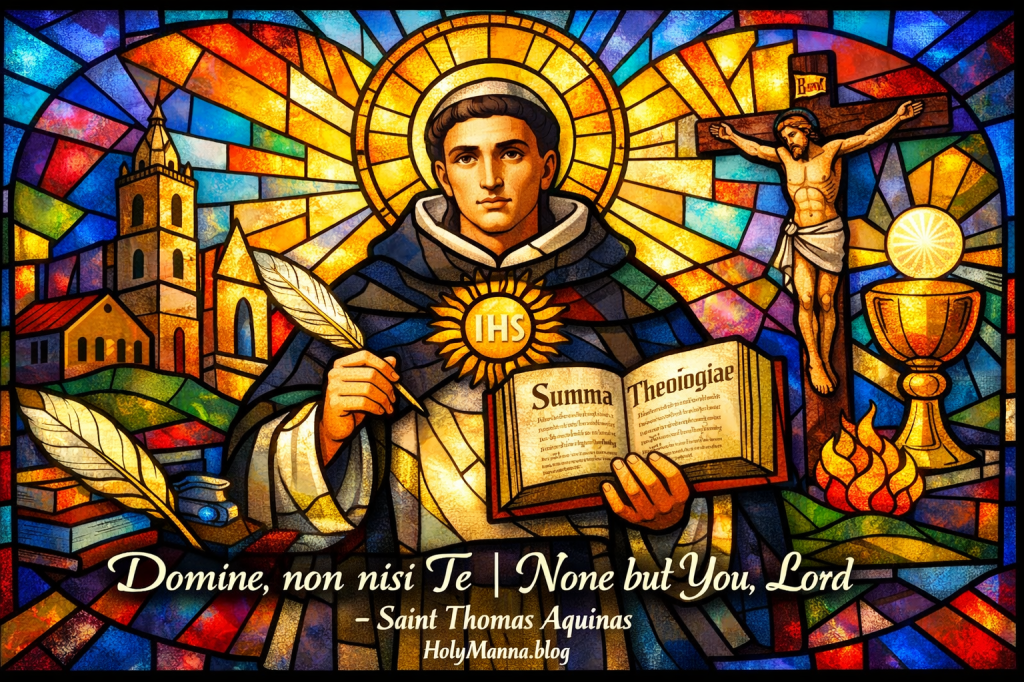
Catholic tradition records extraordinary spiritual moments in Thomas’ life that point to God’s closeness. One well known account says that after Thomas wrote profoundly about Christ, the crucifix spoke to him, praising his work and asking what reward he desired. Thomas answered with a line that captures the core of sanctity: “None but You, Lord.” This response is often remembered in Latin as “Domine, non nisi Te.” It shows what real wisdom looks like, because it does not ask for applause, comfort, or control. It asks for God Himself.
Near the end of his life, after a profound experience while celebrating Mass in late 1273, Thomas stopped writing and said, “All that I have written seems like straw to me.” This was not contempt for theology. It was humility before the infinite mystery of God. It was the confession of a saint who realized that the greatest truth is not an idea on a page but a living Person encountered in prayer and sacrament.
The Cross Without Blood
Saint Thomas was not martyred in the bloody sense, but he carried real suffering. His earliest cross was family opposition that became severe, personal, and humiliating. That kind of trial can shape a person toward bitterness or toward deeper trust in God. Thomas chose trust, and he did not build his identity on approval from others. He built it on obedience to Christ and fidelity to his vocation.
Later hardships came from conflict in the academic world and from the burden of responsibility. He lived at a time when universities, Church leaders, and religious orders faced real tensions, and he labored in the middle of debates that demanded patience and charity. He also carried the daily cost of Dominican life, which demanded discipline, poverty, and constant labor. His greatness included the hidden sacrifice of a man who gave his best to the Church without turning his gifts into a spotlight for himself.
In 1274, Thomas was traveling toward the Council of Lyon at the Church’s request when he fell seriously ill. He was taken to the abbey at Fossanova and died there on March 7, 1274. Catholic accounts preserve his deep reverence for the Eucharist and his humble submission to the Church at the end of his life. His death fits the pattern of his whole life, because he lived and died as a faithful son of the Church.
A Legacy That Still Forms Souls
Devotion to Saint Thomas grew quickly after his death. He was canonized in 1323 and later named a Doctor of the Church, recognizing the lasting value of his teaching for the entire Catholic world. His relics have been honored with special veneration, especially through their association with Toulouse, which became a major place connected to his memory. In Catholic life, relics are never treated like superstition. They are reminders that God sanctifies real bodies and that the communion of saints is real, as the Church teaches about the unity of the faithful in Christ in CCC 946-962.
Miracles have been attributed to his intercession, as is common with saints whose holiness is widely recognized, and this continues in the lived experience of the faithful. Even when not every story is preserved in popular devotion with the same detail, the Catholic perspective stays steady: God remains active, the saints truly intercede, and the Church approaches claims of miracles with reverence and seriousness. The point is never spectacle. The point is always mercy.
His cultural impact is also unmistakable, especially in Catholic education. He was named patron of Catholic schools and universities, and his work continues to shape seminaries, institutes, and theology programs worldwide. This influence is not about turning Aquinas into a replacement for Scripture. It is about receiving him as a faithful servant who helps Catholics think clearly, pray deeply, and remain obedient to the Church.
Living Like Thomas in a Loud World
Saint Thomas Aquinas is a gift for Catholics living in a distracted and confused age. Modern life is filled with shallow certainty and constant noise, and many people settle for opinions when the soul is really searching for truth. Thomas offers something better: calm clarity, disciplined prayer, and a life ordered toward God.
His life teaches that the mind can be a place of sanctification. Study can be holy when it becomes an offering. Work can become worship when it is offered to God instead of used to inflate pride. Thomas also gives a practical lesson about purity and self-mastery. Temptation is not a modern invention, and neither is grace. His story encourages serious Catholics to pursue chastity with humility and confidence, trusting that God strengthens those who ask for help and cooperate with grace, as taught throughout CCC 2337-2350.
A practical way to imitate Saint Thomas is to build habits that unite faith and reason. Scripture should be read daily, because God still speaks through His Word. The faith should be learned through The Catechism, because Catholics do not have to guess what the Church teaches. Sunday Mass should be treated as the center of the week, because the Eucharist is not an accessory. Time in Eucharistic adoration should be sought whenever possible, because that is where the soul learns what Thomas already knew: Jesus is worth everything.
How would life change if work and study became an offering instead of a performance? What would shift if prayer stopped being occasional and became steady? The path of Saint Thomas is not reserved for theologians. It is a path for anyone who wants to love God with the whole heart and the whole mind.
Engage with Us!
Share thoughts and reflections in the comments below. Every Catholic has seasons of doubt, growth, and deeper surrender, and it helps to hear how God is working in real lives.
- What part of Saint Thomas Aquinas’ story hits closest to home right now, his love of truth, his fight for purity, or his Eucharistic devotion?
- How can study or work become an act of worship this week instead of a source of pride or anxiety?
- What is one concrete way to bring faith and reason together more faithfully, by learning a teaching of the Church, praying with Scripture, or seeking wise guidance?
- If Jesus asked, “What reward do you want?” what would the honest answer be, and what needs to change so the answer becomes: “None but You, Lord.”?
May Saint Thomas Aquinas pray for every mind that feels scattered, every heart that wants to be pure, and every Catholic trying to love Jesus without compromise. Keep walking in faith. Keep choosing mercy. Keep doing everything with the love and mercy Jesus taught, because the goal is not to be impressive. The goal is to be holy.
Saint Thomas Aquinas, pray for us!
Follow us on YouTube, Instagram and Facebook for more insights and reflections on living a faith-filled life.

 Holy Manna!
Leave a comment