The Saint Who Bought Back the Captive
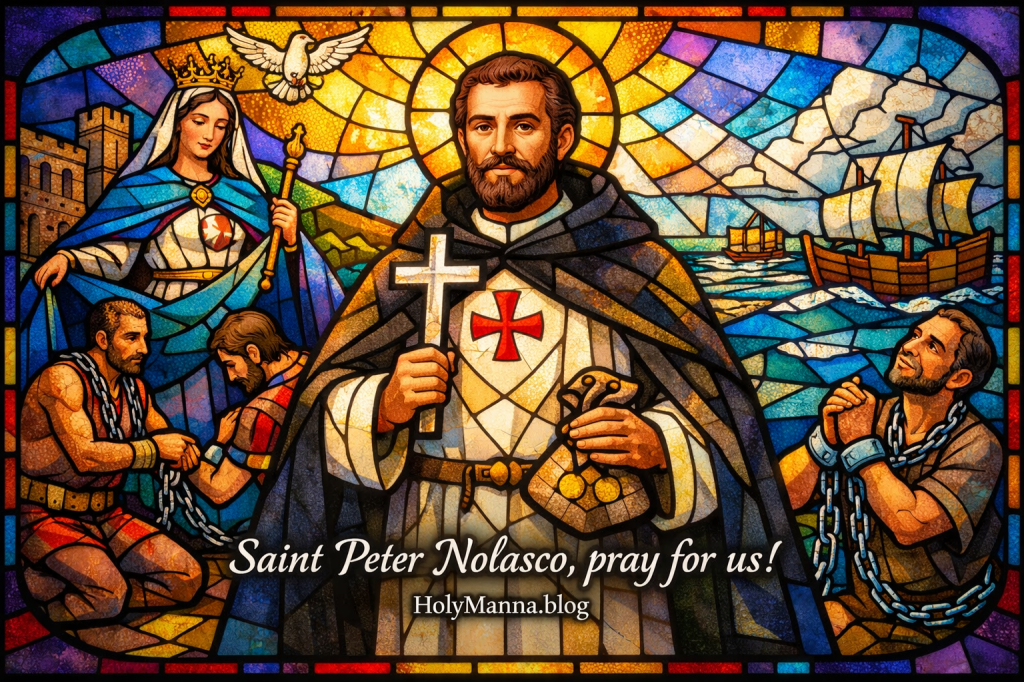
Saint Peter Nolasco is one of those saints who makes Catholic mercy feel less like an inspiring idea and more like a concrete mission. In the Middle Ages, many Christians were taken captive through warfare and raids, and captivity often came with pressure to abandon the Faith. Peter Nolasco recognized that this crisis threatened both bodies and souls, so he responded with the kind of sacrificial love that looks a lot like the Heart of Jesus.
He is remembered as the founder of the Order of the Blessed Virgin Mary of Mercy, commonly called the Mercedarians, a community formed to redeem Christians held in captivity. His legacy is deeply Marian because devotion to the Blessed Virgin Mary under the title of Our Lady of Mercy sits at the center of the Order’s identity. In Catholic life, Mary never competes with her Son, because she always leads souls toward Him. A mission dedicated to mercy in her name is meant to reflect Christ, who came to redeem and set free.
The Church teaches that the corporal works of mercy are a real measure of Christian life, not a spiritual hobby for extra motivated people. Saint Peter Nolasco’s entire story is a living lesson in that truth, because he took the suffering of strangers personally and treated their freedom as a Christian responsibility. His witness challenges modern comfort, because it insists that real love is willing to pay a price.
A Layman Shaped by Charity
Catholic sources preserve more than one detail about Saint Peter Nolasco’s birthplace and exact birth year, but they consistently present him as a late twelfth century layman formed by Christian piety and generosity. Many accounts connect his origins to southern France, and his adult life is strongly associated with Barcelona, a city shaped by commerce and by the painful reality of captives and ransom. Some traditions also describe him as a merchant, and that detail matters because it shows how God can use ordinary skills for extraordinary mercy.
His conversion is not usually described as a sudden dramatic shift. It looks more like a deepening of faith through direct confrontation with human suffering. He became aware of Christians in chains, not as an abstract tragedy, but as real people torn from their families and placed in spiritual danger. That awareness changed how he used his wealth, his time, and his energy, because he began spending his resources to redeem captives and reunite families.
As his money ran out, he did not stop. He learned that personal charity, while beautiful, was not enough for a crisis that affected so many. A stable work of mercy was needed, something organized and lasting, something that could endure beyond one man’s lifespan. That is where the seed of a religious order began to grow, and it is a reminder that holiness often becomes more serious when it becomes more consistent.
A Rescue Order Under Our Lady
The heart of Saint Peter Nolasco’s life is the founding of the Mercedarians, traditionally dated to 1218. Mercedarian tradition strongly associates the founding with an inspiration connected to the Blessed Virgin Mary, honored as Our Lady of Mercy. Catholic accounts also connect Saint Raymond of Peñafort and King James I of Aragon with early support surrounding the mission’s emergence. In the medieval world, a work like this needed spiritual clarity, practical organization, and real backing to survive.
The mission was simple and shocking. The Mercedarians existed to redeem captives. This was not a vague promise to care about human dignity, because it required raising funds, negotiating ransoms, and traveling into dangerous situations where a rescuer could easily become a captive. The Order later received papal approval and lived under the Rule of Saint Augustine, which helped stabilize the community and keep the mission rooted in prayer and discipline.
One of the most striking parts of Mercedarian life is the fourth vow, beyond poverty, chastity, and obedience. This vow centered on the redemption of captives and included a willingness to offer one’s own freedom, even to remain as a hostage, so that another Christian could be released. This is not a metaphor or a poetic flourish. It is the Gospel lived with real consequences, echoing the logic of Christ who gives Himself so others can live.
Mercy Lived in the Real World
Saint Peter Nolasco’s daily life was shaped by holy realism. Captives needed redemption, and redemption required action that was practical, risky, and often exhausting. That meant money, planning, and negotiations that demanded prudence, because any mission involving power and resources can be tempted by corruption. A saint like this had to keep his heart clean, because mercy can easily turn into ego if the soul is not anchored in Christ.
Catholic sources do not always provide a neat catalog of verified miracles performed by him during his lifetime. Medieval biographies often preserve devotion, tradition, and history together, and the details do not always line up the way modern readers want. Still, the greatest “miracle” tied to his life is undeniable: a work of mercy that kept bearing fruit in a violent world where it should have collapsed under human limits.
Some older Catholic storytelling preserves pious traditions and signs associated with him, and these should be received with balance. The Church does not ask anyone to build faith on legends, but she also does not despise stories that highlight virtue and encourage confidence in God. The core truth remains steady. Saint Peter Nolasco’s compassion was disciplined and sacrificial, and his charity took organized form so captives and their families could be restored.
Trials Without a Martyr’s Sword
Saint Peter Nolasco did not die as a martyr in the classic sense, but his mission demanded a kind of courage that most people never have to practice. Negotiating ransoms involved danger, travel, and the possibility of imprisonment. He lived in an age when violence and instability could destroy even the best intentions, so he had to practice prudence and boldness at the same time.
There was also a deeper hardship that matters spiritually. Captivity often came with pressure to renounce the Faith, so redemption was not only about chains and walls. It was also about protecting perseverance and guarding souls from despair and coercion. That is a very Catholic instinct, because the Church serves the whole person and never treats spiritual danger as a minor detail.
Even within the Church, a growing mission required patience. The development of a new institute, its approval, its rule, and its leadership structure took time and discipline. Some Catholic sources note that the Order’s leadership eventually required priestly superiors, reflecting Church law and prudence as the community matured. That kind of adjustment can be difficult, but it also shows the Church guiding a charism so it remains stable and fruitful.
Signs After Death and a Living Legacy
After his death, devotion to Saint Peter Nolasco continued to grow. Older Catholic biographies speak of miracles associated with his relics, and while the specific details vary, the consistent message is that the faithful believed his intercession remained active. The Church’s formal recognition of his sanctity matured over time, culminating in canonization under Pope Urban VIII in the seventeenth century. This long path reflects the Church’s careful discernment and the endurance of devotion surrounding him.
His legacy is also seen clearly in the continued work of the Mercedarian Order. Mercedarian tradition speaks of a vast number of captives redeemed across the centuries, and the Order’s mission expanded as history changed. As patterns of slavery and imprisonment shifted, Mercedarians began to interpret their charism in light of new forms of captivity, including imprisonment, exploitation, and addictions that trap people interiorly as much as externally.
His memory remains closely tied to devotion to Our Lady of Mercy, a Marian title associated with rescue, protection, and compassion. This devotion left a deep cultural footprint in places shaped by Mercedarian history, and it continues to remind Catholics that Mary’s maternal care always points toward the saving power of Jesus Christ. In a world that often forgets the suffering, this saint’s story insists that the Church must remember.
Reflection: Ransom Still Matters
Saint Peter Nolasco offers a clear challenge to modern Catholics. Mercy must become action, and action must remain rooted in Christ. His life teaches that Christian charity is not sentimental and it is not performative. It is disciplined love aimed at real freedom, especially for people who cannot rescue themselves.
His witness also pushes Catholics to take spiritual captivity seriously. Captivity today is not always iron chains. It can be habitual sin, fear, despair, or addictions that hollow out the soul. A Catholic response does not begin with shaming. It begins with rescue, which includes prayer, fasting, confession, accountability, and patient support that helps a person walk toward freedom.
A practical way to live out his spirit is to practice the works of mercy consistently. Supporting ministries that serve prisoners, the exploited, and those recovering from addiction is a concrete start. Praying intentionally for those in bondage, visible or invisible, is also essential, because grace does what human strength cannot. This saint’s life is a reminder that Christ is Redeemer, and the saints teach believers how to cooperate with that redemption in everyday life.
Engage with Us!
Share thoughts and reflections in the comments below. It is always encouraging to hear how God is moving in hearts through the witness of the saints.
- Where are the “captivities” that show up most often in daily life, whether in personal sin, fear, or discouragement?
- What is one concrete work of mercy that can be practiced weekly, even if it feels small?
- Who is someone that needs prayer and spiritual rescue right now, and what sacrifice can be offered for that person this week?
- How can devotion to Our Lady of Mercy deepen trust in Jesus and strengthen the courage to serve others?
May Saint Peter Nolasco teach courage that does not quit and mercy that does not stay comfortable. May every day become a chance to help set someone free, and may everything be done with the love and mercy Jesus taught us.
Saint Peter Nolasco, pray for us!
Follow us on YouTube, Instagram and Facebook for more insights and reflections on living a faith-filled life.

 Holy Manna!
Leave a comment