Memorial of Saint Thomas Aquinas, Priest and Doctor of the Church – Lectionary: 319
God Builds the House, the Word Makes It Home
Some days the heart shows up ready to impress God with good intentions, big plans, and serious spiritual momentum. Today’s readings gently correct that instinct and replace it with something far better: the Lord is not primarily looking for human construction projects, because He is the One who builds the lasting house. The central theme tying everything together is God’s faithful covenant, fulfilled in Christ, made fruitful when the Word is received in a receptive heart.
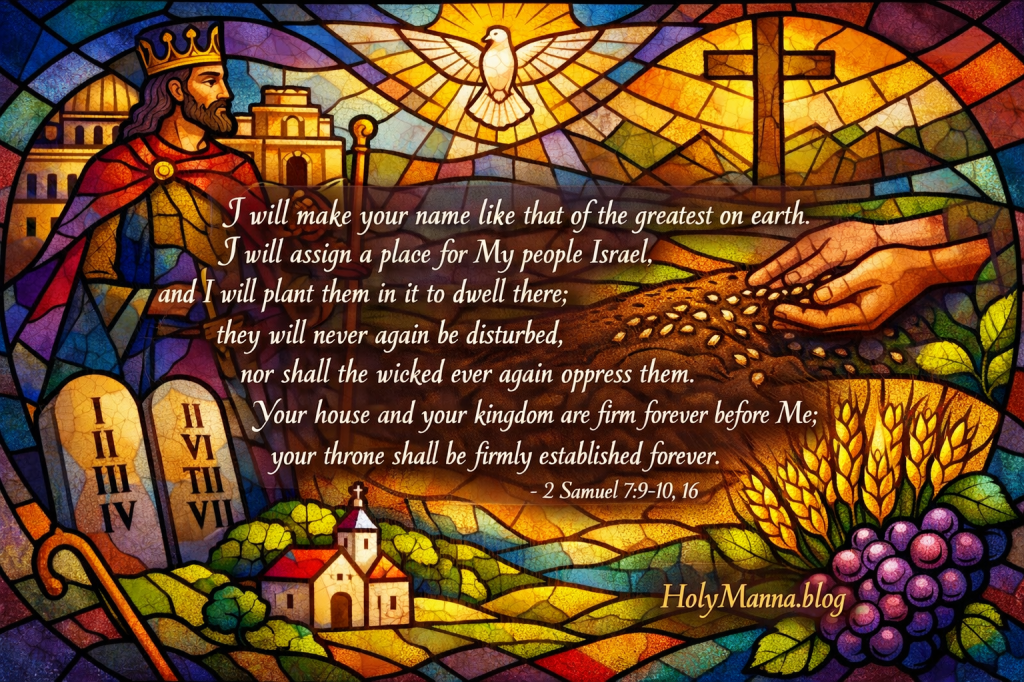
In the First Reading, David wants to build a dwelling for the Lord, a house of cedar that looks worthy of the God of Israel. In the ancient world, kings proved stability through monuments, and temples signaled power, permanence, and divine favor. Yet the Lord speaks through Nathan and flips the whole idea on its head. God reminds David that He has walked with His people since the Exodus, dwelling in the tent of meeting, close to them and not contained by stone. Then God makes a promise that reaches far beyond David’s lifetime: “The LORD also declares to you that the LORD will make a house for you” and “Your house and your kingdom are firm forever before me; your throne shall be firmly established forever” (2 Samuel 7:11, 16). David’s “house” becomes more than a building. It becomes a royal line, a covenant, and a hope that points toward the Messiah.
The Responsorial Psalm answers that promise with worship and confidence, because the Church knows that God’s covenants are not fragile. They are held together by mercy. When the psalm sings, “I will make your dynasty stand forever and establish your throne through all ages” (Psalm 89:5), it is not praising David’s achievements. It is praising the Lord’s fidelity. The father son language rises to the surface as well, preparing the soul to recognize that the promised King is not only David’s heir but also God’s own Son.
That is exactly where the Gospel lands. Jesus speaks the Parable of the Sower, and suddenly the “house” God is building becomes deeply personal. The Kingdom is not established first through bricks, cedar, or even human strength. The Kingdom grows as the Word is sown into hearts and either rejected, choked, shallowly received, or welcomed with perseverance. The same God who promised a forever throne now teaches how citizens of that Kingdom are formed: by hearing, accepting, and bearing fruit. The real question is not whether God is generous with His Word. The real question is whether the heart will become rich soil.
This is why the Memorial of Saint Thomas Aquinas fits like a key in a lock. Thomas shows what happens when the Word is taken seriously with humility, discipline, and prayer. He did not treat faith like a passing inspiration or a private hobby. He let God build an interior house of wisdom, so that truth could be loved, lived, and handed on. What kind of soil is the heart offering to the Lord today, and what would it look like to let Him build something lasting there?
First Reading – 2 Samuel 7:4-17
God Refuses David’s Blueprint So He Can Fulfill His Promise
By the time this passage happens, King David has already brought the Ark of the Covenant into Jerusalem and secured a season of stability for Israel. In the ancient world, a king with peace on his borders would naturally want to build a permanent temple to honor his god and to solidify the nation’s identity. That is exactly what David wants to do, and on the surface it looks like pure devotion. However, the Lord speaks to David through the prophet Nathan and reveals something deeper: God is not impressed by human “religious projects” as if He needs them. God is the One who takes the initiative, the One who establishes covenants, and the One who builds what lasts.
This reading fits perfectly with today’s theme because it teaches that God does not simply accept what the human heart tries to build for Him. God first builds the human heart into a dwelling for His presence through promise, correction, and covenant love. David wants to build God a house, but God promises to build David a “house,” meaning a lasting dynasty that ultimately points to the Messiah. This is covenant theology at the center of Israel’s story, and it becomes the backbone of the Church’s confession that Jesus Christ is the true Son of David whose Kingdom has no end.
2 Samuel 7:4-17 – New American Bible (Revised Edition)
4 But that same night the word of the Lord came to Nathan: 5 Go and tell David my servant, Thus says the Lord: Is it you who would build me a house to dwell in? 6 I have never dwelt in a house from the day I brought Israel up from Egypt to this day, but I have been going about in a tent or a tabernacle. 7 As long as I have wandered about among the Israelites, did I ever say a word to any of the judges whom I commanded to shepherd my people Israel: Why have you not built me a house of cedar?
8 Now then, speak thus to my servant David, Thus says the Lord of hosts: I took you from the pasture, from following the flock, to become ruler over my people Israel. 9 I was with you wherever you went, and I cut down all your enemies before you. And I will make your name like that of the greatest on earth. 10 I will assign a place for my people Israel and I will plant them in it to dwell there; they will never again be disturbed, nor shall the wicked ever again oppress them, as they did at the beginning, 11 and from the day when I appointed judges over my people Israel. I will give you rest from all your enemies. Moreover, the Lord also declares to you that the Lord will make a house for you: 12 when your days have been completed and you rest with your ancestors, I will raise up your offspring after you, sprung from your loins, and I will establish his kingdom. 13 He it is who shall build a house for my name, and I will establish his royal throne forever. 14 I will be a father to him, and he shall be a son to me. If he does wrong, I will reprove him with a human rod and with human punishments; 15 but I will not withdraw my favor from him as I withdrew it from Saul who was before you. 16 Your house and your kingdom are firm forever before me; your throne shall be firmly established forever. 17 In accordance with all these words and this whole vision Nathan spoke to David.
Detailed Exegesis
Verse 4 “But that same night the word of the LORD came to Nathan:”
God’s timing is immediate and personal. David’s idea is not ignored, and Nathan’s role as prophet matters because the king is not the final authority over worship. Israel is not a kingdom where the ruler invents religion. The Lord reveals, and the people receive.
Verse 5 “Go and tell David my servant, Thus says the LORD: Is it you who would build me a house to dwell in?”
The question is not a rejection of David’s love. It is a correction of David’s assumptions. David is acting like God needs housing the way humans do, but the Lord refuses to be reduced to a status symbol. God is transcendent, yet He chooses to be near on His own terms.
God reminds Israel of salvation history. The Lord who delivered them in the Exodus chose to dwell with them in a tent, which signaled closeness and companionship rather than distance. This is also a quiet warning against turning worship into an attempt to control God.
Verse 7 “As long as I have wandered about among the Israelites, did I ever say a word to any of the judges whom I commanded to shepherd my people Israel: Why have you not built me a house of cedar?”
God exposes the hidden pride in the plan. David wants to give God something impressive, but God never demanded it. Worship is not supposed to be driven by ego, competition, or appearances. It is obedience to God’s initiative.
Verse 8 “Now then, speak thus to my servant David, Thus says the LORD of hosts: I took you from the pasture, from following the flock, to become ruler over my people Israel.”
The Lord re-centers David’s identity. David is not self-made. David is chosen, lifted, and entrusted. The title “LORD of hosts” emphasizes God’s sovereignty over all powers, visible and invisible. David’s kingship is a gift and a vocation, not a personal brand.
Verse 9 “I was with you wherever you went, and I cut down all your enemies before you. And I will make your name like that of the greatest on earth.”
God names His providence in David’s life. Victories are not merely military skill. They are signs of God’s presence. The promise of a “great name” anticipates how God raises up the humble, but it also sets the stage for a deeper fulfillment that reaches beyond David himself.
Verse 10 “I will assign a place for my people Israel and I will plant them in it to dwell there; they will never again be disturbed, nor shall the wicked ever again oppress them, as they did at the beginning,”
This is covenant language of security and permanence. God is promising stability for His people, which echoes the deeper biblical pattern of God preparing a dwelling place. Historically, Israel will still face troubles, which signals that this promise ultimately looks forward to a more complete peace under the Messiah.
Verse 11 “and from the day when I appointed judges over my people Israel. I will give you rest from all your enemies. Moreover, the LORD also declares to you that the LORD will make a house for you:”
This is the turning point. David wanted to build a house for God, but God promises to build a house for David. In biblical terms, a “house” means a dynasty, an enduring line. God is teaching David that the covenant is not a transaction. It is grace.
Verse 12 “when your days have been completed and you rest with your ancestors, I will raise up your offspring after you, sprung from your loins, and I will establish his kingdom.”
The promise becomes generational. In the near term, it points toward Solomon. In the long term, the Church recognizes this as part of the messianic promise culminating in Christ. God is building history toward a fulfillment that human planning could never manufacture.
Verse 13 “He shall build a house for my name, and I will establish his royal throne forever.”
Solomon will build the temple, but the word “forever” stretches beyond Solomon’s mortal reign. The temple itself becomes a sign, and the “forever throne” becomes a messianic horizon. This is one reason the angel’s message to Mary is so striking: “The Lord God will give him the throne of David his father, and he will rule over the house of Jacob forever, and of his kingdom there will be no end.” (Luke 1:32-33).
Verse 14 “I will be a father to him, and he shall be a son to me. If he does wrong, I will reprove him with a human rod and with human punishments;”
This father son relationship describes covenant adoption language tied to kingship. The king represents the people, and God fathers the king as a sign of His covenant care. Discipline is included because God’s love is not indulgent. It is formative.
Verse 15 “but I will not withdraw my favor from him as I withdrew it from Saul who was before you.”
God contrasts David’s line with Saul’s failure. The point is not that David’s house will never sin. The point is that God’s covenant mercy will not be revoked in the same way. This prepares the heart for the Gospel’s insistence that fruitfulness depends on receiving the Word and persevering through correction.
Verse 16 “Your house and your kingdom are firm forever before me; your throne shall be firmly established forever.”
This is one of the most important promises in the Old Testament. The Church reads it as a major strand in the unfolding revelation of the Messiah. The Davidic covenant becomes a foundation for the confession that Jesus is King, not by election or conquest, but by divine promise and divine sonship.
Verse 17 “In accordance with all these words and this whole vision Nathan spoke to David.”
God’s Word is delivered faithfully. Nathan does not soften it to please the king. This is a reminder that authentic spiritual guidance tells the truth with reverence, even when it challenges good intentions.
Teachings
This reading reveals a key biblical pattern that shows up again and again: God’s relationship with His people is driven first by grace, not human initiative. That is why The Catechism begins the whole story of salvation with God’s generous purpose, not human achievement: “God, infinitely perfect and blessed in himself, in a plan of sheer goodness freely created man to make him share in his own blessed life.” (CCC 1). David’s desire is real, but God’s plan is deeper. God is building a “house” that will carry salvation forward, not merely a building that will impress a nation.
This passage also teaches how God’s sovereignty and human cooperation fit together. David’s plan is corrected, Solomon will still build the temple, and God remains the primary author of the story. The Catechism describes this kind of divine action with clarity: “God is the sovereign master of his plan. But to carry it out he also makes use of his creatures’ cooperation. This use is not a sign of weakness, but rather a token of almighty God’s greatness and goodness.” (CCC 306). David’s role matters, Nathan’s role matters, and Solomon’s role will matter, but God remains the One building the covenant future.
The father son language in this reading also prepares the heart to recognize Jesus Christ not only as David’s heir, but as the eternal Son who fulfills every promise in a way no merely human king could. The Church sees the Old Testament as real history and real covenant, but also as preparation and prophecy. The Davidic covenant shapes Israel’s hope for a Messiah, and the Gospel reveals that the Kingdom arrives through the Word taking root in hearts. God builds the house from the inside out.
Finally, this passage teaches something very practical about holiness: God sometimes says no to good ideas so that the soul can learn trust. That lesson fits beautifully with a line often attributed to Saint Thomas Aquinas, which captures how grace perfects what is already human: “Grace does not destroy nature, but perfects it.” God does not despise David’s love. God purifies it, redirects it, and makes it serve a promise bigger than David could see.
Reflection
This reading invites a serious but freeing examination of motives. Many people want to do something “big” for God because it feels satisfying, visible, and controllable. God often wants something quieter and harder at first. God wants the heart to surrender control, to accept correction, and to receive the Word like good soil. That is how God builds a lasting house.
A practical way to live this reading is to bring plans to prayer with open hands. A good intention can still be the wrong assignment. Another practical step is to welcome spiritual correction without sulking or spinning. Nathan’s message to David was not an insult. It was mercy. God was protecting David from confusing devotion with self-direction.
This reading also encourages patience with God’s timing. David wanted to build immediately, but God was shaping history toward Christ. That is still how God works. God often writes straight lines through slow seasons, hidden obedience, and humble faithfulness.
Is the heart trying to impress God with a project instead of obeying Him with trust? Is there a good plan that needs to be placed back on the altar so God can purify it or redirect it? When God closes a door, does the soul assume rejection, or does it look for a bigger promise that God is preparing? What would it look like this week to let God build the “house” of prayer, virtue, and perseverance from the inside out?
Responsorial Psalm Psalm 89:4-5, 27-30
When God Makes a Promise, Mercy Holds It Together
Psalm 89 is one of Israel’s great covenant psalms, a prayer that clings to God’s sworn fidelity, especially to the promise made to David. In the life of ancient Israel, the king was not merely a political figure. He was a covenant sign, called to shepherd the people under God’s authority. This psalm remembers that the Lord freely chose David, pledged a lasting dynasty, and tied that promise to mercy that does not quit when human strength fails.
That is why this psalm fits today’s theme so perfectly. The First Reading reveals God’s surprising initiative, because David wants to build God a “house,” and God promises to build David a “house.” Now the psalm becomes the Church’s response, not with anxious bargaining, but with confident worship. It celebrates a God who binds Himself by covenant and keeps His word across generations. That is exactly the kind of divine faithfulness Jesus assumes in the Gospel when He speaks of the Word being sown. The sower is generous because God’s covenant love is generous. The question is whether the heart will receive that Word and let it take root.
Psalm 89:4-5, 27-30 – New American Bible (Revised Edition)
4 I have made a covenant with my chosen one;
I have sworn to David my servant:
5 I will make your dynasty stand forever
and establish your throne through all ages.”
Selah27 He shall cry to me, ‘You are my father,
my God, the Rock of my salvation!’
28 I myself make him the firstborn,
Most High over the kings of the earth.
29 Forever I will maintain my mercy for him;
my covenant with him stands firm.
30 I will establish his dynasty forever,
his throne as the days of the heavens.
Detailed Exegesis
Verse 4 “I have made a covenant with my chosen one; I have sworn to David my servant:”
This verse sets the tone with covenant language that is solemn and binding. God is not making a casual promise. He is swearing by His own authority. Calling David “my servant” also keeps the relationship properly ordered. David is chosen, but he remains a servant under God, not a self-directed hero.
Verse 5 “I will make your dynasty stand forever and establish your throne through all ages.”
The word “forever” is the heart of the Davidic covenant. In the immediate historical sense, Israel experienced political upheaval, exile, and loss of earthly kingship, which forces the faithful to read this promise with deeper spiritual expectation. The Church receives this as ultimately fulfilled in Jesus Christ, the Son of David, whose Kingship is not temporary or territorial but eternal.
Verse 27 “He shall cry to me, ‘You are my father, my God, the Rock of my salvation!’”
This verse reveals the interior posture of the covenant king. He does not claim independence. He cries out like a son to a Father. Calling God “Rock” expresses stability and protection, which is exactly what covenant faith offers in a shifting world. Spiritually, this verse is a lesson in prayer. God’s promises are not meant to produce passivity. They are meant to produce trustful dependence.
Verse 28 “I myself make him the firstborn, Most High over the kings of the earth.”
In biblical language, “firstborn” signals priority, inheritance, and authority. It does not always mean the first in time, but the one given preeminence. This is royal theology that points beyond David to the true King. When the Church proclaims Christ as Lord, it is not borrowing political language for drama. It is proclaiming the fulfillment of God’s covenant plan, in which the Messiah holds supreme authority over every earthly power.
Verse 29 “Forever I will maintain my mercy for him; my covenant with him stands firm.”
This verse ties permanence directly to mercy. God does not maintain covenant because humans never fail. God maintains covenant because His mercy is faithful. The stability of the promise rests on God’s steadfast love, not David’s flawless performance. This is deeply Catholic in its logic, because grace always comes first and sustains what it begins.
Verse 30 “I will establish his dynasty forever, his throne as the days of the heavens.”
The imagery is cosmic and expansive. “As the days of the heavens” signals unshakeable continuity, a reign that cannot be outlasted by history. Once again, the fullest meaning presses toward Christ. Earthly thrones rise and fall, but the Kingdom of God endures.
Teachings
This psalm is a living lesson in how the Church understands salvation history. God makes covenants, and God remains faithful even when His people struggle. The Catechism gives a clear summary of what a covenant is in Scripture and how it reveals God’s heart: “God binds himself to his people by a covenant.” (CCC 56). That is exactly what Psalm 89 is celebrating, because God’s sworn promise is not a vague optimism. It is a binding commitment flowing from divine love.
This psalm also teaches what faith sounds like when it is mature. It does not pretend life is easy. It anchors hope in God’s fidelity. That is why The Catechism describes hope as confidence rooted in God, not in personal strength: “Hope is the theological virtue by which we desire the kingdom of heaven and eternal life as our happiness, placing our trust in Christ’s promises and relying not on our own strength, but on the help of the grace of the Holy Spirit.” (CCC 1817). The psalm’s whole spirit is exactly that, because it rests on God’s promise and God’s mercy.
Saint Thomas Aquinas helps clarify the logic behind this kind of trust. When God promises, He does not promise like a human who might forget, change, or fail. God’s faithfulness is part of who He is. That is why covenant worship is not sentimental. It is rational and grounded. It is also why the Gospel’s parable is not fatalistic. God sows generously because God is faithful, and grace is truly offered, even if it is not always received.
Finally, there is a real historical weight behind this psalm. Israel would later sing this kind of prayer through seasons when the Davidic throne seemed gone. That suffering purified their expectation and sharpened their longing for the Messiah. In that sense, this psalm trained generations to hope for Christ, even when the visible signs looked weak.
Reflection
This psalm is a spiritual anchor for anxious seasons. It teaches that God’s mercy is not a mood. God’s mercy is a covenant commitment. That matters because daily life can feel like a series of small failures, delays, and disappointments. The psalm responds by shifting attention away from personal instability and toward God’s stability. If God maintains His mercy “forever,” then discouragement does not get the final word.
A practical way to live this psalm is to pray it when emotions are loud. It is also wise to bring this psalm into moments of temptation, because temptation often whispers that God is unreliable and that sin is more dependable than grace. This psalm answers with a steady truth: God’s covenant stands firm.
Another practical step is to let this psalm shape how prayer sounds. It is normal to ask God for help, but it is also important to speak to God as Father and Rock, especially when life feels fragile. The psalm gives language for that kind of prayer, and it trains the heart to return to trust instead of spiraling into control.
Where is the heart tempted to believe that God’s mercy runs out when patience runs thin? Does prayer sound like a son speaking to a Father, or does it sound like a worker trying to earn a paycheck? What would change this week if the soul truly believed that God’s covenant love is firmer than shifting circumstances? Which thorny anxieties need to be named and surrendered so the Word can take deeper root and bear real fruit?
Holy Gospel – Mark 4:1-20
The Word Is Sown Generously, but the Harvest Depends on the Heart
In The Gospel of Mark, Jesus teaches the crowds along the Sea of Galilee, a place where fishermen, farmers, and ordinary working families understood the basics of sowing and harvest. A first-century sower did not plant with modern precision. Seed was scattered broadly by hand, and it was normal for some to land on hard footpaths, thin rocky patches, or thorny edges of a field. Jesus takes that everyday scene and turns it into a spiritual diagnosis: the Kingdom of God is not built first through impressive structures, but through the Word of God taking root in real human hearts.
This Gospel fits perfectly with today’s theme. In the First Reading, David wants to build God a house, but the Lord promises to build David a lasting house through covenant. In the Responsorial Psalm, the Church sings confidence that God’s mercy keeps His promises firm. Now Jesus reveals how that covenant life becomes personal: God sows His Word generously, and the “house” God builds is a life that actually receives the Word, holds it through trials, and bears fruit. This is also a quiet warning for every sincere believer. Good intentions are not the same as good soil, and surface-level enthusiasm is not the same as deep conversion.
Mark 4:1-20 – New American Bible (Revised Edition)
The Parable of the Sower. 1 On another occasion he began to teach by the sea. A very large crowd gathered around him so that he got into a boat on the sea and sat down. And the whole crowd was beside the sea on land. 2 And he taught them at length in parables, and in the course of his instruction he said to them, 3 “Hear this! A sower went out to sow. 4 And as he sowed, some seed fell on the path, and the birds came and ate it up. 5 Other seed fell on rocky ground where it had little soil. It sprang up at once because the soil was not deep. 6 And when the sun rose, it was scorched and it withered for lack of roots. 7 Some seed fell among thorns, and the thorns grew up and choked it and it produced no grain. 8 And some seed fell on rich soil and produced fruit. It came up and grew and yielded thirty, sixty, and a hundredfold.” 9 He added, “Whoever has ears to hear ought to hear.”
The Purpose of the Parables. 10 And when he was alone, those present along with the Twelve questioned him about the parables. 11 He answered them, “The mystery of the kingdom of God has been granted to you. But to those outside everything comes in parables, 12 so that
‘they may look and see but not perceive,
and hear and listen but not understand,
in order that they may not be converted and be forgiven.’”13 Jesus said to them, “Do you not understand this parable? Then how will you understand any of the parables? 14 The sower sows the word. 15 These are the ones on the path where the word is sown. As soon as they hear, Satan comes at once and takes away the word sown in them. 16 And these are the ones sown on rocky ground who, when they hear the word, receive it at once with joy. 17 But they have no root; they last only for a time. Then when tribulation or persecution comes because of the word, they quickly fall away. 18 Those sown among thorns are another sort. They are the people who hear the word, 19 but worldly anxiety, the lure of riches, and the craving for other things intrude and choke the word, and it bears no fruit. 20 But those sown on rich soil are the ones who hear the word and accept it and bear fruit thirty and sixty and a hundredfold.”
Detailed Exegesis
Verse 1 “On another occasion he began to teach by the sea. A very large crowd gathered around him so that he got into a boat on the sea and sat down. And the whole crowd was beside the sea on land.”
Jesus teaches with authority, but also with practical wisdom. The boat becomes a natural pulpit, making it easier for the crowd to hear. Spiritually, the image is striking: the Word comes close, but the crowd still has to listen with faith. Proximity to Jesus does not automatically mean receptivity.
Verse 2 “And he taught them at length in parables, and in the course of his instruction he said to them,”
Parables are not childish stories. They are spiritual training. Jesus is forming a people who can recognize the Kingdom when it arrives in hidden, humble ways. The length of His teaching also highlights patience. God is not stingy with truth, but the heart must be willing to stay and learn.
Verse 3 “Hear this! A sower went out to sow.”
Jesus begins with a command, not a suggestion. Listening is the first act of discipleship. The sower’s action shows God’s initiative. Grace goes first. The Word is offered before anyone deserves it.
Verse 4 “And as he sowed, some seed fell on the path, and the birds came and ate it up.”
The path is hardened ground. It cannot receive anything because it is compacted. The birds represent the immediate loss of the Word. This is what happens when the heart is closed by cynicism, constant distraction, or habitual sin. The Word lands, but it never penetrates.
Verse 5 “Other seed fell on rocky ground where it had little soil. It sprang up at once because the soil was not deep.”
The rocky ground can look promising at first. Quick growth can appear like spiritual success. However, shallow soil means shallow roots. This is a warning against confusing emotional excitement with conversion.
Verse 6 “And when the sun rose, it was scorched and it withered for lack of roots.”
The sun is not evil. It simply reveals what is real. Trials, inconvenience, and pressure expose whether faith is rooted or merely impulsive. A person who never develops depth in prayer and perseverance will find that ordinary heat can ruin what looked alive.
Verse 7 “Some seed fell among thorns, and the thorns grew up and choked it and it produced no grain.”
This is one of the most recognizable soils in modern life. The seed is not rejected. It is crowded. The Word is present, but it cannot breathe. The tragedy is not dramatic apostasy. The tragedy is slow suffocation.
Verse 8 “And some seed fell on rich soil and produced fruit. It came up and grew and yielded thirty, sixty, and a hundredfold.”
Good soil does not merely receive the Word. It bears fruit. The abundance shows divine power at work, because ordinary efforts do not explain a harvest like this. Spiritually, fruit means real change, real virtue, real charity, and real perseverance.
Verse 9 “He added, ‘Whoever has ears to hear ought to hear.’”
Jesus presses for a decision. Hearing is not passive. It is moral and spiritual. A person can hear sounds without hearing the Word. True hearing includes obedience.
Verse 10 “And when he was alone, those present along with the Twelve questioned him about the parables.”
The disciples ask questions, which is a sign of humility. They admit they need help. This is already a lesson in how to become good soil: stay close to Jesus, and do not pretend to understand what has not been received.
Verse 11 “He answered them, ‘The mystery of the kingdom of God has been granted to you. But to those outside everything comes in parables,’”
The “mystery” is not a puzzle for smart people. It is a gift for disciples. Jesus draws a line between those who remain outside by resistance and those who enter through trust. The difference is not intelligence. The difference is openness.
Verse 12 “so that ‘they may look and see but not perceive, and hear and listen but not understand, in order that they may not be converted and be forgiven.’”
Jesus quotes prophetic language that reveals a sobering truth: persistent hardness can become its own punishment. God does not delight in withholding mercy, but a heart that refuses conversion also refuses forgiveness. The parable protects the mystery from being trampled by a heart determined not to repent.
Verse 13 “Jesus said to them, ‘Do you not understand this parable? Then how will you understand any of the parables?’”
This parable is foundational. It explains how the Kingdom spreads, why responses differ, and why fruitfulness is not automatic. If a person does not grasp receptivity, then everything else about discipleship stays blurry.
Verse 14 “The sower sows the word.”
Jesus gives the key. The seed is the Word of God. The Kingdom comes through proclamation, hearing, and reception. The battlefield is the heart, not the headlines.
Verse 15 “These are the ones on the path where the word is sown. As soon as they hear, Satan comes at once and takes away the word sown in them.”
Jesus names spiritual warfare plainly. Evil is not only “out there.” It targets the interior life, especially at the moment the Word is heard. This is why carelessness after hearing Scripture can be dangerous. The Word must be guarded through prayer, memory, and obedience.
Verse 16 “And these are the ones sown on rocky ground who, when they hear the word, receive it at once with joy.”
Joy is good, but joy alone is not a root. Some people love the feeling of faith more than the demands of faith. Jesus does not shame their joy. He warns them that joy must deepen into commitment.
Verse 17 “But they have no root; they last only for a time. Then when tribulation or persecution comes because of the word, they quickly fall away.”
The Word provokes resistance in the world and in the flesh. When faith becomes costly, shallow believers feel betrayed. Jesus teaches that trouble is not proof the Word failed. Trouble is often proof the Word is real.
Verse 18 “Those sown among thorns are another sort. They are the people who hear the word,”
These hearers are not indifferent. They are busy. The Word is present, but it is competing. Many people live here without realizing it, because thorns can look like responsibilities, ambitions, and “reasonable” distractions.
Verse 19 “but worldly anxiety, the lure of riches, and the craving for other things intrude and choke the word, and it bears no fruit.”
Jesus names the thorns. Anxiety can dominate attention. Riches can seduce the imagination. Cravings can fill every interior space. None of these require rejecting God outright. They simply crowd Him out until fruitfulness dies.
Verse 20 “But those sown on rich soil are the ones who hear the word and accept it and bear fruit thirty and sixty and a hundredfold.”
Good soil is described with three actions: hearing, accepting, and bearing fruit. Acceptance implies surrender, not mere agreement. Fruit implies perseverance, not brief enthusiasm. The harvest is God’s gift, but the heart must cooperate by staying open.
Teachings
This Gospel teaches that receiving the Word is an act of faith and obedience, not merely an intellectual exercise. The Catechism describes faith with words that fit this parable perfectly: “By faith, man completely submits his intellect and his will to God. With his whole being man gives his assent to God the revealer.” (CCC 143). When the Word is heard and accepted, the heart is doing exactly that. It is submitting, assenting, and trusting.
The parable also teaches that perseverance matters because spiritual life is not sustained by initial excitement alone. Trials do not mean God has left. Trials often reveal whether the Word has roots. This is why Christian maturity cannot be built on vibes, trends, or emotional highs. It must be built on a steady life of prayer, sacramental grace, and obedience to Christ even when it costs something.
The thorny soil is a direct confrontation with modern idols. Anxiety, money, and cravings can become functional gods, shaping decisions and choking charity. This is not only a moral issue. It is a worship issue. Whatever dominates attention and desire begins to dominate the heart.
Saint Thomas Aquinas is a powerful companion to this Gospel because he explains how grace works with human nature in a way that encourages steady growth rather than spiritual shortcuts. His famous line is brief but loaded: “Grace does not destroy nature, but perfects it.” (Saint Thomas Aquinas, Summa Theologiae I, q. 1, a. 8, ad 2). Good soil is not created by pretending to be someone else. Good soil is created when grace perfects ordinary habits, ordinary responsibilities, and ordinary daily choices until they become fertile ground for the Word.
Finally, the abundance of the harvest points to hope. God is not asking for perfection before He gives grace. God is asking for openness that cooperates with grace over time. Hope is not self-confidence. It is confidence in God’s promise and God’s help. The Catechism describes hope in a way that matches the patient growth of good soil: “Hope is the theological virtue by which we desire the kingdom of heaven and eternal life as our happiness, placing our trust in Christ’s promises and relying not on our own strength, but on the help of the grace of the Holy Spirit.” (CCC 1817).
Reflection
This Gospel invites an honest inventory of the heart, and it does not need excuses because Jesus already knows the terrain. The goal is not to label the soul and give up. The goal is to let God cultivate the soil so the Word can actually live and bear fruit.
A good first step is to name the dominant soil pattern right now. A person who feels spiritually numb might be living on the path, hardened by constant noise, resentment, or habitual compromise. A person who starts strong but collapses under pressure might be living on rocky ground, needing deeper roots through consistent prayer and fidelity to the sacraments. A person who stays “generally religious” but never seems to grow might be living among thorns, with anxiety, money, entertainment, or nonstop stimulation quietly choking the Word.
Practical change usually starts small and stays consistent. If the heart feels like the path, silence is not optional, because the Word needs a place to land. If the heart feels rocky, commitment matters more than intensity, so a steady daily rhythm of prayer and a serious relationship with Sunday Mass and confession becomes root-building, not mere routine. If the heart feels thorny, pruning is necessary, because a crowded life does not become fruitful by accident. Good soil is usually formed by choosing the better thing over the urgent thing, again and again, until the Word has room to breathe.
Which soil sounds most like the heart right now, and what evidence proves it? What is one concrete thorn that can be pruned this week so the Word is not constantly crowded out? When suffering or pressure hits, does the soul run, or does it press deeper into prayer and obedience? If the Word truly took root, what fruit would show up in the way time is used, in the way people are treated, and in the way temptations are resisted?
Let God Build Something That Lasts
Today’s readings come together with a simple but life-changing message: God is the One who builds the lasting house, and He does it by planting His Word in a heart that is willing to receive it. In the First Reading, David’s good intentions are purified when the Lord flips the script and promises to build David a “house,” a covenant dynasty that points beyond Solomon to the Messiah. In the Responsorial Psalm, the Church responds with confident worship, because God’s promises stand firm through mercy, not through human perfection. In the Holy Gospel, Jesus brings it home and makes it personal. The Kingdom grows as the Word is sown into real hearts, and the harvest depends on whether the soil is hardened, shallow, crowded, or receptive.
The thread running through everything is God’s initiative and God’s faithfulness. God does not ask for performance first. God offers grace first. The only question that remains is whether the heart will cooperate with that grace long enough for roots to form and fruit to appear.
A strong next step is to stop treating faith like a project that needs constant self-management and start treating faith like a relationship that needs real receptivity. That means making room for the Word, guarding it from distraction, letting it go deeper than feelings, and pruning whatever chokes it. A person does not become good soil by accident. Good soil is formed through prayer, sacramental life, obedience, and patience during trials.
Let today be a clean reset. Let the Word land, let it sink in, and let it shape the day’s decisions in a concrete way. The Lord is not looking for a perfect life before He begins His work. The Lord is looking for an honest heart that will keep showing up, keep listening, and keep choosing Him when it costs something. When that happens, God builds a house that does not collapse, and He brings a harvest that is far bigger than anyone could produce alone.
Engage with Us!
Share reflections in the comments below, because hearing how God is working in other lives strengthens faith and keeps the Word from staying stuck in the head. Take a few minutes to sit with each reading and answer these questions with honesty and hope, because the Lord can do a lot with a heart that is willing to listen.
- First Reading, 2 Samuel 7:4-17: Where has God gently corrected a “good plan” lately, and what bigger promise might He be inviting trust in instead? What would it look like to let God build the “house” of holiness from the inside out rather than trying to manage everything through effort alone?
- Responsorial Psalm, Psalm 89:4-5, 27-30: Where is the heart tempted to doubt God’s mercy because of fear, past failures, or uncertainty about the future? How can prayer sound more like a child speaking to a Father and a Rock, instead of a worker trying to earn approval?
- Holy Gospel, Mark 4:1-20: Which soil best describes the heart right now, and what concrete evidence proves it? What is one thorn that needs to be pruned this week so the Word can breathe and bear real fruit?
Keep showing up for the Lord with humility and consistency, because God loves to build something lasting in ordinary lives. Live a life of faith this week with steady prayer, real repentance, and practical charity, and do everything with the love and mercy Jesus taught, so the Word can grow deep roots and produce a harvest that blesses everyone around you.
Sacred Heart of Jesus, we trust in You!
Immaculate Heart of Mary, pray for us!
Saint Michael the Archangel, defend us in battle!
Follow us on YouTube, Instagram and Facebook for more insights and reflections on living a faith-filled life.

 Holy Manna!
Leave a comment