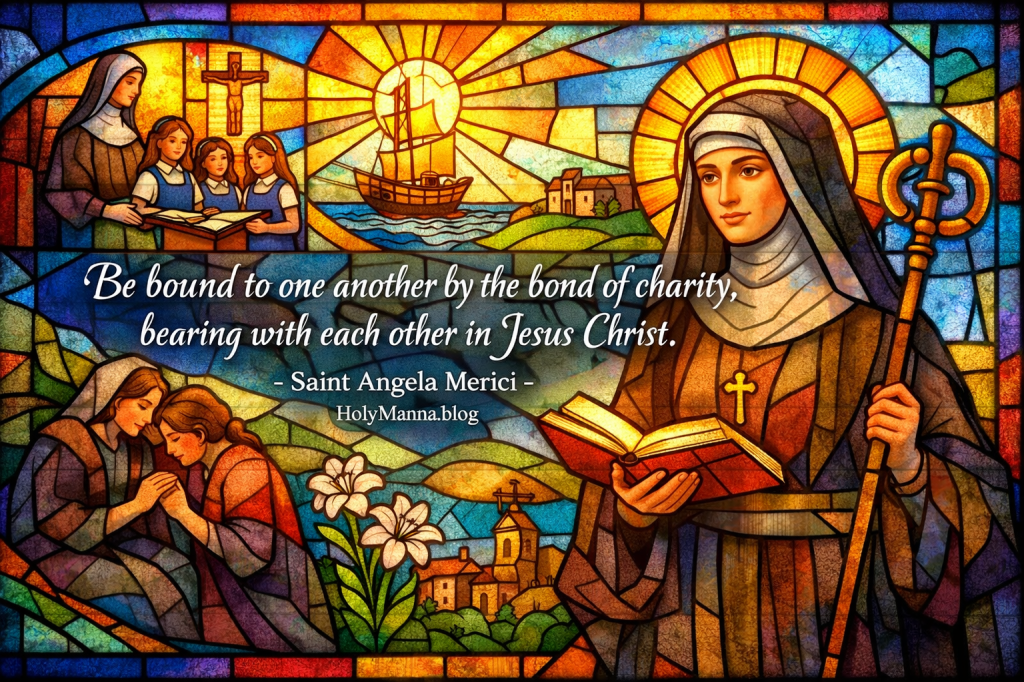
A Saint Who Quietly Rebuilt the Church
Saint Angela Merici did not lead armies, argue in royal courts, or become famous for dramatic public sermons. She became a saint the way most people are called to become saints, through prayer, sacrifice, obedience, and steady love poured into ordinary lives. She lived in northern Italy during the Renaissance, a time of artistic brilliance and social turmoil, and she saw clearly that the Church’s renewal would not come mainly from trends or politics. Renewal would come from Jesus Christ forming hearts, especially through families and through the formation of the young.
Angela is revered because she founded the Company of Saint Ursula, a community of consecrated women dedicated to building up Christian life while remaining present in the world. This was a bold path in her time, and it became a seed that grew into a massive Catholic legacy of education, catechesis, and spiritual motherhood. The Church celebrates her on January 27, and her life still speaks to anyone who wonders if quiet faithfulness can really change anything. It can, and it does, because grace works through humility. CCC 799 to 801 teaches that God gives gifts and charisms for the good of the Church, and Angela’s charism strengthened the Church where it often struggles most, which is the slow, patient work of forming souls.
Orphaned Young and Taught Early to Trust God’s Mercy
Angela was born near Lake Garda in Desenzano, in the late 1400s. Her early life was marked by real loss and a kind of instability that forces a person to grow up fast. She was orphaned while still young and went to live with relatives, which meant she learned early that comfort is not guaranteed, but God’s providence is real. Instead of growing bitter, she grew prayerful, and her heart became the kind of place where the Lord could build something strong.
One of the most painful events remembered in Catholic tradition is the sudden death of her sister, who died without receiving the sacraments. That kind of grief can shake a person’s faith, but Angela’s response was deeply Catholic and deeply human. She leaned into prayer, repentance, and trust in the mercy of God, refusing to believe that despair has the final word. This is the kind of hope the Church teaches, a hope that clings to Christ even when emotions are raw. CCC 1817 to 1821 describes hope as the virtue that keeps the heart steady because it is anchored in God’s promises, not in perfect circumstances.
Angela became a Franciscan tertiary, embracing a life shaped by humility, simplicity, and penance. That was not a lifestyle choice for aesthetics. It was a serious commitment to conversion of heart, and it prepared her to serve others without needing applause. The Church teaches that every Christian is called to holiness and the perfection of charity, and Angela’s early years became a school of that truth. CCC 2013 to 2014 reminds the faithful that holiness is not reserved for a few, and Angela lived as proof.
Consecrated in the World and Devoted to Forming Souls
Saint Angela is most known for founding the Company of Saint Ursula in 1535, with the original dedication traditionally associated with November 25. What made this remarkable was not just the founding itself, but the form it took. These women consecrated themselves to God without immediately withdrawing behind cloister walls. Angela helped open a path for women to live a committed, consecrated vocation while remaining present in daily society, close to families, parishes, and those in need.
This was not rebellion against the Church. It was an act of love for the Church, guided by discernment and obedience. Angela saw the pastoral needs of her time and responded with a mission that fit those needs. She understood that forming girls and young women in Christian virtue was not a side project. It was a strategy for renewing families and strengthening the faith of entire communities. CCC 2221 to 2231 teaches that parents are the first educators of their children and that the wider Christian community supports that mission. Angela’s work supported the family by strengthening the spiritual formation that makes family life resilient and truly Catholic.
Angela also became known as a wise spiritual counselor. People trusted her not because she had power, but because she had holiness that could be felt. She offered counsel, comforted the suffering, and strengthened people facing grief. Catholic tradition remembers her consoling a grieving mother in Brescia, which shows that her mission was never only academic learning. It was the formation of Christian life through charity, truth, and steady spiritual guidance that led people closer to Christ.
Pilgrimage Faith and the Healing of Sight
Angela’s faith was not theoretical, and her spiritual life did not stay locked inside private devotion. She walked her faith out through pilgrimages and acts of trust, and she treated these journeys as moments of penance, discernment, and renewal. Catholic tradition also remembers her traveling to Rome during a Jubilee period, which strengthened her sense that her mission belonged to the Church, not to personal preference or private ambition.
The best-known miracle associated with her life is connected to her 1524 pilgrimage toward the Holy Land. Catholic tradition reports that she lost her eyesight during the journey, often connected with the island of Crete. Instead of giving up and turning back, she continued the pilgrimage in trust, living out the kind of faith most people claim to want but rarely practice. Later, on the return journey, her sight was restored through prayer before a crucifix at the place connected to her loss of vision.
This miracle is not just a story about a body being healed. It is a lesson about spiritual maturity and perseverance. Angela’s life says that faithfulness does not depend on perfect conditions, and it does not depend on constant clarity. Faithfulness depends on Christ, and when the path is dark, the disciple still walks. This is the kind of endurance the Church praises because it shows a heart that trusts God more than comfort. CCC 1500 to 1505 teaches that illness and suffering test the heart, yet they can also lead a person to deeper conversion and reliance on God.
Angela’s words capture that same urgency and confidence. She urged action, courage, and prayer with a faith that sounds almost shocking today because it is so direct. “Act, get moving, believe, exert yourself, hope, cry out to God with all your heart; you will surely see marvels!” This is not shallow optimism. It is a saint teaching Catholics how to cooperate with grace through prayer and real effort.
Enduring Trials With Charity and Courage
Saint Angela was not martyred, but she was tested. She carried the wounds of early loss, lived with the vulnerability of a lay consecrated woman in a complicated era, and guided a movement that did not fit neatly into the categories people were used to. That kind of mission brings resistance, misunderstanding, and pressure, even when no one is throwing stones. Angela endured these challenges with patience, prayer, and a steady refusal to become harsh or cynical.
She also had to lead women in a culture that did not always understand the spiritual authority of a holy woman. Yet she did not become bitter, and she did not become prideful. She became more rooted in charity. She understood something that feels especially relevant now, which is that division destroys communities from the inside, and charity rebuilds them. CCC 1822 to 1829 teaches that charity is the heart of Christian perfection, and Angela demanded that her spiritual daughters live it for real, not only talk about it.
Her emphasis on unity is a message Catholics need when tempers run hot and opinions turn into grudges. She insisted on patient love and practical mercy inside community life. “Be bound to one another by the bond of charity, bearing with each other in Jesus Christ.” That line is not sentimental. It is a call to carry each other like Christians, with truth, patience, and forgiveness.
Signs After Death and a Mission That Kept Growing
Angela died on January 27, 1540, and devotion to her spread quickly. Catholic tradition records intense veneration after her death, including reports that many visited her body over an extended period and regarded its condition as a sign of sanctity. The Church is careful about how these signs are interpreted, but the faithful have always seen them as encouragement. God often strengthens the people by reminding them that holiness is real and that saints are not myths.
Her legacy after death is even more obvious. The Company of Saint Ursula endured, developed, and expanded, even as later centuries brought changes and different forms of Ursuline life in different places. The important point is that Angela’s charism did not fade. It multiplied. Her spiritual motherhood became a worldwide Catholic force for education, catechesis, and the formation of young people, especially girls and young women. CCC 914 to 933 teaches that consecrated life is a gift to the Church and a sign of the Kingdom, and Angela’s legacy shows what happens when that gift is lived with discipline and joy.
Angela also left behind a written spiritual legacy remembered in Catholic tradition, including her Rule, Counsels, and Testament. Even when these were dictated rather than written in a scholar’s study, they preserved the heart of her vision, which was a community bound by charity, disciplined in prayer, and faithful to the Church. Her spirituality remains Christ-centered and practical, the kind of spirituality that builds strong Catholics who can live the faith in the real world.
Bringing Angela’s Wisdom Into Everyday Catholic Life
Saint Angela Merici is a strong antidote to modern spiritual laziness and modern spiritual chaos. She shows that holiness is built through habits, not hype, and through obedience, not self invention. Her life invites Catholics to take formation seriously, starting with the home and extending into parish life, schools, friendships, and mentoring relationships. The Church teaches that the family is the domestic church and that the faith is meant to be handed on with intention. CCC 1655 to 1658 and CCC 2221 to 2231 both reinforce that this is not optional for a Catholic who wants to live the faith honestly.
Her example also teaches perseverance in trial. Angela did not wait for life to become easy before she served. She served while grieving. She served while misunderstood. She served when the path was dark, and she trusted Christ to lead. This is the kind of Catholic courage needed today. It is not loud courage. It is steady courage. It is the courage that prays, obeys, and keeps showing up even when it feels unnoticed.
How would life change if the faith was treated like a mission and not just a mood?
Where is God asking for a calm, disciplined yes, even if nobody applauds it?
Who needs patient formation, encouragement, or a stronger example of Catholic life right now?
Engage with Us!
Share your thoughts and reflections in the comments below.
- Which part of Saint Angela Merici’s story feels most relevant today, her early suffering, her courage in mission, or her focus on formation?
- What is one concrete way to strengthen Catholic formation in daily life, whether in the home, in friendships, or through parish involvement?
- Where does charity need to be rebuilt, especially with someone difficult, so that unity becomes a real Christian witness?
- What would it look like this week to live Angela’s challenge to “act, get moving” with faith instead of hesitation?
Keep walking forward in faith. Keep forming hearts patiently. Keep choosing the love and mercy Jesus taught, and let that steady Catholic courage shape every word, every decision, and every relationship.
Saint Angela Merici, pray for us!
Follow us on YouTube, Instagram and Facebook for more insights and reflections on living a faith-filled life.

 Holy Manna!
Leave a comment