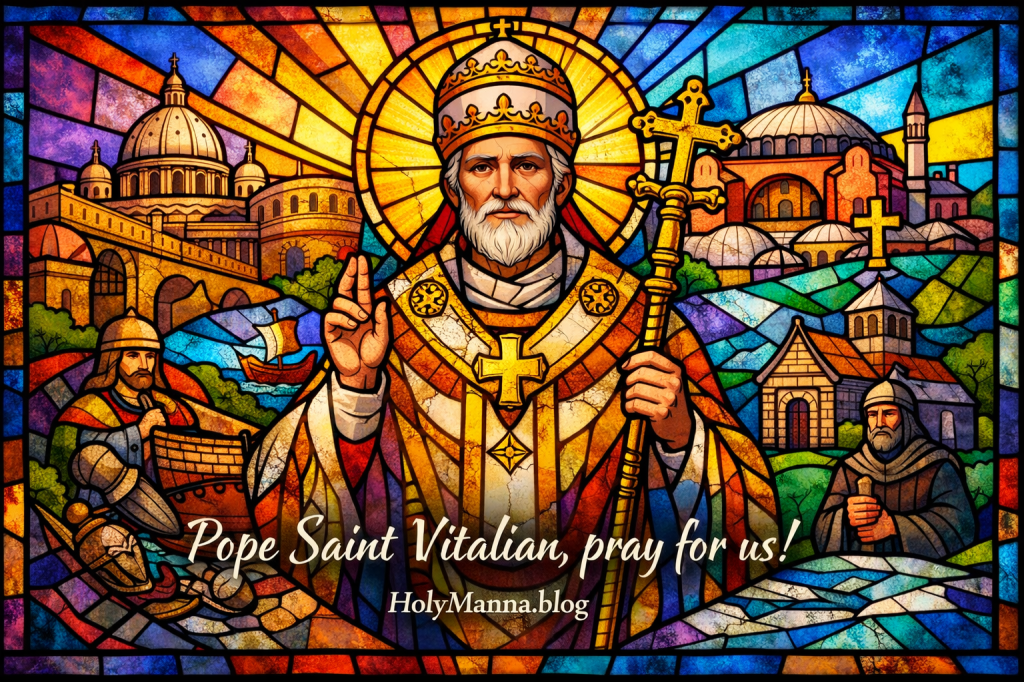
The Pope Who Held the Line with Peace
Pope Saint Vitalian served as Bishop of Rome from 657 to 672, and his whole pontificate reads like a lesson in spiritual steadiness. This was not an era where a pope could focus only on local matters and ignore the wider world. The Church was caught in a storm of political power plays, theological tension, and wounded relationships between East and West. The Church reveres Vitalian as a saint because he governed like a shepherd, not like a politician, and because he worked for unity without treating doctrine like something negotiable.
In every age, Catholics feel the tension between wanting peace and needing truth. Saint Vitalian’s life shows that real peace is never built by pretending differences do not matter. Real peace is built when the Church clings to Jesus Christ, who is Truth Himself. The pope’s ministry is meant to serve that unity, and CCC 882 teaches it plainly: “The Pope, Bishop of Rome and Peter’s successor, is the perpetual and visible source and foundation of the unity.” His sanctity is tied to that mission. He did not chase applause, and he did not shrink back when unity became expensive.
A Quiet Beginning That Speaks Loudly
Catholic sources preserve only a few reliable details about Vitalian’s early life, and that humility is almost fitting. He came from Segni in Italy, and his father was named Anastasius. Beyond that, the record goes quiet, which is not unusual for a seventh-century pope. That silence can actually be a gift because it forces attention where the Church places it. The Church looks less at the trivia of a life and more at the fruit of fidelity.
There is no dramatic conversion story recorded for Vitalian, but conversion does not always look like a sudden lightning strike. Many saints are formed through years of ordinary obedience, prayer, and responsibility. Vitalian was elected after the death of Pope Eugene I, and he was consecrated on July 30, 657. From that moment forward, his life became public in a serious way. He carried the burden of guiding the Church through conflict without letting conflict shape his soul.
Unity Without Compromise
Vitalian is most known for how he navigated the tense relationship between Rome and Constantinople during the long controversy tied to Monothelitism. The dispute was not merely academic. It touched how Christians speak about the Lord Jesus Christ and how the Church protects the truth handed down from the Apostles. Political leaders often wanted a settlement that would quiet the noise without actually resolving the doctrinal problem, but the Church cannot purchase peace by blurring the faith.
Vitalian chose a path that requires real courage. He kept communication open, not to flatter emperors or patriarchs, but to pursue communion without surrender. He sent formal letters to Emperor Constans II and to the Patriarch of Constantinople, and for a time relations improved enough that his name was placed on the diptychs in Constantinople. That was a serious sign of restored ecclesial recognition. Yet the peace was fragile. Later his name was removed again, and the wider doctrinal crisis continued beyond his lifetime. The final condemnation of Monothelitism would come later at the Sixth Ecumenical Council. Vitalian did not live to see the end of the controversy, but his papacy helped keep the Church from drifting. He held the line with patience, and he trusted God to finish what he could not.
The Emperor’s Visit and the Sting of Betrayal
One of the most dramatic moments of Vitalian’s pontificate came in 663 when Emperor Constans II visited Rome. This was extraordinary in itself. Vitalian received him with solemn honor, accompanied him to Saint Peter’s, and the emperor participated in liturgical celebrations. On the surface, it looked like a moment of reconciliation and respect between Rome and the imperial world.
Then came the ugly turn. When Constans II left Rome, he removed large amounts of bronze works and treasures from the city, including material taken from the Pantheon, which had long been used as a Christian church. This detail stings because it shows how the Church could be treated by the powerful even when those powerful men claimed Christian identity. Vitalian’s holiness shines here because he served the Church in a world where political friendships could become exploitation. His task was not to win imperial approval. His task was to guard the Church’s worship, unity, and integrity even when the world acted like the world.
Ravenna’s Rebellion and the Cost of Communion
Vitalian also faced a major internal struggle when the Archbishop of Ravenna attempted to detach his see from Roman authority. Ravenna was influential, politically connected, and not interested in correction. The conflict became bitter enough that Vitalian excommunicated the archbishop Maurus, and Maurus responded with the audacity of attempting to excommunicate the pope. It sounds unbelievable, but it reveals the stakes. This was not petty drama. It was a real threat to visible unity.
The emperor supported Ravenna and issued an edict that weakened Rome’s jurisdiction there for a time. Eventually the situation was reversed after Vitalian’s death, but his firm response still mattered. He demonstrated that unity requires real authority and that authority must be exercised as service to truth. This connects naturally to the Church’s teaching about communion and leadership. In CCC 882, the pope’s role is presented as a visible foundation of unity. Vitalian’s life shows what that looks like in real history, with real resistance, and with real consequences.
Rome as a Father and Judge for the Wider Church
A surprising aspect of Vitalian’s papacy is how it shows Rome functioning as a court of appeal beyond the Latin West. One notable case involved John of Lappa in Crete. John had been deposed, and when he appealed to Rome he was even imprisoned for daring to appeal. Vitalian responded through synodal judgment and demanded that John be restored. He also addressed disciplinary matters connected to clerical conduct in the same correspondence, which shows how seriously the Church treated holiness and order.
This is important because it reveals a pope who understood his office as service. The papacy is not merely ceremonial, and it is not simply a platform for strong opinions. It is meant to protect unity, defend justice, correct abuses, and strengthen discipline for the sake of the Gospel. Vitalian’s pontificate shows that kind of leadership. It is quiet, practical, and often unglamorous, but it keeps the Church from bleeding out in the long run.
England’s Turning Point and a Gift That Lasted
Vitalian’s legacy becomes especially bright when looking at the Church in England. After the Synod of Whitby, leaders sought unity with Roman practice, especially concerning the dating of Easter. A priest named Wighard was sent to Rome to be consecrated Archbishop of Canterbury, but he died in Rome before that could happen. That sudden loss could have left the English Church divided and leaderless at exactly the wrong time.
Vitalian responded with careful wisdom. He appointed Theodore of Tarsus as Archbishop of Canterbury and sent him with Abbot Hadrian. Theodore’s mission helped organize the Church in England with stronger unity, discipline, and connection to the wider Catholic world. This decision shaped generations. It was not a flashy move, but it was a foundational one. There is also a tradition connected to this growing bond that points to early papal protection of English monastic life, including Medeshamstede, later known as Peterborough. Even if the name is unfamiliar, the point is clear. Catholic unity was growing across cultures, and Vitalian helped strengthen that communion.
Miracles, Legends, and Catholic Honesty
Some saints are remembered for extraordinary miracles. In the major Catholic historical accounts, Pope Saint Vitalian is not presented with a list of well attested miracle stories performed during his lifetime. That does not diminish his holiness. It clarifies it. The Church does not need exaggeration to honor a saint. Holiness is not measured by how dramatic the stories sound. Holiness is measured by fidelity to Christ.
There is also an old claim that Vitalian introduced the organ into church worship. This tradition has been repeated, but careful Catholic scholarship treats the claim as doubtful. That detail is worth mentioning because it shows a healthy Catholic instinct. Devotion should never require stretching the truth. When evidence is weak, serious Catholic sources say so. That honesty protects the faithful from confusing pious legend with history, and it keeps attention on what truly matters about the saint.
A Holy Death and an Enduring Witness
Pope Saint Vitalian died on January 27, 672, and tradition holds that he was buried at Saint Peter’s. The Church commemorates him on January 27, and that liturgical memory is a quiet but powerful sign that his life mattered to the faithful across centuries. Major Catholic reference accounts do not preserve a widely known stream of posthumous miracle stories connected to his relics or a famous pilgrimage culture built around his name. His veneration rests primarily on recognized holiness and on the enduring impact of his governance.
His legacy after death is written into the Church’s memory of unity. He helped keep Rome and Constantinople from collapsing into complete rupture during a dangerous era. He defended the Church’s rightful authority when challenged by local power. He strengthened England through an appointment that shaped a whole region’s Catholic future. This is a saint for anyone who thinks ordinary faithfulness does not matter. God uses steady people, and God uses patient shepherds.
Living the Lesson of Saint Vitalian Today
Saint Vitalian teaches that Christian maturity is not measured by how loud someone can be. It is measured by how faithful someone can be. Modern life is full of arguments, factions, and quick outrage. His pontificate encourages a steadier path. Unity must be pursued, but it must be unity rooted in Christ, not unity built on ignoring truth. Authority must be respected, but it should also be exercised with humility and charity, because leadership in the Church is meant to look like service.
This can be applied in everyday life in a very practical way. Disagreements at home or in parish life do not have to become wars. Catholics can learn to speak clearly without speaking cruelly. Catholics can learn to stay calm without becoming passive. Catholics can learn to pray for Church unity without treating doctrine like a hobby. How often does pride disguise itself as “being right,” when the Lord is really asking for humility and charity? Saint Vitalian’s example fits perfectly with the Church’s teaching on communion. It is a reminder that holiness often looks like patience, prayer, and steady obedience when it would be easier to panic.
Engage with Us!
Share thoughts and reflections in the comments below.
- Where has God been asking for patience and steadiness instead of a dramatic “big move”?
- When unity feels impossible, what would it look like to pursue peace without surrendering truth?
- How can Catholic charity show up in disagreements at home, at work, or in parish life this week?
- What is one concrete way to support the Church’s unity through prayer, humility, and faithful speech?
May Pope Saint Vitalian’s quiet courage strengthen trust in Christ and love for His Church. Keep walking in faith, keep choosing prayer over panic, and keep doing everything with the love and mercy Jesus taught us, because that is how saints are formed in every generation.
Pope Saint Vitalian, pray for us!
Follow us on YouTube, Instagram and Facebook for more insights and reflections on living a faith-filled life.

 Holy Manna!
Leave a comment