Tuesday of the Third Week in Ordinary Time – Lectionary: 318
When the King Comes Close
It is easy to treat God like a background presence, as if He belongs on the edges of life instead of at the center of it. Today’s readings call for something bolder and more honest. The central theme tying everything together is this: God comes near as the true King, and those who welcome Him with worship and obedience are gathered into His household.
In the First Reading from 2 Samuel 6:12-15, 17-19, Israel is not dealing with an abstract idea of God. The Ark of the Covenant represents the Lord’s dwelling among His people, the holy sign of His kingship and His saving power. David brings the Ark into Jerusalem with joy, sacrifice, and public worship because God’s presence is not meant to be hidden or tamed. In that cultural world, a king did not only rule by politics, he also led the people in right worship. David’s dancing and offerings show what it looks like when leadership becomes surrender and when the heart refuses to be embarrassed about loving God.
The Responsorial Psalm, Psalm 24:7-10, sounds like a liturgical chant sung at the city gates, as if creation itself is being told to make room for the Lord. The repeated cry is not simply poetic. It is a proclamation that the God of Israel is the victorious King of Glory, worthy to enter His sanctuary and reign among His people. When that Psalm is prayed alongside the Ark’s entrance, it becomes clear that worship is about welcoming the Lord as King, not just acknowledging Him as an idea.
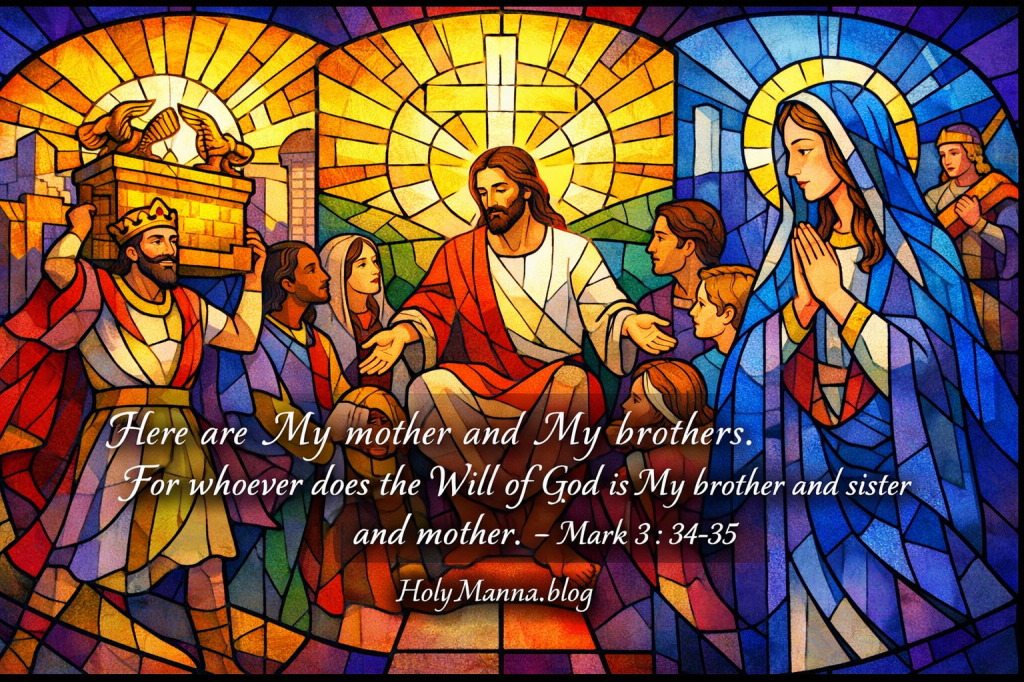
Then the Holy Gospel from The Gospel of Mark 3:31-35 brings everything to fulfillment in Christ. Jesus does not deny His mother or dismiss family bonds. He reveals that God’s kingdom forms a new kind of family, one built on doing the will of God. The King of Glory does not only enter a city with shouting and song. He enters hearts, and He gathers disciples into communion with Himself. This is the thread running through the whole day: God draws near, and the right response is not distance or mere respectability. The right response is worship that is real, obedience that is concrete, and a life opened wide so the King can enter and make His home.
First Reading – 2 Samuel 6:12-15, 17-19
When God Comes Home, Joy Becomes Worship
This scene takes place at a turning point in Israel’s life. King David has secured Jerusalem as the political center of the kingdom, but he knows something even more important has to happen. The Ark of the Covenant, the sacred sign of the Lord’s presence among His people, must be brought into the City of David. In the religious world of ancient Israel, the Ark was not a lucky charm and it was not a museum piece. It represented the Lord’s kingship, His covenant, and His nearness to His people. That is why David responds with sacrifice, public praise, and even dancing, because the arrival of the Ark means the Lord is taking His place at the heart of Israel’s life.
This reading fits today’s theme perfectly because it shows what it looks like to welcome the King of Glory with the whole heart. Psalm 24 calls the gates to open for the King to enter, and The Gospel of Mark reveals that the Lord’s kingdom also creates a new family shaped by obedience. David’s joy is not random emotion. It is the proper response of a people who recognize that God is not distant, and that true worship changes an entire city, an entire culture, and eventually an entire life.
2 Samuel 6:12-15, 17-19 – New American Bible (Revised Edition)
12 When it was reported to King David that the Lord had blessed the household of Obed-edom and all that he possessed because of the ark of God, David went to bring up the ark of God from the house of Obed-edom into the City of David with joy. 13 As soon as the bearers of the ark of the Lord had advanced six steps, he sacrificed an ox and a fatling. 14 Then David came dancing before the Lord with abandon, girt with a linen ephod. 15 David and all the house of Israel were bringing up the ark of the Lord with shouts of joy and sound of horn.
17 They brought in the ark of the Lord and set it in its place within the tent which David had pitched for it. Then David sacrificed burnt offerings and communion offerings before the Lord. 18 When David had finished sacrificing burnt offerings and communion offerings, he blessed the people in the name of the Lord of hosts, 19 and distributed among all the people, the entire multitude of Israel, to every man and every woman, one loaf of bread, one piece of meat, and one raisin cake. Then all the people returned to their homes.
Detailed Exegesis
Verse 12 When it was reported to King David that the Lord had blessed the household of Obed-edom and all that he possessed because of the ark of God, David went to bring up the ark of God from the house of Obed-edom into the City of David with joy.
David is responding to a concrete sign of blessing. The Ark’s presence brings favor, which teaches Israel that God’s holiness is not sterile or lifeless. When the Lord is welcomed rightly, His presence is life-giving. David’s decision also shows leadership in faith. He does not want God’s presence on the sidelines. He wants the worship of the Lord at the center of national life.
Verse 13 As soon as the bearers of the ark of the Lord had advanced six steps, he sacrificed an ox and a fatling.
The sacrifices underline reverence and obedience. Earlier in this larger story, Israel learned the hard way that God’s holiness cannot be handled casually. Here, every step is treated as sacred. The sacrifices also express atonement and communion, reminding readers that joy in God is not sentimental. It is rooted in covenant fidelity, humility, and right worship.
Verse 14 Then David came dancing before the Lord with abandon, girt with a linen ephod.
David’s dancing is worship, not performance. The linen ephod is associated with priestly service, which highlights David’s role as king leading the people in honoring God. This is not David trying to look impressive. This is David lowering himself in love before the Lord. Genuine worship often looks foolish to a proud world because it refuses to put the ego first.
Verse 15 David and all the house of Israel were bringing up the ark of the Lord with shouts of joy and sound of horn.
The whole community is involved. Worship is personal, but it is never meant to be private-only. The procession, the shouting, and the horn are signs of liturgy: a public act of praise where the people agree together that the Lord is King. This verse also prepares the heart for Psalm 24, where the “gates” are commanded to open for the King of Glory.
Verse 17 They brought in the ark of the Lord and set it in its place within the tent which David had pitched for it. Then David sacrificed burnt offerings and communion offerings before the Lord.
The Ark is enthroned, so to speak, in its proper place. David prepares a tent as a sacred space, which echoes the tabernacle tradition of Israel’s worship. The burnt offering expresses total surrender to God, and the communion offerings express restored fellowship. This is the pattern: God draws near, the people respond with surrender, and communion is renewed.
Verse 18 When David had finished sacrificing burnt offerings and communion offerings, he blessed the people in the name of the Lord of hosts.
David does not keep the blessing to himself. Worship overflows into mission, which begins with blessing. The title “Lord of hosts” proclaims God’s authority over all powers, earthly and spiritual. This blessing also signals that when God is placed at the center, the people become ordered toward life, peace, and unity under His kingship.
Verse 19 and distributed among all the people, the entire multitude of Israel, to every man and every woman, one loaf of bread, one piece of meat, and one raisin cake. Then all the people returned to their homes.
The arrival of the Ark leads to generosity. Notice the detail that every man and every woman receives food. Worship produces communion among the people, and communion produces concrete care. The people return home strengthened, not merely inspired. The movement is important: God is welcomed, sacrifice is offered, blessing is given, and the community is fed.
Teachings
This reading is a strong corrective to the modern habit of treating worship as optional or purely internal. David teaches that when God is truly recognized as King, worship becomes embodied, joyful, and reverent. It involves sacrifice, humility, and public praise. It also spills out into charity and communion, because people who adore the Lord cannot stay closed off from one another.
This is where Catholic worship becomes especially clear. The Church does not treat worship as a self-made expression of personal preference. Worship is a response to God’s initiative, and it is centered on the Eucharist, where the Lord is not symbolically near but truly present. The Catechism states this plainly in CCC 1324: “The Eucharist is ‘the source and summit of the Christian life.’” If David rejoiced to welcome the Ark, Catholics have even more reason to rejoice because the Eucharist is not a sign of God’s presence only. It is the Lord Himself, given for the life of the world.
The same point becomes even sharper in CCC 1374, which explains what the Church means by the Real Presence: “In the most blessed sacrament of the Eucharist ‘the body and blood, together with the soul and divinity, of our Lord Jesus Christ and, therefore, the whole Christ is truly, really, and substantially contained.’” David’s procession teaches reverence and joy before God’s presence. Catholic faith recognizes that this presence reaches its fullness in Christ known and adored in the Eucharist.
The distribution of food also matters. It shows that true worship forms a people who share. In every age, the temptation is to make religion a private experience that does not change how anyone treats others. David’s liturgy ends in generosity, which is a quiet prophecy of how God’s presence should shape a community. The King comes close, and the people become more united, more grateful, and more willing to give.
Reflection
David’s example invites a simple but challenging examination of the heart. Worship is not meant to be cold, controlled, or embarrassed. It is meant to be reverent and real, because God is real. Many people have learned to keep faith hidden so they can keep their image safe. David does the opposite. He risks looking foolish because honoring the Lord matters more than managing appearances.
A practical step is to bring David’s posture into daily prayer and especially into Mass. Reverence is not about being stiff. Reverence is about being awake to who God is. Joy is not about noise. Joy is about letting gratitude show up in the face, the voice, and the choices.
Another practical step is to imitate the last verse of the reading. Worship should make people more generous and more attentive to others. If prayer and Mass never lead to charity, something is missing. The King of Glory does not enter a life only to decorate it. He enters to reign, and His reign always produces love.
Is worship treated like an obligation to survive, or like a meeting with the living God who blesses His people? What would change if the heart stopped worrying about looking impressive and started caring more about honoring the Lord? Who needs a “loaf of bread” today in the form of help, attention, forgiveness, or encouragement, given freely because God has been welcomed first?
Responsorial Psalm – Psalm 24:7-10
Open the Gates, Because the Real King Is Here
This Psalm sounds like a conversation at the city gates, and that is exactly how it has often been understood. In Israel’s worship, Psalm 24 was associated with the Lord entering His holy place in triumph, especially in moments when the people processed toward the sanctuary in praise. Prayed alongside today’s First Reading, it fits like a key in a lock. David is bringing the Ark into Jerusalem, and the Psalm commands the gates to open wide because the Lord Himself is coming to reign among His people.
The religious message is not subtle. God is not a guest who needs a polite welcome. He is the King of Glory, the Lord of hosts, the One who defeats His enemies and saves His people. That is why the Psalm speaks of strength, might, and victory. It also prepares the heart for the Holy Gospel, because when Jesus names those who do God’s will as His true family, He is revealing what it looks like when the King actually enters. The gates are not only made of wood and iron. The gates can be the heart, the mind, the home, and the daily choices that either welcome Christ or keep Him waiting outside.
Psalm 24:7-10 – New American Bible (Revised Edition)
7 Lift up your heads, O gates;
be lifted, you ancient portals,
that the king of glory may enter.
8 Who is this king of glory?
The Lord, strong and mighty,
the Lord, mighty in war.
9 Lift up your heads, O gates;
rise up, you ancient portals,
that the king of glory may enter.
10 Who is this king of glory?
The Lord of hosts, he is the king of glory.
Selah
Detailed Exegesis
Verse 7 Lift up your heads, O gates; be lifted, you ancient portals, that the king of glory may enter.
The Psalm speaks to the gates as if they were alive, because worship uses poetry to announce something greater than architecture. The “ancient portals” evoke Jerusalem’s old gates and the holiness of the place where God is worshiped. The command to “lift up” is more than a physical image. It is a call to make room for God’s kingship. This verse harmonizes with today’s theme by showing that God’s coming demands a response. He is welcomed, not ignored.
Verse 8 Who is this king of glory? The Lord, strong and mighty, the Lord, mighty in war.
The question and answer sound like a liturgical dialogue. One group calls for the gates to open, and another asks who is worthy to enter. The answer is not a human king. It is the Lord Himself. The phrase “mighty in war” does not mean God is violent in a worldly way. It means God is victorious over the powers that enslave His people. In the Old Testament, that includes enemies and chaos. In the full light of Christ, it includes sin, death, and the devil. God is strong enough to save, and that is why He deserves to reign.
Verse 9 Lift up your heads, O gates; rise up, you ancient portals, that the king of glory may enter.
The repetition is deliberate because worship forms memory and desire. When the heart forgets, the Psalm repeats. When the will resists, the Psalm repeats. This second call intensifies the invitation. It also hints at something personal. The heart needs repeated conversion. A door that has been shut for years often needs more than one knock.
Verse 10 Who is this king of glory? The Lord of hosts, he is the king of glory. Selah
Here the Psalm reaches its climax. “Lord of hosts” proclaims God as commander of the heavenly armies and Lord over every power. Nothing in heaven or on earth rivals Him. The word “Selah” is a pause that invites reverent silence and contemplation. It is as if the Psalm says, “Stop and let this sink in.” The King is not coming eventually. The King is here, and He must be received with awe, trust, and obedience.
Teachings
This Psalm teaches that worship is fundamentally about God’s kingship. He is not a life coach and He is not a spiritual accessory. He is the Lord. The Church’s faith has always insisted that the proper response to God is adoration, because God is the highest good and the source of every blessing.
The Catechism describes adoration as the basic attitude of the creature before the Creator. It says in CCC 2628: “Adoration is the first attitude of man acknowledging that he is a creature before his Creator. It exalts the greatness of the Lord who made us and the almighty power of the Savior who sets us free from evil. Adoration is homage of the spirit to the ‘King of Glory,’ respectful silence in the presence of the ‘ever greater’ God. Adoration of the thrice-holy and sovereign God of love blends with humility and gives assurance to our supplications.” That is basically Psalm 24 put into the Church’s own words. Open the gates. Bow the heart. Let respectful silence return. Then speak and ask with confidence.
Saint Augustine also reads this Psalm as more than a historical chant. He takes the image of the gates and applies it to the interior life. The call to lift up the gates becomes a call to lift the heart from pride, from sin, and from everything that blocks God’s reign. His point is simple and sharp. If the King is truly glorious, then the heart has to become a worthy entrance, not by self-made perfection, but by humility and repentance.
In Christian tradition, this Psalm has also been prayed with Christ’s victory in mind. The Lord who is “mighty” is ultimately the crucified and risen Christ who conquers death. The gates open because the true King has won. That fits perfectly with today’s Gospel, where Jesus does not only teach about God’s will. He gathers those who do it into His own family, which is the living sign that His kingdom has arrived.
Reflection
This Psalm is a strong reality check because it forces a decision. Either the gates open, or they stay shut. Many people want a God who blesses them but never challenges them. Psalm 24 does not allow that. The King of Glory is not content to be visited occasionally. He wants to enter and reign.
A practical way to live this Psalm is to make the “gates” concrete. The gate could be the morning routine, because the first minutes of the day often determine the entire day’s direction. The gate could be the phone, because what gets consumed forms the imagination and the desires. The gate could be the mouth, because speech can either honor God or build a kingdom of ego. The gate could be the home, because a house can be opened to grace or crowded out by resentment and distraction.
The Psalm also teaches that the heart needs repetition. Conversion usually does not happen once and then stay finished. The Psalm repeats the call because the soul needs repeated surrender. The good news is that the King who enters is not coming to crush. He is coming to save, to heal, and to make a new family of those who do the will of God.
What “gate” is kept shut most often, the schedule, the habits, the grudges, or the hidden sins that no one wants to name? If the King of Glory walked into the day like a real King, what would change first, the words, the entertainment, the priorities, or the way others are treated? What would it look like to offer the Lord “respectful silence” today, so that His presence is not crowded out by constant noise?
Holy Gospel – Mark 3:31-35
When Jesus Redefines Family, He Is Calling Everyone Higher
In first century Jewish culture, family bonds were everything. Identity, protection, reputation, and even survival were deeply tied to the household. So when Mary and Jesus’ relatives arrive and send word to Him, it is not a casual interruption. It is a serious moment, especially in The Gospel of Mark, where tension is rising and Jesus is already being misunderstood. The crowd is gathered around Him inside, and His family is outside calling for Him, which sets up a sharp contrast between physical proximity and spiritual belonging.
This Gospel fits today’s theme because it reveals what happens when the King of Glory actually enters and claims His throne. In the First Reading, David leads Israel in welcoming God’s presence into the city. In Psalm 24, the gates are commanded to lift up so the King can enter. Here, Jesus shows that the true “gates” are the human heart and the human will. The King gathers a new family, not through bloodlines or social status, but through obedience to God. The surprise is that this does not push Mary away. It shows why Mary is truly blessed, because she is the first and best example of doing the will of God.
Mark 3:31-35 – New American Bible (Revised Edition)
Jesus and His Family. 31 His mother and his brothers arrived. Standing outside they sent word to him and called him. 32 A crowd seated around him told him, “Your mother and your brothers [and your sisters] are outside asking for you.” 33 But he said to them in reply, “Who are my mother and [my] brothers?” 34 And looking around at those seated in the circle he said, “Here are my mother and my brothers. 35 [For] whoever does the will of God is my brother and sister and mother.”
Detailed Exegesis
Verse 31 His mother and his brothers arrived. Standing outside they sent word to him and called him.
The scene is vivid. Jesus is inside teaching, and His family is outside. In that culture, being called outside by family carried weight, because family obligations were considered sacred. Mark’s detail that they are “standing outside” also matters symbolically. Being outside can reflect distance from understanding who Jesus is and what His mission requires.
Verse 32 A crowd seated around him told him, “Your mother and your brothers [and your sisters] are outside asking for you.”
The crowd is not merely present, it is “seated around him,” which suggests discipleship and attentiveness. They are positioned like learners around a teacher. The message they deliver highlights the social expectation that Jesus should respond. The moment invites a decision: will family claim authority over His mission, or will God’s will take first place.
Verse 33 But he said to them in reply, “Who are my mother and [my] brothers?”
Jesus is not insulting His family. He is teaching. The question is meant to open minds and reframe the meaning of belonging. He is revealing that the kingdom of God is not built on biology alone. It is built on grace, faith, and obedience. This is the King of Glory establishing His household.
Verse 34 And looking around at those seated in the circle he said, “Here are my mother and my brothers.”
Jesus looks at the people around Him, not out the door. He identifies His true family among those who receive His word. This is both comforting and challenging. It is comforting because anyone can be brought close to Jesus through faith. It is challenging because it means discipleship is not an accessory to life. It becomes a new identity and a new set of loyalties.
Verse 35 [For] whoever does the will of God is my brother and sister and mother.
Jesus names the condition of belonging. It is doing the will of God. Notice how wide the family becomes. Brother, sister, and even mother are offered as spiritual kinship. Jesus is not reducing Mary’s dignity. He is revealing the deepest reason for her greatness. She belongs because she does the will of God perfectly. This verse ties the whole day together. The gates open for the King, and those who open them by obedience become family.
Teachings
This Gospel is a foundation stone for a Catholic understanding of discipleship and the Church. Jesus creates a real family, not a metaphorical club, and that family is formed by hearing and doing God’s will. The Church calls this the supernatural family of God, where baptism makes believers children of the Father and members of Christ.
The Catechism addresses this directly when it explains that following Christ can require a clear priority of faith over even legitimate family claims. CCC 2232 says: “Family ties are important but not absolute. Just as a child grows to maturity and human and spiritual autonomy from his parents, so too the new ties of Christ’s discipleship are more important than the ties of flesh: ‘Whoever does the will of my Father in heaven is my brother, and sister, and mother.’ Parents should respect this call and encourage their children to follow it.” That quote is basically today’s Gospel stated as a rule for Christian life. Jesus is not abolishing family. He is purifying it, ordering it toward God, and making room for a wider communion.
This reading also helps clarify a common confusion about “brothers and sisters.” The Church teaches that these terms in Scripture can refer to close relatives, not necessarily children of Mary. CCC 500 states: “Against this doctrine the objection is sometimes raised that the Bible mentions brothers and sisters of Jesus. The Church has always understood these passages as not referring to other children of the Virgin Mary. In fact James and Joseph, ‘brothers of Jesus,’ are the sons of another Mary, a disciple of Christ, whom St Matthew significantly calls ‘the other Mary.’ They are close relations of Jesus, according to an Old Testament expression.” The point is not to win an argument. The point is to see the Gospel clearly. Jesus is building a spiritual family, and Mary’s place in it is not diminished. It is illuminated.
The saints love to underline this truth. St. Augustine expresses it in a way that protects both Mary’s honor and Jesus’ message: “Mary is more blessed in receiving the faith of Christ than in conceiving the flesh of Christ.”
That line does not downgrade Mary’s motherhood. It shows its deepest root. Mary is Mother because she believes, obeys, and receives the Word with a whole heart. That is exactly what Jesus is praising when He says that doing the will of God makes someone family.
Reflection
This Gospel is comforting because it offers belonging to anyone who feels like an outsider. It is also demanding because it removes excuses. The King of Glory does not only want admiration. He wants obedience, because obedience is where love becomes real.
A practical way to live this is to stop treating God’s will like a mystery that can never be found. Often, God’s will is already known in the ordinary duties of the day. It is the next honest choice, the next act of patience, the next decision to refuse sin, the next moment of prayer instead of endless distraction. Doing the will of God is not about dramatic speeches. It is about steady fidelity.
This Gospel also invites a healthier way to love family. Family love becomes stronger, not weaker, when it is ordered under Christ. When Jesus comes first, spouses become more faithful, parents become more patient, and children become more grounded. When Jesus is pushed to the side, even good family love can turn into control, fear, or resentment.
Is Christ treated like a respected relative who gets occasional attention, or like the King who has the first claim on every part of life? What is one clear act of God’s will that has been delayed because it feels inconvenient or uncomfortable? If Jesus looked around the room today, would daily choices show that belonging to His family truly matters more than saving face and staying comfortable?
Lift the Gates, Welcome the King, Live Like Family
Today’s readings leave no room for a casual, half-hearted faith. In the First Reading from 2 Samuel 6:12-15, 17-19, David shows what it looks like when God is treated as the true center. He welcomes the Lord’s presence with sacrifice, joy, and public worship, and that worship spills into blessing and generosity for the whole community. In the Responsorial Psalm, Psalm 24:7-10, the Church is given the words to pray when God comes near: “Lift up your heads, O gates… that the king of glory may enter.” The message is clear. The King is not meant to stay outside the city, outside the home, or outside the heart.
Then the Holy Gospel from The Gospel of Mark 3:31-35 brings everything to its fullest meaning in Jesus. The King of Glory does not only enter a place. He forms a people. He builds a new family, and the mark of belonging is simple and serious: doing the will of God. That is the thread holding the whole day together. God comes close, and the right response is worship that is real, obedience that is concrete, and a life that opens its doors wide so Christ can reign.
A warm call to action comes naturally from these readings. Let the gates lift today in a practical way. Choose one place where the Lord has been kept outside, whether that is a habit that needs to die, a prayer life that needs to restart, a relationship that needs forgiveness, or a Sunday commitment that needs to become non-negotiable again. Then welcome Him like David did, with joyful reverence and without worrying about looking impressive. Finally, live like family by doing the Father’s will in the ordinary moments, because the deepest proof of love is obedience.
The King of Glory is not looking for a perfect performance. He is looking for an open heart. When the gates lift, the King enters, and when the King enters, life begins to look like the household of God.
Engage with Us!
Please share your reflections in the comments below, because God often speaks through the insights and experiences of other faithful Catholics who are trying to live the Gospel in real life.
- First Reading, 2 Samuel 6:12-15, 17-19: What would change if worship stopped being about looking composed and started being about honoring God with the whole heart, like David did? What is one concrete way to let joy and reverence show up more clearly at Mass and in daily prayer?
- Responsorial Psalm, Psalm 24:7-10: What “gate” has been hardest to lift lately, whether it is pride, distraction, resentment, or a hidden habit that keeps the heart closed? What is one practical step that can be taken today to open that gate so the King of Glory can enter more freely?
- Holy Gospel, The Gospel of Mark 3:31-35: Where is God’s will already clear but still being delayed, whether in forgiveness, purity, honesty, reconciliation, or prayer? What would it look like to live as part of Jesus’ family today by choosing obedience in one specific situation?
Keep walking forward with confidence. A life of faith is built one yes at a time, and every yes becomes an opening for grace. Do everything today with the love and mercy Jesus taught, and trust that the King of Glory never enters a heart without bringing blessing, strength, and peace.
Sacred Heart of Jesus, we trust in You!
Immaculate Heart of Mary, pray for us!
Saint Michael the Archangel, defend us in battle!
Follow us on YouTube, Instagram and Facebook for more insights and reflections on living a faith-filled life.

 Holy Manna!
Leave a comment