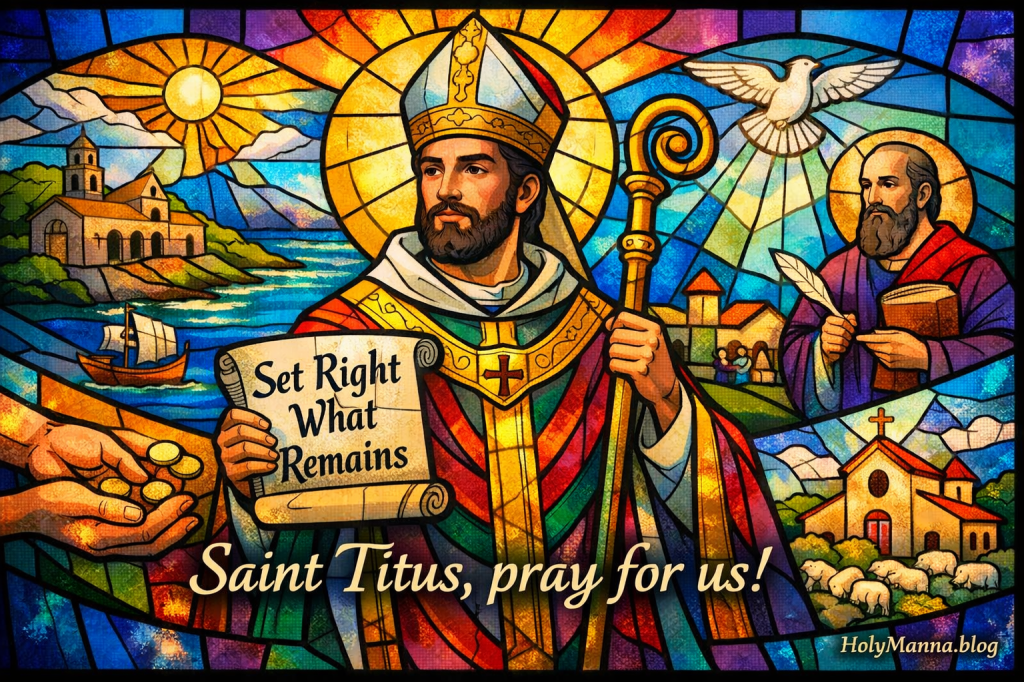
A Quiet Giant in the Age of the Apostles
Saint Titus belongs to that small circle of men who helped carry the Church from the age of the Apostles into the life of local Christian communities. He was not chasing attention, and he was not building a reputation for himself. He was building up the Church, even when the work was messy and thankless. Titus is remembered because Saint Paul trusted him with the hard assignments, the kind that required courage, patience, and a steady spiritual backbone.
Titus also matters because he shows how the Church was already living a Catholic pattern very early on. The faith was not treated as private opinion, and it was not passed along as personal inspiration only. The Gospel was handed on, taught, guarded, and lived through real pastoral authority. The Church sees in Titus a clear witness of apostolic mission extending through bishops, a reality rooted in Christ’s will for His Church and reflected in CCC 861-862 and CCC 880. That is why Titus is not just an interesting historical figure. He is a model of how Christ continues to shepherd His people through faithful leaders.
The Household of Faith
Titus was Greek and raised outside the covenant people of Israel, which could have made him an outsider in the earliest Christian communities. Instead, God used that detail in a surprising way. Titus became a living sign that Jesus Christ came to save all nations, not by turning Gentiles into cultural Jews, but by making them new through faith and Baptism. When Saint Paul speaks about Titus in The Letter to the Galatians, the point is clear. Titus was not forced into circumcision, and his freedom became part of the Church’s defense of the Gospel against those who wanted to treat the Old Covenant ceremonial law as a requirement for belonging to Christ.
This is not a minor argument, and it is not a side issue. It protected the truth that salvation is a gift of grace, not a reward for joining the right tribe or performing the right rituals. Titus stood right at that crossroads, and his very life became testimony. Sometimes God uses quiet obedience to settle enormous controversies, and Titus is a prime example of that.
Scripture also hints at the closeness between Paul and Titus in a way that feels personal and deeply Catholic. Paul calls him “my true child in our common faith” in Titus 1:4, which points to spiritual fatherhood, formation, and trust. Titus was not just a helper running errands. He was shaped into a mature disciple who could carry responsibility and represent apostolic authority with integrity.
The Man Paul Sent When Things Were Falling Apart
Titus becomes especially visible when the Church is under strain. Corinth was not a tidy parish with a calm leadership team and a peaceful calendar. It was a spiritual battlefield marked by factions, wounded pride, moral failures, and suspicion toward apostolic authority. Saint Paul did not send Titus there because he was a smooth talker. He sent him because Titus had the kind of character that could walk into a storm and not lose his head.
In 2 Corinthians, Paul describes how deeply he was consoled by Titus’ arrival and by the report that the Corinthians had responded with repentance and renewed obedience. That tells you a lot about Titus. He carried a painful message and still managed to build a bridge rather than burn one. He helped restore communion without watering down the truth, which is exactly the kind of leadership the Church always needs.
Paul also entrusted Titus with organizing the collection for the suffering Christians in Jerusalem, which meant Titus carried responsibility involving money, logistics, and public credibility. Money can tear communities apart, and Paul knew it. Titus was trusted because he was steady, honest, and capable of acting in the open without scandal. That kind of trust is a rare thing, and it is a quiet sign of holiness.
The Call to Set Right What Remains
Eventually, Paul left Titus in Crete with an instruction that sounds like a mission statement for anyone called to rebuild what is broken. Paul says, “I left you in Crete so that you might set right what remains to be done” in Titus 1:5. Those words imply unfinished problems, unfinished formation, and unfinished structure. They also imply that Titus had to carry real authority, not as a tyrant, but as a shepherd who protects the flock and keeps the faith from drifting.
Crete was known in the ancient world for rough public life and a culture that did not naturally support Christian virtue. That is why The Letter to Titus spends serious time connecting doctrine to conduct. Titus is told to insist on integrity, self-control, and a life that honors Christ in public. The goal is not to impress outsiders with religious talk. The goal is to form Christians whose lives make the Gospel believable.
Titus is traditionally remembered as the bishop of Crete, often spoken of as the first bishop there. That legacy shows that the Church was establishing stable local leadership very early, and it also shows that the Gospel was taking root in places that were not naturally friendly to the demands of holiness. Titus helps prove that the Church was never meant to be a private spiritual club. The Church was meant to be a light in the world, even in hard territory.
Healing Through Truth and Unity
The New Testament does not record a catalog of dramatic miracles performed by Titus. That does not make him less of a saint. It highlights a kind of miracle many Catholics need to notice again, especially in a time obsessed with spectacle. Titus’ miracles were pastoral. He helped heal division. He helped restore trust. He helped form communities where people could actually grow in holiness instead of staying stuck in confusion and compromise.
That kind of work is supernatural even when it looks ordinary. Reconciliation is not just conflict management, because pride does not die easily. Unity in the Church is not manufactured, because unity is a gift that has to be received and protected. Titus shows what it looks like to participate in that gift with courage and patience.
The letter addressed to him offers one of the strongest summaries of how grace shapes the moral life. Scripture says, “The grace of God has appeared… training us… to live temperately, justly, and devoutly” in Titus 2:11-12. That line alone can reset a whole spiritual life. Grace is not permission to stay the same. Grace trains the heart, forms habits, and teaches a Christian how to live with strength and humility at the same time.
The Cost of Being a Real Shepherd
Titus’ hardships were not preserved as a dramatic trial narrative like some martyr accounts, but that does not mean his path was easy. He lived in an age when Christians could be misunderstood, slandered, and sometimes persecuted. Even when persecution was not the immediate threat, internal battles were heavy. False teachers, corrupt motives, moral compromise, and public scandal can crush a community from the inside, and Titus had to confront these challenges without becoming harsh or cowardly.
The work of correction is exhausting because it often brings criticism. The work of establishing leaders is exhausting because not everyone wants to be led. The work of calling people to repentance is exhausting because many people want comfort before conversion. Titus carried that burden, and he did it with the kind of steadiness that only comes from a real interior life with God.
Some traditions refer to Titus as a martyr, but the more commonly received tradition is that he died in old age after long service. That kind of death is not a lesser victory. A faithful death after decades of carrying the Church’s burdens is a powerful witness, especially for Catholics who want quick results and immediate clarity. Titus teaches endurance, and he teaches what long obedience looks like when it is rooted in love.
A Living Memory in the Church
After Titus’ death, devotion to him remained especially tied to Crete. Early Christian memory there did not treat him as a vague legend. His name became connected to the Church’s life and identity in the region, and ancient Christian sites dedicated to him testify that the local Church remembered him as a foundational shepherd. Even when details of a saint’s later years are not fully documented in Scripture, the Church’s enduring veneration still speaks loudly.
Catholic tradition also preserves the veneration of relics connected to Titus, including the honoring and preservation of relics associated with him and their return to Crete in the modern era. Relics can confuse modern people because modern people often treat the body as disposable. The Church does not. The Church honors the body because the Son of God took flesh, and because the body is destined for resurrection. This is the logic of the Incarnation lived out in devotion, and it keeps Catholics grounded in the truth that holiness is not imaginary. Holiness touches real history and real bodies.
Even when a saint’s posthumous miracle stories are not widely documented, their legacy can still be deeply fruitful. The fruit of a saint’s life is not measured only by extraordinary events. It is measured by the enduring strength of faith, clarity, and courage that continues to build the Church across generations.
How to Live Like Titus
Saint Titus is a saint for people who want the Church to be stronger, clearer, and more faithful. He shows that renewal begins with sound doctrine and real virtue, not with trends and moods. He also shows that truth has to be lived, not merely repeated. Catholic life should produce stability, integrity, and charity that holds up under pressure.
Titus teaches that leadership is service, and service is not always comfortable. Real leadership is willing to walk into tension and not run away. Real leadership is willing to correct error without humiliating people. Real leadership is willing to insist on holiness without becoming self-righteous. Titus shows that balance, and it is a balance worth fighting for in everyday life.
A practical way to imitate Titus is to take one area of life that has drifted and set it right with humble discipline, asking God for the grace to follow through. It might be speech, purity, honesty, responsibility, or prayer. The grace of God trains the heart when a person cooperates with it, and that cooperation is where transformation becomes real. Titus teaches that a Catholic should not be content with vague goodness. A Catholic should aim for a life that is steady, coherent, and rooted in Christ.
Where does God need more steadiness and clarity right now, not in someone else, but in the habits of the heart? That is a Titus question, and it can lead to real growth if taken seriously.
Engage with Us!
Share your thoughts and reflections in the comments below. Saint Titus is a saint for messy moments and complicated seasons, and it is worth talking about what that looks like in real life.
- Where in life right now is God asking for patience and steady leadership instead of dramatic gestures?
- What is one area where “sound doctrine” needs to shape daily habits more concretely, especially in speech, purity, or integrity?
- Who in your life needs a Titus right now, someone who brings peace without compromising truth, and how can you serve them this week?
- What does it mean to let grace “train” the heart, and what practical change would show that training is actually happening?
Keep walking forward in faith even when it feels slow. Keep choosing clarity when confusion is easier. Keep doing the next right thing with a clean conscience. A life anchored in Jesus becomes steady, brave, and full of mercy, and everything should be done with the love and mercy Jesus taught us.
Saint Titus, pray for us!
Follow us on YouTube, Instagram and Facebook for more insights and reflections on living a faith-filled life.

 Holy Manna!
Leave a comment