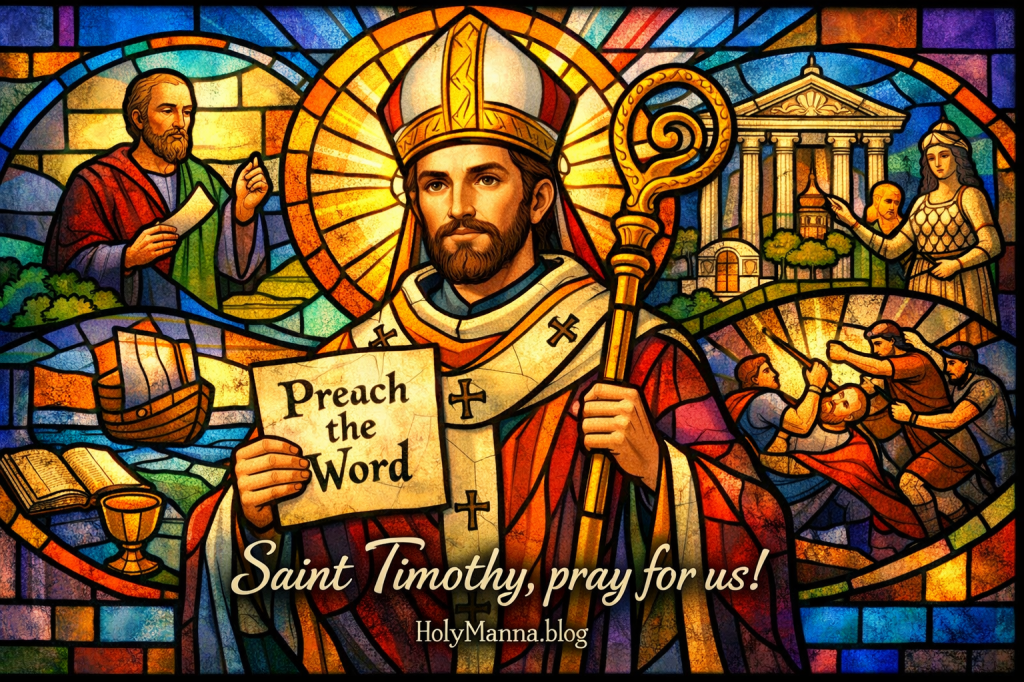
A Shepherd Formed by Apostles
Saint Timothy matters because he shows what the early Church looked like when it was still learning how to stand on its own feet. He was not a flashy public figure, but he was the kind of disciple the apostles trusted with serious responsibility. Scripture presents him as a spiritual son of Saint Paul, and Catholic tradition remembers him as the first Bishop of Ephesus. That combination is powerful because it connects the Church’s missionary beginnings with the stable shepherding that would follow, which is exactly how apostolic Christianity becomes Catholic life in every generation. The Catechism teaches that the Church is apostolic because she remains built on the apostles and because their mission is carried forward through their successors, the bishops, and that truth is not an abstract idea but a living reality seen in saints like Timothy (CCC 857-862).
Timothy is also a saint for anyone who has ever felt unqualified or underestimated. The tone of Saint Paul’s counsel makes it clear that Timothy needed encouragement to lead with confidence and purity, which is comforting because it shows how God works through gradual formation. God does not wait until a person feels ready, because grace strengthens what nature lacks, and the Lord loves to form faithful shepherds through patience, suffering, and real responsibility rather than quick applause.
Raised by Faithful Women
Timothy came from Lystra in Asia Minor, and his family situation was complicated in a way that feels surprisingly modern. His mother Eunice was Jewish, his father was Greek, and his grandmother Lois is remembered too, which says something beautiful about how faith often travels through family lines long before it becomes public. Timothy learned the Scriptures from childhood, and that foundation became a spiritual anchor later when he had to confront false teaching and cultural pressure. The Church has always understood the power of that kind of hidden formation, because the home is often the first school of faith where hearts are trained to recognize God’s voice.
When Saint Paul arrived in the region, Timothy’s faith deepened and his vocation began to take shape. Timothy joined Paul’s mission at a time when Christianity was still viewed with suspicion by both Jewish authorities and pagan society. A striking detail in the early mission is that when Paul and Silas were imprisoned at Philippi, Timothy was spared, and that detail reveals a quiet kind of courage. Timothy did not need to be the one in chains to stay close to the suffering of the Church, and he refused to detach himself from the cost of discipleship. Paul also had Timothy circumcised for the sake of mission among Jews, not because salvation depended on it, but because the apostle knew how to remove obstacles so people could hear the Gospel clearly. Timothy accepted that with humility, which shows a heart more concerned with souls than with personal comfort.
Paul’s Trusted Disciple
Timothy was not simply a helper who followed Paul around. He was a trusted emissary sent into complicated situations where a church needed strengthening, clarity, and stability. He traveled with Paul across Macedonia and Greece and moved through places where the Gospel was received with joy and also with hostility. Timothy was sent to encourage believers under pressure, and he brought news back to Paul that helped guide the apostle’s pastoral decisions. He was present in the wider mission that shaped communities like Corinth, where division and moral confusion demanded patient correction that did not compromise the truth.
Timothy’s role was deeply pastoral, which means it was deeply Catholic in the real sense of the word. He carried apostolic teaching into communities that were tempted to drift, and he helped protect unity in doctrine and unity in worship. The faith is not a private experiment, and it cannot be reduced to personal preference. The Catechism insists that the apostolic faith is preserved through the Church’s living tradition and the teaching office established by Christ, so believers receive the Gospel as a gift rather than inventing it as a lifestyle (CCC 857-860). Timothy lived that reality before it was ever explained in neat paragraphs, and that is why his quiet steadiness still speaks.
Timothy also seems to have known suffering in a personal way. One New Testament letter implies that Timothy was at some point released from imprisonment, which means his discipleship was not theoretical. He was not offering encouragement from the sidelines. He was living the cost of fidelity in a world that did not want Christ to be King.
The First Bishop of Ephesus
Catholic tradition remembers Timothy as the first Bishop of Ephesus, and that detail is more than a historical footnote. It shows how the Church’s structure began to take stable form under apostolic guidance. A bishop is not simply a local organizer, because the bishop is responsible for teaching, sanctifying, and governing the flock in communion with the Church. Timothy’s episcopal mission in Ephesus demanded spiritual maturity, doctrinal clarity, and courage, because Ephesus was saturated with pagan worship and moral confusion. The Church needed shepherds who could love people without flattering their idols, and Timothy is remembered as one of those early bishops who carried that weight with fidelity.
There is also a strong traditional thread connecting Timothy with the broader Christian life of Ephesus, including the memory that Saint John lived in that region later in his life. While not every detail can be proven with the same certainty as Scripture, the tradition highlights something important. Ephesus became a major Christian center, and Timothy’s leadership helped prepare the ground for a Church that would endure through persecution, controversy, and cultural pressure. This is why Timothy becomes a saint for anyone who loves the Church and worries about confusion today. Timothy’s job was not to innovate. Timothy’s job was to guard the deposit of faith with a steady hand, because the truth of Christ is not improved by constant revision.
Faithful Service That Strengthened the Church
Catholic sources do not preserve a widely agreed catalog of miracles performed by Timothy during his lifetime, and Catholic devotion stays honest about that. Still, Timothy’s life has its own kind of miracle, because perseverance is rarely glamorous but it is deeply supernatural. He stayed faithful under pressure, he did not quit when leadership was hard, and he kept serving even while dealing with personal weakness, including health struggles hinted at in Scripture. That human detail is part of why Timothy is sometimes invoked in prayers related to stomach and intestinal ailments, and it is comforting because it shows that sanctity is not the absence of weakness. Sanctity is fidelity in weakness sustained by grace, especially when the work feels repetitive and unseen.
Timothy’s compassion also shows up in how Paul speaks about him, because Paul describes Timothy as genuinely concerned for others. That kind of pastoral charity is a sign of holiness, since it reflects the heart of Christ who comes not to be served but to serve. Timothy was not a cold enforcer of rules, and he was not a soft leader afraid of truth. He was a shepherd who cared about souls enough to be steady, clear, and patient.
Standing Against Idols
Ephesus was famous for devotion to Diana, also known as Artemis, and the city’s identity was tied to pagan worship that Christianity could not bless. Catholic tradition holds that Timothy confronted this idolatry and reproved those who offered sacrifice to Diana. In that society, religion was public, civic, and tied to economic and political power, so that confrontation was dangerous. Timothy’s courage was not reckless, but it was firm, because he knew that idolatry is not harmless entertainment. Idolatry is a spiritual lie that wounds the human heart, and it always demands a price from the people who submit to it.
The Church remembers Timothy as a martyr, and the Roman tradition describes him suffering violence because he rebuked pagan worship. Accounts differ in the exact details of the final blows, but Catholic tradition consistently holds that he died because he refused to treat false worship as acceptable. That martyrdom matters because it reveals what the Catechism teaches about martyrdom as the supreme witness to the truth of the faith, a testimony even unto death (CCC 2473-2474). Timothy did not die for an argument or an ideology. He died because Jesus Christ is Lord, and no idol, no empire, and no cultural mood has the right to take that place.
The Quiet Work of Unity
After Timothy’s death, devotion to him continued through the Church’s memory and through reverence for his relics. Catholic tradition holds that his relics were associated with Constantinople and that some relics were later brought to Termoli in Italy in the thirteenth century. Centuries later, relics associated with Saint Timothy were rediscovered in Termoli during restoration work in the cathedral in the mid twentieth century, and that story has helped renew devotion in a tangible way. This matters because saints are not dead heroes from a history book. Saints are members of the living communion of the Church, and the Church honors them because Christ’s victory is real and His grace transforms real human lives.
The Catholic practice of honoring relics can confuse modern minds, but it is deeply connected to the Christian belief in the resurrection of the body. The body is not disposable, and the body is not an afterthought, because the Word became flesh and redeemed the whole human person. Reverence for relics is not superstition, and it is not magic. It is a sign of respect for what God has redeemed and what God will raise up, and it helps believers remember that holiness is not merely interior feelings but a whole life offered to God. Timothy’s legacy has also been linked in modern times with prayer for Christian unity, which is fitting because Timothy’s entire ministry was about holding the Church together in truth and charity.
Catholic sources do not strongly catalogue miracles after Timothy’s death in the way they do for some other saints, and it is better to stay truthful than to decorate the story. Timothy’s legacy is mainly a legacy of fidelity, apostolic teaching, and courage in a hostile world, and that is exactly why he remains worth imitating.
How to Live Like Timothy
Saint Timothy is a saint for ordinary Catholics who want to stay faithful in a noisy world. His life teaches that consistency is not boring, because consistency is strength when it is rooted in grace. Timothy learned the Scriptures from childhood, which reminds every family that quiet fidelity in the home can shape future saints long before anyone notices. Timothy served the Church with humility, which challenges a culture obsessed with personal branding and public approval. Timothy accepted formation under an apostle, which is a reminder that Catholics do not invent their own Christianity but receive it and grow into it through the Church’s living faith. The Catechism teaches that the Church is apostolic and that her faith is preserved and handed on, not reinvented, and Timothy’s whole life is a yes to that truth (CCC 857-860).
Timothy’s courage was not loud, but it was steady, and that is the kind of courage needed today. It is the courage that shows up on ordinary days, does the duty, teaches the truth, and refuses to bow to modern idols. The idols might not look like a statue of Diana anymore, but they still demand worship through attention, money, pleasure, and pride, and they still promise freedom while delivering slavery. Timothy’s witness encourages practical faithfulness that actually changes a person. Daily prayer, daily Scripture through the Mass readings, faithful Sunday worship, regular confession, and serious boundaries against sin all form the heart over time. That kind of life is not dramatic, but it is powerful, and it is the kind of strength that can carry a family, a parish, and a community through hard seasons. How might Saint Timothy’s quiet fidelity reshape the way work, prayer, and responsibility are handled this week?
Engage with Us!
Share thoughts and reflections in the comments below, because every saint has a way of shining light on a different corner of the spiritual life.
- Where does Timothy’s quiet fidelity challenge the desire to be seen, praised, or validated?
- What habits would help build Timothy-like consistency, especially in prayer, Scripture, and sacramental life?
- Which modern “idols” most tempt the heart to compromise, and what concrete boundary would help resist them this week?
- Who in the family or community needs encouragement the way Timothy encouraged the early churches?
- How does honoring a saint’s relics strengthen belief in the resurrection of the body and the dignity of the human person?
May Saint Timothy’s steady courage inspire a faith that holds the line with love, speaks truth without fear, and serves Christ without needing applause. Keep walking forward with the mercy of Jesus, and do everything with the love and mercy He taught, because that is the only kind of strength that lasts.
Saint Timothy, pray for us!
Follow us on YouTube, Instagram and Facebook for more insights and reflections on living a faith-filled life.

 Holy Manna!
Leave a comment