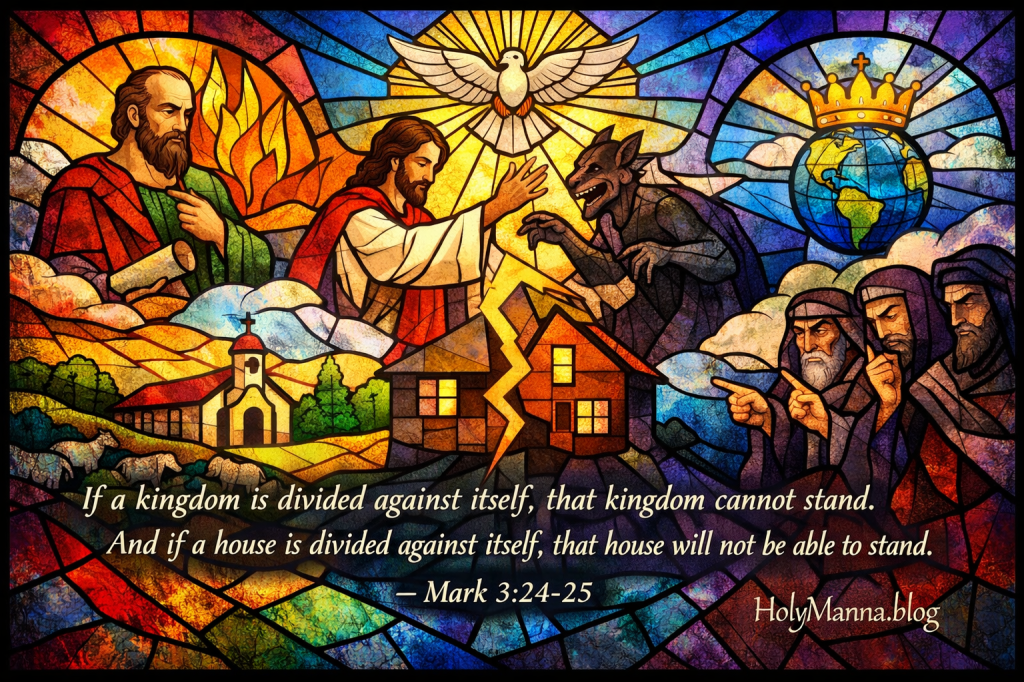
Memorial of Saints Timothy and Titus, Bishops – Lectionary: 520/317
Fan the Flame and Guard the Light
Some days the Church hands out readings that feel like a spiritual gut check in the best way. Today is one of those days, because everything points to one urgent question: Will the heart recognize the Holy Spirit at work, or will it shrink back into fear and suspicion? That is the central theme tying the whole liturgy together, because the Church is calling believers to bold faith, clear witness, and spiritual discernment that refuses to label God’s work as darkness.
Since today is the Memorial of Saints Timothy and Titus, Bishops, the Church gives two options for the First Reading. The reason is simple and beautiful. Both men were spiritual sons of Saint Paul and early shepherds of the Church, and the liturgy can spotlight either one depending on the selection. In 2 Timothy 1:1-8, Paul writes with fatherly love to Timothy and urges him to “stir into flame the gift of God” and to live with “power and love and self-control” instead of fear. In Titus 1:1-5, Paul speaks to Titus as a trusted coworker left in Crete to put the local Church in order and to appoint presbyters. One option highlights the inner fire and courage needed to suffer for the Gospel, while the other highlights the practical, apostolic work of strengthening the Church through sound leadership and ordained ministry. Together they show what bishops are meant to be: men formed by the apostles, set apart for Christ’s mission, and willing to carry responsibility when it would be easier to stay quiet.
That apostolic backdrop matters, because the early Church was not living in comfort. Christians were misunderstood, frequently opposed, and sometimes persecuted, and leaders like Timothy and Titus had to preach, govern, and protect the flock while the world watched with suspicion. That is why Psalm 96 feels like more than a hymn. It is a command to worship like believers mean it and to evangelize like the world needs it, because it does. “Proclaim his salvation day after day” is not soft advice. It is the voice of the Church reminding the baptized that praise is supposed to spill outward into public witness.
Then the Holy Gospel in Mark 3:22-30 shows what happens when religious pride hardens into spiritual blindness. The scribes see Jesus driving out demons and they claim He is empowered by demons, and Christ exposes the absurdity with calm authority. A divided kingdom collapses, and Satan does not cast out Satan. Jesus is the stronger One who binds the strong man and plunders his house, which means He is reclaiming souls from the dominion of evil. That is why His warning about blasphemy against the Holy Spirit lands with such weight. It is not a claim that God is stingy with mercy. It is a warning that a person can resist grace so stubbornly that repentance is refused, and without repentance forgiveness is rejected. The Catechism teaches this clearly in CCC 1864 when it explains that whoever deliberately refuses mercy by repentance rejects the forgiveness God wants to give.
Put it all together and the path forward becomes clear. Today is about asking for courage instead of cowardice, proclaiming Christ instead of hiding, and training the heart to recognize the Holy Spirit’s work with humility. Saints Timothy and Titus stand behind these readings like living examples, because they show what faithful leadership looks like when the culture is confused and the stakes are high. The Church is not inviting anyone to a vague inspiration. The Church is inviting believers to fan the flame, speak the truth, and trust that the Lord who conquers the demons also strengthens His people to endure.
First Reading – 2 Timothy 1:1-8
Keep the fire of faith alive when the world wants it to go cold.
Today the Church offers two possible First Readings because the memorial honors two apostolic coworkers, Saints Timothy and Titus. One option focuses on Timothy being strengthened to suffer for the Gospel, and the other focuses on Titus being entrusted with setting the Church in order by appointing presbyters. This section follows 2 Timothy 1:1-8, which fits today’s theme by calling believers to recognize the Holy Spirit’s work, refuse shame, and live with courage and self-mastery.
This letter is intensely personal. Saint Paul writes as a spiritual father to his “dear child,” and the tone carries both affection and urgency. The early Church is living under pressure, and faithful witness is costly. Paul is not writing from comfort. He is writing as a prisoner, urging Timothy to stand firm, to guard what has been entrusted to him through the laying on of hands, and to suffer with strength that comes from God. This is exactly the opposite of what happens in the Gospel, where hardened hearts look at Christ’s liberating work and try to label the Spirit’s power as something unclean. Paul’s warning is simple: do not let fear, embarrassment, or cultural pressure make the heart timid when the Holy Spirit is calling it to speak and to endure.
2 Timothy 1:1-8 – New American Bible (Revised Edition)
Greeting. 1 Paul, an apostle of Christ Jesus by the will of God for the promise of life in Christ Jesus, 2 to Timothy, my dear child: grace, mercy, and peace from God the Father and Christ Jesus our Lord.
Thanksgiving. 3 I am grateful to God, whom I worship with a clear conscience as my ancestors did, as I remember you constantly in my prayers, night and day. 4 I yearn to see you again, recalling your tears, so that I may be filled with joy, 5 as I recall your sincere faith that first lived in your grandmother Lois and in your mother Eunice and that I am confident lives also in you.
The Gifts Timothy Has Received. 6 For this reason, I remind you to stir into flame the gift of God that you have through the imposition of my hands. 7 For God did not give us a spirit of cowardice but rather of power and love and self-control. 8 So do not be ashamed of your testimony to our Lord, nor of me, a prisoner for his sake; but bear your share of hardship for the gospel with the strength that comes from God.
Detailed Exegesis
Verse 1 – “Paul, an apostle of Christ Jesus by the will of God for the promise of life in Christ Jesus,”
Paul begins by grounding everything in vocation and promise. He is not self-appointed, and he is not motivated by personal ambition. His apostleship exists for one thing: the promise of life in Christ. This sets the tone for the whole reading. Christian ministry and Christian courage are never about winning arguments or protecting an image. They are about guarding and announcing the life Christ offers.
Verse 2 – “to Timothy, my dear child: grace, mercy, and peace from God the Father and Christ Jesus our Lord.”
Paul addresses Timothy as family, because spiritual fatherhood is real in the Church. The greeting is not just polite. “Grace, mercy, and peace” is what Timothy needs to lead and to persevere. Grace strengthens the soul, mercy heals weakness, and peace steadies a heart that is tempted to anxiety.
Verse 3 – “I am grateful to God, whom I worship with a clear conscience as my ancestors did, as I remember you constantly in my prayers, night and day.”
Paul connects Christian faith to continuity, not novelty. He worships the God of Israel with a clear conscience, now fully revealed in Christ. He also shows Timothy what leadership looks like: it is soaked in prayer. “Night and day” is not a throwaway phrase. It describes spiritual responsibility that does not clock out.
Verse 4 – “I yearn to see you again, recalling your tears, so that I may be filled with joy,”
This is tenderness, not weakness. Timothy’s tears are remembered, which suggests real suffering, real pressure, and real love. Paul is not training Timothy to be emotionally numb. He is training him to be spiritually brave. Joy here is not comfort. Joy is communion in the truth, even when hardship continues.
Verse 5 – “as I recall your sincere faith that first lived in your grandmother Lois and in your mother Eunice and that I am confident lives also in you.”
Paul honors the role of family in handing on the faith. Timothy’s “sincere faith” is not an individual invention. It was carried by a grandmother and a mother, and it is now being carried by a bishop. This is how the Church grows: household faith becomes public witness, and private devotion becomes apostolic mission.
Verse 6 – “For this reason, I remind you to stir into flame the gift of God that you have through the imposition of my hands.”
Grace is a gift, but it is not meant to sit untouched. “Stir into flame” implies effort, vigilance, and cooperation. The “imposition of my hands” points to an apostolic act, not a vague spiritual moment. Timothy has been entrusted with a real ministry in the Church, and Paul commands him to live it with intensity, not half-heartedly.
Verse 7 – “For God did not give us a spirit of cowardice but rather of power and love and self-control.”
This verse is a direct correction to fear-driven Christianity. Cowardice is not from God. Power here is not domination. It is spiritual strength to endure, to speak truth, and to resist sin. Love keeps that strength from becoming harsh. Self-control keeps that love from becoming sentimental or unstable. This is the Holy Spirit forming a disciple into a steady, sober, courageous Catholic.
Verse 8 – “So do not be ashamed of your testimony to our Lord, nor of me, a prisoner for his sake; but bear your share of hardship for the gospel with the strength that comes from God.”
Paul names the real temptation: shame. Shame makes believers hide, soften the truth, or keep the faith private. Paul commands the opposite. Testimony must be public and clear, and solidarity with suffering Christians must be real. Hardship is not a surprise in the Christian life. It is part of the path, and it must be carried with strength that comes from God, not from personality or bravado.
Teachings
This reading teaches that Catholic faith is not merely an interior feeling. It is a public witness rooted in grace and carried in communion with the Church. Timothy’s gift is received through the laying on of hands, and that points directly to the Church’s sacramental reality. Christ works through the apostles and their successors, and He gives real grace for real mission.
The Church teaches that every baptized person is called to witness, and that witness can become costly. The Catechism speaks with clarity about the duty and dignity of confession of faith: “The Christian is not to ‘be ashamed then of testifying to our Lord.’ In situations that require witness to the faith, the Christian must profess it without equivocation, after the example of St. Paul before his judges. We must keep ‘a clear conscience toward God and toward men.’” (CCC 1816) This is exactly Paul’s message to Timothy: courage without compromise, and conscience without deceit.
This reading also highlights that the Spirit’s strength is meant to shape the whole person, not just a public persona. Power, love, and self-control belong together. When power loses love, it becomes aggression. When love loses self-control, it becomes confusion. When self-control loses power, it becomes fear. The Holy Spirit forms disciples who can speak clearly, love faithfully, and endure pressure without folding.
The early Church understood this apostolic structure and this courage as part of Catholic identity from the beginning. Saint Ignatius of Antioch, writing in the earliest generations after the apostles, ties unity to Christ through the bishop in a way that fits today’s memorial of apostolic shepherds: “Wherever the bishop appears, there let the people be; as wherever Jesus Christ is, there is the Catholic Church.” (St. Ignatius of Antioch, Letter to the Smyrnaeans 8:2) Timothy and Titus represent that living continuity, not as mere administrators, but as guardians of faith, worship, and unity.
Reflection
This reading speaks directly to modern life because fear is one of the main tools used to silence disciples. Fear of being judged can make faith private. Fear of conflict can make truth negotiable. Fear of discomfort can make holiness feel unrealistic. Paul’s words cut through all of it by naming what comes from God and what does not. Cowardice is not from God. Power, love, and self-control are from God.
A practical starting point is to treat faith like a fire that needs attention. The flame fades when prayer becomes occasional, when confession is delayed, and when spiritual habits are replaced by endless distraction. The gift is still there, but it must be stirred. That stirring happens through daily prayer, regular reception of the sacraments, and a steady decision to stop hiding what is true.
This reading also invites Catholics to rethink what courage looks like. Courage is not loudness and it is not aggression. Courage is the quiet willingness to do what is right, to speak the name of Jesus without embarrassment, and to remain faithful when it costs something socially, professionally, or emotionally.
Where has fear been quietly steering decisions, shaping silence, or shrinking Christian witness into something safe and invisible?
What specific habit would help stir the flame again, especially prayer, confession, Scripture, or accountability?
When was the last time testimony to Christ was offered plainly, without pretending faith is just a private preference?
OR
First Reading – Titus 1:1-5
God builds His Church on truth
Today the Church offers two possible First Readings because this memorial honors two apostolic coworkers, Saints Timothy and Titus, who carried Saint Paul’s mission into the next generation. The 2 Timothy option highlights courage under pressure and the need to stir the Spirit’s gift into flame. The Titus option highlights something just as urgent: the Church must be grounded in truth and strengthened through apostolic order, especially when a culture is confused and morally unstable.
Titus 1:1-5 drops readers into the early Church as it spreads beyond Jerusalem into the wider Roman world. Communities are forming, converts are coming in fast, and the Church cannot survive on vibes and good intentions. She needs the preaching of the truth, the hope of eternal life, and shepherds who are appointed, not self-appointed. This fits today’s theme because the Gospel shows how badly things go when religious leaders stop recognizing God’s work and start labeling it as evil. Paul gives the opposite vision: the Holy Spirit builds unity through truth, and Christ strengthens His people through the Church’s real, visible leadership, so the world can hear the Gospel without distortion.
Titus 1:1-5 – New American Bible (Revised Edition)
Greeting. 1 Paul, a slave of God and apostle of Jesus Christ for the sake of the faith of God’s chosen ones and the recognition of religious truth, 2 in the hope of eternal life that God, who does not lie, promised before time began, 3 who indeed at the proper time revealed his word in the proclamation with which I was entrusted by the command of God our savior, 4 to Titus, my true child in our common faith: grace and peace from God the Father and Christ Jesus our savior.
Titus in Crete. 5 For this reason I left you in Crete so that you might set right what remains to be done and appoint presbyters in every town, as I directed you,
Detailed Exegesis
Verse 1 – “Paul, a slave of God and apostle of Jesus Christ for the sake of the faith of God’s chosen ones and the recognition of religious truth,”
Paul starts with humility and authority at the same time. He calls himself a “slave of God,” which means his life is not his own, and he belongs entirely to the Lord. He also claims apostleship, which matters because the faith is not invented by local communities or shaped by cultural fashion. Paul’s mission serves “God’s chosen ones,” which reminds every believer that the Church is not a club formed by preference. The phrase “recognition of religious truth” is key, because truth is not a mood. Truth is something to be recognized, received, guarded, and lived.
Verse 2 – “in the hope of eternal life that God, who does not lie, promised before time began,”
Hope is not optimism and it is not denial. Christian hope is anchored in God’s character. God “does not lie,” so His promise is solid. That matters in a world where people often bend truth to protect reputation or power. It also matters in a spiritual sense, because the devil’s whole strategy is deception. When Jesus drives out demons in the Gospel, He is exposing lies with light. Paul reminds Titus that the Church stands on a promise older than human history, promised “before time began,” which points to God’s eternal plan.
Verse 3 – “who indeed at the proper time revealed his word in the proclamation with which I was entrusted by the command of God our savior,”
God’s Word is revealed “at the proper time,” which keeps believers from acting as if salvation history is random. It is guided. It is purposeful. Paul also stresses proclamation. The faith is announced publicly, not kept private. He was “entrusted” with this preaching, and it came “by the command of God our savior,” which means evangelization is not optional. This lines up with the Psalm’s call to proclaim salvation day after day, because worship naturally turns into witness.
Verse 4 – “to Titus, my true child in our common faith: grace and peace from God the Father and Christ Jesus our savior.”
Paul speaks to Titus like a spiritual father. “True child” and “common faith” show that ministry is relational, but it is not casual. It is family in Christ. Grace and peace are not soft words here. Grace is what strengthens a leader to teach clearly and live cleanly. Peace is what steadies a leader who is dealing with conflict, criticism, and spiritual warfare. This greeting also quietly reinforces unity, because the Church cannot survive when the house is divided.
Verse 5 – “For this reason I left you in Crete so that you might set right what remains to be done and appoint presbyters in every town, as I directed you,”
This verse is the heartbeat of the passage. Titus is left in Crete to “set right” what is unfinished, which tells the truth about the Church on earth. There is always work to complete. Then Paul gives the method: appoint presbyters in every town. This is not a DIY ministry model. This is apostolic structure. The Church is built locally through ordained shepherds who receive authority in communion with the apostolic mission. Paul’s words also imply urgency. Disorder and confusion do not fix themselves. They must be faced, corrected, and healed through faithful leadership.
Teachings
This reading teaches that Christianity is inseparable from truth, hope, and apostolic order. Paul ties the Church’s mission to “religious truth,” and that matters because modern culture often treats truth like a personal preference. The Church cannot do that, because Jesus is not merely a teacher of ideas. Jesus is the Truth, and the Gospel becomes distorted the moment people decide they can label God’s work however they want. The scribes in the Gospel show a terrifying example of that distortion, because they see Christ liberating people and they call it unclean. Paul insists that the Church must be built on the opposite posture: recognition of the truth, not suspicion of it.
This reading also teaches that God shepherds His people through real, visible ministry. Titus is told to appoint presbyters, which points to the Church’s consistent understanding that ordained leadership is not a later invention. It belongs to how Christ cares for His flock. The Catechism teaches that the apostles were sent by Christ and that their mission continues in the Church through those who succeed them, especially bishops and their collaborators, the priests. This is why the Church speaks of apostolic succession and sacramental ministry as part of her identity, not as an optional layer added later. When Paul gives Titus authority to appoint presbyters, it shows that the Church is not meant to be scattered, leaderless, or driven by charisma. She is meant to be one, holy, catholic, and apostolic, with shepherds who teach, sanctify, and govern in communion with the whole Church.
There is also a quiet cultural detail that makes Paul’s words land harder. Crete had a reputation for moral mess and loose speech, and later in this same chapter Paul will even quote a saying about Cretans being liars. Against that backdrop, verse 2 is almost a spiritual punch to the mouth: “God, who does not lie” is the foundation. In other words, the Church cannot absorb a dishonest culture and remain healthy. She must be purified by the truth, led by faithful shepherds, and anchored in God’s promise of eternal life.
Saints Timothy and Titus embody this in different ways. Timothy shows the courage to suffer without shame, and Titus shows the steady strength to set things in order when disorder feels normal. Both show what the Holy Spirit does in the Church: He gives clarity, unity, and leadership so the Gospel can be proclaimed with confidence.
Reflection
This reading hits daily life right where it tends to hurt, because most people know what it feels like to have unfinished business. Paul’s phrase “set right what remains to be done” is not only about church administration. It is also a mirror. Every soul has areas that are out of order, and pretending otherwise only lets the chaos spread.
A practical way to live this reading is to stop treating spiritual life like something that runs on autopilot. If a home needs structure to stay peaceful, the soul needs structure too. Prayer needs a real place in the day. Confession needs to be regular, not rare. Sundays need to be protected. Relationships need honest boundaries. None of that is rigid. It is freeing, because truth always frees.
This passage also challenges the temptation to distrust the Church’s authority whenever it feels inconvenient. Paul does not leave Titus with a vague spiritual mood. He gives him a mission and a method. The same Christ who drives out demons also provides shepherds for His people, because wolves do not take days off. Supporting priests, praying for bishops, and staying close to parish life is not a side hobby for serious Catholics. It is part of staying close to how Christ actually feeds and guards His flock.
What is one area of life that remains out of order because it is easier to ignore than to face?
How would daily life change if truth was treated like a gift to receive instead of a threat to avoid?
Is there a willingness to be shepherded by the Church, especially when pride wants to stay independent?
Responsorial Psalm – Psalm 96:1-3, 7-8, 10
Worship that stays private is not worship that understands the King.
Psalm 96 is a royal proclamation dressed in joyful music. It belongs to the tradition of Israel’s worship where the people do not just speak to God in private, but publicly announce who He is and what He has done. In the ancient world, kingship was not a background idea. Kingship meant order, protection, judgment, and the public recognition of authority. This Psalm takes that kingship language and places it where it belongs: on the Lord Himself. Israel sings because God reigns, and His reign is not tribal or local. His glory is meant to be declared “among the nations.”
That makes this Psalm a perfect fit for today’s theme. The First Reading, whether from 2 Timothy or Titus, shows apostolic leaders being strengthened to proclaim the truth and put the Church in order, not to hide out in fear. The Gospel shows what happens when hearts refuse to recognize God’s work and instead label it as evil. Psalm 96 calls for the opposite posture. It calls believers to praise with confidence, to evangelize without embarrassment, and to announce the Lord’s kingship as the foundation of a stable world. When the heart truly recognizes who God is, the mouth cannot stay silent.
Psalm 96:1-3, 7-8, 10 – New American Bible (Revised Edition)
God of the Universe
1 Sing to the Lord a new song;
sing to the Lord, all the earth.
2 Sing to the Lord, bless his name;
proclaim his salvation day after day.
3 Tell his glory among the nations;
among all peoples, his marvelous deeds.7 Give to the Lord, you families of nations,
give to the Lord glory and might;
8 give to the Lord the glory due his name!
Bring gifts and enter his courts;10 declare among the nations: The Lord is king.
The world will surely stand fast, never to be shaken.
He rules the peoples with fairness.
Detailed Exegesis
Verse 1 – “Sing to the Lord a new song; sing to the Lord, all the earth.”
A “new song” is not just a new melody. It is a renewed response to God’s saving action. Scripture often connects the “new song” with fresh acts of deliverance and with the dawning of God’s reign. “All the earth” expands the horizon beyond Israel. The Lord is not a local deity. This anticipates the universal mission fulfilled in Christ, where the Gospel is preached to every nation.
Verse 2 – “Sing to the Lord, bless his name; proclaim his salvation day after day.”
To “bless his name” means to honor God for who He is, not only for what He gives. Then the Psalm shifts immediately into mission: “proclaim his salvation day after day.” This is daily discipleship, not occasional enthusiasm. Salvation is not a private hobby. Salvation is news. When God saves, His people speak.
Verse 3 – “Tell his glory among the nations; among all peoples, his marvelous deeds.”
“Glory” in the biblical sense is the weight of God’s presence and the radiance of His holiness. The nations are meant to hear about it, because they are meant to be drawn to it. The “marvelous deeds” include God’s mighty works in history, and for Christians they ultimately point to Christ’s death and resurrection. This verse carries a missionary heartbeat that matches the apostolic tone of the First Reading.
Verse 7 – “Give to the Lord, you families of nations, give to the Lord glory and might;”
Now the nations are not only hearing. They are responding. “Families of nations” suggests the whole human family, not isolated individuals. Giving God “glory and might” is an act of worship and an act of truth-telling, because it places power where it really belongs. This is spiritual warfare in a peaceful form. It refuses to hand ultimate authority to idols, rulers, or demons.
Verse 8 – “give to the Lord the glory due his name! Bring gifts and enter his courts;”
Worship is not only feelings. Worship includes offering. The line about bringing gifts reflects temple worship in Israel, where entering God’s courts meant approaching Him with reverence, sacrifice, and thanksgiving. For Catholics, this finds its fulfillment in the Eucharist, where the Church enters the Father’s presence through Christ and offers the perfect sacrifice in union with Him. The heart of the verse is still the same: God deserves real honor, not casual leftovers.
Verse 10 – “declare among the nations: The Lord is king. The world will surely stand fast, never to be shaken. He rules the peoples with fairness.”
This is the climax. The proclamation is direct: the Lord is king. Then come the consequences. The world stands firm because reality is stable when it rests on God’s authority rather than human pride. God’s rule is also fair, which means His kingship is not tyranny. It is justice. This verse exposes how backwards the scribes are in the Gospel. They look at the King freeing captives and accuse Him of serving darkness. Psalm 96 trains the tongue and the mind to confess the truth instead: the Lord reigns, and His reign is good.
Teachings
This Psalm teaches that worship and mission belong together. To praise God truthfully is to proclaim Him publicly, because God is not only the comfort of the individual soul. He is the King of the nations. The Church takes this seriously because evangelization is not an optional program. It flows from the Lord’s kingship and the dignity of every person who needs salvation.
The Catechism teaches that the Church is missionary by nature, because she is sent by Christ to bring the Gospel to the world: “The Church on earth is by her very nature missionary since, according to the plan of the Father, she has as her origin the mission of the Son and the Holy Spirit.” (CCC 767) That mission is exactly what Psalm 96 sounds like when it says, “Proclaim his salvation day after day” and “Tell his glory among the nations.”
This Psalm also teaches a Catholic understanding of what it means to call God “King.” The Lord’s kingship is not just future. It begins now, and it is revealed decisively in Christ. That is why the Church dares to speak of Christ’s reign as a present reality even when the world looks unstable. God “rules with fairness,” which is a reminder that divine authority is always ordered toward truth, justice, and mercy. The Gospel shows what happens when leaders refuse that truth and mislabel the work of the Holy Spirit. This Psalm forms Catholics to do the opposite: to name God’s work as God’s work, and to respond with reverence, gratitude, and public confession.
Reflection
This Psalm presses on one of the biggest weak spots in modern Christian life: the temptation to keep faith polite, quiet, and invisible. The Psalm does not allow that. It calls for singing, blessing, telling, and declaring. That kind of language is not meant to create obnoxious people. It is meant to create honest people, because if the Lord really is King, then silence becomes a kind of practical denial.
A good way to live this Psalm is to build a daily rhythm of proclamation that is simple and steady. Proclamation can begin at home with the way Sundays are prioritized, the way prayer is treated as real, and the way God is spoken about naturally instead of awkwardly. It also means letting worship shape the week. If worship is real on Sunday but God is ignored Monday through Saturday, then the “new song” turns into background noise.
The Psalm also calls for a deeper trust in God’s stability. When life feels shaky, the instinct is to grasp for control, but the Psalm insists that the world stands firm under the Lord’s kingship. That trust changes how people talk, how they react, and how they carry stress. It makes room for courage, which ties directly to the First Reading’s call to avoid cowardice, and it protects the heart from the Gospel’s danger of confusing light for darkness.
Is worship shaping the way God is spoken about in daily life, or is faith being treated like something that should stay hidden?
What would change if the Lord’s kingship was taken seriously in decisions, relationships, and entertainment choices?
Where is stability being sought in something other than God, and how can that grip be loosened through prayer and trust?
Holy Gospel – Mark 3:22-30
When God shows up with power
This Gospel lands like a warning flare, because it shows how close a person can be to the truth and still miss it completely. The scribes come down from Jerusalem, which means they are not random critics. They are trained religious authorities, men who know the Scriptures and who believe they are defending God’s honor. Yet when they see Jesus casting out demons, they do not rejoice that people are being freed. They accuse Him of being possessed and claim He drives out demons by the power of the prince of demons.
In the first reading options for today’s memorial of Saints Timothy and Titus, Saint Paul stresses courage, clarity, and faithfulness to the truth. The Psalm commands public proclamation of God’s reign. This Gospel shows what happens when the heart refuses those same things. Instead of recognizing the Holy Spirit’s work, the scribes twist it into something unclean. Jesus responds with calm logic and then issues one of His most sobering warnings, because spiritual blindness can harden into a deliberate refusal of grace. That refusal is what the Church calls the danger of final impenitence, where a person rejects the very mercy that could save him.
Mark 3:22-30 – New American Bible (Revised Edition)
22 The scribes who had come from Jerusalem said, “He is possessed by Beelzebul,” and “By the prince of demons he drives out demons.”
Jesus and Beelzebul. 23 Summoning them, he began to speak to them in parables, “How can Satan drive out Satan? 24 If a kingdom is divided against itself, that kingdom cannot stand. 25 And if a house is divided against itself, that house will not be able to stand. 26 And if Satan has risen up against himself and is divided, he cannot stand; that is the end of him. 27 But no one can enter a strong man’s house to plunder his property unless he first ties up the strong man. Then he can plunder his house. 28 Amen, I say to you, all sins and all blasphemies that people utter will be forgiven them. 29 But whoever blasphemes against the holy Spirit will never have forgiveness, but is guilty of an everlasting sin.” 30 For they had said, “He has an unclean spirit.”
Detailed Exegesis
Verse 22 – “The scribes who had come from Jerusalem said, ‘He is possessed by Beelzebul,’ and ‘By the prince of demons he drives out demons.’”
The accusation is both theological and personal. They are not saying Jesus is merely mistaken. They are saying His power is demonic. In the Jewish world, Jerusalem is the center of religious authority, so this is official pressure. The name Beelzebul is used as a title for the devil, and the scribes are attempting to discredit Jesus by claiming He is in league with evil. This is a classic tactic of pride. If the truth cannot be denied, it gets re-labeled.
Verse 23 – “Summoning them, he began to speak to them in parables, ‘How can Satan drive out Satan?’”
Jesus does not panic and He does not dodge. He calls them close, which is mercy, because He confronts them directly. His question exposes the nonsense of their claim. Evil does not destroy itself in order to strengthen itself. Jesus uses parables because He is not only winning an argument. He is trying to pierce hardened hearts.
Verse 24 – “If a kingdom is divided against itself, that kingdom cannot stand.”
This is a principle that works in politics, families, and souls. Division destroys stability. Jesus uses a simple image because it is undeniable. If Satan’s kingdom was fighting itself by driving out demons, it would collapse.
Verse 25 – “And if a house is divided against itself, that house will not be able to stand.”
The image gets more personal. A house divided collapses, which also warns the listener spiritually. If the heart is divided between truth and pride, between repentance and self-justification, that interior house will not stand. This verse is a quiet call to integrity and unity of heart.
Verse 26 – “And if Satan has risen up against himself and is divided, he cannot stand; that is the end of him.”
Jesus presses the logic all the way through. Their accusation does not even work on its own terms. If it were true, it would mean Satan’s end. The implication is obvious: Jesus is not serving Satan. Jesus is ending Satan’s grip.
Verse 27 – “But no one can enter a strong man’s house to plunder his property unless he first ties up the strong man. Then he can plunder his house.”
This is a short parable of victory. The strong man is the devil, the house is the territory of sin and bondage, and the property is the people being held captive. Jesus is the stronger One. He binds the strong man and frees what was stolen. The Church understands Christ’s exorcisms as signs of the arrival of the Kingdom and the defeat of the devil’s dominion. The Catechism explains this clearly: “Jesus’ expulsions of demons are a sign that the Kingdom of God has come upon you. ‘If it is by the finger of God that I cast out demons, then the Kingdom of God has come upon you.’” (CCC 550) This verse is not mainly about demons as a curiosity. It is about Christ as King.
Verse 28 – “Amen, I say to you, all sins and all blasphemies that people utter will be forgiven them.”
Jesus opens a door of mercy that feels almost too wide to believe. “All sins” means no one is beyond hope if repentance is real. This is important because it sets up the next verse properly. Jesus is not saying God is reluctant to forgive. Jesus is announcing how expansive divine mercy is.
Verse 29 – “But whoever blasphemes against the holy Spirit will never have forgiveness, but is guilty of an everlasting sin.”
This is one of the most misunderstood lines in the Gospels. The Church teaches that God’s mercy has no limits, but a person can refuse mercy by refusing repentance. Blasphemy against the Holy Spirit is not about accidentally saying the wrong phrase. It is the hardened, deliberate rejection of the Spirit’s saving work, especially when a person calls God’s light darkness and refuses to turn back. The Catechism gives the Church’s guidance with precision: “There are no limits to the mercy of God, but anyone who deliberately refuses to accept his mercy by repenting, rejects the forgiveness of his sins and the salvation offered by the Holy Spirit. Such hardness of heart can lead to final impenitence and eternal loss.” (CCC 1864)
Verse 30 – “For they had said, ‘He has an unclean spirit.’”
This verse explains the warning. The scribes are not confused because they lack evidence. They are resisting because they do not want to surrender. They see liberation and call it unclean. This is the spiritual danger Jesus is confronting: a person can become so committed to self-justification that even God’s mercy is treated as a threat.
Teachings
This Gospel teaches that spiritual warfare is real, and Christ is the victor. Jesus does not simply teach about evil. He confronts it, drives it out, and reveals that the Kingdom of God is breaking into the world. The Church affirms this reality and teaches that Christ’s authority over demons is a sign of His divine mission and the coming of the Kingdom, as stated in CCC 550. It also teaches that the Church continues Christ’s liberating work through prayer, sacrament, and, in specific cases, the ministry of exorcism: “When the Church asks publicly and authoritatively in the name of Jesus Christ that a person or object be protected against the power of the Evil One and withdrawn from his dominion, it is called exorcism.” (CCC 1673)
This Gospel also teaches the seriousness of rejecting grace. The unforgivable sin is not a limit in God’s love. It is the tragedy of a heart that refuses conversion. That is why CCC 1864 ties the warning to deliberate refusal of repentance. In other words, the only unforgiven sin is the one a person refuses to bring to the Lord for healing. The scribes are approaching that edge because they are not merely doubting. They are calling the Holy Spirit’s work demonic. That kind of posture poisons repentance, because it flips the moral compass.
Historically, this warning shaped Catholic preaching and pastoral care in a balanced way. The saints consistently teach that scrupulous fear is not the point of this passage. The point is to avoid hardening the heart. A person who is anxious about offending God is usually not the one Jesus is warning about. The warning is aimed at the person who refuses to repent, refuses to be corrected, and refuses to name sin as sin.
Reflection
This Gospel is painfully relevant because the temptation to label God’s work as inconvenient shows up in ordinary life all the time. When the Church teaches a hard truth about sexuality, marriage, confession, or authority, the modern instinct is often to treat that truth as harmful, backward, or oppressive. That is not the same as the scribes’ accusation, but the direction can be similar if the heart starts calling good evil simply because it is demanding.
A practical response is to build habits of humility that keep spiritual vision clear. Humility asks, “What if the Lord is correcting something that pride wants to protect?” Humility also learns to rejoice when someone else is set free, even if it exposes personal bitterness, jealousy, or control. The scribes could not celebrate deliverance because they were committed to preserving their own status and interpretation.
Another practical step is to stay close to repentance. Confession keeps the heart soft. Honest examination of conscience keeps the interior house from becoming divided. Daily prayer to the Holy Spirit keeps the soul from drifting into suspicion and cynicism. The Gospel’s warning is not meant to paralyze faithful Catholics. It is meant to keep them awake and teachable, because mercy is offered constantly, but it must be received.
Where has pride tempted the heart to explain away God’s work instead of surrendering to it?
Is there any area where repentance keeps getting delayed because it feels easier to justify than to change?
How can the Holy Spirit be invited daily to form power, love, and self-control, so faith becomes steady instead of reactive?
Choose the Light and Keep the Flame Alive
Today’s readings come together like a single, urgent invitation: recognize the Holy Spirit at work, respond with courage, and refuse the slow drift into spiritual compromise. The memorial of Saints Timothy and Titus reminds the Church that faith is not meant to be improvised. It is meant to be received, guarded, and handed on. Whether the First Reading highlights Timothy being urged to stir the gift into flame or Titus being sent to set the Church in order, the message is steady and practical. God strengthens His people through grace, and He shepherds His Church through apostolic leadership so the truth can be proclaimed without confusion.
Psalm 96 then turns that truth into praise that cannot stay silent. The Lord is King, and that kingship is not a private opinion. It is reality. When the heart truly believes that, worship becomes witness and gratitude becomes proclamation. The mouth starts telling the truth about God’s glory because the soul has learned to trust that His reign is stable and His judgment is fair.
The Gospel brings the sharp warning and the clear hope. Jesus is binding the strong man and freeing captives, and yet prideful hearts try to label His work as unclean. That is the danger of a hardened conscience, because a person can get so committed to self-justification that repentance is treated like an insult and mercy is treated like a threat. The Catechism puts it plainly: “There are no limits to the mercy of God, but anyone who deliberately refuses to accept his mercy by repenting, rejects the forgiveness of his sins and the salvation offered by the Holy Spirit. Such hardness of heart can lead to final impenitence and eternal loss.” (CCC 1864) The point is not to panic. The point is to stay humble, repentant, and teachable, because the Lord is always ready to forgive, heal, and restore.
A good response to today’s liturgy is simple and strong. Fan the flame through daily prayer, not occasional inspiration. Stay close to confession so the heart stays soft and honest. Speak about Christ with calm confidence instead of treating faith like something embarrassing. Support the Church’s shepherds with prayer and loyalty, because the Gospel is too precious to be left to confusion. The Lord is King, and He is still setting captives free. The only real tragedy is refusing to recognize His goodness when it is right in front of the eyes.
What would change this week if God’s kingship was treated as real, repentance was treated as urgent, and witness was treated as normal?
Engage with Us!
Share reflections in the comments below, because hearing how God speaks through these readings helps strengthen the whole community and keeps the faith from staying trapped in the head. Take a few minutes with the questions below and let the Word of God get specific, because that is usually where real conversion begins.
- First Reading option one, 2 Timothy 1:1-8: Where is fear or embarrassment quietly shrinking Christian witness, and what concrete step can be taken this week to stir the gift of God into flame with power, love, and self-control?
- First Reading option two, Titus 1:1-5: What part of life still needs to be set right, and how can submission to God’s truth and trust in the Church’s shepherding help bring real order and peace instead of ongoing chaos?
- Responsorial Psalm, Psalm 96:1-3, 7-8, 10: What would change in daily life if the Lord’s kingship was treated as real, and how can worship become more consistent so proclamation and gratitude flow naturally each day?
- Holy Gospel, Mark 3:22-30: Where is there temptation to label God’s demands as “too much” or to explain away the Holy Spirit’s work, and how can repentance, humility, and prayer to the Holy Spirit keep the heart soft and teachable?
Keep walking forward in faith with steady confidence, even when it costs something, because the Lord is King and His mercy is stronger than every chain. Live the truth with courage, stay close to repentance, and do everything with the love and mercy Jesus taught, so the world can see the light and recognize that it comes from God.

 Holy Manna!
Leave a comment