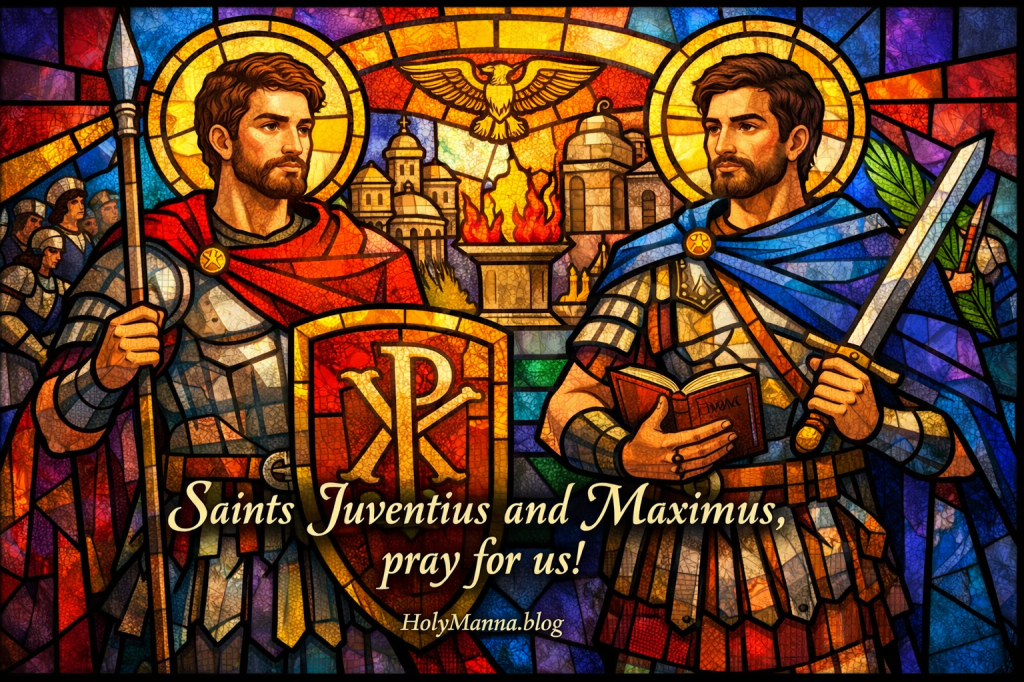
The Banquet Where Two Soldiers Chose Heaven
Saints Juventius and Maximus are remembered as fourth century soldier martyrs from Antioch who stayed faithful to Jesus when loyalty to the emperor started demanding spiritual compromise. Their story does not come wrapped in sentimental details, and that is part of what makes it hit so hard. These men were not famous bishops with long writings, and they were not desert hermits living far from trouble. They were working men in a high pressure environment, close to power, close to temptation, and surrounded by expectations to keep quiet. Their witness still matters because it shows what martyrdom really is in the Catholic sense, not a stunt and not reckless anger, but steady fidelity that refuses to worship anyone or anything but God.
The Church reveres them because their confession of Christ is exactly what The Catechism calls the supreme testimony to the truth of the faith, as taught in CCC 2473. Their traditional commemoration is January 25, and their memory is tied to the preaching of Saint John Chrysostom, who honored them as examples of courage for ordinary Christians trying to live faithfully. Their lives also show that holiness is not reserved for monks in the desert, because grace can make a saint in the middle of civic life when a believer refuses to compromise.
Close to the Emperor, Closer to Christ
The Church does not preserve a detailed account of their childhood, family background, or the kind of conversion story that can be neatly summarized. That silence matters because it keeps the focus where the ancient tradition places it, on their confession of Christ in the moment of testing. What is known is that Juventius and Maximus were Christian men serving as officers in the imperial military, and they were positioned close to the emperor as part of his military suite. That means they lived in a world where favors, promotions, and survival often depended on saying the right thing at the right time, and where silence could buy comfort.
Instead of treating faith like a private preference, they carried it as a real identity. Their conversion is best understood as a deepening and strengthening of a faith they already held, and it was proven in the heat of temptation. They had been formed enough to recognize idolatry even when it came disguised as normal civic life, and they had the courage to name it. Catholic teaching is clear that worship belongs to God alone, and idolatry is a real spiritual danger, as taught in CCC 2096 and CCC 2112. Their lives are also a reminder that obedience has limits, because when an authority demands sin, a Christian must obey God rather than men, which the Church teaches clearly in CCC 2242.
The Holiness of Refusing to Compromise
The crisis that brought their witness into the open happened during the reign of Emperor Julian, who turned away from Christianity and attempted to revive pagan worship. In Antioch, the pressure did not always come as a blunt command to bow before an idol. It could come as a moral trap laid in everyday routines, where refusing to go along made a believer look dramatic or disloyal. The tradition describes sacrificial rites being used in a way meant to entangle Christians even through ordinary food and drink. This is exactly how spiritual compromise often works, because it rarely arrives as a giant obvious evil, and it usually shows up as something small that everyone is expected to tolerate until it becomes the new normal.
Juventius and Maximus refused to let that happen. At a banquet, they spoke openly about what was being done, and the early tradition preserves a line that echoes the cry of the faithful in Daniel 3. Their words were not polished for public relations, and they were not shouted for attention. They were spoken like men who believed God was real and judgment was real: “You have given us over to an impious prince, an apostate beyond all the nations on the earth.” There are no reliable accounts of dramatic miracles performed by these saints during their lifetime, and it is important not to pretend otherwise. Their witness offers a different kind of miracle, the miracle of fortitude, which the Church calls one of the cardinal virtues, and it is the grace to endure fear without surrendering truth, as described in CCC 1808.
Scourged, Silenced, and Crowned
Once their words were reported to the emperor, Juventius and Maximus were interrogated. They could have played the safe game, softened the message, blamed misunderstanding, and probably walked away with their careers intact. Instead, they accepted the interrogation as an opportunity to confess what they believed. They refused to treat idolatry as harmless, and they refused to pretend that public life is morally neutral. Their refusal was not a political tantrum. It was a religious confession, and Catholics understand that when the state asks for what belongs to God, the answer must be a firm no. Conscience has to be obeyed, as taught in CCC 1776.
The tradition says they were scourged and killed, and Western retellings commonly describe beheading in prison at Antioch. Some accounts also speak of their property being confiscated, which fits the pattern of persecution that tries to punish the family and erase a witness. One of the most revealing details is that Julian allegedly tried to frame their execution as punishment for insolence rather than admitting they died for Christ. That move is spiritually important because it shows that even enemies of the faith often know martyrs strengthen the Church. A martyr’s death is not just an ending. It is a proclamation that Jesus is Lord and death is not the final word, which the Church teaches when it speaks of the faithful entering the glory of heaven, as reflected in CCC 1023.
A Tomb and the Power of Their Intercession
After their death, Christians in Antioch honored Juventius and Maximus with veneration at their burial, and the tradition speaks of a prominent tomb and annual remembrance. This is not superstition. It is a very Catholic instinct rooted in the Incarnation, because the body matters since Christ took a real body, died in a real body, and rose in a real body. The faithful honor the martyrs because the martyrs belonged to Christ, and their bodies remind the Church of the resurrection of the body, as taught in CCC 990 and CCC 999. Their memory also spread through the preaching of Saint John Chrysostom, which shows their impact was strong enough to shape the faith of ordinary families in Antioch who needed courage to resist pressure.
There are no consistent, well documented posthumous healing stories universally attached to Saints Juventius and Maximus the way there are for some later saints. Still, their legacy after death is real. The Church’s devotion to martyrs is not based only on spectacular stories, but on the certainty that those who die in Christ are alive in Him. Their intercession fits the doctrine of the Communion of Saints, which teaches that the saints do not stop caring for the Church once they are with God. They can intercede for the faithful, not as rivals to Christ, but as friends of Christ who pray with the Church and for the Church, as taught in CCC 956. A famous line preserved in tradition captures how the Church views martyrs like them, and it still rings true: “They support the church as pillars, defend it as towers, and repel all assaults as rocks.”
Bringing Their Courage Into Ordinary Life
The lesson from these saints is not that every Catholic must chase conflict. The lesson is that every Catholic must love God more than comfort. Their story is a warning about subtle compromise, especially the kind that makes sin look normal and makes courage look extreme. It is easy to think the big threats to faith are always dramatic, but these saints show that the real battlefield is often a banquet table, a workplace conversation, or a quiet moment when the conscience is tempted to stay silent.
A practical way to imitate them is to form the conscience and then obey it. That means staying close to the sacraments, living a real prayer life, and learning the moral teaching of the Church so that truth is not improvised in a crisis. It also means practicing courage in small things, because small compromises train the heart for larger collapses. A believer who cannot say no to gossip, impurity, or dishonest shortcuts will struggle to say no when the stakes get higher. These saints teach that integrity is not only about what is avoided. It is also about what is confessed with calm clarity and without hatred, because truth without charity turns into pride, and charity without truth turns into surrender.
Where has the heart been tempted to keep quiet about Jesus just to keep the peace? What would change this week if the conscience was treated like a sacred place that belongs to God? Who needs a calm, clear word of truth that refuses to compromise but also refuses to hate?
Engage With Us!
Share your thoughts and reflections in the comments below. Saints Juventius and Maximus lived in a world where compromise felt normal, and their courage still speaks to everyday decisions that shape a soul.
- What is one area of life where faith has been treated like something optional instead of something real?
- When pressure shows up through friends, coworkers, or cultural expectations, what helps the conscience stay clear?
- What is one small act of courage that can be practiced this week, not for attention, but for love of Christ?
- How can prayer and the sacraments strengthen the heart to choose truth without bitterness or fear?
Keep walking forward with faith. Choose what is right even when it costs something, forgive quickly, and do everything with the love and mercy Jesus taught us.
Saints Juventius and Maximus, pray for us!
Follow us on YouTube, Instagram and Facebook for more insights and reflections on living a faith-filled life.

 Holy Manna!
Leave a comment