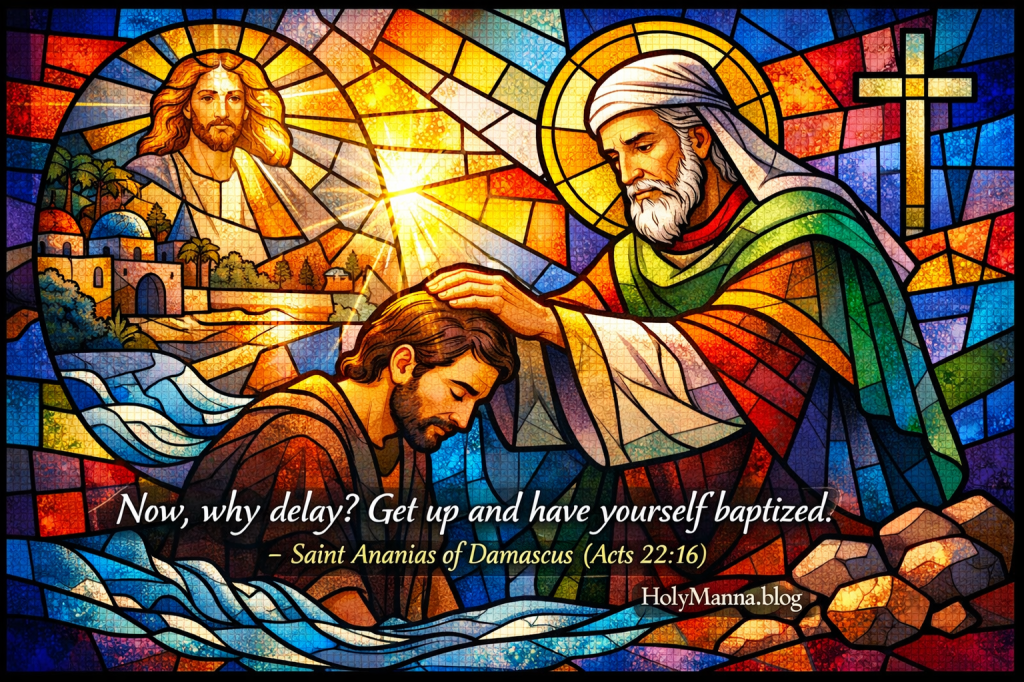
The Disciple Who Welcomed Saint Paul into the Church
Saint Ananias of Damascus is one of the most important background saints in Christian history. He is the disciple the Lord chose to restore Saul’s sight after the Road to Damascus encounter, and he is the man who brought Saul into the sacramental life of the Church through Baptism as described in The Acts of the Apostles 9 and The Acts of the Apostles 22. His holiness looks like obedience when obedience is terrifying, and charity when charity feels risky, because God often changes history through ordinary disciples who simply do what He asks.
His story also protects a deeply Catholic truth. God can strike a heart in an instant, but God also loves to heal and save through His Church. Saul meets Christ on the road, but Saul becomes part of Christ’s Body through the ministry of a faithful disciple and through the sacramental grace that makes a man new, which is exactly how the Church describes Baptism in CCC 1213. Saint Ananias matters because he shows how Jesus works through ordinary believers who say yes when it would be easier to stay quiet.
Damascus Before the Spotlight
Scripture does not give a biography of Ananias’s childhood, family, or profession, and faithful Catholic storytelling should not pretend to know what God did not reveal. What is known is still rich and meaningful. The Acts of the Apostles describes him as a disciple living in Damascus, which implies he belongs to the early Christian community, he prays, and he has the kind of interior life that is attentive to God.
When Saint Paul later retells his conversion story, he adds an important detail about Ananias. Paul calls him a devout man and says he was well spoken of by the Jews living there in The Acts of the Apostles 22. That suggests Ananias had a reputation for integrity and seriousness, even among those who did not share his faith in Christ. A faithful disciple who is respected in a divided city is usually a man who lives the truth without being hateful, and who holds his ground without becoming arrogant.
The Moment Jesus Called His Name
Ananias’s defining conversion moment is not a dramatic turn from scandal to sanctity, but a deeper surrender to God. The Lord calls him by name in a vision, and Ananias replies with simple readiness in The Acts of the Apostles 9. “Here I am, Lord.” That line is short, but it is not shallow, because it is the posture of someone who truly expects God to direct his life.
Then Christ gives him an assignment that sounds unreasonable. He is told to go to a specific place in Damascus and to find Saul, the man known for hunting down Christians. Ananias already knows what everyone knows, and he does not pretend otherwise. He brings his fear into prayer and tells the Lord about Saul’s reputation, which is a healthy kind of faith because it does not deny reality. Christ answers by revealing His plan, and Ananias obeys anyway, which is where his courage becomes a living example for every Catholic who has ever felt hesitant to do the right thing.
Healing Hands and Waters That Made a Saint
When Ananias finds Saul, he lays hands on him and Saul’s blindness is healed as described in The Acts of the Apostles 9. Scripture portrays this healing as something like scales falling from Saul’s eyes, showing that God is doing something deeper than restoring physical sight. Saul is being turned from darkness to light, from violence to mission, and from pride to obedience, and the healing becomes a sign of the interior transformation taking place.
Ananias also speaks God’s purpose over Saul, which matters because it shows that conversion is not only about leaving sin behind. It is also about being chosen for a life of witness and fidelity. In Paul’s retelling in The Acts of the Apostles 22, Ananias explains that the God of their ancestors has chosen Saul to know His will and to be a witness. Ananias is not flattering Saul, and he is not making a motivational speech. He is naming what God is doing and calling Saul to step into it.
Then Ananias does what faithful Catholics should never treat as an afterthought. Saul rises and is baptized, and Ananias urges him with an unforgettable challenge in The Acts of the Apostles 22. “Now, why delay? Get up and have yourself baptized.” This is the voice of someone who knows that grace is not meant to be admired from a distance, and that conversion becomes real when a person enters the sacramental life Christ entrusted to His Church. The Church teaches that Baptism is the gateway to life in the Spirit and the sacrament of new birth, and that is why Ananias is essential to the conversion of Saint Paul, as reflected in CCC 1213.
Miracles of Mercy and Faith
The most clearly recorded miracle associated with Saint Ananias is the healing of Saul’s blindness through the laying on of hands in The Acts of the Apostles 9. That miracle is not a random display of power. It shows Christ’s authority working through a disciple, and it shows that the Lord can use human hands as instruments of His mercy. This should encourage anyone who feels insignificant, because God often chooses humble instruments so the glory stays with Him.
There is also a miracle of grace in the way Ananias relates to Saul. Ananias does not treat Saul as permanently stained by his past. He receives him as someone God is reclaiming, and that kind of charity is not natural. It is supernatural, and it reflects the Church’s confidence that God can truly convert hearts. Saint Ananias is important because he models the kind of courage and compassion that allows conversions to take root, especially when the convert has a messy history and people have reasons to distrust them.
The Crown of Martyrdom
Scripture does not describe the later years of Ananias’s life, but Catholic tradition has long honored him as a bishop and a martyr. The Church’s martyrological tradition commonly remembers him as the first bishop of Damascus and as a preacher of the Gospel beyond that city. These details are preserved through the Church’s memory even when the New Testament remains silent about the timeline, and they fit naturally with what is already known about his role in Damascus.
Catholic tradition also remembers his death as a martyrdom. He is described as suffering harsh persecution and being killed for preaching Christ, often described as death by stoning. Even when some details are preserved through tradition rather than Scripture, the Church’s judgment about his witness is clear. He is honored as a man who followed Christ not only in the moment of courage with Saul, but all the way to the end. Martyrdom is not a love of suffering, but the final form of fidelity, and the martyr proves that Jesus is worth more than comfort, reputation, or even life itself.
A Living Memory
Saint Ananias continues to be remembered through the Church’s prayer and devotion. He is commemorated in the Roman Martyrology on January 25, the same day the Roman Rite celebrates the Conversion of Saint Paul. That pairing makes sense because the Church quietly insists that Paul’s conversion is not only a private experience. It is a Church event completed through the ministry of a disciple and sealed through Baptism, which is the sacrament of new birth described in CCC 1213.
Catholic tradition also associates Ananias with a longstanding site of Christian devotion in Damascus, commonly remembered as the place connected to his home and the early Christian community. Even after centuries of upheaval, that memory persists as a witness that the Gospel took root in real streets and real homes, not in legends floating above history. When it comes to miracles after his death, Catholic sources do not preserve a large collection of dramatic stories the way they do for some other saints. His legacy remains quieter, and in a sense that is part of the lesson, because his greatest ongoing fruit is the ripple effect of his obedience and the way his yes helped shape the mission of Saint Paul.
The Ananias Way of Living the Catholic Life
Saint Ananias is a saint for anyone who feels overlooked or ordinary. God used a seemingly unknown disciple to shape one of the greatest saints in history, and that should give hope to every Catholic trying to live the faith faithfully in a normal routine. God does not measure holiness by visibility. God measures it by obedience and love, and Ananias lived both.
Ananias also teaches something practical about conversion. Many people crave a dramatic spiritual moment, but they delay the concrete steps that make conversion real. Saint Ananias does not let Saul remain in a vague spiritual haze. He brings him into the sacramental life of the Church, which is a deeply Catholic lesson. The Church speaks of Baptism as the principal place of first conversion, and it also teaches that conversion is ongoing and lifelong, which is why repentance and growth never stop, as reflected in CCC 1427. Saint Ananias shows the first step, and his whole witness suggests the steady perseverance that follows.
This saint also models forgiveness and spiritual courage. He walked toward a man who had done real harm to Christians, not because he was naive, but because Christ told him to go. That kind of obedience can be lived today in smaller but real ways. It can look like choosing Confession instead of delay, choosing prayer instead of spiraling, choosing charity instead of contempt, and choosing to accompany someone who is struggling instead of writing them off.
Engage with Us!
Share your thoughts and reflections in the comments below.
- Where is the Lord asking for a simple yes that feels uncomfortable or risky right now?
- Is there someone in your life you have labeled forever, like Saul, even though God might be changing them?
- What does it look like to treat conversion as urgent, especially when it comes to the sacraments and daily repentance?
- How can you practice Ananias’s kind of courage this week in a concrete and measurable way?
May Saint Ananias remind every Christian that holiness is not about being famous. Holiness is about being faithful. Go live a life of faith, and do everything with the love and mercy Jesus taught us.
Saint Ananias of Damascus, pray for us!
Follow us on YouTube, Instagram and Facebook for more insights and reflections on living a faith-filled life.

 Holy Manna!
Leave a comment