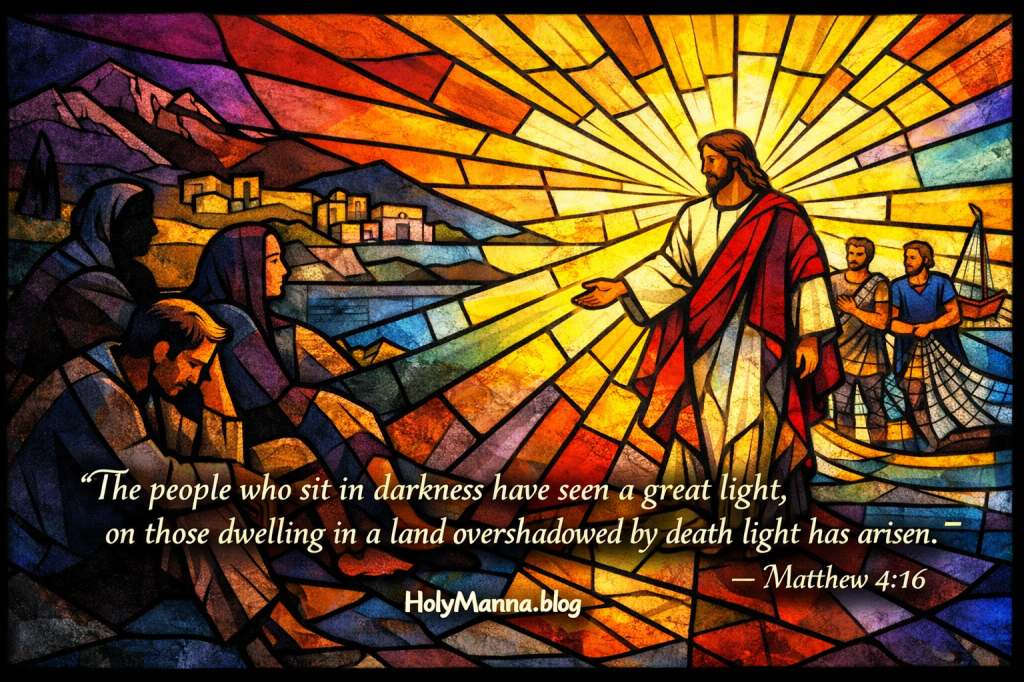
Third Sunday in Ordinary Time – Lectionary: 67
When the Light Turns On, Everything Changes
Sometimes God does not begin by fixing every problem on the outside. Sometimes God begins by turning on the light. That is the thread running through today’s readings, and it is as practical as it is profound. The central theme is simple and strong: Christ enters the places of darkness, calls for real repentance, gathers a divided people into unity, and sends them on mission. When that light shines, fear loses its grip, division loses its logic, and ordinary life becomes the setting for a holy calling.
There is a reason the liturgy starts in the north, in the lands of Zebulun and Naphtali. In Israel’s history, this region knew invasion, humiliation, and cultural pressure long before the south felt it. It was a borderland, exposed and often looked down on, and it came to be associated with Gentile influence and mixed populations. Isaiah speaks directly into that wound with a promise that sounds almost impossible: “The people who walked in darkness have seen a great light.” God announces not only relief, but reversal. The yoke is broken, joy returns, and what was once degraded is glorified. That promise is not vague spiritual poetry. Matthew shows it becoming flesh and blood when Jesus goes to live in Capernaum and begins preaching the first word of the Kingdom: “Repent, for the kingdom of heaven is at hand.”
That is where the Psalm becomes more than a comforting line and starts sounding like a battle plan. “The Lord is my light and my salvation; whom should I fear?” This kind of confidence is not bravado. It is the steadiness of someone who has learned that the safest place in the world is the presence of God. The desire “to dwell in the Lord’s house all the days of my life” is the desire to live close to the Light, because the heart becomes what it gazes upon.
Then Saint Paul steps in and makes sure nobody turns the Light into a spotlight on themselves. The Corinthians were dividing into camps, attaching their identity to personalities and preferences, and Paul cuts through the noise with surgical clarity: “Is Christ divided?” The Church does not belong to Paul, Apollos, Cephas, or any modern tribe. The Church belongs to the Crucified and Risen Lord, and unity is not a nice extra. It is part of fidelity to Jesus Himself, because Baptism binds believers into one Body in Christ, not into competing fan clubs.
All of that sets up the Gospel moment that feels almost too direct: Jesus walks by the sea and calls working men in the middle of a normal day, and they leave their nets to follow Him. Light does not merely reveal. Light summons. The Kingdom is not only announced. The Kingdom claims lives, heals what is broken, and turns disciples into fishers of men. Where is the Lord asking for repentance that is real, not performative, so that His light can bring unity, courage, and mission into everyday life?
First Reading – Isaiah 8:23-9:3
God Turns the Lights On in the Places Everyone Forgot
Isaiah is speaking into a real wound in Israel’s story, not an imaginary one. The lands of Zebulun and Naphtali were in the north, exposed to invasion, cultural pressure, and political humiliation. When the Assyrian empire swept through, these border regions were among the first to be crushed, and people learned what it felt like to live under a yoke they could not lift. That is why today’s theme of light hitting darkness is not just poetic. It is God announcing a reversal that only He can accomplish. The very places associated with loss and shame will become the stage for glory, joy, and freedom. This is also why the Church pairs this reading with the Gospel, because Jesus begins His public ministry in that same region. God does not avoid the hard places. God redeems them, and He starts the rescue right where the darkness felt most permanent.
Isaiah 8:23-9:3 – New American Bible (Revised Edition)
8:23 There is no gloom where there had been distress. Where once he degraded the land of Zebulun and the land of Naphtali, now he has glorified the way of the Sea, the land across the Jordan, Galilee of the Nations.
9:1 The people who walked in darkness
have seen a great light;
Upon those who lived in a land of gloom
a light has shone.
2 You have brought them abundant joy
and great rejoicing;
They rejoice before you as people rejoice at harvest,
as they exult when dividing the spoils.
3 For the yoke that burdened them,
the pole on their shoulder,
The rod of their taskmaster,
you have smashed, as on the day of Midian.
Detailed Exegesis
Verse 23 “There is no gloom where there had been distress. Where once he degraded the land of Zebulun and the land of Naphtali, now he has glorified the way of the Sea, the land across the Jordan, Galilee of the Nations.”
Isaiah begins with a spiritual pattern that shows up all over salvation history. God allows His people to feel the consequences of sin, pride, and political compromise, but He does not abandon them to despair. The mention of Zebulun and Naphtali is intentional, because these were vulnerable territories on the edge. “Galilee of the Nations” signals a mixed region, a crossroads where Gentile influence was strong. That can sound like an insult in the ancient world, but the prophecy flips it. God will “glorify” what looked like a spiritual backwater. This is a preview of the Gospel logic, because God loves to begin where nobody expects Him.
Verse 1 “The people who walked in darkness have seen a great light; Upon those who lived in a land of gloom a light has shone.”
Darkness here is not only emotional sadness. It includes oppression, confusion, fear, and the spiritual fog that settles over a people who feel forgotten. The key word is “seen,” because God is not offering abstract ideas. God is promising an objective intervention, a light that truly arrives. The Church hears this with a messianic ear, because Christ is not merely a teacher who talks about light. Christ is the Light who enters the darkness and makes it possible to see again.
Verse 2 “You have brought them abundant joy and great rejoicing; They rejoice before you as people rejoice at harvest, as they exult when dividing the spoils.”
Isaiah moves from light to joy, because joy is what happens when God restores what was stolen. The harvest image is earthy and concrete. It is the relief of hunger ending and the satisfaction of a season finally bearing fruit. The “dividing the spoils” image points to victory after defeat, when what the enemy claimed is taken back. Spiritually, this is what grace does. When God saves, He does not merely reduce sadness. He restores life, dignity, and the ability to rejoice in His presence.
Verse 3 “For the yoke that burdened them, the pole on their shoulder, The rod of their taskmaster, you have smashed, as on the day of Midian.”
The language is heavy on purpose. A yoke, a pole, and a rod are the tools of enforced labor and domination. Isaiah says God Himself smashes them. Then he adds, “as on the day of Midian,” recalling the victory God gave through Gideon, when Israel could not credit military strength or clever strategy. The point is clear. Deliverance is God’s work first, and it is meant to produce humble gratitude, not self-congratulation. This is how God frees souls too. The chains break because grace is stronger than the oppressor.
Teachings
This reading teaches that God’s salvation is not an upgrade for the already comfortable. It is rescue for those in darkness, including darkness caused by external oppression and darkness caused by interior sin. That is why the Church consistently proclaims Christ as the true Light, not as a vague symbol, but as the definitive revelation of God’s mercy and truth.
The Catechism expresses this connection between Christ’s light and the Church’s mission with striking clarity. CCC 748 says, “Christ is the light of humanity; and it is, accordingly, in the Church that this light shines.” That fits Isaiah perfectly. The light does not remain a private consolation. It becomes a public witness, because God intends to gather His people and illuminate the nations.
This passage also harmonizes with the Church’s teaching on conversion, because God’s light is not given so people can admire it from a distance. God’s light is given so people can walk differently. CCC 1427 says, “Jesus calls to conversion. This call is an essential part of the proclamation of the kingdom.” Isaiah describes the result of that kingdom breaking in: burdens lifted, fear replaced by joy, and a people restored to worship.
The historical backdrop matters, too. The Assyrian crises of the eighth century before Christ created a national trauma, especially in the north. Isaiah’s prophecy is a promise that political terror does not get the final word. When the Gospel later places Jesus in Galilee, it is not random geography. It is God keeping His word in the exact location where the pain once felt most personal. God’s timing can feel slow, but God’s faithfulness is precise.
Saint Augustine offers a line that pairs well with the “yoke smashed” image, because it keeps the focus on grace and cooperation. He is often quoted saying, “God created you without you, but will not save you without you.” God is the Deliverer, but the heart still has to stop clinging to the chains.
Reflection
This reading invites a hard but hopeful honesty. Darkness is not only “out there” in the culture or the news cycle. Darkness can settle into the soul through habitual sin, cynicism, secret fear, and the slow resignation that says things will never change. Isaiah refuses that resignation. God shines light, and then God breaks burdens. That means the spiritual life is not about managing the darkness better. It is about bringing the dark places into the presence of Christ so He can heal, correct, and free.
A practical step is to name the yoke clearly. A yoke can be an addiction, a pattern of anger, a cycle of impurity, a grudge that keeps replaying, or a constant anxiety that refuses to trust God. Then it is time to bring it to the Lord with the steadiness Isaiah models. God does not shame the wounded. God liberates the captive. That liberation often begins with repentance, confession, and daily decisions that cooperate with grace instead of negotiating with the old slavery.
It also helps to remember where God likes to begin. God often starts in “Galilee,” meaning the part of life that feels unimpressive, messy, or embarrassed. That is the place He chooses to glorify. Where has discouragement convinced the heart that darkness is normal, even though God is offering light? What burden has been carried so long that it feels like part of identity, even though God calls it a yoke to be smashed? If God can glorify Zebulun and Naphtali, what part of life might He be ready to redeem right now, if it is surrendered without excuses?
Responsorial Psalm – Psalm 27:1, 4, 13-14
Courage Is Not a Mood. It Is a Decision to Live in God’s Light.
Psalm 27 is a Psalm of David, and it sounds like a man who knows both danger and God’s protection. In Israel’s world, kingship was never a comfortable desk job. David lived through betrayal, warfare, exile, and moments where fear would have been the normal response. That background matters because the Psalm is not pretending life is safe. It is proclaiming that God is safer. That is why this Psalm fits today’s theme so perfectly. Isaiah promised a great light shining in darkness, and the Gospel shows that Light arriving in Christ. The Psalm teaches what to do when the Light has appeared. It teaches how to stand firm, seek the Lord’s presence, and wait with courage when answers are not immediate. It also teaches the religious heart of Israel, because the desire to dwell in the Lord’s house points to worship at the Temple, the place where God’s presence was honored and where the faithful learned to trust the Lord more than circumstances.
Psalm 27:1, 4, 13-14 – New American Bible (Revised Edition)
Trust in God
1 Of David.
The Lord is my light and my salvation;
whom should I fear?
The Lord is my life’s refuge;
of whom should I be afraid?4 One thing I ask of the Lord;
this I seek:
To dwell in the Lord’s house
all the days of my life,
To gaze on the Lord’s beauty,
to visit his temple.13 I believe I shall see the Lord’s goodness
in the land of the living.
14 Wait for the Lord, take courage;
be stouthearted, wait for the Lord!
Detailed Exegesis
Verse 1 “The Lord is my light and my salvation; whom should I fear? The Lord is my life’s refuge; of whom should I be afraid?”
David begins with identity before emotion. God is not merely helpful. God is “my light,” which means God is the One who makes reality visible and gives direction when confusion and darkness press in. God is also “my salvation,” which means rescue is not a theory. It is personal. Then David names God as “my life’s refuge,” which evokes the ancient instinct to run to a stronghold when enemies approach. The spiritual meaning is clear. Fear loses its claim when the heart knows where safety truly is. This does not mean fear never shows up. It means fear does not get to be the leader.
Verse 4 “One thing I ask of the Lord; this I seek: To dwell in the Lord’s house all the days of my life, To gaze on the Lord’s beauty, to visit his temple.”
This verse reveals what actually produces courage. David’s “one thing” is not control over outcomes. It is communion with God. In Israel, the Temple was not entertainment or private spirituality. It was the center of worship and covenant life. To “dwell” in the Lord’s house expresses a desire for stability in God’s presence. To “gaze on the Lord’s beauty” is not shallow aesthetics. It is the steady contemplation of God’s holiness, goodness, and faithfulness. When the heart learns to gaze at God, it stops being ruled by whatever is loudest and most anxious.
Verse 13 “I believe I shall see the Lord’s goodness in the land of the living.”
David speaks with a faith that is grounded, not dreamy. “The land of the living” means this life, not only heaven. That matters because Scripture does not teach a faith that postpones everything to the afterlife. God’s goodness is real now, even when it is partial and still contested. This line is a refusal to surrender to despair. It is the language of hope that expects God’s providence to act, even if the timeline is not under human control.
Verse 14 “Wait for the Lord, take courage; be stouthearted, wait for the Lord!”
This is one of the most practical spiritual commands in the Bible. Waiting is hard because it forces surrender, and surrender is exactly what pride resists. David repeats “wait” because hearts forget quickly. The call to be “stouthearted” is a call to endurance, not to swagger. In the context of today’s readings, this verse sounds like the posture of discipleship. Christ the Light has come, and the Christian life becomes a steady walk of trust, repentance, and perseverance until God completes what He begins.
Teachings
This Psalm teaches that courage is not manufactured by personality or circumstance. Courage grows from worship and trust. When the Psalm says the Lord is “my light,” it lines up perfectly with the Church’s confession that Christ is the definitive Light who reveals the Father and saves the world. The Church also teaches that faith is not blind optimism. Faith is a supernatural virtue that anchors the soul in God’s truth and goodness.
The Catechism describes hope in a way that matches verses 13 and 14 with clarity. CCC 1817 says, “Hope is the theological virtue by which we desire the kingdom of heaven and eternal life as our happiness, placing our trust in Christ’s promises and relying not on our own strength, but on the help of the grace of the Holy Spirit.” This Psalm is hope in action. It desires God, trusts God, and refuses to rely on self as the final refuge.
The Psalm’s desire to “dwell in the Lord’s house” also harmonizes with the Catholic understanding of prayer as living relationship. CCC 2565 says, “In the New Covenant, prayer is the living relationship of the children of God with their Father who is good beyond measure, with his Son Jesus Christ and with the Holy Spirit.” David’s longing is not for a building alone. It is for closeness to the Lord, which becomes even more intimate in the New Covenant through Christ and the sacraments.
Saint Augustine often preached that hearts are restless until they rest in God, and that line captures what verse 4 is really after. The human heart tries to dwell in success, approval, pleasure, or control, and none of it holds. God alone is a home that does not collapse.
Reflection
This Psalm is a gift for anyone who feels pulled in ten directions by fear, noise, and constant urgency. It teaches a simple spiritual reordering. The most important question is not, “How does everything get fixed today?” The most important question is, “Where does the heart live?” If the heart lives in headlines, conflicts, resentments, or fantasies, fear will always have leverage. If the heart lives in the Lord’s presence, fear may still knock, but it will not own the house.
A concrete step is to reclaim the “one thing” logic. Build a daily habit that protects time for prayer and Scripture, even if it feels small. Make Mass and Eucharistic adoration, when possible, the place where the heart learns to gaze on the Lord’s beauty instead of grazing on distraction. Practice the command to wait by bringing one specific worry to God each day and refusing to rehearse it like a script.
Waiting also becomes easier when it is paired with obedience. The Psalm does not teach passive spirituality. It teaches active trust, which means continuing to repent, continuing to forgive, continuing to serve, and continuing to show up for the duties of one’s state in life while God works.
What is currently being treated as a refuge, even though it cannot actually protect the soul? What would change in daily life if the Lord were treated as the true light that interprets everything else? Where is God asking for stouthearted patience instead of frantic control, so that trust can mature into real peace?
Second Reading – 1 Corinthians 1:10-13, 17
Stop Building Teams. Start Living the Cross.
Corinth was a wealthy port city, loud with commerce, competition, and status-seeking. People were used to proving themselves by association, attaching their identity to impressive leaders, popular speakers, and the latest philosophical trends. It is not surprising that some of that culture leaked into the early Church there. Instead of living as one family in Christ, believers began forming camps and slogans. Saint Paul writes into that mess with urgency because division is not a small inconvenience. Division is a spiritual wound that contradicts the Gospel itself. This fits today’s theme perfectly. Isaiah and the Gospel proclaim a great Light shining in darkness, but Paul insists that the Light does not create a fan club. The Light creates a united Body, gathered around one Lord, one Baptism, and one saving Cross.
1 Corinthians 1:10-13, 17 – New American Bible (Revised Edition)
Groups and Slogans. 10 I urge you, brothers, in the name of our Lord Jesus Christ, that all of you agree in what you say, and that there be no divisions among you, but that you be united in the same mind and in the same purpose. 11 For it has been reported to me about you, my brothers, by Chloe’s people, that there are rivalries among you. 12 I mean that each of you is saying, “I belong to Paul,” or “I belong to Apollos,” or “I belong to Cephas,” or “I belong to Christ.” 13 Is Christ divided? Was Paul crucified for you? Or were you baptized in the name of Paul?
17 For Christ did not send me to baptize but to preach the gospel, and not with the wisdom of human eloquence, so that the cross of Christ might not be emptied of its meaning.
Detailed Exegesis
Verse 10 “I urge you, brothers, in the name of our Lord Jesus Christ, that all of you agree in what you say, and that there be no divisions among you, but that you be united in the same mind and in the same purpose.”
Paul appeals “in the name of our Lord Jesus Christ,” which means this is not a preference or a leadership style. It is a matter of obedience to Christ. The call to be “united” does not mean everyone has the same personality or the same opinions about every detail. It means believers share the same core confession, the same worship, and the same moral direction, and they refuse to treat each other as enemies. “Same mind and same purpose” points to a shared orientation toward Christ and His mission, not toward personal ego.
Verse 11 “For it has been reported to me about you, my brothers, by Chloe’s people, that there are rivalries among you.”
Paul names the issue plainly. Rivalries are more than disagreements. Rivalries are competitive, pride-driven conflicts that seek to win rather than to love. The mention of “Chloe’s people” shows that this division had become public enough to be widely known. That is an important warning. Sin rarely stays private, especially when it involves speech, factions, and contempt.
Verse 12 “I mean that each of you is saying, ‘I belong to Paul,’ or ‘I belong to Apollos,’ or ‘I belong to Cephas,’ or ‘I belong to Christ.’”
Paul lists the slogans exactly as they sounded. “Paul” and “Apollos” likely represent different preaching styles or perceived strengths. “Cephas” points to Peter, which could indicate an appeal to apostolic authority in a way that becomes partisan instead of faithful. The most revealing slogan is “I belong to Christ,” because it can be spoken with real devotion, but it can also be weaponized as the ultimate spiritual flex, as if to say, “Unlike the rest of you, this group has Christ correctly.” Paul refuses to let even the name of Christ be used as a badge of superiority.
Verse 13 “Is Christ divided? Was Paul crucified for you? Or were you baptized in the name of Paul?”
Paul fires off three questions that expose the absurdity of factionalism. Christ is one, and His Body is meant to reflect that unity. Paul was not crucified for anyone, and no one was baptized into Paul. Baptism is not an initiation into a brand. Baptism is incorporation into Christ. Paul is also reminding the Corinthians that salvation is not rooted in personal preference. Salvation is rooted in the Cross and received through faith and sacramental life.
Verse 17 “For Christ did not send me to baptize but to preach the gospel, and not with the wisdom of human eloquence, so that the cross of Christ might not be emptied of its meaning.”
Paul is not diminishing Baptism, because Baptism is commanded by Christ and essential to Christian life. Paul is clarifying his apostolic role in Corinth, where others likely performed most baptisms. His emphasis is on preaching the Gospel in a way that keeps the Cross central. “Human eloquence” here points to rhetorical showmanship that could turn the Gospel into entertainment or philosophy. Paul refuses to let style eclipse substance. If preaching becomes a performance, the Cross can be “emptied,” meaning its scandal and saving power can be softened into something safe and acceptable. Paul insists that the Gospel must remain cruciform, because that is where God’s power is revealed.
Teachings
This reading teaches that unity is not optional for Christians, and it is never built on personalities, trends, or tribes. Unity is built on Christ, received through Baptism, nourished by the Eucharist, and guarded by charity and truth. The Church is not a loose network of religious consumers. The Church is a Body, and division is a tearing of that Body.
The Catechism describes the Church’s unity as something Christ wills, something the Holy Spirit works, and something believers must protect. CCC 813 says, “The Church is one because of her source. The highest exemplar and source of this mystery is the unity, in the Trinity of Persons, of one God, the Father and the Son in the Holy Spirit.” That means unity is not mainly a strategy. Unity is a reflection of God’s own life.
The Catechism also speaks about the scandal of division and the call to restore unity among Christians. CCC 817 says, “In this one and only Church of God from its very beginnings there arose certain rifts, which the Apostle strongly censures as damnable. But in subsequent centuries much more serious dissensions appeared and large communities became separated from full communion with the Catholic Church for which, often enough, men of both sides were to blame.” Paul is doing exactly what the Catechism describes. He strongly censures division because it contradicts the will of Christ.
Saint John Chrysostom, preaching on this passage, pushes the point even harder by calling division in the Church a grave evil, because it breaks the peace that should mark the people who share one altar and one Lord. His pastoral instinct is practical. Pride inflames rivalry, and rivalry destroys communion.
Historically, Corinth also helps explain why Paul is so intense about “eloquence.” Greek culture prized skilled rhetoric, and speakers could build followings like celebrities. Paul refuses to let the Church become another version of that marketplace. The Gospel is not a product, and the Cross is not a branding tool. The Cross is the saving act of Christ that humbles every ego and unites every repentant sinner.
Reflection
This reading lands right in the middle of modern life because the temptation to form tribes is everywhere. It can happen in politics, sports, online spaces, and sadly, even in Catholic life. There is a way to appreciate different spiritualities, charisms, and teachers while remaining rooted in communion. There is also a way to turn preferences into identity and identity into contempt. Paul is calling for a conversion of speech, because factions are often built with words before they are built with actions.
A practical step is to examine how conversations sound, especially about other Catholics. When the tongue regularly labels, mocks, or dismisses, it is usually a sign that pride is looking for a team to hide behind. Another step is to re-center daily prayer on the Cross. The Cross humbles the heart because it reminds everyone of the same truth. Nobody gets saved by being right on social media. Everybody gets saved by Christ crucified, received with repentance and faith.
It also helps to remember that unity does not mean avoiding truth. Unity means telling the truth with charity and receiving correction with humility. It means refusing to treat fellow Catholics as enemies, and it means choosing the hard work of patience, clarity, and prayer instead of the easy dopamine of outrage.
Where has identity been built more on a camp than on Christ Himself? When talking about the Church, do the words build communion, or do they quietly train the heart to despise other believers? What would change if every argument and preference were placed under the Cross, so that pride could be crucified before it starts another rivalry?
Holy Gospel – Matthew 4:12-23
The Light Arrives, the Kingdom Opens, and Ordinary People Get Called
This Gospel marks a turning point in The Gospel of Matthew. John the Baptist has been arrested, and Jesus steps forward into public ministry with urgency and clarity. He does not begin in Jerusalem’s power centers, and he does not start with the religious elite. He withdraws into Galilee and makes his home in Capernaum, right in the region of Zebulun and Naphtali. That detail is not random geography. It is the fulfillment of Isaiah’s prophecy that a great light would rise in a land of darkness. Galilee was a borderland, influenced by trade routes and Gentile presence, and it could be looked down on as spiritually unimpressive. Jesus chooses it anyway, which tells the truth about how God works. God glorifies what the world dismisses. This fits today’s theme perfectly. The Light shines, the call to repentance begins, and Christ forms a united people through a simple invitation that changes everything: follow me.
Matthew 4:12-23 – New American Bible (Revised Edition)
12 When he heard that John had been arrested, he withdrew to Galilee. 13 He left Nazareth and went to live in Capernaum by the sea, in the region of Zebulun and Naphtali, 14 that what had been said through Isaiah the prophet might be fulfilled:
15 “Land of Zebulun and land of Naphtali,
the way to the sea, beyond the Jordan,
Galilee of the Gentiles,
16 the people who sit in darkness
have seen a great light,
on those dwelling in a land overshadowed by death
light has arisen.”17 From that time on, Jesus began to preach and say, “Repent, for the kingdom of heaven is at hand.”
The Call of the First Disciples. 18 As he was walking by the Sea of Galilee, he saw two brothers, Simon who is called Peter, and his brother Andrew, casting a net into the sea; they were fishermen. 19 He said to them, “Come after me, and I will make you fishers of men.” 20 At once they left their nets and followed him. 21 He walked along from there and saw two other brothers, James, the son of Zebedee, and his brother John. They were in a boat, with their father Zebedee, mending their nets. He called them, 22 and immediately they left their boat and their father and followed him.
Ministering to a Great Multitude. 23 He went around all of Galilee, teaching in their synagogues, proclaiming the gospel of the kingdom, and curing every disease and illness among the people.
Detailed Exegesis
Verse 12 “When he heard that John had been arrested, he withdrew to Galilee.”
John’s arrest signals that opposition is real and the hour is serious. Jesus does not act out of fear, but with sober prudence. He withdraws to Galilee in a way that aligns with the Father’s timing. This also shows that the Kingdom does not advance by reckless showmanship. It advances by obedience, wisdom, and courage at the right time.
Verse 13 “He left Nazareth and went to live in Capernaum by the sea, in the region of Zebulun and Naphtali.”
Jesus relocates from Nazareth to Capernaum, a working town near the Sea of Galilee, positioned along major routes. Spiritually, this is a mission move. It places him where people pass through, where cultures meet, and where the light can spread. It also plants the ministry in the very territory Isaiah named, underlining that God keeps his promises with precision.
Verse 14 “That what had been said through Isaiah the prophet might be fulfilled.”
Matthew pauses to teach how to read Scripture. The life of Jesus is not improvised. It is fulfillment. This is a reminder that the Old Testament is not abandoned. It is completed in Christ. God’s plan is coherent, and the Church receives the Scriptures as one unified story of salvation.
Verse 15 “Land of Zebulun and land of Naphtali, the way to the sea, beyond the Jordan, Galilee of the Gentiles.”
These place names carry memory. They recall regions scarred by invasion and mixed with Gentile influence. The phrase “Galilee of the Gentiles” hints at the widening of God’s saving work. The Messiah comes first for Israel, but he comes to draw all nations into one people. The borderland becomes the launchpad for a worldwide mission.
Verse 16 “The people who sit in darkness have seen a great light, on those dwelling in a land overshadowed by death light has arisen.”
The darkness here is not only ignorance. It includes sin, fear, oppression, and the shadow of death itself. The light is not an idea. The light is a person. Christ reveals the Father, exposes sin, heals the wounded, and opens the path to eternal life. This is also the logic of conversion. Light shows what is real, and that is why it can feel uncomfortable at first. It reveals so it can heal.
Verse 17 “From that time on, Jesus began to preach and say, ‘Repent, for the kingdom of heaven is at hand.’”
This is the first summary of Jesus’ preaching in Matthew, and it starts with repentance. Repentance is not a vibe or a temporary regret. It is a decisive turning of the heart toward God. The kingdom is “at hand” because the King is present. The reign of God is arriving in Christ’s words, works, and sacramental mission, and it demands a response.
Verse 18 “As he was walking by the Sea of Galilee, he saw two brothers, Simon who is called Peter, and his brother Andrew, casting a net into the sea; they were fishermen.”
Jesus calls real people in the middle of real work. Peter and Andrew are not in a classroom or temple setting. They are doing ordinary labor. This is a reminder that vocation often begins in the middle of daily duty. God’s grace enters ordinary life and turns it toward supernatural purpose.
Verse 19 “He said to them, ‘Come after me, and I will make you fishers of men.’”
Jesus does not merely invite them to learn concepts. He invites them into relationship and discipleship. “Come after me” is the heart of Christian life. Then he promises transformation, “I will make you,” because discipleship is not self-made. Grace forms the disciple. “Fishers of men” does not mean manipulation. It means participating in God’s rescue, drawing souls out of the waters of sin and death into the life of the Kingdom.
Verse 20 “At once they left their nets and followed him.”
The immediacy shows the authority of Christ and the work of grace in the heart. They leave what sustained their livelihood because they recognize a greater call. This verse challenges the temptation to follow Jesus only after every risk is removed. The Gospel shows a faith that moves when Christ speaks.
Verse 21 “He walked along from there and saw two other brothers, James, the son of Zebedee, and his brother John. They were in a boat, with their father Zebedee, mending their nets. He called them.”
James and John are pictured repairing nets, which is a quiet image of preparation and responsibility. Jesus interrupts that normal scene with a call that reorders priorities. The presence of their father highlights that following Christ affects family life, not because family is despised, but because the Lord must come first.
Verse 22 “And immediately they left their boat and their father and followed him.”
This does not teach contempt for parents. It teaches the supremacy of the Kingdom. In the Catholic understanding, vocation is never meant to be selfish, but it is always meant to be total. When Christ calls, loyalty to him becomes the foundation for every other loyalty. Even family love is purified and strengthened when it is placed under God.
Verse 23 “He went around all of Galilee, teaching in their synagogues, proclaiming the gospel of the kingdom, and curing every disease and illness among the people.”
Matthew summarizes Jesus’ mission with three actions: teaching, proclaiming, and healing. Teaching forms minds in truth. Proclaiming announces the Kingdom as good news, not as moralism. Healing shows that the Kingdom is not talk. It is power and mercy. This also hints at the Church’s continuing mission, because Christ’s ministry continues through the proclamation of the Word and the sacramental life that heals and restores.
Teachings
This Gospel teaches that Jesus is the promised Light, and that the first response to the Light is repentance. The Catechism describes conversion as central to Jesus’ proclamation. CCC 1427 says, “Jesus calls to conversion. This call is an essential part of the proclamation of the kingdom.” Repentance is not humiliation for its own sake. It is the doorway into freedom, because sin thrives in darkness and collapses when brought into the light.
The Gospel also teaches vocation and discipleship. Jesus calls disciples into communion with him, and that communion becomes mission. The Church does not treat discipleship as a private self-help path. It is a calling into the life of Christ, into the Church, and into participation in his saving work. The Catechism captures the heart of this mission through the Church’s identity. CCC 849 says, “The missionary mandate. ‘Having been divinely sent to the nations that she might be the universal sacrament of salvation, the Church, in obedience to the command of her founder and because it is demanded by her own essential universality, strives to preach the Gospel to all men.’” The phrase “fishers of men” is not a slogan. It is the pattern of the Church’s life.
This Gospel also reveals the shape of Christ’s ministry, which the Church continues. Word and mercy belong together. Teaching without healing becomes cold. Healing without truth becomes shallow. Jesus does both, and the Church is called to do the same in fidelity to him.
Saint Gregory the Great preached often about the call of the apostles, emphasizing that God chooses the humble to confound the proud, and that the fishermen are not selected because they are impressive, but because they are willing. That is a strong correction for any age that prizes image over holiness.
Reflection
This Gospel presses for a response that is concrete. It is easy to admire the Light in theory and still live like the darkness is normal. Jesus does not offer that option. He says, “Repent.” That means naming sin honestly, rejecting what pulls the soul away from God, and choosing the path of obedience even when it costs something.
A wise daily step is to treat repentance as a habit, not as a rare emergency. A brief examination of conscience each evening can train the heart to live in the light. Confession, approached regularly, becomes the place where darkness is exposed without despair, because mercy is real and grace actually changes people. Another step is to take Jesus seriously when he says, “Follow me.” Following him includes prayer, Sunday Mass, moral discipline, and real charity, but it also includes being available for mission in ordinary life. The people around any home, workplace, and parish are the “Sea of Galilee” where Christ still calls and still saves.
This Gospel also asks what nets are being clung to. Nets can be habits that provide comfort but keep the soul stuck. Nets can be addictions to approval, constant entertainment, lust, anger, or control. Jesus does not ask people to drop nets to make life smaller. He asks them to drop nets to make life truer and larger.
Where is Christ shining light on a part of life that has been kept in the shadows? What specific act of repentance would prove that the Kingdom is being taken seriously, not just talked about? What net needs to be left behind so that following Christ can be real and joyful instead of delayed and theoretical?
Walk in the Light
Today’s readings land like one unified message from the Lord, and it is hard to miss what God is doing. God shines light into real darkness, not as a decoration, but as a rescue. Isaiah promises that the very places marked by humiliation and distress will be glorified, and that God will smash the yoke that burdens His people. The Responsorial Psalm answers that promise with a posture for daily life, because courage is born when the heart chooses to live near God’s presence and to wait for Him with steady trust. Saint Paul then gets practical and calls out the kind of division that quietly poisons a parish or a family, insisting that Christians cannot build identity on camps and slogans because Christ is not divided. Then the Gospel brings everything to a point. Jesus, the promised Light, goes straight into Galilee’s shadows, preaches repentance, calls ordinary workers to follow Him immediately, and begins teaching, proclaiming, and healing with the authority of the Kingdom.
The key message is this. When Christ the Light arrives, everything changes. Darkness does not get the final word. Fear does not get to be in charge. Division does not get to be normal. The Kingdom is at hand, which means the moment to respond is now, not someday. Repentance is not a punishment. It is the doorway into freedom. Unity is not a personality preference. It is obedience to Jesus and love for His Body, the Church. Mission is not reserved for specialists. It is the ordinary calling of disciples who have been found and forgiven.
A warm call to action fits today because the readings are not asking for vague inspiration. They are asking for a real step. Choose one place in life where darkness has been tolerated and bring it into the light through honest prayer and concrete repentance. Choose one relationship or conversation pattern where rivalry or contempt has crept in, and replace it with humility, patience, and truth spoken with charity. Choose one simple way to follow Christ more seriously this week, whether that means making a good confession, protecting time for Scripture, showing up for Mass with a focused heart, or serving someone who is suffering. Then do not keep the light to yourself. Christ still makes fishers of men, which means someone nearby is waiting for a word of hope, an invitation back to the sacraments, or the steady example of a Catholic who actually lives like the Lord is light and salvation.
What would change this week if Christ were treated as the true Light, instead of one interest among many? Who needs to see God’s goodness through a concrete act of mercy, patience, or courage? The Lord has already spoken in the readings. The next move is to follow.
Engage with Us!
Share your reflections in the comments below, because the Lord speaks uniquely to every heart through His Word, and hearing how these readings land in real life can strengthen the whole community.
- First Reading, Isaiah 8:23-9:3: Where has life felt like a “land of gloom,” and what would it look like to let God’s light shine into that specific place through repentance, prayer, and trust?
- Responsorial Psalm, Psalm 27:1, 4, 13-14: What has been treated like a refuge besides God, and how can daily life be reordered so that the heart truly “gazes on the Lord’s beauty” instead of living in anxiety and distraction?
- Second Reading, 1 Corinthians 1:10-13, 17: Where have rivalries, labels, or spiritual pride tempted the heart to take sides, and what concrete step can be taken to build unity in the Church around Christ crucified?
- Holy Gospel, Matthew 4:12-23: What “net” is being clung to that keeps discipleship comfortable but not total, and how is Jesus calling for an immediate and joyful yes to follow Him more seriously?
Keep leaning into the Lord’s light this week with courage and consistency, and choose to live a life of faith that is steady, humble, and real, doing everything with the love and mercy Jesus taught us.
Sacred Heart of Jesus, we trust in You!
Immaculate Heart of Mary, pray for us!
Saint Michael the Archangel, defend us in battle!
Follow us on YouTube, Instagram and Facebook for more insights and reflections on living a faith-filled life.

 Holy Manna!
Leave a comment