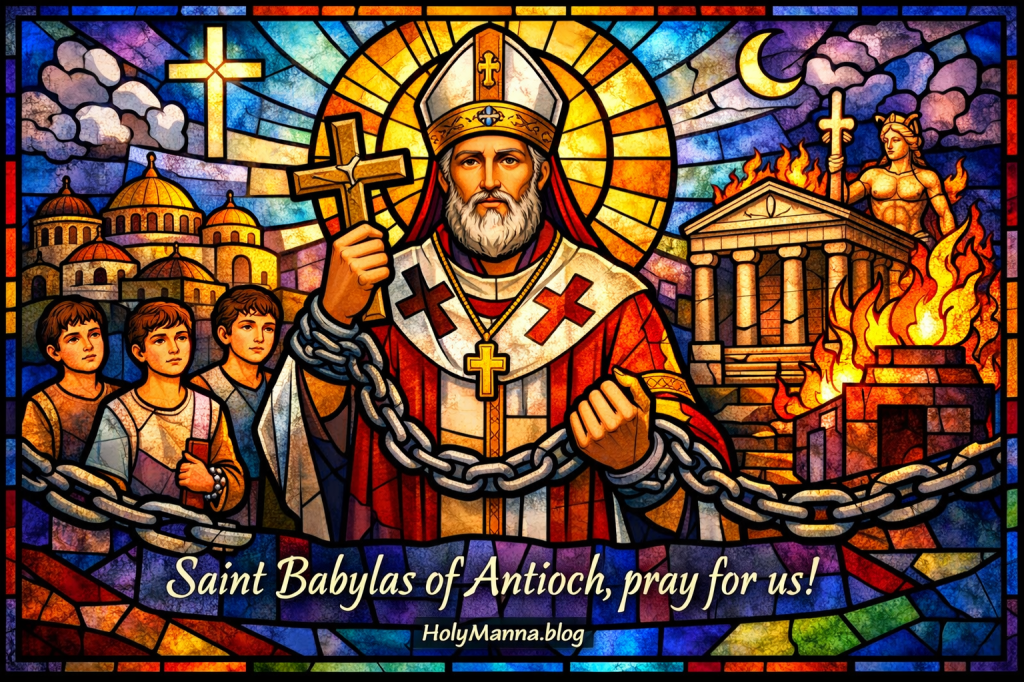
Chains That Would Not Break
Saint Babylas of Antioch stands out in the early Church as a bishop who refused to let faith become a political accessory. He lived in a time when Christians could be tolerated one year and hunted the next, and when public worship itself could become a flashpoint. As Bishop of Antioch, one of the most important sees of the ancient Christian world, he carried the burden of guarding doctrine, protecting the flock, and keeping worship holy in a culture that often tried to control religion for its own purposes.
What makes Babylas so compelling is that his legacy is not built on celebrity, strategy, or self-preservation. It is built on spiritual authority that comes from Christ. The Church has always taught that bishops are not managers of religious vibes. They are successors of the apostles, charged with teaching, sanctifying, and governing in the name of Jesus. That is why Babylas is remembered as a man who treated repentance as real, the Eucharist as sacred, and the truth as worth suffering for.
His witness feels especially relevant today because modern life constantly pressures believers to soften convictions for the sake of comfort. Babylas shows a different path. He shows what it looks like when a shepherd loves souls enough to tell the truth, even when the truth is costly.
Hidden Beginnings and a Public Calling
Catholic sources do not preserve a detailed account of Babylas’ childhood, family background, or early education. His story does not come with the kind of personal backstory modern audiences often expect. No reliable record fills in the usual details about birthplace, parents, or early formation in the way later saints sometimes have.
That silence is actually part of the lesson. Holiness is not dependent on having a dramatic origin story. The Church remembers Babylas primarily because he was faithful in the office God gave him. He was chosen as a bishop in Antioch during the third century, and he served at a time when leadership could easily mean imprisonment and death. That alone says something about the kind of man he must have been. The Church did not put cowards in that chair.
A major tradition connected with Babylas centers on a bishop who refused to admit an emperor to the Church’s worship until the emperor accepted public penance. Catholic scholarship often treats the core meaning of the story as solid, while also acknowledging that ancient sources do not always preserve every detail with the same clarity, such as the exact identity of the emperor in every retelling. Even with those historical cautions, the spiritual point remains sharp. The Church does not exist to flatter power. The Church exists to call every soul to conversion, from the poorest sinner to the highest ruler.
This lines up perfectly with what The Catechism of the Catholic Church teaches about Christ giving the Church real authority to bind and loose, and about conversion being a serious response to sin, not a mood or a slogan. This is not about gatekeeping. This is about love that refuses to lie. See CCC 553 and CCC 1430-1431.
Courage That Protected the Holy Things
When people hear the word miracle, they often picture dramatic healings. With Saint Babylas, Roman Catholic tradition does not preserve a list of clearly documented wonders performed during his lifetime the way it does for some other saints. Instead, his life highlights a different kind of miracle, the kind that often saves souls in the real world. It is the miracle of courage that stands firm without becoming theatrical.
Babylas is remembered as a bishop who protected the sacredness of the Church’s worship. If the tradition about confronting an emperor is applied correctly, it does not become a political talking point. It becomes a spiritual wake-up call. The Eucharist is not a prop. Confession is not optional when sin is serious. Worship is not meant to be reshaped around the preferences of the powerful. The Christian life is not a performance, and repentance is not a public relations strategy.
This is why the Church insists on reverence and conversion. It is why she teaches that the faithful should examine their consciences, repent, and approach the sacraments with humility. See CCC 1385, CCC 1430, and CCC 1457. Babylas’ story also points Catholics back to the apostolic conviction that “We must obey God rather than men.” in Acts 5:29. He shows that real courage is steady and obedient, not dramatic and showy.
The Chains of a Martyr
Babylas lived during a period when persecution could erupt into open violence, and bishops were obvious targets. Catholic tradition remembers him suffering during the persecutions of the third century, enduring imprisonment and harsh treatment, and finally dying after his confession of faith. The Church venerates him as a martyr because he bore witness to Christ publicly and accepted suffering rather than deny the Lord.
One detail preserved in the Roman tradition makes his martyrdom feel painfully real. The Roman Martyrology summarizes his end with a line that is both simple and unforgettable: “He ended his holy life in chains, with which he ordered his body to be buried.” This is not a casual detail. It is a final act of preaching. Those chains became a testimony that he belonged entirely to Christ, even when the world treated him like a criminal.
The Church has always taught that martyrdom is not about loving pain. It is about loving Jesus more than life. That is why The Catechism of the Catholic Church speaks so plainly about it: “Martyrdom is the supreme witness given to the truth of the faith.” CCC 2473. Babylas did not win by escaping. He won by remaining faithful.
Catholic tradition also associates Babylas with three young companions, often remembered as boy martyrs. Their names appear with variations across different traditions, but the constant memory is what matters for faith. A bishop and his spiritual children stood together. That is a sobering image for any Catholic who feels isolated in the culture. The saints prove that fidelity is contagious when it is lived with conviction.
A Saint Who Keeps on Preaching
Babylas’ legacy after death is one of the most striking parts of his story, and it is deeply tied to the Catholic understanding of relics and the victory of Christ over idols. His burial place became celebrated, and later his relics were translated near Antioch, including to the area of Daphne, which was known for a major pagan shrine connected with the worship of Apollo. In the Christian memory preserved by ancient preaching and later Catholic sources, the presence of Babylas near that shrine was linked to a humiliating event for paganism. The oracle was said to fall silent, as if the lies could not speak in the presence of a martyr who belonged to Christ.
This kind of story needs to be understood in a Catholic way. The Church does not teach superstition. Relics are not magic objects. The Church venerates relics because the human body matters, because the saints are truly members of Christ’s Body, and because God has often chosen to work through material signs to strengthen faith and call cultures away from idols. In Babylas’ case, the miracle is not just an individual healing. It is the exposure of spiritual fraud. It is a reminder that demons do not like saints, and idols cannot stand forever when Christ is taken seriously.
Later tradition connects this conflict at Daphne with the time of Emperor Julian, often called the Apostate, who tried to revive pagan worship. The Christian memory describes Julian taking action to move the relics away, and then the pagan temple being destroyed by fire. Whether every detail is presented with the same emphasis in every account, Catholic sources consistently preserve the spiritual meaning. Christ is not threatened by the idols of the age, and the witness of the martyrs continues to shape history long after their deaths.
Babylas also has an enduring cultural footprint in Catholic life beyond the ancient world. His relics were connected with later veneration in Italy, including in Cremona, and devotion to him became especially strong in Milan, where the name San Babila remains part of the city’s Christian memory. His feast is kept in the Roman tradition on January 24, and the Ambrosian tradition has also honored him with particular devotion.
Lessons for Catholics Who Want to Stay Faithful
Saint Babylas teaches a truth that modern people often forget. The faith is not a vibe. The faith is a real allegiance to Jesus Christ. If the world is pressuring believers to treat religion like a costume, Babylas reminds them that Christianity is a conversion, a discipline, and a worship.
His example can be lived in ordinary life without needing a dramatic confrontation. It looks like taking confession seriously, especially when sin is serious. It looks like treating the Eucharist with reverence, refusing to approach it casually, and preparing with prayer and repentance. It looks like refusing to surrender to the fear of what people think. It looks like speaking truth with charity, but without watering it down.
Babylas also offers hope to anyone who feels worn down by cultural pressure. His chains did not destroy him. They testified to him. His suffering did not erase his impact. It multiplied it. A Catholic who holds the line faithfully in the workplace, in the family, or in the parish might feel small and ignored, but Heaven does not ignore fidelity. The saints prove that God uses quiet courage to silence loud lies.
Where is God asking for steadier courage right now? What would change if repentance and reverence were treated as non-negotiable parts of everyday Catholic life?
Engage with Us!
Share thoughts and reflections in the comments below. The Church grows stronger when Catholics sharpen one another through honest conversation and practical faith.
- What part of Saint Babylas’ witness feels most challenging today: confronting power, guarding the holiness of worship, or suffering patiently for the truth?
- Where is the temptation strongest to soften the faith so it fits in more easily with culture?
- What is one concrete step that can be taken this week to practice real repentance and deeper reverence, especially regarding confession and the Eucharist?
- Who needs encouragement right now to stay faithful under pressure, and how can that encouragement be offered with charity and clarity?
May Saint Babylas pray for every Catholic who feels pressured to compromise. Keep walking with Christ. Keep choosing repentance over pride. Keep choosing truth over approval. Live a life of faith and do everything with the love and mercy Jesus taught us.
Saint Babylas of Antioch, pray for us!
Follow us on YouTube, Instagram and Facebook for more insights and reflections on living a faith-filled life.

 Holy Manna!
Leave a comment