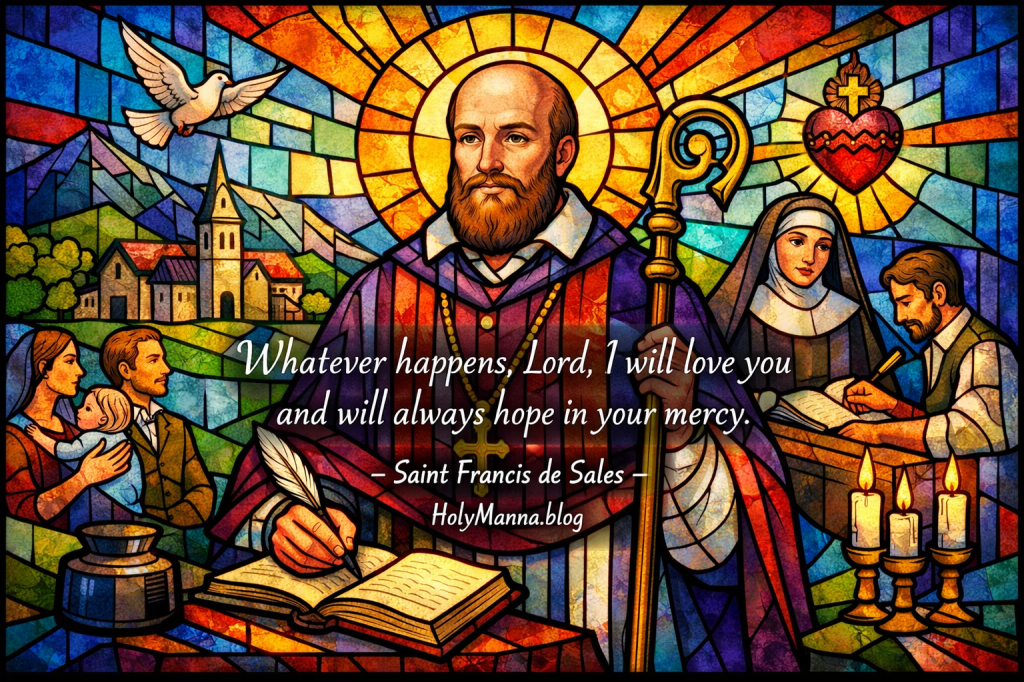
The Saint Who Taught Ordinary People to Become Holy
Saint Francis de Sales stands out because he makes Catholic holiness feel concrete and attainable. He was a bishop in a tense era, a missionary in contested territory, a founder of a religious order, and a master spiritual writer. His greatest gift was teaching ordinary people how to love God without abandoning their responsibilities. He lived at a time when religious arguments could easily become cruel, and he refused to let truth be separated from charity. The Church reveres him as a Doctor of the Church because his teaching is not only beautiful, but also reliable, balanced, and deeply rooted in the Gospel.
He remains a patron for Catholic writers and communicators because he understood the power of words. He knew that words can either heal the wounded or harden the proud, and he chose to use speech as an instrument of grace. His life still hits home in a world addicted to outrage, because he proves that conviction and kindness can live in the same heart when Christ is truly Lord.
From Noble Birth to a Heart Captured by God
Francis was born in 1567 in Savoy, into a noble family that expected greatness in a worldly sense. His upbringing included strong formation, high standards, and the kind of education reserved for families with influence. His father wanted him to succeed in civil life, so Francis studied in Paris and later in Padua, becoming thoroughly trained in law. From the outside, it looked like a clean path to prestige, comfort, and recognition.
Under the surface, God was already shaping him in a much deeper way. During his student years, he went through a severe spiritual trial centered on fear and despair about salvation. This was not a passing doubt or a dramatic mood swing. It was the kind of interior suffering that can make prayer feel difficult and the future feel closed. Yet this crisis became a turning point, because it forced him to confront the heart of the Christian life. Catholic faith is not fatalism. Catholic faith is trusting the merciful love of God revealed in Jesus Christ.
In that darkness, Francis surrendered himself to God, choosing hope even when his emotions offered no comfort. His later guidance to others would carry the imprint of that lesson. He learned that the heart needs mercy and patience, not spiritual bullying. When the call to priesthood became undeniable, he embraced it even though it disappointed his father and required real sacrifice. He was ordained in 1593, stepping into a ministry that would demand courage, clarity, and steady love.
A Shepherd with a Pen
As a young priest, Francis volunteered for a difficult mission in a region heavily influenced by Calvinism. This was not a safe assignment, and it was not a comfortable one. The work demanded public preaching, private conversations, and extraordinary patience with people who were suspicious of Catholic teaching. He met resistance not only from opposing voices, but also from indifference. Many people simply refused to come hear him speak.
Instead of forcing results or turning bitter, he adapted with creative pastoral wisdom. He began writing short explanations of Catholic doctrine and circulating them widely. In an age without modern media, he recognized that the printed word could travel where the preacher could not. He used the page like a missionary road, slipping truth into households and hearts when doors were closed. This method bore fruit over time, not because he watered down the faith, but because he presented it with clarity and charity.
His legacy still challenges Catholics to communicate like disciples, not like angry commentators. He proves that conviction does not require cruelty, and that truth spoken with patience can penetrate where shouting never will. How often does the heart need gentle clarity more than it needs a verbal victory?
A Bishop’s Daily Death to Self
Francis became Bishop of Geneva in 1602, but he could not live in Geneva because it was controlled by Calvinists. He governed from nearby Annecy, living as an exiled shepherd. That reality could have produced resentment or passivity, but Francis chose to pour himself out in pastoral care. He preached frequently, strengthened catechesis, visited parishes, encouraged priests, and worked to renew Catholic life in harmony with the reforms of the Council of Trent.
His leadership was not built on flashy programs. It was built on prayer, sacramental life, sound teaching, and steady virtue. He took priestly formation seriously and understood that strong parishes require faithful shepherds. He also cared about the formation of the young and the building of Catholic culture, because he knew families needed more than arguments. They needed a way of life shaped by truth and grace.
Francis also became known for spiritual direction, especially through correspondence. He had a remarkable ability to guide souls toward holiness without crushing them with unrealistic expectations. He encouraged steady progress rather than dramatic spiritual performances. That pastoral realism is part of what makes him so credible. Is there a place in life right now where steady faithfulness is needed more than spiritual intensity?
A Teacher of Holy Life
Two works made Saint Francis de Sales beloved across the Catholic world. Introduction to the Devout Life was written for ordinary people living in towns, working jobs, raising families, and facing temptations that do not disappear just because someone loves God. He taught that holiness does not require abandoning daily duties. Holiness requires offering daily duties to God with love, discipline, and patience. He insisted that it is a serious mistake to treat devotion as something only for cloisters. The Christian life belongs to the whole Church.
His Treatise on the Love of God goes deeper, showing that love is not a mood or a vague inspiration. Love is the center of the Christian soul, shaped by truth and strengthened by grace. He taught that the spiritual life is really about learning to love God sincerely and steadily, even when feelings are dry. This is one reason his teaching has endured. It is not sentimental, and it is not unrealistic.
His friendship with Saint Jane Frances de Chantal led to the founding of the Order of the Visitation in 1610. This foundation was especially striking because it created a path for women who were called to religious life but could not endure harsh physical austerities common at the time. Francis understood that grace works through human limits rather than pretending they do not exist. His spiritual style can be captured in one line that has guided countless Catholics: “Do all through love, nothing through constraint.”
The Cross He Carried
Saint Francis de Sales was not a martyr in the strict sense, but his life carried real hardship. His ministry demanded constant travel, endless correspondence, emotional strain, and the pressure of shepherding people in a divided world. His earlier missionary work exposed him to hostility, and his later episcopal work required him to rebuild and strengthen Catholic life without turning it into a culture of bitterness.
One of his most important battles was internal. Catholic tradition emphasizes that his gentleness did not come from being naturally easygoing. It came from grace and discipline. He worked against impatience and resisted the temptation to anger, choosing meekness as a deliberate act of love. That makes him especially relevant, because it means his virtue is not reserved for people with a calm temperament. It is a path open to anyone willing to cooperate with grace.
He died in 1622 after years of generous service. His death was not dramatic in a worldly way, but it was holy. He had spent his life teaching others to trust God, and in the end he practiced what he preached. Where is meekness being tested right now, and what would it look like to choose charity instead of irritation?
Love That Did Not Die
After his death, devotion to Saint Francis de Sales spread quickly. Catholics sought his intercession and reported many favors and graces connected to prayer through him. His relics were honored, not as superstition, but as a Catholic expression of the communion of saints and the dignity God gives to the bodies of His faithful servants. Places associated with his life became reminders that holiness is not a myth and that the saints remain close to the Church on earth.
The Church canonized him and later named him a Doctor of the Church, recognizing the depth and reliability of his teaching. His influence spread through later saints and spiritual families who drew from his wisdom. His patronage became closely associated with writers and communicators because he understood that words can either build up the Body of Christ or tear it down. His prayer from his season of trial remains a powerful witness of trust: “Whatever happens, Lord, I will love you and will always hope in your mercy.”
Bringing Salesian Wisdom into Daily Life
Saint Francis de Sales offers a roadmap for Catholics who want to grow without becoming harsh, anxious, or discouraged. His spirituality is built on love of God, sacramental life, and steady virtue. He teaches that prayer should be faithful even when it feels dry. He teaches that confession is a gift that keeps the heart honest and free. He teaches that holiness is not about escaping the world but sanctifying daily duties through charity.
His example challenges the modern habit of living angry. He proves that clarity does not require cruelty, and that strong convictions can be expressed without contempt. Small choices become a real spiritual rule of life. Speech can become more careful and charitable. Duties can become offerings. Temptations can be resisted with humility rather than shame. Corrections can be given with truth and patience rather than sarcasm. Over time, these habits reshape a home, a workplace, and a soul. What would change if daily responsibilities were treated as the main altar where God is loved and served?
Engage With Us!
Share your thoughts and reflections in the comments below. Saints like Francis de Sales have a way of exposing what is harsh in the heart, while also giving real hope that grace can change it.
- Where does daily life tempt the heart to become sharp, impatient, or controlling, and what would it look like to respond with Christlike gentleness instead?
- Which part of ordinary life feels least “holy” right now, and how could it become an offering to God through love and consistency?
- When speaking truth is necessary, how can it be done with clarity and charity instead of pride or frustration?
- What would change in prayer life if trust in God’s mercy became the foundation instead of fear?
May Saint Francis de Sales pray for every home, every workplace, and every Catholic trying to live the Gospel in the middle of real life. Keep walking in faith, keep choosing repentance when needed, and keep doing everything with the love and mercy Jesus taught us.
Saint Francis de Sales, pray for us!
Follow us on YouTube, Instagram and Facebook for more insights and reflections on living a faith-filled life.

 Holy Manna!
Leave a comment