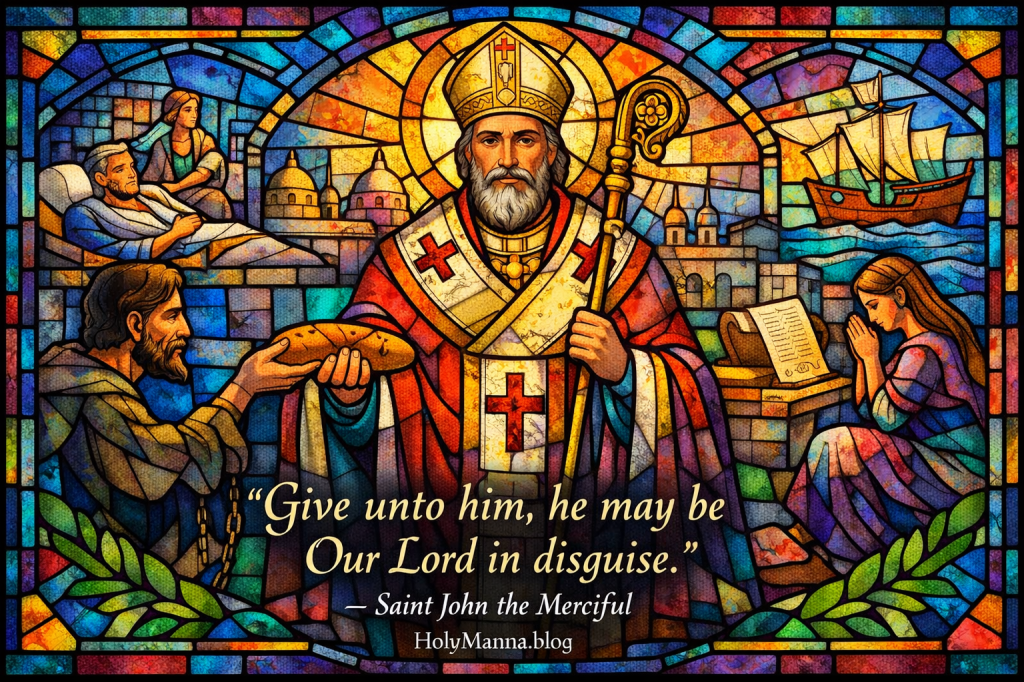
The Patriarch Who Treated the Poor Like Kings
Saint John the Merciful, also called Saint John the Almoner or Saint John the Almsgiver, served as Patriarch of Alexandria in the early seventh century. He is revered because he made the works of mercy look like the normal rhythm of Catholic life, not a rare burst of generosity. He did not treat the poor as an interruption to the Church’s mission. He treated them as a living part of the Church, and he believed their prayers were powerful before God.
John’s holiness is especially striking because it was both tender and practical. He did not only feel compassion. He organized mercy. He built systems that protected the weak, strengthened hospitals, and ensured that Church resources reached real human needs. He is remembered as a model of Christian leadership because he used authority the way Christ teaches: not to be served, but to serve. His legacy still matters because modern life constantly tempts people to hide behind comfort and call it peace. John shows that peace without charity is not peace at all.
From Cyprus to the Cross of Compassion
John was born in Amathus on the island of Cyprus, into a noble family with wealth and influence. Catholic tradition remembers his father as Epiphanius, a man of rank and responsibility. Before he became a patriarch, he lived a real layman’s life. He entered marriage, became a father, and learned the responsibilities of ordinary adult life. That detail matters because it shows his sanctity did not come from escaping real life. It came from living it faithfully and then surrendering everything to God when suffering arrived.
He endured a sorrow that changes a man forever. He lost his wife and his children, and those losses could have left him bitter, guarded, and angry at God. Instead, grief became a furnace that purified his heart. He leaned into prayer and began to see earthly security for what it is, a fragile gift that can disappear overnight. In that spiritual turning, John embraced a deeper dedication to God and a growing devotion to mercy.
Catholic tradition also preserves a memorable spiritual moment from his youth, a vision of a radiant figure described as Compassion or Charity, crowned with an olive garland. The meaning of the story is not to chase visions, but to recognize how God forms a soul over time. John’s whole life became a response to that call, as if heaven had placed mercy in his hands and said, “Do not let go.”
The Almsgiver’s Great Work
When Alexandria needed a patriarch, John was chosen and appointed under Emperor Phocas. Alexandria was a city of wealth and influence, and the patriarchate carried real responsibility. John did not enter that office like a politician. He entered it like a shepherd. One of his first acts was to identify the poor and provide for them in an organized way. Tradition records a large number under his care, often given as 7,500. He called them his masters, not because he enjoyed being dramatic, but because he believed Christ listens closely to the cries of the poor.
This was not charity that only happened when the mood was right. John treated almsgiving as a duty rooted in Catholic teaching about the dignity of the human person and the demands of the Gospel. He poured Church resources into hospitals, relief for the sick, and aid for those without stability. He is also remembered for freeing many slaves, a striking witness in an era when slavery was woven into society. He saw every act of mercy as a direct service to Christ.
John’s leadership also included reform, because mercy is not only about giving money. Mercy includes protecting people from exploitation. Catholic sources describe his work to ensure honest weights and measures so that the poor would not be cheated at the marketplace. He rejected bribery and refused to let Church officials take gifts that blurred the line between service and self-interest. He also made himself available in a very direct way. Tradition remembers that he would sit at set times, often Wednesdays and Fridays, so that ordinary people could bring disputes, needs, and appeals directly to him. He worked to reconcile enemies, settle conflicts, and restore peace before resentments grew into hatred.
There is also a strong tradition that he strengthened the life of the Church in Alexandria in a major way, including expanding orthodox church presence and encouraging serious Christian instruction. John is not just the patron of charitable hearts. He is a reminder that the Church’s mercy is meant to be joined to truth, sacramental life, and real pastoral care.
Miracles That Followed a Merciful Heart
Stories from John’s life include remarkable moments that Catholic tradition preserves as signs of God’s providence. One well known account tells of a merchant who had suffered losses, including shipwreck, and came to John in desperation. John helped him repeatedly, and when the man was still trapped in distress, John provided grain and support for a new journey. The ship was carried far and arrived in a land where grain was scarce, and the sale brought unexpected relief. The story is meant to teach a spiritual lesson. God is never outdone in generosity, and mercy offered in faith can become the channel for surprising help.
John’s sayings reveal the spiritual fire behind his charity. When someone hesitated to give because a beggar seemed suspicious, John is remembered for saying, “Give unto him; he may be Our Lord in disguise.” That is not sentimental talk. It is Catholic realism. Christ truly identifies Himself with the poor, and every act of mercy becomes a meeting with Jesus.
Another famous episode shows how steady his charity was even when others tried to trap him in comfort. A wealthy man gave him an expensive blanket. John sold it and gave the money away. The man bought it back and gave it again. John sold it again. When the cycle continued, John reportedly said, “We will see who tires first.” That line sticks because it exposes a temptation many people know well. Comfort always tries to return, like a familiar habit. John refused to let luxury settle into his life because he believed those resources already belonged to Christ in the suffering poor.
Some traditions also describe him being warned of danger and spared from violent plots, and they recount spiritual experiences that guided his final steps. These stories are shared not to turn the saint into a superhero, but to show that God guards the works of mercy and that the Lord can guide His servants even through uncertainty. How often does fear convince the heart to hold back love when God is asking for trust?
A Holy Death Marked by Poverty
John’s era was not peaceful. The region faced major upheaval, and Catholic tradition highlights how he responded to suffering beyond his own city. After Jerusalem was devastated in 614, John is remembered for sending significant aid, including food, money, and supplies. He supported the relief of captives and helped refugees who were displaced by violence. His mercy expanded with the crisis. He did not retreat into self-protection. He looked outward with the heart of a father.
Eventually, when Alexandria itself was threatened and occupied, John was forced to flee. He returned toward Cyprus in old age, leaving behind the patriarchal seat he had served with such devotion. His hardships were not a martyrdom of execution, but they were a real form of persecution and suffering. He endured exile, instability, and the heavy burden of caring for countless distressed souls while the world around him shook.
Catholic tradition preserves a moving detail about his final poverty. Near death, he expressed gratitude to God that he possessed almost nothing, and he ordered that even his last small coin be given away. That ending is the perfect summary of his spirituality. He spent his life giving, and he died the same way. It is a lesson that every Christian needs to hear, because the world constantly trains hearts to cling to control. John shows what it looks like to die like a disciple, relying on God’s mercy rather than personal security.
Tradition also describes a final vision in which he was summoned by a radiant messenger who told him, “The King of Kings is asking for you.” He received that call with peace, as a man who had spent years preparing for judgment through works of mercy and a clean conscience. If the Lord called a soul home tonight, would the heart feel ready, or would it reach for excuses?
A Legacy That Still Builds Mercy
Catholic tradition records striking signs after John’s death that emphasize the Church’s belief in the communion of saints. One ancient account describes his burial in a tomb already occupied by other bishops, and the bodies were said to have shifted aside to make room for him, as if honoring him even in death. The story is vivid because it shows how the early Christian imagination understood sanctity. Holiness is recognized not only by words, but by signs that point to God’s favor.
Another famous posthumous miracle involves a woman who had handed John a written confession sealed in a tablet. John promised never to open it, and he kept his promise even at death. Afterward, the woman prayed intensely at his tomb, troubled by fear and shame. Tradition says the tablet was returned, and when it was opened, her writing had been erased and replaced with a message declaring, “For the sake of My servant John your sin is blotted out.” That story speaks directly to Catholic life because it highlights both seriousness about sin and confidence in mercy. Sin is not treated lightly, but neither is repentance treated as hopeless. God forgives, and the saints intercede.
There is also a tradition that a fragrant myrrh-like perfume flowed from his body during a yearly vigil, understood as a sign of sanctity and healing. Over time, veneration of Saint John spread widely. His relics were associated with translation through major Christian centers, and devotion took root strongly in places like Venice, where churches and confraternities honored his memory. The Roman Catholic liturgy commemorates him on January 23, and that yearly remembrance keeps his message in front of the faithful. Mercy is not optional for Christians.
His legacy also shaped Catholic charitable identity. He is remembered as a patron linked to the spirit of hospitaller care, the kind of charity that does not simply toss help from a distance, but draws near to suffering and serves with dignity. His name became a reminder that the Church’s credibility rises or falls with her willingness to love the poor as Christ loves them. What would change if mercy became the first instinct instead of the last resort?
Bringing His Mercy into Daily Life
Saint John the Merciful is a saint for anyone who wants faith to be real, not just emotional. His life teaches that mercy is not only about giving spare change. Mercy is about a heart trained to notice, a conscience trained to refuse corruption, and a will trained to choose love even when comfort complains. This is the kind of mercy the Church praises because it reflects the Heart of Jesus, who does not love from a safe distance.
His example invites a serious examination of daily life. When a person looks at a budget, it is worth asking if generosity is planned or accidental. When a person deals with coworkers, it matters whether respect comes easily or whether impatience rules the day. When opportunities arise to cut corners, integrity must hold firm. John shows that holiness includes financial honesty, generosity that hurts a little, and courage to serve people who cannot repay anything.
His famous line still challenges the modern instinct to judge who deserves help. “Give unto him; he may be Our Lord in disguise.” That is not a command to be reckless. It is a command to be humble, because Christians are not the judges of hidden hearts. In a culture that worships comfort, John teaches a better way. Live simply, give steadily, and treat mercy like a discipline, not a mood. Where is the heart being asked to surrender comfort so love can become more real?
A practical imitation of his spirit can be steady and concrete. It can mean choosing a consistent habit of almsgiving, serving locally with real presence, refusing to participate in the small dishonesties that everyone tries to normalize, and seeking reconciliation instead of nursing grudges. Over time, those choices shape a soul. That is how saints are formed. That is also how ordinary Catholics learn to do everything with the love and mercy Jesus taught us, which is the only way the world will ever believe the Gospel is true.
Engage with Us!
Share thoughts and reflections in the comments below, because the witness of saints becomes even more powerful when it leads to real conversion and practical love.
- Where does daily life offer real chances to serve Christ in someone who is struggling, overlooked, or alone?
- What would change if the poor were treated as brothers and sisters instead of problems to avoid?
- What is one concrete act of mercy that can be practiced this week, not as a mood, but as a commitment?
May Saint John the Merciful pray for every heart that wants to love Jesus more seriously. Keep walking forward in faith, keep choosing the good even when it costs something, and keep doing everything with the love and mercy Jesus taught us.

 Holy Manna!
Leave a comment