A Shepherd with a Marian Heart
Saint Ildephonsus of Toledo shines as the kind of Catholic leader the Church still needs, a man who proved that strong doctrine and a tender heart belong together. He served as Archbishop of Toledo in seventh century Spain, at a time when the Church carried immense responsibility for forming the faith of an entire people. He is revered because he defended Catholic teaching with courage, especially the Church’s confession that Mary remained ever virgin, and because he knew how to bring theology down to street level so ordinary believers could live it with confidence.
His writings helped Catholics understand the beauty of the sacraments and the meaning of a life shaped by grace, and his memory is also tied to ancient traditions that present Heaven honoring his Marian devotion. Even when the details of these stories are told with different emphases across the centuries, Catholic tradition holds onto the same essential message: fidelity to Christ and love for His Mother are never wasted, and God delights in strengthening the Church through saints who love truth.
A Vocation That Chose God Over Approval
Ildephonsus was born into a prominent family in Visigothic Spain, with connections to Church leadership through Saint Eugenius of Toledo, who was his uncle and later his predecessor in the see of Toledo. That background could have pushed him toward influence and comfort, but his heart moved toward hidden fidelity. Catholic tradition remembers that his father strongly resisted his desire to become a monk, and that detail reveals the kind of courage that often comes before any public honor.
He entered the monastery of Agali near Toledo and allowed monastic life to shape him slowly through prayer, discipline, and service. The monastery was not a retreat from responsibility. It was a training ground for humility and stability, and it prepared him to carry the burdens of leadership without becoming proud. He was ordained a deacon and eventually became abbot, which meant he was trusted to guide others in the spiritual life with patience and firmness.
Catholic tradition also remembers that he founded and endowed a convent for nuns while still a monk, showing that his charity and leadership extended beyond his own community. Some later traditions associate him with the influence of Saint Isidore of Seville, which fits the intellectual strength seen in his writings, even if the most reliable historical core focuses more on his monastic formation and pastoral work. What stands out is that his holiness was formed through obedience and perseverance long before the wider Church recognized him.
A Bishop Who Defended Mary to Protect Jesus
When Ildephonsus became Archbishop of Toledo, he stepped into a role with spiritual and cultural weight. Toledo was a major center of Catholic life in Spain, and its bishops were expected to teach clearly, govern wisely, and guard unity during a complex era. He served a little more than nine years, yet his influence outlived his short episcopate because he taught the faith in a way that strengthened both minds and hearts.
He is most known for defending the perpetual virginity of the Blessed Virgin Mary, and that is not a side issue in Catholic life. In Catholic teaching, what is true about Mary protects what is true about Jesus. Mary’s virginity proclaims that the Incarnation is God’s work, not a human achievement, and that Christ is truly holy, truly divine, and truly given as pure gift. Ildephonsus defended this teaching so the faithful would not lose the thread of the Gospel in an age when confusion could spread quickly.
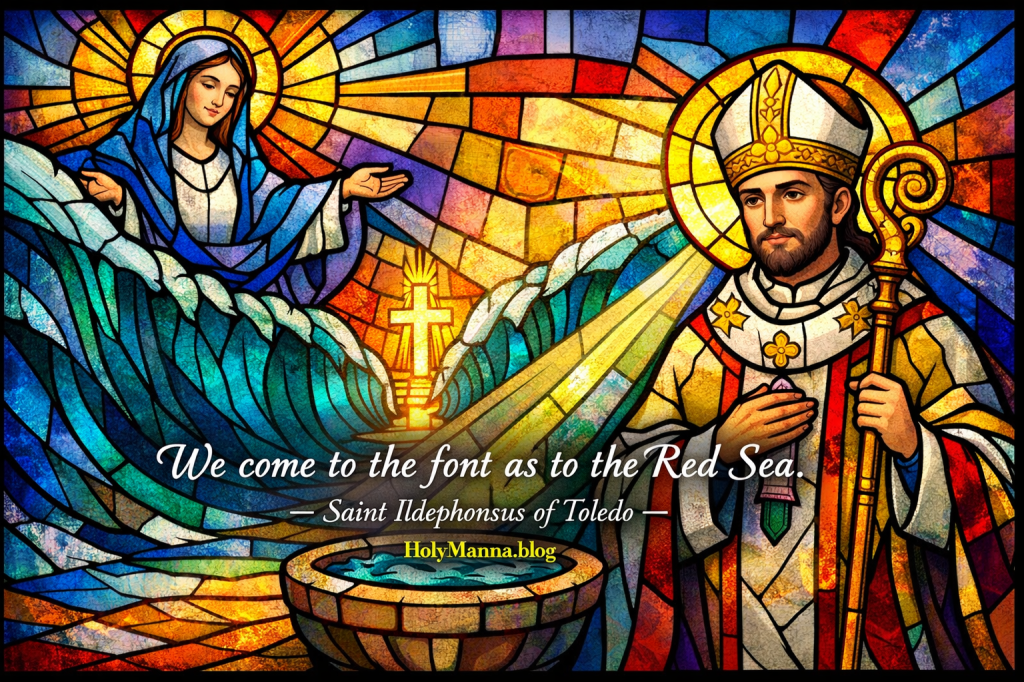
He also wrote about Baptism and the Christian life after Baptism, describing conversion as a real passage from slavery to freedom. One line from his baptismal teaching is preserved and loved because it speaks with biblical force: “We come to the font as to the Red Sea.” That image forms a Catholic conscience. Baptism is not merely a symbol of personal intention. Baptism is God acting, rescuing, cleansing, and claiming a soul for Christ, much like Israel passing through the waters into a new life.
His writings also served the Church of Spain by strengthening ecclesial identity and encouraging fidelity to Catholic tradition. Even when scholars carefully distinguish what is certainly his from what may have been attributed later, the heart of his legacy remains clear. He used his mind, his pen, and his office to serve the truth and to form the faithful in a Christ-centered love for Mary and the sacraments.
A Life Rooted in Prayer
Saint Ildephonsus is surrounded by miracle traditions that have long been cherished in Catholic Spain, and these traditions are remembered as signs meant to strengthen devotion rather than distract from Christ. Catholic sources themselves note that detailed storytelling grew over time, yet the Church has continued to hold these accounts as meaningful expressions of the communion of saints and the maternal care of the Blessed Virgin Mary.
One tradition recounts that while he was praying before the relics of Saint Leocadia, the martyr rose from her tomb and thanked him for honoring the Mother of God. This kind of story reflects a distinctly Catholic instinct. The saints are alive in Christ, and God can grant extraordinary signs when it serves the spiritual good of His people and confirms the faithful in true devotion.
The most famous tradition describes the Blessed Virgin Mary appearing to Ildephonsus and giving him a heavenly vestment, commonly described as a brilliant white chasuble. This story became deeply woven into Spanish Catholic memory, and later generations saw in it a clear spiritual message. Mary is close to the Church, she rejoices when bishops teach what is true about her Son, and she supports those who honor her with purity and reverence. This is not the kind of devotion that competes with Jesus. It is the kind of devotion that leads deeper into Jesus, because authentic Marian devotion always magnifies the Lord.
What would change in daily prayer if Mary were approached not as a distant figure, but as a real Mother who draws souls into deeper fidelity to Christ and His Church? That question gets to the heart of why Ildephonsus still matters. His witness calls Catholics to a devotion that is warm, disciplined, and grounded in truth.
Quiet Crosses
Ildephonsus was not a martyr, but his life carried real hardship and real spiritual warfare. His vocation began under family resistance, and that kind of opposition can tempt a person toward bitterness or compromise. Instead, he stayed steady and allowed obedience to form him. That is a kind of suffering many people understand, especially when faithfulness is misunderstood by those closest to them.
As archbishop, the burdens would have been heavy. He lived in a time when public life was unstable and when the Church had to labor constantly to form consciences and protect doctrine. Serving faithfully in that environment required patience, clarity, and courage, not the dramatic courage of a battlefield, but the slow courage of daily responsibility. Saints like Ildephonsus show that endurance can be just as heroic as martyrdom when it is carried with humility and prayer.
His perseverance teaches an important lesson. A Catholic life is not measured only by moments of intensity. It is measured by steady fidelity in ordinary pressures, by continuing to pray when enthusiasm fades, and by continuing to teach the truth even when it is inconvenient. That is how saints build strong communities and form future generations.
A Saint Who Keeps Preaching
Saint Ildephonsus died on January 23, 667, and Catholic tradition holds that he was buried in the Basilica of Saint Leocadia in Toledo. Later tradition says his relics were moved during times of danger and eventually came to be venerated in Zamora. This continued devotion is a very Catholic expression of hope. The body is not disposable, and the saints are not distant legends. They are living members of the Church, and their relics become reminders that grace truly sanctifies the human person in body and soul, and that resurrection is not poetry but promise.
His cultural impact is also striking. The tradition of Our Lady giving him a vestment became one of the great Marian themes in Spain, inspiring sacred art and strengthening devotion over centuries. The Church does not preserve these stories because she needs entertainment. She preserves them because they preach a message of fidelity, purity, and doctrinal clarity, and they remind the faithful that Heaven is not indifferent to the Church on earth.
His feast day on January 23 keeps his witness close in the rhythm of Catholic life. In places where he is especially honored, his memory functions like a familiar spiritual anchor, encouraging Catholics to love truth, love Mary rightly, and live the sacramental life with seriousness and joy.
Learning His Lessons in a Noisy World
Saint Ildephonsus offers a surprisingly practical model for Catholics who want to be faithful without becoming harsh, anxious, or shallow. His life shows that devotion should be intelligent and that doctrine should be lived. Catholics do not have to choose between loving Mary and loving theology. In the Church, Marian teaching is never a distraction. It is a safeguard for faith in the Incarnation, and a school for humility, purity, and trust.
His image of Baptism as the Red Sea is also a needed wake-up call in an age that often treats Baptism as a family photo rather than a lifelong identity. Baptism is an exodus. It is leaving slavery behind, learning to trust God in the desert of daily life, and refusing to run back to Egypt when temptation feels familiar. That means cultivating habits that reinforce a sacramental identity, including regular confession, serious prayer, and an honest desire to live in a state of grace.
Where is the greatest temptation to compromise right now, and what would it look like to respond with calm Catholic confidence instead of fear or frustration? Saint Ildephonsus answers that question by example. He stayed steady. He taught clearly. He loved the Mother of God in a way that always strengthened love for Christ. That is a path worth copying.
Engage with Us!
Share thoughts and reflections in the comments below.
- What would change in daily life if Baptism were treated as a real passage from slavery to freedom, like crossing the Red Sea?
- How can devotion to the Blessed Virgin Mary become more intentional, more doctrinally grounded, and more Christ-centered?
- Where is perseverance needed right now, especially in a vocation or responsibility that feels misunderstood or resisted?
- What is one concrete habit that could strengthen faith this week through prayer, the sacraments, or learning the teachings of the Church?
Keep walking forward with faith. Choose mercy, choose truth, and do everything with the love and compassion Jesus taught, trusting that God can make steady fidelity into a powerful witness.
Saint Ildephonsus of Toledo, pray for us!
Follow us on YouTube, Instagram and Facebook for more insights and reflections on living a faith-filled life.

 Holy Manna!
Leave a comment