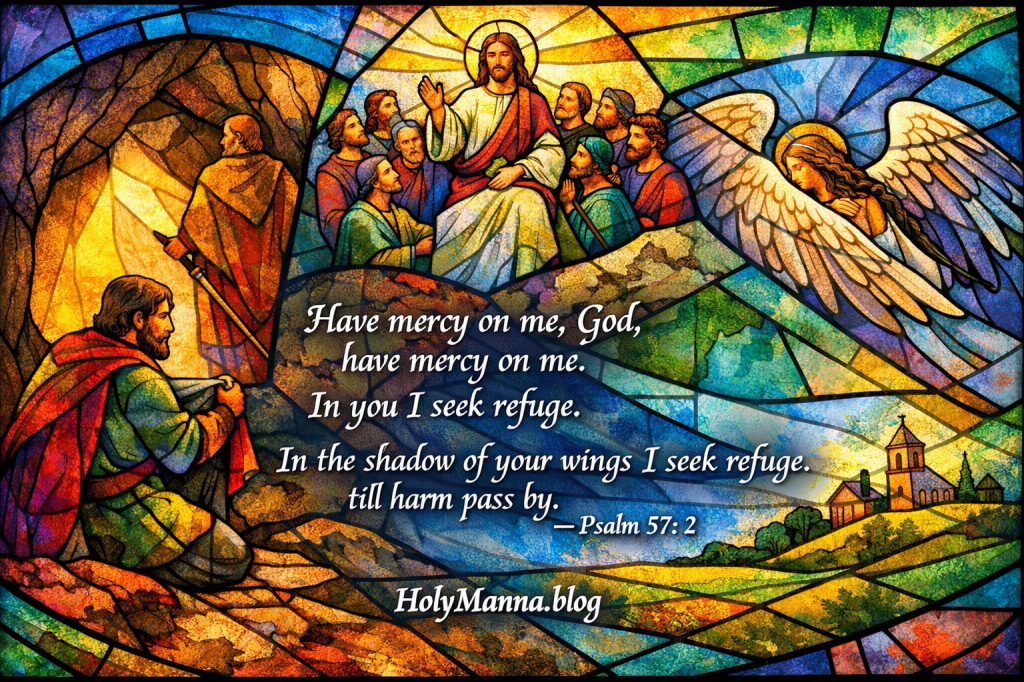
Friday of the Second Week in Ordinary Time – Lectionary: 315
The Strength That Refuses Revenge
There are days when the Word of God feels like a spotlight on the heart, and today is one of those days. The readings circle one central theme with surprising unity: God forms His people through mercy that refuses revenge, because authority is meant to serve the Lord’s plan, not personal anger.
In the First Reading, Israel is still learning what it means to live under God’s kingship. Saul is the first king, publicly chosen and anointed, which in Israel’s religious life made him more than a political figure. He carried a sacred weight as the Lord’s anointed in 1 Sm 24:6. David, though already promised a future, is still living as a hunted man in the wilderness. That historical tension matters because it exposes a temptation that is always modern: when a person has the chance to seize control, it can feel like permission from God. David’s decision inside the cave quietly teaches that righteousness is not proven by power, but by restraint.
The Responsorial Psalm gives language to what mercy costs. In Ps 57:2-4, 6, 11, the soul does not pretend danger is unreal. Instead, it runs to God as refuge, trusting that the Lord’s fidelity is higher than any threat. That is the inner life that makes David’s outward mercy possible. Hearts that stay under God’s wings do not need to become predators.
Then the Gospel lifts the eyes to the mountain, where Jesus calls the Twelve in Mk 3:13-19. In a world where religious leaders and political rulers often grabbed authority, Christ does something different. He summons, forms, and sends, giving authority not for domination but for communion and mission. The apostles are chosen to be with him before they are sent to preach, which is a quiet warning and a great comfort. Authority in God’s Kingdom begins in closeness to Jesus, and it is proven by how it treats enemies, handles power, and trusts the Father’s timing.
Where is the heart being tempted to strike back, prove a point, or take control in a way that feels justified? Today’s readings prepare the soul for a better path. They teach that real strength is merciful, real refuge is God, and real authority is received from Christ and used in love.
First Reading – 1 Samuel 24:3-21
Mercy that refuses revenge becomes the clearest proof of a heart that trusts God.
This scene drops right into the gritty middle of David’s wilderness years. Saul is still king, still publicly anointed, and still carrying a sacred weight in Israel’s religious life, even while he is spiraling into jealousy and injustice. David is the anointed future king in waiting, but he is living like a fugitive. That tension matters because it is exactly where the soul gets tested. When fear is high and options finally open up, it becomes easy to confuse opportunity with God’s will.
In Israel, “the Lord’s anointed” was not a cute title. Anointing meant consecration for office, and it demanded reverence, even when the man holding the office was acting badly. Today’s theme runs straight through this reading. Mercy is not weakness. Mercy is strength under control, and it flows from trust that God is Judge, Defender, and the One who raises up kings in His time.
1 Samuel 24:3-21 – New American Bible (Revised Edition)
3 So Saul took three thousand of the best men from all Israel and went in search of David and his men in the direction of the wild goat crags. 4 When he came to the sheepfolds along the way, he found a cave, which he entered to relieve himself. David and his men were occupying the inmost recesses of the cave.
5 David’s servants said to him, “This is the day about which the Lord said to you: I will deliver your enemy into your hand; do with him as you see fit.” So David moved up and stealthily cut off an end of Saul’s robe. 6 Afterward, however, David regretted that he had cut off an end of Saul’s robe. 7 He said to his men, “The Lord forbid that I should do such a thing to my master, the Lord’s anointed, to lay a hand on him, for he is the Lord’s anointed.” 8 With these words David restrained his men and would not permit them to attack Saul. Saul then left the cave and went on his way. 9 David also stepped out of the cave, calling to Saul, “My lord the king!” When Saul looked back, David bowed, his face to the ground in homage, 10 and asked Saul: “Why do you listen to those who say, ‘David is trying to harm you’? 11 You see for yourself today that the Lord just now delivered you into my hand in the cave. I was told to kill you, but I took pity on you instead. I decided, ‘I will not raise a hand against my master, for he is the Lord’s anointed.’ 12 Look here, my father. See the end of your robe which I hold. I cut off an end of your robe and did not kill you. Now see and be convinced that I plan no harm and no rebellion. I have done you no wrong, though you are hunting me down to take my life. 13 May the Lord judge between me and you. May the Lord exact justice from you in my case. I shall not lay a hand on you. 14 As the old proverb says, ‘From the wicked comes wickedness.’ Thus I will not lay a hand on you. 15 What is the king of Israel attacking? What are you pursuing? A dead dog! A single flea! 16 The Lord will be the judge to decide between us. May the Lord see this, defend my cause, and give me justice against you!”
Saul’s Remorse. 17 When David finished saying these things to Saul, Saul answered, “Is that your voice, my son David?” And he wept freely. 18 Saul then admitted to David: “You are more in the right than I am. You have treated me graciously, while I have treated you badly. 19 You have declared this day how you treated me graciously: the Lord delivered me into your hand and you did not kill me. 20 For if someone comes upon an enemy, do they send them graciously on their way? So may the Lord reward you graciously for what you have done this day. 21 And now, since I know that you will certainly become king and that the kingship over Israel shall come into your possession,
Detailed Exegesis
Verse 3: “So Saul took three thousand of the best men from all Israel and went in search of David and his men in the direction of the wild goat crags.”
Saul’s obsession is now organized, resourced, and intense. The number and quality of the troops show how far Saul has drifted from his true mission of shepherding Israel. When leadership becomes personal vendetta, everybody suffers, including the innocent soldiers pulled into it.
Verse 4: “When he came to the sheepfolds along the way, he found a cave, which he entered to relieve himself. David and his men were occupying the inmost recesses of the cave.”
The setting is almost uncomfortable because it highlights Saul’s vulnerability. David’s men are hidden deep inside, which makes the moment feel “handed” to them. The cave becomes a kind of confessional space where motives get exposed. The real question is not what David can do, but what kind of man David will become.
Verse 5: “David’s servants said to him, ‘This is the day about which the Lord said to you: I will deliver your enemy into your hand; do with him as you see fit.’ So David moved up and stealthily cut off an end of Saul’s robe.”
The servants interpret providence like a weapon. Even if David has received promises about his future, the crowd’s excitement can still distort discernment. Cutting the robe feels small, but it is symbolic. In that culture, a robe could represent authority, identity, and honor. David is tempted to make a point through humiliation.
Verse 6: “Afterward, however, David regretted that he had cut off an end of Saul’s robe.”
David’s conscience is alive, and that is a sign of grace. Regret here is not mere emotion. It is a moral awakening that says, “This is not who a righteous king becomes.” A heart formed by God does not need to win through disrespect.
Verse 7: “He said to his men, ‘The Lord forbid that I should do such a thing to my master, the Lord’s anointed, to lay a hand on him, for he is the Lord’s anointed.’”
David anchors his restraint in God, not in Saul’s behavior. Saul is wrong, but Saul is still consecrated. David refuses to treat sacred office as disposable. This is an important Catholic instinct too. Respect for legitimate authority is not the same as approval of wrongdoing. It is a commitment to let God handle what belongs to God.
Verse 8: “With these words David restrained his men and would not permit them to attack Saul. Saul then left the cave and went on his way.”
David has to govern his own team before he ever governs a kingdom. Restraining the men is leadership. Mercy is not only a private virtue. Mercy becomes a public witness when it stops a whole group from doing evil together.
Verse 9: “David also stepped out of the cave, calling to Saul, ‘My lord the king!’ When Saul looked back, David bowed, his face to the ground in homage,”
David’s posture shows reverence without fear. This is not flattery. It is a deliberate refusal to mirror Saul’s rage. David is modeling what it looks like to honor the office while still confronting the injustice.
Verse 10: “and asked Saul: ‘Why do you listen to those who say, “David is trying to harm you”?’”
Saul’s violence is being fed by misinformation and poisoned counsel. David names the real problem: Saul is letting other voices interpret reality for him. When a person’s heart is insecure, it becomes easy to believe the worst and call it wisdom.
Verse 11: “You see for yourself today that the Lord just now delivered you into my hand in the cave. I was told to kill you, but I took pity on you instead. I decided, “I will not raise a hand against my master, for he is the Lord’s anointed.”
David makes the truth undeniable. He had power and refused to use it for bloodshed. Mercy is framed as pity, but it is really faith. David is choosing God’s standard over the tribe’s standard.
Verse 12: “Look here, my father. See the end of your robe which I hold. I cut off an end of your robe and did not kill you. Now see and be convinced that I plan no harm and no rebellion. I have done you no wrong, though you are hunting me down to take my life.”
Calling Saul “my father” is both respectful and painful. David is not pretending the situation is normal. He is offering evidence and pleading for reason. This is what righteous defense looks like. It is honest, concrete, and clean of hatred.
Verse 13: “May the Lord judge between me and you. May the Lord exact justice from you in my case. I shall not lay a hand on you.”
This is the heart of the passage. David refuses personal vengeance and hands the case to God. It is not passive. It is a deliberate choice to let divine judgment replace personal retaliation.
Verse 14: “As the old proverb says, ‘From the wicked comes wickedness.’ Thus I will not lay a hand on you.”
David knows that violent behavior shapes the soul. If David answers wickedness with wickedness, he becomes what he hates. He refuses to let Saul’s sin recruit him.
Verse 15: “What is the king of Israel attacking? What are you pursuing? A dead dog! A single flea!”
David exposes the absurdity of Saul’s obsession. The images are intentionally humbling. David is saying, in effect, “This is not kingly behavior.” It is a sharp moment, but it is aimed at waking Saul up, not crushing him.
Verse 16: “The Lord will be the judge to decide between us. May the Lord see this, defend my cause, and give me justice against you!”
David repeats his trust because repetition strengthens resolve. He is not trying to control outcomes. He is asking God to see, defend, and judge. That is the language of a man who knows he is not alone.
Verse 17: “When David finished saying these things to Saul, Saul answered, ‘Is that your voice, my son David?’ And he wept freely.”
Mercy can crack even a hardened heart, at least for a moment. Saul’s tears show that he knows what righteousness looks like when it stands in front of him. Emotional response, however, is not the same as conversion, and Saul’s story will prove that.
Verse 18: “Saul then admitted to David: ‘You are more in the right than I am. You have treated me graciously, while I have treated you badly.’”
Saul confesses the moral difference plainly. David’s graciousness becomes a mirror that reveals Saul’s ugliness. This is one reason mercy is powerful. It makes excuses harder to keep.
Verse 19: “You have declared this day how you treated me graciously: the Lord delivered me into your hand and you did not kill me.”
Saul recognizes that David’s mercy was not accidental. It was chosen. David’s restraint becomes a public testimony that God is doing something different in David’s heart.
Verse 20: “For if someone comes upon an enemy, do they send them graciously on their way? So may the Lord reward you graciously for what you have done this day.”
Saul admits how uncommon this is. The world expects enemies to be crushed, not spared. Saul even speaks a blessing, which shows how mercy can pull a person toward the good, even if that person does not remain faithful to it.
Verse 21: “And now, since I know that you will certainly become king and that the kingship over Israel shall come into your possession.”
Saul finally says what he has feared. David’s path to kingship will not be paved with revenge. It will be marked by a kind of righteousness that looks a lot like the Kingdom Christ later preaches. God’s plan advances without David needing to stain his hands.
Teachings
This reading teaches that holy people do not justify additional sin by pointing to someone else’s sin. David refuses the logic of retaliation, and that refusal is not weakness. It is moral strength grounded in reverence for what God has consecrated and confidence that God’s justice is real.
A deeply Catholic lens also sees something important about authority here. David honors Saul’s anointing even while Saul abuses his power. That balance is a school for the soul. It teaches that respect for office and resistance to injustice can exist together when the heart is anchored in God rather than in rage. It also exposes a temptation that shows up in every generation: the urge to “fix” problems through spiritually reckless shortcuts. David models patient righteousness. He refuses to seize what God has promised through methods God has not permitted.
Finally, this passage shows how mercy can become a form of evangelization. Saul is not converted long term, but he is pierced. The righteous person’s restraint can reveal truth more sharply than a thousand arguments. Mercy can disarm excuses and force the conscience to speak.
Reflection
This reading lands in everyday life where there are tense conversations, wounded pride, and moments when the perfect comeback is ready to fire. David’s cave is not only a place in the desert. It is every moment when someone has enough power to embarrass, punish, expose, or ruin another person, and it feels justified.
A practical step is to pause long enough to name what is actually being desired. The desire might be justice, but it might also be domination, humiliation, or emotional payoff. David refused to let pain decide the method. Another step is to entrust the “case” to God in prayer before acting. That does not mean staying silent forever, but it does mean refusing revenge as a tool. The heart can speak truth firmly without becoming cruel.
Where has resentment been rehearsed like it is a plan for survival, instead of a chain that keeps the soul stuck?
When an opportunity appears to strike back, is it treated as “providence,” or is it tested against the character of holiness?
What would change if the heart chose to believe that God can defend the cause without needing sin as an assistant?
David shows that mercy does not deny danger or ignore wrongdoing. Mercy refuses to become wicked in response to wickedness. That kind of strength is exactly what prepares the soul to recognize Christ’s authority and to live under God’s wings when harm is passing by.
Responsorial Psalm – Psalm 57:2-4, 6, 11
Refuge before retaliation, praise before panic.
This psalm is a perfect companion to the cave scene from 1 Sm 24:3-21. In fact, the traditional setting of Psalm 57 is David praying while hunted, hiding, and waiting for God to act. It is not the prayer of someone who has everything under control. It is the prayer of someone who refuses to become ruthless under pressure. That is why it fits today’s theme so well. Mercy does not begin in the hands. Mercy begins in the heart that chooses God as refuge, trusts His timing, and keeps praising even when the threat is still nearby.
Psalm 57:2-4, 6, 11 – New American Bible (Revised Edition)
2 Have mercy on me, God,
have mercy on me.
In you I seek refuge.
In the shadow of your wings I seek refuge
till harm pass by.
3 I call to God Most High,
to God who provides for me.
4 May God send help from heaven to save me,
shame those who trample upon me.
May God send fidelity and mercy.
Selah6 Be exalted over the heavens, God;
may your glory appear above all the earth.11 For your mercy towers to the heavens;
your faithfulness reaches to the skies.
Detailed Exegesis
Verse 2: “Have mercy on me, God, have mercy on me. In you I seek refuge. In the shadow of your wings I seek refuge till harm pass by.”
This verse opens with urgency and humility. The repetition of “Have mercy” shows a heart that knows it needs God, not just solutions. The image of “the shadow of your wings” echoes the Temple and the biblical theme of God sheltering His people. It teaches that refuge is not denial. Refuge is a decision to stay close to God until the storm loses its power.
Verse 3: “I call to God Most High, to God who provides for me.”
Calling on “God Most High” is a quiet act of spiritual realism. The problem feels big, but God is bigger. The phrase “who provides for me” is a reminder that God does not merely watch from a distance. He acts, sustains, and supplies what the soul cannot generate on its own, especially patience and courage.
Verse 4: “May God send help from heaven to save me, shame those who trample upon me. May God send fidelity and mercy.”
This verse names the pain clearly. There are real enemies, real pressure, and real injustice. The prayer is not a private vendetta. It hands the situation to God and asks for rescue. The most revealing line is the last one, because it asks for God’s fidelity and mercy, not personal revenge. It is a plea for God’s steadfast love to be the decisive force.
Verse 6: “Be exalted over the heavens, God; may your glory appear above all the earth.”
Here the psalm lifts the eyes above the cave and above the conflict. This is worship in the middle of warfare. Praise is not an escape. Praise is the soul refusing to let fear be the loudest voice. God’s glory is placed above the entire situation, which is exactly how trust becomes stable.
Verse 11: “For your mercy towers to the heavens; your faithfulness reaches to the skies.”
This verse is a confident conclusion. God’s mercy is not small, temporary, or fragile. It is vast and higher than every threat. God’s faithfulness is dependable, even when human leadership fails, as Saul does in the First Reading. This is the emotional and spiritual foundation for David’s restraint. A person who believes mercy is infinite can afford to be merciful.
Teachings
The Church teaches that the psalms are not only ancient poems. They are the living prayer of God’s people, fulfilled in Christ and prayed in the Church’s liturgy. When this psalm begs for mercy and refuge, it is training the heart in the theological virtue of hope, which refuses despair and refuses to take matters into sinful hands.
The Catechism gives a direct, practical teaching about what happens when prayer meets pressure. It explains that the struggle in prayer is normal, and that God uses it to purify trust. “The habitual difficulty in prayer is distraction. The remedy lies in faith.” (CCC 2729) It also speaks about the deeper trial that appears when prayer feels unanswered or when life feels unsafe. “Filial trust is put to the test when we feel that our prayer is not always heard. The Gospel invites us to ask ourselves about the effectiveness of our prayer.” (CCC 2734) This psalm models that filial trust. It keeps calling, keeps praising, and keeps waiting for God to send mercy and fidelity.
Saint Augustine often teaches that the psalms give voice to Christ and His Body, which means they form Christians to pray not only for comfort, but for holiness. The cry for refuge is not simply about escaping danger. It is about becoming the kind of person who clings to God rather than clinging to retaliation.
Reflection
This psalm is for anyone who feels hunted, misunderstood, or trapped in a conflict that keeps dragging on. It is also for anyone who is tempted to “fix it” with a sharp tongue, a harsh message, a public humiliation, or a private grudge. The psalm offers a better first move. Before any response is drafted, it teaches the soul to run under God’s wings and stay there until harm passes by.
A simple daily practice is to begin the day with Verse 2 and to repeat it when the nervous system starts to spike. Another strong step is to replace reactive speech with a short act of praise, because Verse 6 shows how worship re-centers the heart. When praise goes first, the next decision is usually cleaner. Mercy becomes possible because fear is no longer driving.
Where does the heart run first when stress hits: into prayer, or into planning revenge in the imagination?
What would change if the first response to conflict was to ask for God’s fidelity and mercy instead of demanding immediate payoff?
How might God be inviting deeper trust through a situation that cannot be controlled, only surrendered?
Holy Gospel – Mark 3:13-19
Christ builds His Church by calling ordinary men into communion
After watching the Lord confront sickness, sin, and demonic oppression, The Gospel of Mark brings the reader up a mountain. In Scripture, mountains are not random scenery. Mountains are places of revelation, covenant, and mission, which calls to mind Moses and Sinai, Elijah, and the great moments when God forms His people. Jesus climbs the mountain not to escape the crowds, but to establish something lasting. He freely chooses the Twelve, echoing the twelve tribes of Israel, showing that He is reconstituting God’s people around Himself.
This fits today’s theme in a sharp way. In the First Reading, David refuses to grasp power through revenge because he trusts God’s order and timing. Here, Jesus shows where true authority comes from. It is not seized. It is received. The apostles are chosen first to be with Him, and only then are they sent to preach and confront the kingdom of darkness. Mercy and mission both start in communion with God.
Mark 3:13-19 – New American Bible (Revised Edition)
The Mission of the Twelve. 13 He went up the mountain and summoned those whom he wanted and they came to him. 14 He appointed twelve [whom he also named apostles] that they might be with him and he might send them forth to preach 15 and to have authority to drive out demons: 16 [he appointed the twelve:] Simon, whom he named Peter; 17 James, son of Zebedee, and John the brother of James, whom he named Boanerges, that is, sons of thunder; 18 Andrew, Philip, Bartholomew, Matthew, Thomas, James the son of Alphaeus; Thaddeus, Simon the Cananean, 19 and Judas Iscariot who betrayed him.
Detailed Exegesis
Verse 13: “He went up the mountain and summoned those whom he wanted and they came to him.”
Jesus initiates the call. Discipleship is not self-appointed activism. It begins with Christ’s choice and the humble response of coming to Him. The mountain signals that this call has covenant weight, not just personal inspiration.
Verse 14: “He appointed twelve [whom he also named apostles] that they might be with him and he might send them forth to preach”
The order matters. “That they might be with him” comes before being sent. Communion precedes mission. The title “apostles” means those who are sent, which shows that Christian authority is always tied to being commissioned by Christ, not to personal charisma.
Verse 15: “and to have authority to drive out demons:”
Jesus shares real authority, not motivational influence. Driving out demons is a sign that the Kingdom of God is breaking in, and it also reveals the Church’s spiritual warfare as something grounded in Christ’s power, not human confidence. This authority is a gift ordered toward liberation, not domination.
Verse 16: “[he appointed the twelve:] Simon, whom he named Peter;”
The renaming is significant. In Scripture, a new name often marks a new mission. Peter is singled out, not because he is flawless, but because Christ establishes an order for the sake of unity. The Church is not built on perfect personalities, but on Christ’s decision and grace.
Verse 17: “James, son of Zebedee, and John the brother of James, whom he named Boanerges, that is, sons of thunder;”
The nickname shows temperament, intensity, and potential. Jesus does not wait for their rough edges to disappear before calling them. He calls them and then forms them. The Gospel quietly teaches that holiness is not about having a calm personality. Holiness is about letting Christ govern the fire.
Verse 18: “Andrew, Philip, Bartholomew, Matthew, Thomas, James the son of Alphaeus; Thaddeus, Simon the Cananean,”
This list is a reminder that the Church is built from a mix of backgrounds and strengths. Some names are famous, some are quiet, and that is part of the point. The mission does not depend on being noticed. It depends on fidelity to the One who sends.
Verse 19: “and Judas Iscariot who betrayed him.”
This line is sobering. Proximity to Jesus is not the same as surrender to Jesus. Judas is included in the call, included in the community, and still chooses betrayal. The Gospel is warning that ministry, knowledge, and even spiritual experiences do not replace conversion of heart.
Teachings
This passage is a foundational text for Catholic understanding of the Church as apostolic. Jesus deliberately establishes the Twelve as a visible, structured beginning of the new people of God, and He shares His authority with them for preaching and spiritual deliverance.
The Catechism speaks directly to this moment. “Jesus is the Father’s Emissary. From the beginning of his ministry, he called to him those whom he desired, and appointed twelve, whom he also named apostles, to be with him, and to send them out to preach.” (CCC 858) This shows that apostolic mission is not invented by the Church later. It is Christ’s own design.
The Catechism also explains the role of Peter within the apostolic college. “When Christ instituted the Twelve, ‘he constituted [them] in the form of a college or permanent assembly, at the head of which he placed Peter, chosen from among them.’ Just as by the Lord’s institution, St. Peter and the other apostles constitute a single apostolic college, so in like fashion the Roman Pontiff, Peter’s successor, and the bishops, the successors of the apostles, are related with and united to one another.” (CCC 880) This teaching helps the Gospel land in real life. Christ’s authority is not meant to dissolve into private opinion. It is meant to gather, guide, and guard the Church in unity and truth.
Saints and Doctors often highlight the phrase “that they might be with him” as the heart of Christian ministry. The Church does not evangelize by running faster than everyone else. The Church evangelizes by staying close enough to Jesus to speak and act in His name. This is also why the apostles are not chosen because they already look saintly. They become holy through proximity, correction, forgiveness, and mission.
Reflection
This Gospel is a reality check for any soul tempted to treat faith like a personal brand or a private project. Christ calls. Christ forms. Christ sends. That rhythm protects the heart from two dangers: grasping for control like Saul, and rushing into mission without prayer like someone trying to fight demons with human energy.
A solid daily step is to rebuild life around being with Jesus. That happens through faithful Mass attendance, a real prayer routine, and regular confession, because closeness is not a mood. It is a commitment. Another step is to treat authority in the home, workplace, and parish as a responsibility to serve, not as permission to win. Jesus gives authority for liberation, truth, and mercy, not for ego and revenge.
Judas is the uncomfortable mirror in the text. He shows that it is possible to be near holy things and still choose self-will. That is why the heart needs ongoing conversion, not occasional inspiration.
Is time with Jesus treated like the first priority, or is it treated like something squeezed in after everything else is finished?
Where is there a temptation to grasp influence, control outcomes, or prove a point, instead of receiving a mission with humility?
What would change if the day began with being with Christ, so that every conversation and decision flowed from communion rather than impulse?
When the Church lives this Gospel well, it starts to look like David in the cave and like the psalmist under God’s wings. Power is restrained. Mercy is chosen. Authority becomes service. The Kingdom advances without the soul becoming cruel.
Mercy That Builds the Kingdom
Today’s readings land like a single, steady message: real strength looks like mercy, real safety is found in God, and real authority is received from Christ and used to serve. In 1 Sm 24:3-21, David has every reason to strike back, and he has the perfect chance to do it. Instead, he refuses revenge, honors what God has anointed, and entrusts justice to the Lord. That choice does not make David weaker. It reveals a heart that is being trained for kingship without becoming corrupted by anger.
Then Ps 57:2-4, 6, 11 shows what is happening inside a soul like that. The psalm does not pretend the threat is small. It chooses refuge over rage and praise over panic. It teaches that mercy is not an impulse that appears randomly. Mercy grows in the heart that runs under God’s wings and stays there until harm passes by.
Finally, Mk 3:13-19 reveals the source of the Church’s life and mission. Jesus climbs the mountain, calls whom He wills, and appoints the Twelve so they might be with Him and then be sent with His authority. This is how God builds His Kingdom. It is not built by grasping power or crushing enemies. It is built by communion with Christ that produces faithful, disciplined, merciful strength.
Now is a good time to make this practical. The next time an opportunity appears to embarrass someone, punish someone, or win an argument in a way that feels justified, let David’s restraint set the standard. Let the psalm become the first response: “In the shadow of your wings I seek refuge till harm pass by.” Then let the Gospel reset the whole day. Make room to be with Jesus, because mission without communion becomes noise, and authority without prayer becomes ego.
Where is the Lord asking for restraint instead of retaliation?
What would change if the day’s decisions were made under God’s wings rather than under pressure?
How might Christ be calling the heart to be with Him more intentionally, so that words and actions carry His peace?
Choose one concrete act today that reflects these readings. Forgive an old offense. Hold back the sharp response. Pray before responding to tension. Make a humble confession of impatience or pride. Ask the Lord for the grace to use influence like an apostle, not like a rival. When mercy becomes the habit, the Kingdom becomes visible, and the heart becomes freer than revenge ever allowed it to be.
Engage with Us!
Readers are invited to share reflections in the comments below, because the Word of God comes alive when it is prayed, wrestled with, and lived together in the Church. Here are a few questions to help the heart engage each reading with honesty and hope.
- First Reading, 1 Sm 24:3-21: Where is there a temptation to take revenge or “prove a point,” and what would it look like to entrust justice to God instead?
- Responsorial Psalm, Ps 57:2-4, 6, 11: When stress rises, what is the usual “refuge,” and how can the heart practice running to God first under the shadow of His wings?
- Holy Gospel, Mk 3:13-19: What would change in daily life if being with Jesus became the foundation before trying to fix, lead, or serve anything else?
Take these questions into prayer, bring them into the ordinary moments of the day, and keep choosing the path of faith when it would be easier to react. May every decision be shaped by the love and mercy Jesus taught, so that home, work, and relationships become places where His Kingdom is quietly made visible.
Sacred Heart of Jesus, we trust in You!
Immaculate Heart of Mary, pray for us!
Saint Michael the Archangel, defend us in battle!
Follow us on YouTube, Instagram and Facebook for more insights and reflections on living a faith-filled life.

 Holy Manna!
Leave a comment