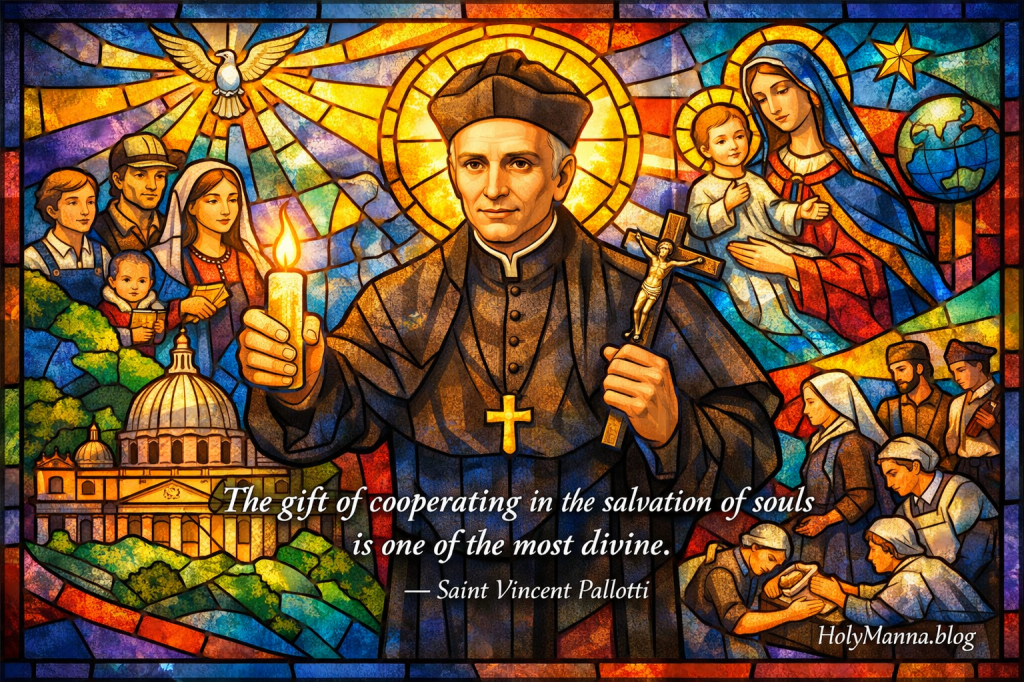
The Saint Who Refused to Let Anyone Sit on the Sidelines
Saint Vincent Pallotti is one of those saints who quietly flips a switch in the mind. He was a Roman priest, yes, but his great work was not about building a personality cult around clergy. His great work was about waking up the whole Church. He preached with urgency that the mission of Jesus Christ belongs to every baptized person. That does not mean everyone becomes a preacher in the public square. It means every Catholic has a real share in the apostolic life of the Church through prayer, sacrifice, mercy, and courageous witness in the state of life God has given.
Pallotti lived at a time when many Catholics assumed the “serious” work of the Church belonged to priests and religious while everyone else simply tried to stay out of trouble. He saw how that mindset shrank the Gospel down to private morality. He believed the Holy Spirit wanted something more generous and more Catholic, meaning universal and outgoing. His vision gathered clergy, religious, and laity into one coordinated work of faith and charity, always rooted in the Eucharist and anchored in love for the Blessed Mother, especially under the title Mary, Queen of Apostles. His legacy matters because it still pushes Catholics to stop treating faith like a Sunday routine and start treating it like the lifeline it is.
Rome Raised Him, Grace Claimed Him
Vincent Pallotti was born in Rome on April 21, 1795, in a world where the Church’s presence was everywhere, from parishes to pilgrim shrines to the daily rhythm of Catholic devotion. Growing up in the heart of Christendom did not make him complacent. It made him attentive. He learned early that Catholic life is not meant to be abstract. It is meant to be lived, practiced, and offered to God like bread placed on an altar.
His childhood and youth were marked by strong devotion and a special tenderness toward the poor. There is a small story that keeps getting told because it shows what kind of soul he had. Before giving money to the poor, he would wash the coin. He believed he was giving it to Christ Himself, and he wanted it to be offered with reverence. That is not a quirky habit. That is the Gospel taken literally, and it is exactly the kind of detail that reveals the inner life of a saint.
He was ordained a priest on May 16, 1818. His “conversion” was not a dramatic break from atheism or a sudden escape from scandal. It was a steady deepening into full surrender. He lived like a man convinced that holiness is real, judgment is real, mercy is real, and souls matter. Over time his priestly identity became more and more focused on one burning idea: Catholics were not created to be spiritual couch potatoes. Catholics were created to be saints and apostles in the ordinary places where God has planted them.
The Gospel Trumpet That Would Not Let People Sleep
Pallotti’s priesthood was active, organized, and relentless, but it was never just activism. It was a life flowing out of prayer, confession, and Eucharistic worship. He preached and taught constantly, and he had a special gift for drawing people into serious devotion without turning them into gloomy perfectionists. He wanted Catholics to love God and to love their neighbor with practical courage, not with vague religious feelings.
One of his most important works began after Mass on January 9, 1835, when he set in motion a new apostolic union aimed at awakening zeal and charity in all the faithful. The image often used is that of an evangelical trumpet. A trumpet is not background music. A trumpet is a call to action. He believed the Lord wanted a coordinated apostolic spirit in the whole Church, where clergy, religious, and lay people each served according to their vocation while working together for the salvation of souls.
He did not limit his concern to church walls. He opened night schools for workers who could not study during the day, because he saw education as a form of mercy and formation as a form of evangelization. He served the sick and organized aid, especially during the cholera outbreak in 1837, when fear was everywhere and charity was costly. He also responded to the vulnerable, including young girls left orphaned and exposed to exploitation, by helping establish shelter and care that protected both body and soul.
He was also known for bold pastoral courage. There is a famous account that he disguised himself as an old woman to reach a dying man who had threatened to shoot any priest who approached. Whatever details people remember most from that story, the spiritual lesson is clear. Pallotti was willing to look foolish and risk his safety to bring someone to repentance, because he believed no soul should be abandoned.
Another often overlooked part of his legacy is his devotion to the mystery of Epiphany and what it says about the universality of the Church. In 1836 he instituted a solemn Octave of the Epiphany, a major Roman religious celebration that emphasized Christ as light to the nations and kept unity and mission in front of the Catholic imagination. This was not a trendy ecumenical gesture. It was a deeply Catholic desire that all peoples and all Christians would be gathered into the full truth and charity of Christ.
Misunderstood Zeal and a Final Gift of Himself
Saint Vincent Pallotti was not martyred, but it would be a mistake to imagine he had an easy path. Zeal often meets resistance, even inside the Church, and Pallotti’s insistence on a vigorous apostolate for the laity could be misunderstood. He pushed against spiritual laziness and clerical isolation, not by attacking anyone, but by building something new that demanded cooperation and humility. That kind of work is rarely applauded by everyone.
He carried the ordinary hardships of a priest who spends himself. He faced misunderstandings, practical obstacles, and the slow grind of trying to organize charity and formation in a city full of competing interests and distractions. Yet he remained deeply obedient to the Church, rooted in the sacraments, and committed to doing good quietly. The tone of his life was not rebellion. It was fidelity.
His final hardship came in sickness. After demanding ministry connected with the Epiphany celebrations and winter conditions, he became gravely ill with pleurisy and died on January 22, 1850. Even his death reflected his spirit of surrender. His last words are remembered as a simple request of trust and obedience: “Of your charity, let me go, where God wants me.” That line sounds like a man who practiced dying well long before he actually died.
God’s Signature After His Death
The Church does not canonize saints based on emotional stories. She looks for heroic virtue and, in many causes, verified miracles attributed to the saint’s intercession. After Pallotti’s death, devotion to him spread and the Church formally recognized miracles connected to his cause. These accounts matter because they are treated as signs pointing back to Jesus Christ, not as entertainment for curious minds.
Among the miracles attributed to his intercession are sudden and complete healings. For beatification, miracles included the healing of a young boy in Rome, Alexander Lutei, after a severe head injury, and the healing of Margareta Sandner, who had suffered for years from multiple sclerosis. For canonization, additional miracles included the healing of Angelo Balzarini from a severe, life threatening infection with toxemia, and the healing of Father Adalbert Turowski from a grave post operative tox infective condition with cardiac insufficiency. These healings strengthened the Church’s confidence that Pallotti’s holiness was not merely admired on earth, but that his intercession was active in heaven.
His canonization took place in 1963, and his feast day is commonly observed on January 22, the day he entered eternal life. His legacy also lives through the apostolic family he founded, which continues to encourage Catholics to live like evangelists in ordinary life. In a time when many believers feel overwhelmed by the world’s noise, Pallotti’s example is a reminder that steady prayer and steady charity can still shake the world.
A Straightforward Challenge for Modern Catholics
Saint Vincent Pallotti makes excuses harder to keep. He does not allow Catholics to hide behind the idea that holiness is for specialists. He also does not allow Catholics to confuse mission with ego. His whole approach was rooted in prayer, the Eucharist, confession, and humble charity, because real apostolic work begins with conversion of heart.
A practical way to imitate him is to take the state of life seriously. A Catholic father, mother, single adult, student, worker, retiree, priest, or religious can each live an apostolic life by being faithful to daily duties and intentionally offering them to God for the salvation of souls. That begins with the small things done with love, and it grows into a life that naturally invites others toward Christ. Where is God asking for a little more courage, a little more patience, and a little more charity this week?
Pallotti’s words still hit with force: “The gift of cooperating in the salvation of souls is one of the most divine.” That does not mean anyone saves souls by their own power. It means God dignifies His people by letting them participate in His saving work, just as The Gospel of Matthew shows again and again when Jesus sends ordinary disciples to do extraordinary things by grace. In a culture that trains people to live for comfort, Pallotti trains Catholics to live for Christ, and to love their neighbor with a seriousness that looks a lot like the Cross.
Engage with Us!
Share your thoughts and reflections in the comments below.
- What part of Saint Vincent Pallotti’s life challenges the most comfortable habits of faith today?
- Where is God calling ordinary Catholics to step into mission with more courage and less hesitation?
- What is one practical way to “revive faith and rekindle charity” in daily life this week?
- Who in personal life might need a patient invitation back to the sacraments, or at least a promise of prayer?
Keep walking forward with confidence. Live a life of faith, stay close to the sacraments, and do everything with the love and mercy Jesus taught us.
Saint Vincent Pallotti, pray for us!
Follow us on YouTube, Instagram and Facebook for more insights and reflections on living a faith-filled life.

 Holy Manna!
Leave a comment