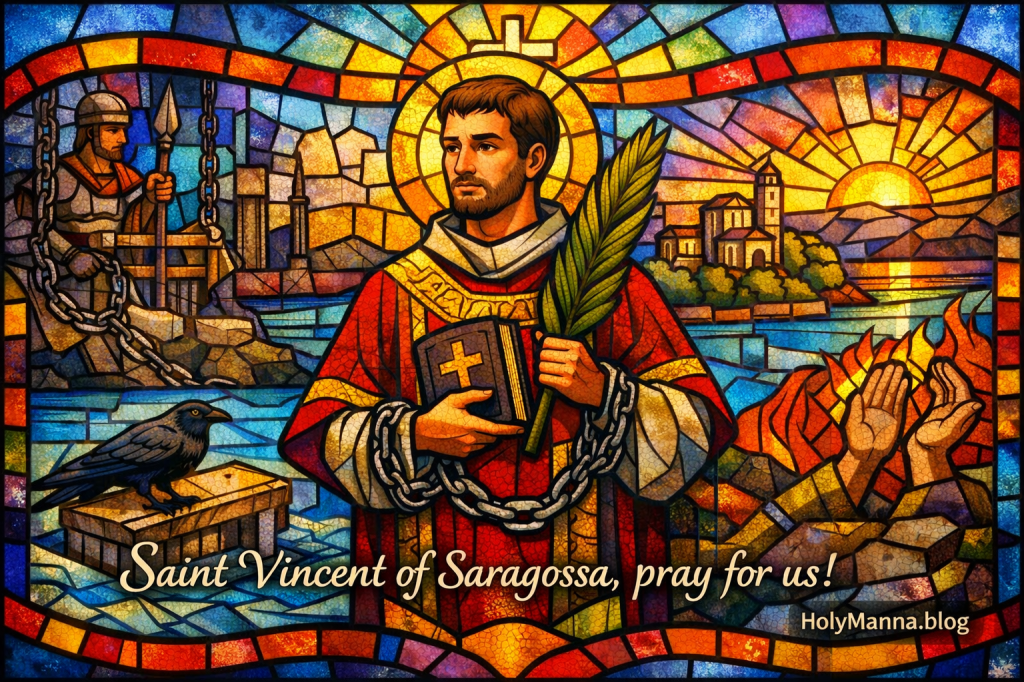
Fire Tested Faith in a City of Idols
Saint Vincent of Saragossa stands among the Church’s most honored martyrs because his witness was not only brave, but steady and unshakable. He lived in a world where the Roman state demanded religious conformity, where the emperor’s will could feel like the only “truth” allowed in public life. Vincent quietly refused that lie. He belonged to Jesus Christ, and he served the Church with the kind of loyalty that does not bend when pressure rises. Catholics revere him because his life makes it plain that holiness is not reserved for monks in the desert or scholars in libraries. Holiness is for ordinary Christians who cling to Christ when it costs something.
His story also highlights the beauty of the diaconate. Deacons are not meant to be celebrities. They are meant to be servants of the altar, servants of the poor, and servants of the Word. Vincent is remembered as a deacon who carried that calling with courage and humility, and who proved by his martyrdom that the Gospel is worth more than comfort, reputation, or even life itself.
A Young Deacon Formed for Service
Saint Vincent’s roots are tied to Zaragoza in Spain, and Catholic tradition preserves family details that later Christians handed on with reverence. Those early biographical pieces matter less than the spiritual shape of his life, because the Church’s clearest memory is about his vocation and fidelity. Vincent served as a deacon under Bishop Valerius, and tradition holds that the bishop struggled with speech, which meant Vincent often carried the responsibility of public preaching and proclamation. That small detail reveals a lot. Vincent was not simply assisting with logistics. He was helping the Church speak.
In a healthy parish, everybody knows the value of someone who steps in quietly, carries weight without complaint, and stays steady when others feel weak. Vincent did that for his bishop and for the faithful. He was trained in a world where being a Christian could cost everything, so his faith was not sentimental. It was practical, disciplined, and rooted in worship. A man does not stand firm on the rack by accident. He stands firm because he has already decided, long before the crisis comes, that Christ is Lord.
The Quiet Heroism of Preaching and Serving
Catholic sources do not present Vincent as a wonder worker in life with a long catalog of spectacular public miracles, and it is better to respect that than to fill in blanks. What the sources do present is something more challenging, because it hits closer to home. They present a man faithful in the ordinary work of the Church. He preached. He served. He strengthened his bishop. He stood as a public witness when it was dangerous to do so.
This is one of the most important lessons of his life. Many Christians want the dramatic moment of heroism without the daily habits that make heroism possible. Vincent’s ministry reminds believers that the greatest preparation for spiritual warfare is not a hype speech. It is prayer, discipline, sacramental life, and a clean conscience. That is how a Christian becomes steady. That is how a deacon becomes a pillar for the Church. Vincent’s “miracle” in life was the miracle of fidelity, the kind of fidelity that looks ordinary until it is tested, and then it shines like gold.
The Trial That Became a Sermon
During the persecution linked to Emperor Diocletian, Vincent and Bishop Valerius were arrested and taken to Valencia. Catholic tradition preserves the name of the governor as Dacian, and it also preserves the basic shape of what followed: interrogation, pressure to submit, and violence meant to crush Christian resolve. Valerius was eventually exiled, but Vincent remained in custody and was targeted more directly. This was not only a political act. It was a spiritual attack meant to humiliate Christ by humiliating His servant.
The ancient accounts emphasize that Vincent endured severe torture, including the rack and other torments meant to break the body and terrorize the soul. There are also traditions of harsh imprisonment, including conditions designed to cause suffering even while resting. What makes his witness so powerful is not that he enjoyed pain, but that he refused to let pain become his master. His tormentors were trying to force him to treat Caesar like a god. Vincent refused. In that refusal, the courtroom became a sermon. Without a pulpit, without applause, without safety, he proclaimed that Jesus Christ is Lord.
The Church’s liturgy keeps this spiritual meaning front and center. In a sermon used in the Office of Readings, Saint Augustine praises Vincent’s steadfastness and offers a line that has echoed through centuries of Catholic prayer: “Vincent had received both these gifts; he had received them, and he kept them.” The gifts are the grace to confess Christ and the grace to endure suffering. That line keeps the focus where it belongs. This was not a story of stubborn human pride. This was the fruit of grace, received and guarded in faith.
Vincent eventually died from the injuries and sufferings inflicted upon him. His martyrdom is significant because it exposes the emptiness of worldly power. Rome could torture a Christian, but it could not conquer the soul that belongs to Christ. The martyr’s death is not a defeat. It is a victory that preaches the Resurrection without needing words.
When God Honored His Witness
After Vincent’s death, Catholic tradition records striking signs connected to his body and the Church’s devotion. One famous tradition says that when his body was exposed to be destroyed, a raven defended it, keeping it from being desecrated. Another tradition says that when efforts were made to dispose of his remains at sea, the waters returned his body to shore, allowing Christians to recover it and bury it with reverence. These stories have remained in Catholic memory because they highlight a truth modern people often forget. The human body matters. The body is not disposable. The saints are not forgotten. God honors those who honor Him.
Vincent’s veneration spread early and widely. Valencia honored him in a particular way because that is where he suffered and died, and Spain remembered him as one of its most renowned martyrs. Catholic tradition also speaks strongly about devotion to Saint Vincent in Portugal, especially in Lisbon, where relic traditions and local piety shaped the city’s devotional identity. These details should be held with the respect Catholic tradition gives them, while also remembering that the deepest point is not trivia about travel routes. The deepest point is the communion of saints. The Church does not treat the martyrs as ancient history. The Church treats them as living members of the family of God whose witness still strengthens believers today.
Bringing Saint Vincent Into Everyday Discipleship
Saint Vincent’s life is a gift for Catholics trying to live the faith in a culture that constantly pressures believers to soften convictions. Not every pressure looks like a Roman tribunal. Sometimes it looks like workplace intimidation, family conflict, social media mockery, or the quiet temptation to stay silent when truth needs to be spoken. Vincent teaches that courage does not need swagger. Courage needs clarity. Courage needs prayer. Courage needs a soul anchored in Christ.
A practical way to imitate him is to build strong habits that keep the heart steady. Daily prayer matters because it forms the inner life when nobody is watching. Confession matters because it trains the soul to love truth more than image. The Eucharist matters because the Christian cannot endure without being fed by Christ. Vincent also teaches the value of disciplined speech. A Catholic can speak clearly without being harsh. A Catholic can refuse lies without becoming bitter. A Catholic can be firm without being prideful. That is the kind of mature strength that families, parishes, and communities need.
Vincent’s witness also reminds believers that suffering is not automatically holy, but it can become holy when it is united to Christ. When trials arrive, the Christian does not need to pretend it feels good. The Christian needs to offer it, carry it with patience, and trust that Christ is near. How can today’s small sacrifices become a quiet offering that strengthens the soul for bigger tests? That is how everyday people become saints. They keep receiving grace, and they keep it.
Engage with Us!
Share thoughts and reflections in the comments below. Saint Vincent’s story has strengthened Catholics for centuries, and it can still strengthen hearts today.
- Where does pressure to compromise the faith show up most in daily life right now, and what would it look like to respond with calm courage instead of fear?
- What is one concrete practice that can build spiritual endurance, such as daily prayer, confession, fasting, or speaking the truth with charity?
- When suffering or inconvenience comes, what helps keep the heart united to Christ instead of slipping into anger, self pity, or despair?
- Saint Vincent stayed faithful as a servant of the Church. How can service at home, at work, or in the parish become a real path to holiness this week?
Keep walking forward with faith. Keep loving Jesus Christ in the ordinary duties of the day, and do everything with the love and mercy Jesus taught us.
Saint Vincent of Saragossa, pray for us!
Follow us on YouTube, Instagram and Facebook for more insights and reflections on living a faith-filled life.

 Holy Manna!
Leave a comment