Day of Prayer for the Legal Protection of Unborn Children – Lectionary: 314
When Innocence Is Hunted and Mercy Draws Near
It is easy to recognize evil when it looks like open violence, but Scripture often shows it beginning much earlier, inside the human heart, when fear and envy twist the way a person sees the good. Today’s readings move through that exact terrain, and they land on a single, urgent theme: the innocent are always vulnerable when power turns inward, but God raises up protectors, strengthens trust, and sends His Son to heal what sin tries to crush.
In 1 Samuel 18:6-9; 19:1-7, the scene sits in the early days of Israel’s monarchy, when the nation is still learning what kingship is supposed to be. Saul is not merely a private man with private jealousy. He is the anointed ruler of God’s people, and that makes his envy especially dangerous because it spreads outward into policy, pursuit, and potential murder. A simple victory song becomes a spiritual test, and Saul fails it. His heart cannot rejoice in God’s work through another, so he begins to see David not as a gift to Israel, but as a threat to his own security. The moment envy takes the throne inside Saul, innocent blood becomes negotiable.
That is why Jonathan’s intercession matters so much. He stands between a father’s rage and a servant’s life, and he names the truth that rulers are always tempted to forget: “Why, then, should you become guilty of shedding innocent blood by killing David without cause?” Jonathan becomes a quiet image of what God asks in every age, especially on the Day of Prayer for the Legal Protection of Unborn Children: to defend the vulnerable with clarity, courage, and clean motives, even when it costs something socially or personally.
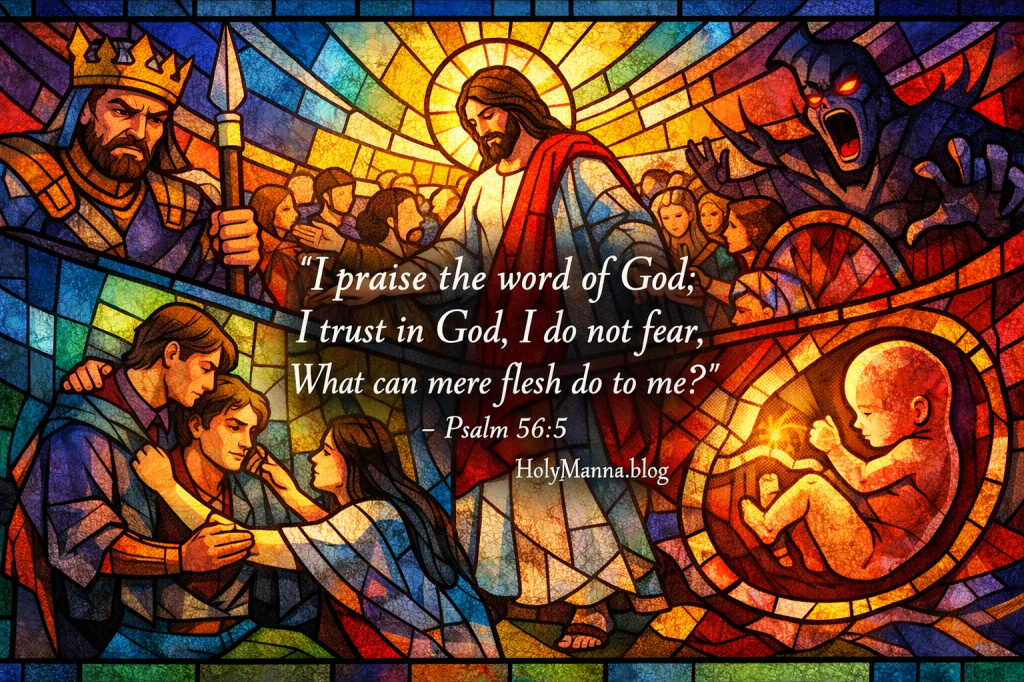
The Responsorial Psalm, Psalm 56:2-3, 5, 9-13, gives David’s interior life while innocence is being hunted. It does not romanticize suffering or pretend fear does not exist. It turns fear into prayer and pressure into trust, repeating the refrain that keeps a believer steady when threats feel loud: “In God I trust, I do not fear. What can mere flesh do to me?” This psalm teaches that God is not distant from hidden anguish. He notices every step, remembers every tear, and remains faithful even when human protection fails.
Then Mark 3:7-12 widens the horizon from one man’s persecution to a whole world of wounded people pressing toward Christ. The crowds are not showing up for entertainment. They are coming because sickness, spiritual oppression, and misery have cornered them, and Jesus is the only One who heals with authority and compassion. The unclean spirits shout a true title, but Jesus silences them because truth does not become holy simply because it is spoken out loud. The Holy One will be known on His terms, through mercy, obedience, and the Cross. Together, these passages prepare the heart to see the day clearly: when envy and fear threaten the innocent, God calls His people to be protectors like Jonathan, pray with trust like David, and cling to Jesus, whose mercy restores life where sin tries to steal it.
First Reading – 1 Samuel 18:6-9; 19:1-7
When Envy Hunts the Innocent and Friendship Becomes a Shield
Israel is still early in her experiment with kingship, and 1 Samuel shows how quickly a leader’s interior life can shape a whole nation’s moral climate. David returns after striking down the Philistine, and the people greet the victory the way ancient Israel often did, with public songs and dancing that celebrated God’s deliverance through His chosen instruments. What should have been gratitude turns into a crisis because Saul receives praise as a threat instead of a gift. This is how today’s theme comes into focus. When envy takes root, innocence becomes vulnerable, and the strong begin to justify what they once would have condemned. Then God raises up a protector in Jonathan, whose courage and clarity keep “innocent blood” from being shed, at least for a time. On a day dedicated to prayer for the legal protection of unborn children, this reading trains the heart to recognize how quickly fear and self-protection can make the vulnerable expendable, and how urgently God calls His people to defend life with truth and integrity.
1 Samuel 18:6-9; 19:1-7 – New American Bible (Revised Edition)
Saul’s Jealousy. 18:6 At the approach of Saul and David, on David’s return after striking down the Philistine, women came out from all the cities of Israel to meet Saul the king, singing and dancing, with tambourines, joyful songs, and stringed instruments. 7 The women played and sang:
“Saul has slain his thousands,
David his tens of thousands.”8 Saul was very angry and resentful of the song, for he thought: “They give David tens of thousands, but only thousands to me. All that remains for him is the kingship.” 9 From that day on, Saul kept a jealous eye on David.
Persecution of David. 19:1 Saul discussed his intention to kill David with his son Jonathan and with all his servants. But Saul’s son Jonathan, who was very fond of David, 2 told him: “My father Saul is trying to kill you. Therefore, please be on your guard tomorrow morning; stay out of sight and remain in hiding. 3 I, however, will go out and stand beside my father in the countryside where you are, and will speak to him about you. If I learn anything, I will let you know.”
4 Jonathan then spoke well of David to his father Saul, telling him: “The king should not harm his servant David. He has not harmed you, but has helped you very much by his deeds. 5 When he took his life in his hands and killed the Philistine, and the Lord won a great victory for all Israel, you were glad to see it. Why, then, should you become guilty of shedding innocent blood by killing David without cause?” 6 Saul heeded Jonathan’s plea and swore, “As the Lord lives, he shall not be killed.” 7 So Jonathan summoned David and repeated the whole conversation to him. He then brought David to Saul, and David served him as before.
Detailed Exegesis
Verse 18:6 – “At the approach of Saul and David, on David’s return after striking down the Philistine, women came out from all the cities of Israel to meet Saul the king, singing and dancing, with tambourines, joyful songs, and stringed instruments.”
This verse sets a public, communal context. In Israel’s culture, women often led victory celebrations with music, as a way of praising God’s saving action and honoring those who served the people. The key detail is that the celebration meets Saul “the king,” meaning the honor is not taken away from him. The problem that follows is not objective humiliation, but Saul’s interior interpretation of the moment.
Verse 7 – “The women played and sang: ‘Saul has slain his thousands, David his tens of thousands.’”
The song uses poetic exaggeration, which is common in ancient celebratory music. It is not a statistical report. It is a way of saying, “This victory is huge, and David has been remarkably effective.” Yet envy rarely listens with balance. A jealous heart hears comparison where a healthy heart hears thanksgiving.
Verse 8 – “Saul was very angry and resentful of the song, for he thought: ‘They give David tens of thousands, but only thousands to me. All that remains for him is the kingship.’”
This verse reveals how envy works like a false lens. Saul receives public honor, yet he fixates on what he thinks was withheld. He then makes a leap from praise to paranoia, imagining an inevitable takeover. Spiritually, this is the moment where fear and pride begin to rewrite reality. It is also the moment where violence becomes thinkable, because Saul starts treating David as a rival instead of a brother Israelite and servant of the Lord.
Verse 9 – “From that day on, Saul kept a jealous eye on David.”
The “jealous eye” is more than a feeling. It becomes a stance, a settled posture of suspicion. Scripture often treats the eyes as windows into the heart’s direction, and here the gaze turns predatory. When someone is watched like a threat, the next step is often control, exile, or elimination.
Verse 19:1 – “Saul discussed his intention to kill David with his son Jonathan and with all his servants.”
Envy matures into planned murder. This is chilling because it is now administrative and social, not merely emotional. Saul involves leadership circles, which means a private sin is becoming a public crime. Sin often seeks allies, because shared wrongdoing feels easier to justify.
Verse 2 – “But Saul’s son Jonathan, who was very fond of David, told him: ‘My father Saul is trying to kill you. Therefore, please be on your guard tomorrow morning; stay out of sight and remain in hiding.’”
Jonathan’s affection is not mere sentimentality. It becomes protective action. He warns David and tells him to hide, which is an act of prudence, not cowardice. In biblical wisdom, prudence is the habit of choosing the right means for the good, especially when danger is real.
Verse 3 – “I, however, will go out and stand beside my father in the countryside where you are, and will speak to him about you. If I learn anything, I will let you know.”
Jonathan chooses a risky middle position. He will stand beside his father, but he will also stand for David. This is a picture of moral courage that refuses false peace. He is not stirring conflict for its own sake. He is placing himself where truth can interrupt violence.
Verse 4 – “Jonathan then spoke well of David to his father Saul, telling him: ‘The king should not harm his servant David. He has not harmed you, but has helped you very much by his deeds.’”
Jonathan appeals to justice and to the concrete record of David’s fidelity. He calls David “servant,” reminding Saul that David is not an enemy but a loyal subject. Jonathan is also modeling what righteous speech looks like. He does not slander Saul, and he does not flatter him. He states the moral line clearly: the king should not harm an innocent man.
Verse 5 – “When he took his life in his hands and killed the Philistine, and the Lord won a great victory for all Israel, you were glad to see it. Why, then, should you become guilty of shedding innocent blood by killing David without cause?”
This verse is the moral center of the passage. Jonathan reminds Saul that the victory was ultimately the Lord’s, which restores the right order of glory. Then Jonathan names the real issue: “innocent blood.” Scripture treats the shedding of innocent blood as a grave offense that cries out to God, because it attacks the image of God in the human person. Jonathan also highlights how irrational envy is, because Saul once rejoiced in David’s good. Envy makes yesterday’s joy into today’s grievance.
Verse 6 – “Saul heeded Jonathan’s plea and swore, ‘As the Lord lives, he shall not be killed.’”
Saul’s oath shows that conscience is not fully dead. Even a compromised heart can still be interrupted by truth, especially when truth is spoken by someone trusted. The phrase “As the Lord lives” is weighty, because it places Saul under God’s judgment if he breaks his word. Still, the wider story of Saul warns that a temporary resolution is not the same as conversion.
Verse 7 – “So Jonathan summoned David and repeated the whole conversation to him. He then brought David to Saul, and David served him as before.”
Jonathan restores peace through truth, not through denial. He communicates clearly, reunites the parties, and David returns to service. David’s willingness to serve “as before” shows humility and fidelity, even after being threatened. It also sets up the later pattern of David as a suffering righteous man, a pattern that ultimately points forward to Christ.
Teachings
The first reading exposes envy as a spiritual poison that can evolve into violence when it is entertained instead of confessed. The Church identifies envy as a capital sin because it generates further sins, including resentment, detraction, injustice, and sometimes even harm toward the innocent.
Here the Church’s moral wisdom is direct and practical. CCC 2539 teaches: “Envy is a capital sin. It refers to the sadness at the sight of another’s goods and the immoderate desire to acquire them for oneself, even unjustly.” This describes Saul with uncomfortable accuracy. Saul is not merely upset. He is saddened by David’s good and begins to desire security “even unjustly.”
The Catechism goes further by showing envy’s spiritual origin and its social consequences. CCC 2540 teaches: “Envy represents a form of sadness and therefore a refusal of charity. The baptized person should struggle against envy by exercising good will. Envy often comes from pride; the baptized person should be taught to live in humility.” Jonathan models that “good will” in action. He refuses to let Saul’s pride redefine reality. He speaks for David, and he insists that kingship must serve justice, not ego.
The reading also gives language that is especially important on a day focused on protecting unborn life: “innocent blood.” Scripture treats the killing of the innocent as a grave injustice because it is the strong using power against the defenseless. While David is not unborn, the moral principle is the same. Innocence does not become less valuable because it is inconvenient to someone’s plans. This is why the Church teaches that every human life, from conception to natural death, must be protected, not because it is useful, but because it is human.
Saints and spiritual writers frequently describe envy as uniquely destructive because it cannot rejoice in another’s blessing. A classic line often attributed to Saint Augustine captures the spiritual ugliness of envy in a way that matches Saul’s posture: “The envious person grows thin with the fatness of another.” Saul’s kingship is already “fat” with honor, yet he grows thin inside because David is praised.
Finally, the passage offers a concrete model of moral friendship. Jonathan’s love is not possessive, and it is not performative. It is sacrificial, rooted in truth, and willing to confront evil. That is what real charity looks like when it meets injustice. It protects the innocent, even when the threat comes from someone powerful.
Reflection
This reading is a mirror, because Saul’s jealousy is not only a royal problem. It is a human temptation that shows up in ordinary life, especially when someone else’s fruitfulness feels like a verdict on personal insecurity. Envy is subtle because it disguises itself as “fairness” or “being realistic,” but its fruit is always the same. It shrinks the heart until the good of another person feels like a personal loss.
One simple step is to practice blessing before the mind starts bargaining. When someone else is praised, chosen, or thriving, the soul can learn to say, quietly and deliberately, “Thanks be to God for what He is doing there.” This is not fake positivity. It is spiritual warfare against envy.
Another step is to imitate Jonathan by choosing moral clarity over comfortable silence. There are moments when doing nothing feels easier, but doing nothing quietly trains the heart to accept injustice as normal. Jonathan did not rage, and he did not grandstand. He spoke with reasons, with reverence for God, and with a clear defense of the innocent.
This reading also pushes deeper than emotions. It asks what kind of person is being formed. Saul becomes the kind of man who can speak about killing a faithful servant as if it were strategy. Jonathan becomes the kind of man who can stand between power and the vulnerable.
Where does envy most often try to take root in daily life, and what pattern usually follows when it is not confronted?
Who needs a Jonathan right now, meaning someone willing to speak up calmly and clearly for what is right, even if it risks discomfort?
What would change if “innocent blood” were treated as unthinkable in every circumstance, not only in principle but also in personal choices and public priorities?
Responsorial Psalm – Psalm 56:2-3, 5, 9-13
When Fear Presses In, Trust Keeps the Soul Standing
This psalm sounds like a man who is being hunted, because it is. In the story world of today’s first reading, David has every reason to feel cornered. Saul’s envy has turned into real danger, and the innocent are learning what it feels like when power becomes unpredictable. Psalm 56 gives the Church a way to pray inside that kind of pressure. In ancient Israel, the psalms were not private poetry for personal therapy. They were Israel’s public worship and spiritual memory, prayed in the presence of God as a people. That matters because it means fear is not meant to isolate anyone. Fear is meant to be carried into the light of worship, where it can be purified into trust.
This fits perfectly with today’s theme. When the innocent are threatened, God does not ask for denial or panic. He invites confident surrender. The psalm’s repeated line is not naïve bravado. It is the steady courage that comes from knowing that God sees everything, counts every tear, and stays faithful when human protection wavers.
Psalm 56:2-3, 5, 9-13 – New American Bible (Revised Edition)
2 Have mercy on me, God,
for I am treated harshly;
attackers press me all the day.
3 My foes treat me harshly all the day;
yes, many are my attackers.
O Most High,5 I praise the word of God;
I trust in God, I do not fear.
What can mere flesh do to me?9 My wanderings you have noted;
are my tears not stored in your flask,
recorded in your book?
10 My foes turn back when I call on you.
This I know: God is on my side.
11 I praise the word of God,
I praise the word of the Lord.
12 In God I trust, I do not fear.
What can man do to me?13 I have made vows to you, God;
with offerings I will fulfill them,
Detailed Exegesis
Verse 2 – “Have mercy on me, God, for I am treated harshly; attackers press me all the day.”
The psalm begins with a plea for mercy, which is the right first move when life feels hostile. The phrase “press me all the day” describes sustained pressure, not a quick scare. Spiritually, this is important because prolonged stress tempts the heart toward resentment, despair, or sin. The psalm teaches that the first response to pressure should be prayer, not self-protection at any cost.
Verse 3 – “My foes treat me harshly all the day; yes, many are my attackers. O Most High,”
Here the psalmist repeats the reality, not because he is spiraling, but because he is being honest with God. He also names God as “Most High,” which is a quiet act of faith. The enemies feel many and close, but God is above them. That title restores perspective. The heart cannot breathe if it only counts attackers. It regains stability when it remembers who reigns.
Verse 5 – “I praise the word of God; I trust in God, I do not fear. What can mere flesh do to me?”
This is the psalm’s hinge. The shift is not that danger disappears. The shift is that trust becomes stronger than fear. “The word of God” is praised because God’s promises and truth are more solid than threats. The phrase “mere flesh” does not deny human power. It relativizes it. Human beings can harm the body, but they cannot steal God’s covenant fidelity. This verse echoes what faithful people learn across salvation history: fear shrinks when the Word is honored.
Verse 9 – “My wanderings you have noted; are my tears not stored in your flask, recorded in your book?”
This verse is one of Scripture’s most tender images of divine attentiveness. “Wanderings” evokes displacement, restlessness, and instability, like a man forced to hide and move. Yet none of it is anonymous to God. The “flask” image suggests that tears are not wasted or ignored. They matter. They are remembered. In a world that often treats suffering as disposable, God treats it as counted and meaningful.
Verse 10 – “My foes turn back when I call on you. This I know: God is on my side.”
The psalmist is not claiming automatic victory on demand. He is confessing a pattern of grace. When he calls on God, the power dynamic changes because God enters the scene. The statement “God is on my side” is not arrogance. It is covenant confidence. God binds Himself to His people, and that covenant means the righteous can rely on Him even when outcomes are delayed.
Verse 11 – “I praise the word of God, I praise the word of the Lord.”
The repetition is deliberate. Praise is not a one-time mood. It is a discipline. The psalmist returns to the Word because the Word re-centers the heart. In Catholic life, this connects naturally to the Church’s insistence that Scripture is not optional for spiritual stability. The Word is meant to be received, prayed, and trusted, especially when emotions fluctuate.
Verse 12 – “In God I trust, I do not fear. What can man do to me?”
The refrain returns, almost like spiritual breathing. Trust is chosen again. Fear is refused again. This is how courage actually works. It is not a single heroic moment. It is repeated surrender. The question is rhetorical, and it reasserts the truth that human threats are real, but not ultimate.
Verse 13 – “I have made vows to you, God; with offerings I will fulfill them,”
The psalm ends with fidelity. In the Old Testament, vows and offerings were concrete acts of gratitude and worship, often connected to deliverance or the hope of deliverance. The psalmist is saying that trust does not only speak. Trust follows through. When God delivers, worship responds. When God is trusted, life becomes an offering.
Teachings
This psalm teaches a deeply Catholic pattern: honest lament that refuses despair, and confident trust that does not pretend suffering is unreal. It is the prayer of someone who feels threatened, yet chooses worship as the place where fear is handled.
The Catechism describes hope in a way that matches this psalm’s posture. CCC 2090 teaches: “When God reveals Himself and calls him, man cannot fully respond to God’s love by his own strength. He must hope that God will give him the capacity to love Him in return and to act in conformity with the commandments of charity.” The psalmist is doing exactly that. He is not summoning courage from ego. He is hoping that God will supply what the heart lacks.
The Catechism also warns about what fear can become when it is not brought to God. CCC 2091 teaches: “The first commandment is concerned also with sins against hope, namely, despair and presumption.” Psalm 56 threads the needle between them. It refuses despair by naming God’s care, and it refuses presumption by staying in prayer rather than triumphalism.
Saint Augustine, who preached often on the psalms, constantly returned to this principle: the psalms teach Christ and the Church how to pray under pressure. Even when a psalm arises from David’s life, the Church hears in it the voice of the suffering righteous, fulfilled perfectly in Christ and shared mystically in His Body. That is why this psalm belongs so naturally alongside a Gospel where crowds press in on Jesus. The same God who stores tears is the God who heals bodies and frees souls.
There is also a historical and religious resonance for the Day of Prayer for the Legal Protection of Unborn Children. The psalm insists that suffering is counted, not erased. That is an uncomfortable truth for a culture that often tries to resolve problems by eliminating the vulnerable. God does not solve fear by discarding lives. He solves fear by inviting trust, conversion, and mercy.
Reflection
This psalm is for anyone who feels pressed, outnumbered, or emotionally exhausted. It also serves anyone who is tempted to handle fear through control, anger, or compromise. The psalm offers a better path. It teaches that fear should become a prompt to pray, not a permission slip to sin.
A practical step is to turn the refrain into a daily habit when anxiety spikes. Saying the words slowly, with attention, retrains the nervous system and the soul at the same time: “In God I trust, I do not fear.” Then the heart can add the psalm’s honest question, not as sarcasm but as perspective: “What can mere flesh do to me?” This does not deny real problems. It refuses to make them ultimate.
Another step is to bring hidden tears to God instead of hiding them from Him. The image of tears “stored” means God is not repulsed by grief. He receives it. He records it. That can free a person from the pressure to perform strength, especially when carrying sorrow related to family, regret, or moral wounds.
This psalm also challenges people who want to defend the innocent with courage but feel overwhelmed. It says that perseverance grows through repeated trust, not through constant adrenaline. The soul steadies when worship becomes the response to threat.
Where does fear most often press in during ordinary life, and what is the usual default reaction when it shows up?
What would change if the day began by praising the Word of God before scrolling, reacting, or rehearsing worst-case scenarios?
If God records every tear, then what sorrow has been avoided bringing to Him, and what might happen if it was finally placed in prayer?
Holy Gospel – Mark 3:7-12
When the Wounded Press In and Jesus Protects Mercy From Noise
In the early chapters of The Gospel of Mark, Jesus’ public ministry accelerates quickly. Word spreads, crowds grow, and opposition begins to form. This passage sits right in that tension. On one side, there is a human tide of suffering, with people traveling from every direction because they have heard that Jesus heals. On the other side, there is spiritual resistance, as unclean spirits recognize His true identity and try to shout it into the open on their own terms. The scene is not random. It shows what happens when divine mercy enters a world where the innocent are often crushed by forces they cannot control, whether those forces are political, social, physical, or demonic.
This fits today’s theme with surprising clarity. In the first reading, envy weaponizes power and threatens innocent blood. In the psalm, the threatened righteous learns to trust God under pressure. In the Gospel, the pressure becomes visible in the crowd itself, and Jesus responds with healing, order, and authority. He refuses to let chaos define His mission, and He refuses to let unclean voices shape how the truth is proclaimed. Mercy is offered freely, but it is also protected, because Christ’s truth is not a tool for spectacle. It is the path to salvation.
Mark 3:7-12 – New American Bible (Revised Edition)
The Mercy of Jesus. 7 Jesus withdrew toward the sea with his disciples. A large number of people [followed] from Galilee and from Judea. 8 Hearing what he was doing, a large number of people came to him also from Jerusalem, from Idumea, from beyond the Jordan, and from the neighborhood of Tyre and Sidon. 9 He told his disciples to have a boat ready for him because of the crowd, so that they would not crush him. 10 He had cured many and, as a result, those who had diseases were pressing upon him to touch him. 11 And whenever unclean spirits saw him they would fall down before him and shout, “You are the Son of God.” 12 He warned them sternly not to make him known.
Detailed Exegesis
Verse 7 – “Jesus withdrew toward the sea with his disciples. A large number of people followed from Galilee and from Judea.”
Jesus “withdrew” not because He is afraid, but because He is prudent. In Mark’s narrative, conflict is rising, and Jesus often chooses movement and timing rather than allowing opponents or crowds to control the moment. The sea becomes a place of space and strategy, where He can continue His mission without being trapped. The detail that people come from both Galilee and Judea shows that His fame crosses regional and cultural lines within Israel.
Verse 8 – “Hearing what he was doing, a large number of people came to him also from Jerusalem, from Idumea, from beyond the Jordan, and from the neighborhood of Tyre and Sidon.”
This list is deliberate. It maps a wide radius, including areas associated with Gentiles and border regions. Tyre and Sidon are outside the Jewish heartland, Idumea is tied to Edomite territory, and “beyond the Jordan” suggests regions east of the river. Mark is quietly showing that Jesus’ mercy is not local hype. It is a signal that the Kingdom is breaking in and drawing people from everywhere. The crowd is a human witness that need is universal and that Christ’s compassion reaches beyond tribal boundaries.
Verse 9 – “He told his disciples to have a boat ready for him because of the crowd, so that they would not crush him.”
This verse is striking because it shows Jesus’ realism. He heals, but He does not romanticize crowds. People can become dangerous even when they mean well, because desperation can turn into pushing and trampling. Jesus arranges a boat as a practical safeguard. Mercy is not disorder. Charity is not chaos. Christ makes space so that people can receive healing without turning the scene into harm.
Verse 10 – “He had cured many and, as a result, those who had diseases were pressing upon him to touch him.”
The pressing is not mere curiosity. It is the movement of wounded people who believe that contact with Jesus is life-changing. In biblical terms, touch often connects to healing and restoration, and it also confronts cultural boundaries around sickness and impurity. Jesus does not recoil from the suffering. He allows Himself to be approached. This reveals the heart of God toward the afflicted. He is not distant. He is approachable.
Verse 11 – “And whenever unclean spirits saw him they would fall down before him and shout, ‘You are the Son of God.’”
The demons recognize what many humans still struggle to grasp. Their reaction includes falling down, which looks like worship, but it is not loving adoration. It is forced recognition of authority. The confession is true, yet it comes from an unclean source with unclean intentions. This matters spiritually because evil can speak truths in order to twist them, weaponize them, or attach them to fear and spectacle.
Verse 12 – “He warned them sternly not to make him known.”
Jesus silences them because revelation is not meant to be delivered by lies, even when the sentence itself is accurate. He will reveal His identity through His works, His teaching, and ultimately His Paschal Mystery, not through demonic shouting. This is also about timing. In Mark’s Gospel, Jesus often restrains premature publicity because misunderstanding can distort His mission into mere wonder-working or political messiah expectations. Christ’s identity must be known rightly, or it will be known falsely.
Teachings
This Gospel teaches that Jesus is both infinitely merciful and perfectly authoritative. He is not one or the other. He heals without hesitation, and He commands the spiritual realm without negotiation. The Church’s teaching on Christ’s miracles fits exactly here. CCC 547 teaches: “Jesus accompanies his words with many ‘mighty works and wonders and signs’, which manifest that the kingdom is present in him and attest that he was the promised Messiah.” His cures are not party tricks. They are signs of the Kingdom.
The Catechism also shows that miracles invite faith, but they do not force it. CCC 548 teaches: “The signs worked by Jesus attest that the Father has sent him. They invite belief in him. To those who turn to him in faith, he grants what they ask. So miracles strengthen faith in the One who does his Father’s works.” That helps explain the crowd pressing in. They are drawn by what He does, and the Lord uses that hunger to invite deeper trust.
This passage also touches spiritual warfare. The Church is clear that Christ came to destroy the works of the devil, and the demonic recognition here is part of that confrontation. CCC 550 teaches: “The coming of God’s kingdom means the defeat of Satan’s: ‘If it is by the Spirit of God that I cast out demons, then the kingdom of God has come upon you.’ Jesus’ exorcisms free some individuals from the domination of demons. They anticipate Jesus’ great victory over ‘the ruler of this world.’” The demons fall because they cannot stand upright before the Holy One. Christ’s authority is not equal to theirs. It is absolute.
The stern command not to make Him known has also been explained by saints and teachers of the Church as a protection of the Gospel from impurity and distortion. A classic patristic insight is that Christ does not want demons to preach, because evil can mix truth with poison, and the messenger can corrupt the message. This is why Catholic tradition insists that truth must be spoken with integrity, charity, and purity of intention. The Gospel is not advanced by rage, manipulation, or spectacle, even when the cause is righteous.
Historically, the crowd scenes in Mark also reflect a world with limited medical resources and immense suffering. Disease could mean social exclusion, economic collapse, and religious stigma. Jesus’ willingness to be touched and approached is not just compassion, because it is also restoration. He draws the excluded back toward life and community.
Reflection
This Gospel challenges two temptations that show up in real life. The first is the temptation to treat suffering as an interruption instead of a call to compassion. Jesus does not treat the sick as a nuisance. He makes room, quite literally, so they will not be crushed. That invites a practical imitation. Mercy often begins by creating space, meaning time, attention, and tangible help for those who are overwhelmed.
The second temptation is to defend truth in a way that damages the soul. Jesus refuses demonic testimony not because the words are wrong, but because the source and intention are corrupt. That is a strong warning for anyone trying to defend human dignity and protect the innocent. The goal cannot be reached with methods that deform charity. Truth must be spoken cleanly. The vulnerable must be defended without contempt for the confused, and without hatred for opponents.
A solid daily step is to bring personal wounds to Jesus with the simplicity of the crowd. They pressed in because they believed contact with Him mattered. That same instinct can be lived through prayer, Scripture, the sacraments, and reverent trust in His presence. Another step is to practice the Lord’s calm authority in moments of noise. When emotions run high, it helps to slow down, speak fewer words, and choose words that heal rather than ignite.
Where does the heart feel crushed right now, and what would change if that need was brought to Jesus with honesty instead of hiding it behind busyness?
When defending what is true and good, does the tone and approach look like Christ’s mercy, or does it start borrowing the world’s anger and spectacle?
Who in daily life is pressing in quietly for help, and what simple act could make space so that person is not crushed by the crowd?
Keep the Heart Clean and Keep the Vulnerable Safe
Today’s readings form a single, clear path. They begin with a warning about what happens when envy takes control, they teach how to pray when fear presses in, and they end by placing every wound in front of the only Savior who heals without harming. 1 Samuel 18:6-9; 19:1-7 shows how quickly a heart can turn dangerous when it stops receiving blessings with gratitude. Saul hears a victory song and immediately starts calculating status, and that calculation becomes suspicion, then intent, then a plan to shed innocent blood. Yet God does not leave the innocent alone. Jonathan steps in with moral clarity and courage, and he names the line that must never be crossed: “Why, then, should you become guilty of shedding innocent blood by killing David without cause?”
Then Psalm 56:2-3, 5, 9-13 teaches what to do when the world feels unsafe. It refuses denial, but it also refuses despair. It turns pressure into prayer and fear into trust, repeating a steady confession that can carry a soul through any storm: “In God I trust, I do not fear. What can mere flesh do to me?” It even reminds believers that no suffering is invisible to God, because every wandering is noted and every tear is remembered.
Finally, Mark 3:7-12 reveals the heart of Jesus in the middle of human desperation. The sick press in because need is urgent, and Christ responds with real healing and real order, protecting people from being crushed while making space for mercy. Even the demons confess the truth, but Jesus silences them, because truth must be spoken cleanly and lived faithfully, not shouted through impurity or spectacle. The Lord’s mercy is strong, and His mission is holy, and He refuses anything that would distort it.
On this Day of Prayer for the Legal Protection of Unborn Children, these readings offer a practical way forward. The heart must be guarded from envy and fear, because those sins can make the innocent seem inconvenient. Prayer must be made steady and honest, because God stores tears and strengthens the weak. Mercy must be lived in the pattern of Christ, which means defending life with clarity and compassion, refusing hatred, refusing dehumanization, and choosing concrete love that actually helps.
What would change if envy was confessed quickly, instead of entertained quietly? What would change if fear was brought into prayer before it became bitterness? What would change if mercy became not just a belief, but a daily habit of protecting the vulnerable, speaking truth with charity, and making room for people who feel crushed? Let today be lived with a clean heart, a steady trust, and hands ready for good. God gives grace for that kind of life, and Jesus is still near to those who press in for healing.
Engage with Us!
Share reflections in the comments below, because God often strengthens faith through honest conversation and shared prayer.
- First Reading, 1 Samuel 18:6-9; 19:1-7: Where does envy most often try to take root in daily life, and what practical step can be taken today to choose gratitude instead of comparison? How does Jonathan’s defense of David challenge the willingness to speak up for the vulnerable when it is uncomfortable?
- Responsorial Psalm, Psalm 56:2-3, 5, 9-13: What fear has been carrying the most weight lately, and how would it change the day if it was placed into prayer using the words “In God I trust, I do not fear”? What does it mean to believe that God notices every wandering and stores every tear?
- Holy Gospel, Mark 3:7-12: Where does the heart feel most “pressed” right now, and what would it look like to bring that need to Jesus with the same humility as the crowd? When speaking truth or defending what is good, does the tone sound like Christ’s mercy, or does it start borrowing the world’s anger and noise?
Keep walking forward in faith, keep choosing what is true even when it costs something, and keep doing everything with the love and mercy Jesus taught us, because that is how the world learns what the Gospel looks like in real life.
Sacred Heart of Jesus, we trust in You!
Immaculate Heart of Mary, pray for us!
Saint Michael the Archangel, defend us in battle!
Follow us on YouTube, Instagram and Facebook for more insights and reflections on living a faith-filled life.

 Holy Manna!
Leave a comment