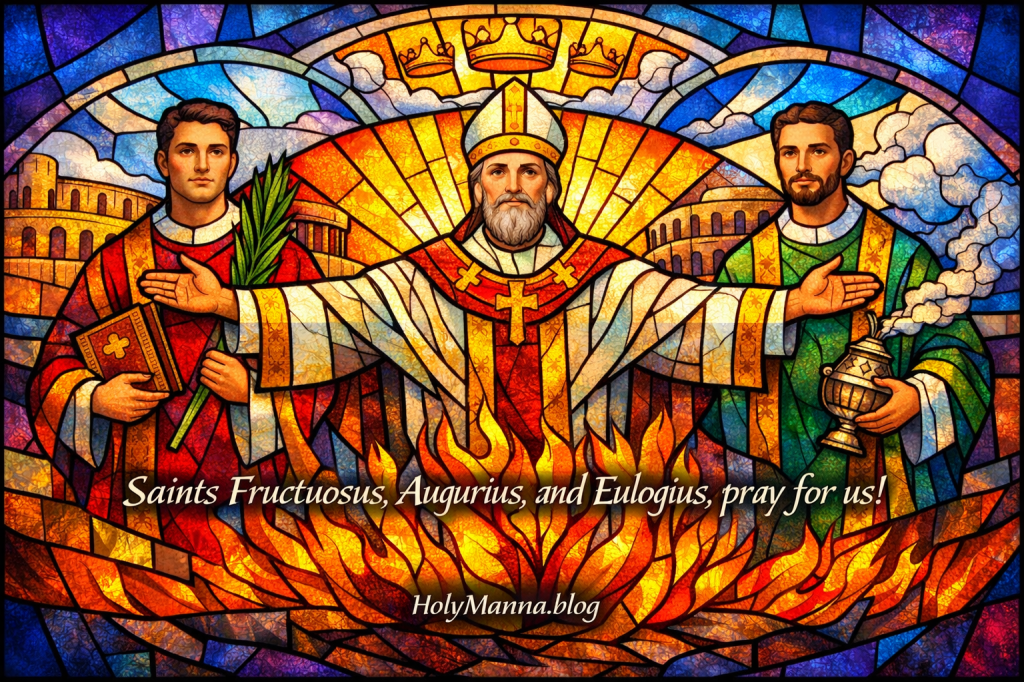
Flames That Could Not Silence the Church
Saint Fructuosus served as the bishop of Tarragona in third century Spain, and Saints Augurius and Eulogius served at his side as deacons. The Church honors them together because their holiness was lived in communion, not in isolation. Their story shows the Church functioning the way Christ designed it, with a bishop shepherding, deacons assisting, and the faithful gathering around them even when fear and violence threatened everything. When Roman authorities demanded public sacrifice to pagan gods, these three men refused because worship belongs to God alone. Their refusal was not stubbornness or political theater. It was the steady Catholic confession that Jesus Christ is Lord, offered with calm courage and a clean conscience.
They are revered because their martyrdom did not become a dead end. It became a proclamation that Christ is worth more than comfort, reputation, and even life itself. Their testimony was preserved early and cherished through the centuries, and the Church still places them before the faithful as examples of stability, fidelity, and prayer under pressure.
When History Is Quiet, Fidelity Still Speaks
For saints this early in Christian history, most personal details such as childhood stories, family background, education, and early ministry are not preserved. The Church does not fill in those gaps with imagination. Instead, Catholic tradition holds tightly to what is actually handed down: the shape of their faith, the clarity of their confession, and the pastoral charity that shone most brightly when the world grew darkest.
Even without a detailed biography, the essentials come through clearly. Fructuosus appears as a true bishop, meaning a spiritual father who guarded the faith and cared for souls. Augurius and Eulogius appear as true deacons, men whose vocation was tied to the altar and to service, standing close to their bishop in life and in death. If there was a dramatic conversion moment, the record does not describe it that way. Instead, their conversion is shown in something even more convincing, which is a life so rooted in Christ that it does not collapse when power turns hostile.
They are most known for being the kind of clergy Catholics still need. They were not performers, and they were not cowards. They were men of prayer who lived within the Church’s discipline and were ready to confess the faith plainly, even when the cost was total.
A Shepherd Who Kept Serving Behind Bars
What the Church remembers about Fructuosus during his final days is strikingly pastoral. After he was arrested, he did not retreat into bitterness or self pity. He remained a bishop, and he carried himself like a father. He prayed constantly and received visits from Christians who came to see him, showing that the Church was not merely an idea but a family willing to risk something for love. He encouraged them and blessed them, which is a quiet detail that carries a lot of weight. A bishop does not stop being a shepherd because the state locks him up.
One of the most memorable events preserved about him is that he baptized a catechumen while imprisoned. Even while awaiting execution, Fructuosus treated baptism as urgent because baptism is not simply a symbol. It is rebirth and incorporation into Christ. That moment teaches something important about Catholic priorities. The sacraments are not optional extras. They are the life of the Church.
Another detail that reveals his inner strength is his commitment to fasting. On the way to death, wine was offered to him, and he refused because the hour had not yet come to break the fast. This was not obsession with rules. It was spiritual freedom shaped by obedience. People who never practice discipline in peaceful times usually do not become steady in terrifying times. Fructuosus practiced fidelity in ordinary discipline, and that prepared him for the extraordinary.
When the governor questioned them, the saints’ answers became a kind of courtroom catechesis. Fructuosus confessed, “I adore one God, who made heaven and earth and all things therein.” Augurius echoed that same confession, affirming God Almighty. Eulogius gave a line that still matters today when Catholic devotion is misunderstood. He made it clear that Christians worship God, not even holy bishops. His testimony insisted that worship belongs to God alone, and he adored the same God that Fructuosus adored. Their words were simple, clear, and deeply Catholic.
Prayer in the Shape of the Cross
Their hardship was not mild discomfort or vague social pressure. It was arrest, interrogation, and a public sentence meant to shame and terrify. They lived during a time when the Roman state treated Christian worship as dangerous because it refused to treat the emperor or pagan gods as divine. The demand placed on them was brutal in its simplicity. Offer sacrifice to the gods, or die. They chose Christ without hesitation.
They were condemned to be burned alive in the amphitheater at Tarragona. The Church remembers their final moments with special reverence because their death looked like worship. As the flames rose, their bonds were consumed, and they stretched out their arms in prayer in the form of a cross. That detail matters because it shows what martyrdom is in Catholic understanding. It is not reckless defiance and it is not hatred of the body. It is a final act of worship, an offering joined to the Cross of Jesus.
Their martyrdom also carried a message to the faithful left behind. Fructuosus spoke words of consolation that sound like the voice of a true pastor. He reminded them that the Lord would not leave them without shepherding. Even in persecution, Christ does not abandon His Church, and the Church does not die when one shepherd falls.
Another saying preserved from Fructuosus reveals the size of his heart. When asked to remember someone, he answered that he was bound to pray for the whole Catholic Church spread from east to west. That is an early window into the Church’s self understanding. Christianity was never meant to be a private hobby or a local club. It is Catholic, meaning universal, and the bishop’s prayer embraced that reality even while the fire was being prepared.
A Faith That Endures
The tradition connected to their martyrdom includes signs meant to strengthen believers. The account speaks of heaven opened and the martyrs being received with crowns. Even when such reports are held with humility, the spiritual meaning is clear. Martyrdom is not defeat. It is victory, not because suffering is good, but because Christ is faithful and death does not have the final word.
Their veneration did not fade as generations passed. Their feast remained part of the Church’s liturgical memory, and later Catholic voices preached on their witness, which shows that their example did not remain locked in one corner of Spain. The same Gospel courage that shone in Tarragona became a gift to the wider Church.
Their relics also became part of how the Church honored them. Catholics do not adore relics, and the Church has never taught that bones are magic. Relics matter because the body matters. The saints served God with their bodies, and God will raise those bodies on the last day. Relics are a reminder that holiness is lived in the real world, with real choices, real sacrifices, and real faith. Tarragona has long guarded the memory of these martyrs, and devotion there has included reverent care for relics and prayerful remembrance connected to the city’s cathedral and the ancient place of execution.
Faith That Builds Unbreakable Men
These martyrs teach a kind of strength that does not need to show off. They did not win by shouting. They won by staying faithful, and their courage was calm because it was trained by prayer and discipline long before the crisis arrived. Their example is a reminder that holiness is built through habits. Prayer that is steady shapes a man who does not panic. Fasting and self denial train the will so it can resist compromise. The sacraments form a conscience that knows what worship is and who deserves it.
There is also a powerful lesson in Fructuosus’ insistence on praying for the whole Church. When life gets stressful, prayer can shrink down to a list of personal emergencies. That is understandable, but it is not the full Catholic vision. A Catholic heart prays wide. It prays for the Church across the world, for persecuted Christians, for bishops and priests, for families, and for conversion. That kind of prayer protects a person from becoming spiritually self absorbed.
How can the daily practice of prayer and self denial become less about mood and more about fidelity? What would change in a home if Catholics treated the sacraments as urgent instead of occasional? Their hands stretched out like a cross are a picture of what every Catholic is called to do in ordinary life. Offer the day, offer the trials, offer the work, and offer the heart in union with Jesus Christ. Then fear loses its grip, and faith becomes steady enough to endure anything.
Engage with Us!
Share thoughts and reflections in the comments below.
- Where does pressure to compromise the faith show up most often in daily life right now, and what would calm courage look like in that situation?
- What is one concrete act of discipline, such as prayer, fasting, or sacramental confession, that could be strengthened this week in order to build spiritual resilience?
- Fructuosus insisted on praying for the whole Church from east to west. How could prayer become less self focused and more truly Catholic?
- Eulogius insisted worship belongs to God alone. How can Catholics explain devotion to the saints in a way that stays clear and faithful?
May these martyrs teach hearts to stay steady when the world gets loud. May their prayers strengthen faith, deepen courage, and purify love. Go live the Gospel with real conviction, and do everything with the love and mercy Jesus taught us.
Saints Fructuosus, Augurius, and Eulogius, pray for us!
Follow us on YouTube, Instagram and Facebook for more insights and reflections on living a faith-filled life.

 Holy Manna!
Leave a comment