Memorial of Saint Agnes, Virgin and Martyr – Lectionary: 313
When Weakness Becomes the Weapon of God
There is something strangely comforting about the way God keeps choosing the small, the overlooked, and the seemingly unqualified. Today’s readings invite the heart to slow down, take a breath, and remember that the Lord does not measure power the way the world measures power. The central theme tying everything together is simple and strong: the Lord saves through faithful obedience and merciful strength, not through human force or religious posturing.
In the First Reading from 1 Samuel 17:32-33, 37, 40-51, Israel stands frozen in fear because Goliath represents everything people naturally dread. He is the kind of problem that cannot be negotiated with, outsmarted with clever words, or handled with ordinary strength. David walks into that moment with no illusion about his own power, but with a living memory of God’s past deliverance. His courage is not built on adrenaline or ego, but on trust. Saul sees a youth who should sit down and be quiet. God sees a shepherd whose heart is trained in hidden battles, and whose confidence rests in the Lord’s name rather than in armor.
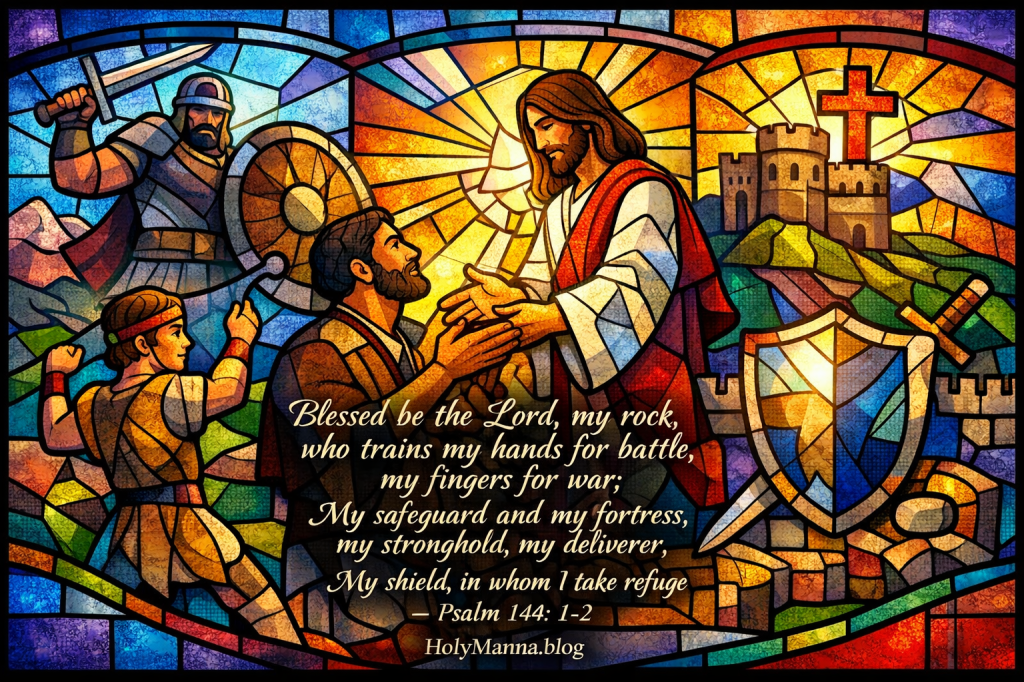
The Responsorial Psalm from Psalm 144:1-2, 9-10 gives language to that same trust. It praises the Lord as rock, fortress, and deliverer, and it also reveals something important about spiritual combat. God does not simply hand victory over like a prize. God forms His people through it. The hands that fight are trained by grace, and the heart that sings is shaped by gratitude. That is why the Psalm can speak about battle and still end in worship, because deliverance always leads to praise.
Then the Holy Gospel from The Gospel of Mark 3:1-6 turns the spotlight in a surprising direction. The battle is no longer out in the valley with a giant shouting insults. The battle is inside the synagogue, inside the human heart, and inside a religious culture that can become rigid when it forgets God’s mercy. Jesus restores a man’s withered hand on the sabbath, and the real scandal is not the healing but the hardness. Christ exposes how easily the commandments can be used as cover for indifference, and how quickly a cold heart can confuse legal correctness with holiness. Jesus asks the question that still echoes today, “Is it lawful to do good on the sabbath rather than to do evil, to save life rather than to destroy it?” and the silence that follows reveals what is really withered.
Taken together, these readings prepare the soul for a sober but hopeful truth. The Lord fights for His people, but He also fights within His people. God topples giants that intimidate the mind, and God confronts hardness that quietly grows in the heart. Where does fear demand worldly armor instead of childlike trust? Where has spiritual life become stiff, cautious, or more concerned with appearing right than loving well? Today sets the stage for a deeper encounter with the God who saves not by sword or spear, but by faith that obeys and love that heals.
First Reading – 1 Samuel 17:32-33, 37, 40-51
God Wins with a Shepherd’s Hands
The battle between David and Goliath is not just a heroic story about courage. It is a revealed lesson about how the Lord saves His people when they are outmatched, intimidated, and tempted to trust in the same weapons as everyone else. In the ancient world, conflicts could be decided by “champion warfare,” where one representative fighter stood for an army, and the whole nation’s morale rose or collapsed with that outcome. Israel is living that pressure in real time, and King Saul is paralyzed by fear because he is measuring the situation by human standards. David walks into the same moment with a shepherd’s clarity, because his confidence is rooted in the Lord’s past faithfulness and in the holiness of God’s name.
This reading fits perfectly with today’s theme because it shows what true spiritual strength looks like. David does not deny danger, and he does not pretend that he is strong enough on his own. He simply refuses to act as if God is absent. The victory is ultimately about the Lord defending His covenant people and making it known that Israel is not abandoned. David’s words and actions set the stage for a pattern that will be fulfilled completely in Jesus Christ, who conquers not by worldly force, but by obedient trust and holy love.
1 Samuel 17:32-33, 37, 40-51 – New American Bible (Revised Edition)
David Challenges Goliath. 32 Then David spoke to Saul: “My lord should not lose heart. Let your servant go and fight this Philistine.” 33 But Saul answered David, “You cannot go up against this Philistine and fight with him, for you are only a youth, while he has been a warrior from his youth.”
37 David continued: “The same Lord who delivered me from the claws of the lion and the bear will deliver me from the hand of this Philistine.” Saul answered David, “Go! the Lord will be with you.”
40 Then, staff in hand, David selected five smooth stones from the wadi and put them in the pocket of his shepherd’s bag. With his sling in hand, he approached the Philistine.
David’s Victory. 41 With his shield-bearer marching before him, the Philistine advanced closer and closer to David. 42 When he sized David up and saw that he was youthful, ruddy, and handsome in appearance, he began to deride him. 43 He said to David, “Am I a dog that you come against me with a staff?” Then the Philistine cursed David by his gods 44 and said to him, “Come here to me, and I will feed your flesh to the birds of the air and the beasts of the field.” 45 David answered him: “You come against me with sword and spear and scimitar, but I come against you in the name of the Lord of hosts, the God of the armies of Israel whom you have insulted. 46 Today the Lord shall deliver you into my hand; I will strike you down and cut off your head. This very day I will feed your dead body and the dead bodies of the Philistine army to the birds of the air and the beasts of the field; thus the whole land shall learn that Israel has a God. 47 All this multitude, too, shall learn that it is not by sword or spear that the Lord saves. For the battle belongs to the Lord, who shall deliver you into our hands.”
48 The Philistine then moved to meet David at close quarters, while David ran quickly toward the battle line to meet the Philistine. 49 David put his hand into the bag and took out a stone, hurled it with the sling, and struck the Philistine on the forehead. The stone embedded itself in his brow, and he fell on his face to the ground. 50 Thus David triumphed over the Philistine with sling and stone; he struck the Philistine dead, and did it without a sword in his hand. 51 Then David ran and stood over him; with the Philistine’s own sword which he drew from its sheath he killed him, and cut off his head.
Flight of the Philistines. When the Philistines saw that their hero was dead, they fled.
Detailed Exegesis
Verse 32 “Then David spoke to Saul: ‘My lord should not lose heart. Let your servant go and fight this Philistine.’”
David begins by addressing the real enemy first, which is discouragement. Fear spreads like an infection through a community, and David challenges that fear with faith. He also calls himself a “servant,” showing humility, not self-promotion.
Verse 33 “But Saul answered David, ‘You cannot go up against this Philistine and fight with him, for you are only a youth, while he has been a warrior from his youth.’”
Saul speaks the language of appearances, credentials, and résumés. He assumes the outcome based on age and experience, which is exactly how the world trains people to evaluate “impossible” problems. Spiritually, this is the voice that says holiness is for “stronger” people and that certain temptations or trials cannot be defeated.
Verse 37 “David continued: ‘The same Lord who delivered me from the claws of the lion and the bear will deliver me from the hand of this Philistine.’ Saul answered David, ‘Go! the Lord will be with you.’”
David’s faith is not abstract optimism. It is a memory of concrete rescues, which becomes the foundation for trust in the present trial. Saul’s blessing is significant because it shows a hesitant king admitting, at least briefly, that victory depends on the Lord, not on military probability.
Verse 40 “Then, staff in hand, David selected five smooth stones from the wadi and put them in the pocket of his shepherd’s bag. With his sling in hand, he approached the Philistine.”
David refuses Saul’s armor earlier in the narrative because it does not belong to him, and because it represents a kind of false security. The shepherd’s staff and sling are not magical objects. They are ordinary tools offered to God in faith, which is often how the Lord likes to work. This also reveals a principle of spiritual life: grace does not eliminate human effort, but it purifies it and orders it toward trust.
Verse 41 “With his shield bearer marching before him, the Philistine advanced closer and closer to David.”
Goliath comes with display, intimidation, and an entire system behind him. Evil often advances with theater and noise, trying to convince the faithful that resistance is pointless. The steady approach heightens the tension and makes David’s calm even more striking.
Verse 42 “When he sized David up and saw that he was youthful, ruddy, and handsome in appearance, he began to deride him.”
The enemy mocks what looks weak. This is how temptation often works as well, by making virtue seem naive and making faithfulness seem childish. Scripture is exposing a recurring pattern: pride misreads God’s instruments because pride cannot imagine power hidden in humility.
Verse 43 “He said to David, ‘Am I a dog that you come against me with a staff?’ Then the Philistine cursed David by his gods.”
Goliath’s insult is more than trash talk. It is contempt for Israel’s apparent poverty of weapons, and it is also a spiritual confrontation, because he invokes false gods. David’s response will clarify that this is ultimately about whose “name” is true.
Verse 44 “And said to him, ‘Come here to me, and I will feed your flesh to the birds of the air and the beasts of the field.’”
The threat is brutal and meant to terrify. The enemy wants David to imagine his own destruction in vivid detail, because fear can disarm a person before any physical blow lands. Spiritually, this resembles the way anxiety rehearses worst case scenarios to weaken trust.
Verse 45 “David answered him: ‘You come against me with sword and spear and scimitar, but I come against you in the name of the Lord of hosts, the God of the armies of Israel whom you have insulted.’”
This is the heart of the reading. David names the difference between worldly power and covenant power. He is not claiming that weapons do not matter at all; he is insisting that weapons do not decide the final verdict. The victory will be a defense of God’s honor and a revelation that the Lord is truly present with His people.
Verse 46 “Today the Lord shall deliver you into my hand; I will strike you down and cut off your head. This very day I will feed your dead body and the dead bodies of the Philistine army to the birds of the air and the beasts of the field; thus the whole land shall learn that Israel has a God.”
David speaks prophetically. His confidence is rooted in the Lord’s action, not his own skill. The purpose is missionary and public: that the land will learn Israel has a God. In other words, God’s saving work is meant to form faith in the community, not just to produce a private victory.
Verse 47 “All this multitude, too, shall learn that it is not by sword or spear that the Lord saves. For the battle belongs to the Lord, who shall deliver you into our hands.”
David’s theology is clear and direct. The Lord is the true Warrior for His people, and Israel’s role is to act in obedient trust. This verse is a spiritual anchor for anyone tempted to believe that prayer and virtue are “weak” compared to worldly methods.
Verse 48 “The Philistine then moved to meet David at close quarters, while David ran quickly toward the battle line to meet the Philistine.”
David does not hesitate. Faith is not passivity, and trust in God does not mean avoiding action. He runs toward the fight, which is a great image of how a person should move toward duty when God’s will is clear.
Verse 49 “David put his hand into the bag and took out a stone, hurled it with the sling, and struck the Philistine on the forehead. The stone embedded itself in his brow, and he fell on his face to the ground.”
The action is simple and decisive. The forehead strike is symbolic because it is the downfall of arrogant pride, the “front” of the giant’s defiance. The fall “on his face” is a dramatic reversal of who is truly strong.
Verse 50 “Thus David triumphed over the Philistine with sling and stone; he struck the Philistine dead, and did it without a sword in his hand.”
Scripture emphasizes the method to teach the lesson. The victory is real, but it is achieved in a way that forces everyone to admit that God’s power is not limited by human weakness. This prepares the heart to recognize the deeper pattern of salvation, where God’s strength is revealed most clearly when the world expects failure.
Verse 51 “Then David ran and stood over him; with the Philistine’s own sword which he drew from its sheath he killed him, and cut off his head.”
David uses the enemy’s sword only after the enemy is already brought down. This underlines that the Lord has already secured the decisive turning point. In spiritual life, this resembles how grace breaks the back of sin first, and then a person follows through with disciplined choices that cut off what leads back into bondage.
Teachings
This reading teaches that God forms His servants in hidden fidelity before He places them in public trials. David did not become brave in the valley. David became brave in the fields, where no one applauded, and where faith had to be real. That is how the Lord often works in the lives of the saints, because holiness is usually built in ordinary obedience long before it is tested under pressure.
The Church also teaches that God’s providence is active even when evil looks dominant. The Lord does not merely watch history unfold. The Lord guides, permits, and redeems in ways that reveal His wisdom and His fatherly care, even through trials that surpass human calculation. The Catechism states: “God is the sovereign master of his plan. But to carry it out he also makes use of his creatures’ cooperation. This use is not a sign of weakness, but rather a token of almighty God’s greatness and goodness.” CCC 306.
David’s words, “the battle belongs to the Lord,” also harmonize with the Church’s teaching on faith as confident surrender, not self-reliance. Faith is not a vague feeling. It is real trust in God’s truth and goodness, which then becomes the engine of courageous action. The Catechism explains: “Faith is a personal act: the free response of the human person to the initiative of God who reveals himself. But faith is not an isolated act. No one can believe alone, just as no one can live alone. You have not given yourself faith as you have not given yourself life.” CCC 166.
Finally, this reading helps correct a common spiritual mistake. Many people assume God only works through obvious strength, perfect conditions, and ideal timing. David shows that the Lord delights in using humble instruments so that the glory belongs to God and the people learn to trust Him. That is not a call to recklessness. It is a call to obedience that refuses despair.
Reflection
David’s confidence came from remembering what the Lord had already done. That is a practical strategy for daily life because fear usually grows when memory shrinks. When the mind forgets past graces, today’s problem feels like the first problem, the biggest problem, and the final problem. David teaches a healthier habit: recall God’s past help and then step forward with steady obedience.
This reading also challenges the temptation to wear “Saul’s armor,” meaning the temptation to copy the world’s methods of control, image management, and frantic self-protection. A person can be outwardly busy and inwardly anxious, convinced that everything depends on personal effort. David’s example gently calls the heart back to a simpler posture: do the duty of the moment with the tools God has actually given, and refuse to act as if God is absent.
What is the Goliath that keeps shouting in the mind right now, and what would change if it was answered in the name of the Lord instead of in personal panic? Where has fear been disguising itself as “prudence,” when it is really just an excuse to avoid obedience? A strong next step is to name one past deliverance, thank God for it in prayer, and then take one concrete act of faith that moves toward the right thing, even if it feels small. David did not wait until he felt like a warrior. David acted like a servant of God, and the Lord did the rest.
Responsorial Psalm – Psalm 144:1-2, 9-10
When God Is the Rock, the Fight Becomes Worship
This psalm comes to the Church as a battle prayer from David, the same shepherd who stepped into the valley against Goliath with nothing but trust in the Lord. In the ancient world, kings were expected to secure victory through alliances, weapons, and reputation, but Israel’s faith insisted on something deeper: the Lord Himself is the true defender of His covenant people. That is why David can bless God as “rock,” “fortress,” and “deliverer,” because the God of Israel does not merely observe human struggles. The Lord trains, protects, and saves.
This fits today’s theme perfectly because it teaches the right posture for every battle, whether the battle looks like a giant in the valley or a hardened heart in the synagogue. The psalm does not glorify violence for its own sake. It glorifies God, who alone gives victory, and it turns the believer from panic to praise. The “hands trained for battle” are ultimately hands trained for faithful obedience, and the “new song” is the sound of a life that knows God is real, present, and powerful.
Psalm 144:1-2, 9-10 – New American Bible (Revised Edition)
A Prayer for Victory and Prosperity
1 Of David.
Blessed be the Lord, my rock,
who trains my hands for battle,
my fingers for war;
2 My safeguard and my fortress,
my stronghold, my deliverer,
My shield, in whom I take refuge,
who subdues peoples under me.9 O God, a new song I will sing to you;
on a ten-stringed lyre I will play for you.
10 You give victory to kings;
you delivered David your servant.
From the menacing sword
Detailed Exegesis
Verse 1 “Blessed be the Lord, my rock, who trains my hands for battle, my fingers for war;”
David begins with blessing, not fear, which is already a spiritual victory. Calling the Lord “my rock” is not poetic decoration. It is covenant language that proclaims stability, protection, and dependability. The training imagery is important because it shows that strength is not self-made. Even natural gifts are meant to be purified and formed by grace, so that a person fights the right battles in the right way, without pride, cruelty, or despair.
Verse 2 “My safeguard and my fortress, my stronghold, my deliverer, My shield, in whom I take refuge, who subdues peoples under me.”
This verse stacks images of protection because David is teaching the soul how to think under pressure. A fortress is not something a frightened person builds in five minutes. It is something dependable that already exists when danger arrives. Spiritually, this is the difference between scrambling for control and choosing refuge in God. The language about peoples being subdued reflects the royal context of ancient Israel, but it also points to a deeper truth for Christian living: God must subdue what is disordered, both in the world and within the human heart, so that peace can take root.
Verse 9 “O God, a new song I will sing to you; on a ten stringed lyre I will play for you.”
After naming God as protector, David moves to worship. The “new song” in Scripture often signals fresh deliverance and renewed gratitude. It is the sound of someone who has seen God act, and who refuses to treat victory as personal achievement. The instrument and artistry also matter, because God is not honored only with survival. God is honored with beauty, reverence, and heartfelt praise.
Verse 10 “You give victory to kings; you delivered David your servant. From the menacing sword”
The psalm makes its theology explicit: victory is a gift from God. David identifies himself as “your servant,” which keeps kingship from becoming ego, and it keeps deliverance from becoming a self-congratulating story. The mention of the sword brings the reader right back into the seriousness of real danger, while also insisting that danger does not get the final word. The Lord does.
Teachings
This psalm teaches that God’s providence and power do not cancel human action, but they do reorder it. David fights, but David fights as a servant, not as a self-sufficient hero. That matches the Church’s constant teaching that God works through the cooperation of His creatures without losing any of His sovereignty. The Catechism puts it plainly: “God is the sovereign master of his plan. But to carry it out he also makes use of his creatures’ cooperation. This use is not a sign of weakness, but rather a token of almighty God’s greatness and goodness.” CCC 306.
This also helps correct a common spiritual mistake, which is thinking that relying on God means doing nothing, or thinking that working hard means relying on the self. Psalm 144 holds both together: God trains hands, and the person still shows up and acts faithfully. In that sense, the psalm becomes a school for spiritual warfare. The “battle” is not limited to outward conflicts. It includes the daily struggle to resist sin, guard the tongue, stay faithful in prayer, and choose mercy when the heart would rather harden.
Finally, the psalm teaches that deliverance should lead to praise. The “new song” is not optional fluff. It is the right response to grace. When God saves, the correct reaction is gratitude that becomes worship, because worship keeps the soul from forgetting who really won the victory.
Reflection
This psalm is a powerful reset for any day that feels heavy, tense, or spiritually crowded. It trains the mind to stop rehearsing worst case scenarios and start naming who God is. It also teaches a practical habit that changes everything: begin difficult moments by blessing the Lord as rock and refuge, because fear loses momentum when the heart chooses trust on purpose.
This reading also challenges the modern temptation to either idolize strength or despise weakness. David does not pretend he is unstoppable, and he does not collapse into passivity. He allows God to train his hands, and then he uses those hands for what is right. That ties directly into the Gospel, where Jesus restores a withered hand and exposes hearts that have become rigid. God does not just train hands for battle. God trains hands for mercy, so that strength becomes service and conviction becomes love.
Where is the heart trying to fight with anxiety, control, or stubborn pride instead of taking refuge in the Lord? What would change if today’s biggest challenge was approached with prayer first, and with gratitude as the final word? A concrete step is simple: pray this psalm slowly before a difficult conversation, a temptation, or a stressful workday, and then choose one deliberate act of goodness that matches the “new song.” When God is the rock, the battle no longer defines the day. Worship does.
Holy Gospel – The Gospel of Mark 3:1-6
Mercy on the Sabbath and the Battle Against a Hardened Heart
This Gospel scene takes place in a synagogue, the heartbeat of Jewish communal worship and instruction. By the first century, the sabbath was cherished as a covenant sign and a weekly proclamation that Israel belonged to the Lord, not to Pharaoh, not to endless labor, and not to idols. It was a holy day set apart for rest, worship, and remembrance. Over time, however, intense debates developed about what kinds of actions were permitted on the sabbath, and some religious leaders treated these interpretations as the main measure of righteousness.
Jesus steps directly into that tension, not to dismiss the sabbath, but to reveal its true purpose. A man with a withered hand stands in front of everyone, and the religious authorities watch closely, not with compassion, but with suspicion. That is where today’s theme becomes sharp and personal. God’s victory is not just over loud enemies like Goliath. God also confronts the quieter enemy of hardness of heart, the kind that can stand in a holy place and still resist mercy. In this moment, Jesus shows that the Lord saves by restoring what is withered, and He exposes how religious pride can twist the commandments into an excuse to avoid love.
Mark 3:1-6 – New American Bible (Revised Edition)
A Man with a Withered Hand. 1 Again he entered the synagogue. There was a man there who had a withered hand. 2 They watched him closely to see if he would cure him on the sabbath so that they might accuse him. 3 He said to the man with the withered hand, “Come up here before us.” 4 Then he said to them, “Is it lawful to do good on the sabbath rather than to do evil, to save life rather than to destroy it?” But they remained silent. 5 Looking around at them with anger and grieved at their hardness of heart, he said to the man, “Stretch out your hand.” He stretched it out and his hand was restored. 6 The Pharisees went out and immediately took counsel with the Herodians against him to put him to death.
Detailed Exegesis
Verse 1 “Again he entered the synagogue. There was a man there who had a withered hand.”
Jesus returns to the place of worship, teaching, and covenant identity. The man’s withered hand represents real suffering and real limitation, and it also symbolizes a life that cannot fully function the way it was created to function. In Scripture, the hand is often tied to work, blessing, and offering, which makes the withering more than physical. It points to lost strength and diminished participation in community life.
Verse 2 “They watched him closely to see if he would cure him on the sabbath so that they might accuse him.”
The tragedy begins here because the watchers are not watching to learn. They are watching to trap. The sabbath becomes a courtroom tool instead of a gift, and the man becomes a prop instead of a neighbor. This verse reveals a spiritual danger that still exists: a person can know religious rules and still be blind to love.
Verse 3 “He said to the man with the withered hand, ‘Come up here before us.’”
Jesus calls the man forward publicly. This protects the man from being ignored, and it also forces the community to face the reality of suffering in their midst. Jesus is not simply performing a private favor. He is teaching publicly that the center of God’s law is the good of the human person, and that mercy is not a side topic.
Verse 4 “Then he said to them, ‘Is it lawful to do good on the sabbath rather than to do evil, to save life rather than to destroy it?’ But they remained silent.”
Jesus reframes the sabbath question in moral clarity. The choice is not between holiness and compassion. The choice is between good and evil, between saving and destroying. Their silence exposes the problem: legal precision can become a disguise for moral emptiness. When a heart refuses to answer a question about saving life, something has gone wrong deep inside.
Verse 5 “Looking around at them with anger and grieved at their hardness of heart, he said to the man, ‘Stretch out your hand.’ He stretched it out and his hand was restored.”
This verse reveals something powerful about Jesus. He is angry, but His anger is not sinful rage. It is the holy response of love when love is resisted and when the vulnerable are treated as inconveniences. He is also grieved, because hardness of heart is a tragedy, not a win. Then Jesus commands the impossible, and the man obeys. The healing happens through Christ’s authority and the man’s trustful response, which becomes a pattern for the spiritual life. Grace calls, the person responds, and God restores what was withered.
Verse 6 “The Pharisees went out and immediately took counsel with the Herodians against him to put him to death.”
The final verse is chilling because it shows how quickly hardened religion can become violent. The alliance is striking because Pharisees and Herodians were not natural friends, yet they unite against Jesus. When mercy threatens a person’s control, the heart can rationalize terrible choices. This is also one of Mark’s early signals that the Cross is not an accident. Jesus’ works of healing and truth provoke opposition that will build toward His Passion.
Teachings
This Gospel teaches that the sabbath is fulfilled in mercy, not canceled by it. Jesus does not reject God’s law. Jesus reveals its true intention, which is always ordered toward love of God and love of neighbor. The Catechism teaches: “The sabbath brings everyday work to a halt and provides a respite. It is a day of protest against the servitude of work and the worship of money.” CCC 2172. That already shows why the sabbath matters, but the Church goes further in explaining how Christ interprets it with divine authority.
When Jesus asks whether it is lawful to do good on the sabbath, He is showing that refusing to do good when good is possible is not neutrality. It is a form of evil. In that light, the sabbath is not a loophole for avoiding mercy. It is a privileged day for honoring God through worship and love. The Catechism says: “Jesus rose from the dead ‘on the first day of the week.’ Because it is the first day, the day of Christ’s Resurrection recalls the first creation. Because it is the ‘eighth day’ following the sabbath, it symbolizes the new creation ushered in by Christ’s Resurrection.” CCC 2174. This matters because it shows that the Lord’s Day is not merely a rule. It is a new creation reality, meant to reshape how believers live.
The Church is also direct about what belongs on the Lord’s Day, and it includes mercy explicitly. The Catechism states: “Sanctifying Sundays and holy days requires a common effort. Every Christian should avoid making unnecessary demands on others that would hinder them from observing the Lord’s Day. Traditional activities, such as sport, restaurants, etc., and social necessities, such as public services, require some people to work on Sundays, but everyone should still take care to set aside sufficient time for leisure. With temperance and charity the faithful will see to it that they avoid the excesses and violence sometimes associated with popular leisure activities.” CCC 2187. Then it adds a line that connects directly to today’s Gospel: “Sunday is a time for reflection, silence, cultivation of the mind, and meditation which further the growth of the Christian interior life.” CCC 2186. The interior life is exactly where hardness of heart is healed, and that healing is meant to overflow into concrete charity.
Finally, this Gospel also echoes the teaching that mercy is never opposed to holiness. Holiness without mercy becomes a mask. Mercy without truth becomes sentimentality. Jesus holds both perfectly, and His anger and grief show that love is not indifferent. Love fights for the good of the other.
Reflection
This Gospel is uncomfortable in the best way because it forces an honest look at what the heart is becoming. The man with the withered hand is easy to sympathize with, but the watchers in the synagogue are closer than most people want to admit. It is possible to sit in a holy place and still carry a cold heart. It is possible to speak about God and still resent compassion when it interrupts a schedule or challenges control. That is why this reading connects so well with David and Goliath. Some battles are loud and obvious, but some battles are inside, and the enemy is hardness.
Jesus calls the man forward and commands him, “Stretch out your hand.” That command still lands in daily life, because Christ often asks for an act of trust before the full healing is felt. A person is invited to stretch out the hand in prayer even when the soul feels dry, to stretch out the hand in forgiveness even when emotions lag behind, and to stretch out the hand in service even when selfishness feels stronger than generosity. Christ does not shame weakness. Christ restores it.
Where has the heart become rigid, quick to judge, or more concerned with being correct than being charitable? When a need appears on the Lord’s Day, does the instinct move toward mercy or toward excuses? A practical step is to treat Sunday as training ground for love, not just an obligation to complete. Go to Mass with the intention of letting Christ soften what is hard, and then look for one concrete act of mercy that day, especially toward someone who cannot repay it. The withered hand was restored in public so everyone could see what the Lord is like. The same Lord is still restoring what is withered, and He is still calling His people to choose good, save life, and refuse the quiet violence of a hardened heart.
The Real Victory
Today’s readings land on one clear message that is easy to remember and hard to forget once it sinks in. God saves in a way that exposes false strength and heals real weakness. David steps into the valley with no armor and no résumé that impresses a king, yet he speaks with the calm authority of someone who knows the Lord is faithful. The Psalm puts words to that same confidence by blessing the Lord as rock, fortress, and deliverer, and by turning victory into worship instead of self-congratulation. Then the Gospel reveals the deeper battleground, where Jesus restores a withered hand and confronts the more dangerous condition of a withered heart. The Lord does not only defeat the giant outside. The Lord also challenges the hardness inside.
A powerful thread ties everything together. God forms His people through trust and obedience, then uses that formed faith to bring life where fear and pride would rather freeze. David teaches that courage grows from remembering God’s past deliverance. The Psalm teaches that real strength begins with refuge in God and ends with praise. Jesus teaches that holiness and mercy are never enemies, and that refusing to do good when good is possible is not neutrality. It is a failure of love.
The invitation today is simple and practical. Bring the biggest “Goliath” to prayer, not as a dramatic speech, but as a surrendered truth. Bless the Lord as rock and refuge before trying to fix everything by force of personality. Then do what Jesus asked the man in the synagogue to do, because it still works the same way in daily life. Stretch out the hand. Stretch it out in prayer even if it feels dry. Stretch it out in forgiveness even if emotions resist. Stretch it out in mercy even if someone else does not deserve it. God is still restoring what is withered, and God is still teaching His people that the battle belongs to the Lord.
What would change this week if every challenge was faced in the name of the Lord instead of in anxious self-reliance? Where is Christ asking for one concrete act of mercy that proves the heart is still alive? Take that step with confidence. The God who toppled the giant and healed the hand is the same God who strengthens the weak, softens the hard, and turns ordinary obedience into a quiet victory that echoes into eternity.
Engage with Us!
Readers are invited to share reflections in the comments below, because faith grows when God’s word is prayed, lived, and spoken about with humility and honesty. These questions are meant to spark meaningful conversation and help each reading move from the page into daily life.
- First Reading, 1 Samuel 17:32-33, 37, 40-51: What is the “Goliath” that has been intimidating the heart lately, and what would it look like to face it with David’s confidence that “the battle belongs to the Lord”?
- Responsorial Psalm, Psalm 144:1-2, 9-10: Where is God asking the heart to take refuge in Him today, and how can prayer become a “new song” of gratitude instead of a last-minute emergency response?
- Holy Gospel, The Gospel of Mark 3:1-6: Where might the heart be tempted toward rigidity or judgment, and what would change if Christ’s question was taken seriously: “Is it lawful to do good on the sabbath rather than to do evil, to save life rather than to destroy it?”?
Stay encouraged and keep moving forward with steady faith. God still restores what is withered, God still defeats what is too big for human strength, and God still calls His people to live every moment with the love and mercy Jesus taught us.
Sacred Heart of Jesus, we trust in You!
Immaculate Heart of Mary, pray for us!
Saint Michael the Archangel, defend us in battle!
Follow us on YouTube, Instagram and Facebook for more insights and reflections on living a faith-filled life.

 Holy Manna!
Leave a comment