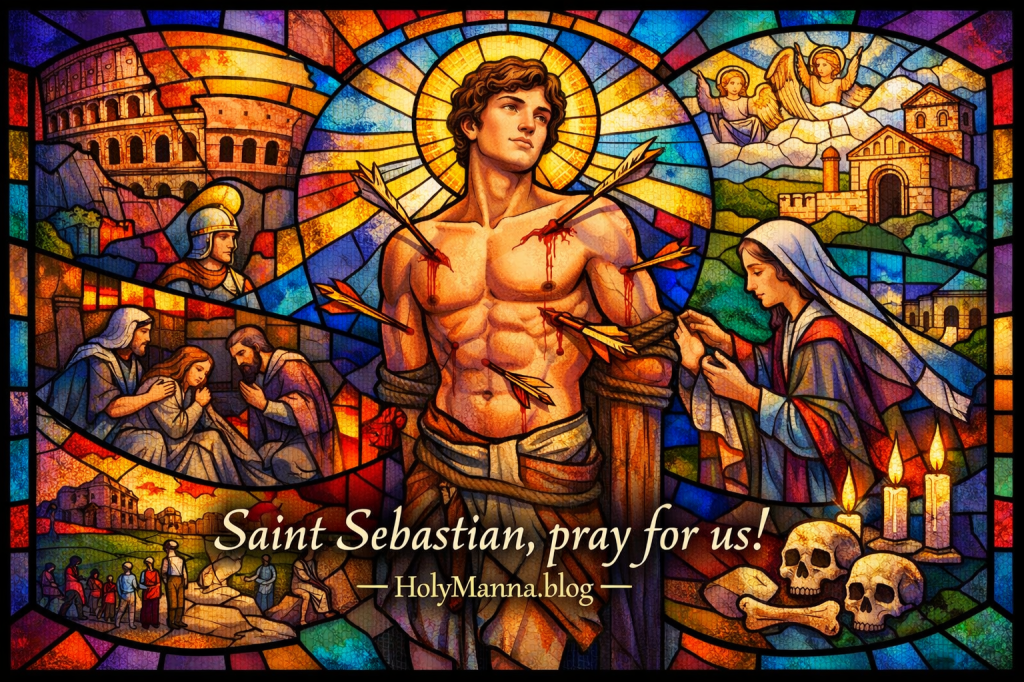
The Soldier Martyr Who Still Shields the Church
Saint Sebastian is one of those saints whose name has never slipped out of the Church’s memory. He is honored on January 20 as a Roman martyr, and that matters because it means Christians were venerating him very early, close to the age of the persecutions. The most solid historical core is simple and powerful: Sebastian died for Christ in Rome, and the faithful knew where he was buried along the Appian Way. From that burial place, devotion grew, pilgrims came, prayers rose, and the Church kept telling the story because the witness kept feeding the faithful.
It is also important to be honest in a Catholic way about what is known and what is received as tradition. The earliest records do not give a modern biography with childhood details and exact dates. Later Christian tradition provides the fuller narrative that Catholics have loved for centuries. That traditional account has shaped preaching, art, and devotion, but it should be received with humility, because not every dramatic detail can be treated like a courtroom transcript. Even with that caution, the message of his life is clear. Saint Sebastian shows what happens when a man chooses Christ over fear, loyalty over comfort, and courage over silence.
Faith That Would Not Stay Hidden
Very little is known with certainty about Sebastian’s early life, and that is not a problem for the spiritual lesson. The Church does not venerate him because of his resume or his origin story. The Church venerates him because he belonged to Jesus Christ all the way to the end. Tradition connects him strongly to Milan and also places him in Rome, where the Church’s ancient memory anchors his martyrdom and burial. That connection to Milan is not just a random footnote either, because even early voices in the Church speak of his veneration there. It shows how quickly his witness spread beyond one neighborhood or one city and became a shared treasure of the Catholic world.
In the traditional narrative, Sebastian enters the imperial military, likely the imperial guard, and that setting explains the kind of courage he needed. He lived inside the system of power, surrounded by pagan expectations and political pressure, yet he stayed faithful. Tradition presents him as a Christian who did not treat the faith like a private accessory. He lived as a disciple. He knew that the persecuted Church needed encouragement, and he used the access and influence his position gave him to strengthen the imprisoned and the terrified. He is most known for that combination of qualities that seems rare in every generation: real strength and real tenderness at the same time.
Strength in the Shadows
The heart of Sebastian’s story is not the arrows. The heart of the story is the way he strengthened other Christians when the cost of faith was blood. Tradition says he visited confessors in prison and urged them not to abandon Christ. That kind of work is easy to underestimate, because it is hidden and it does not look dramatic. In reality, it is the kind of courage that holds the Church together when persecution squeezes the faithful and tries to isolate them. Sebastian is remembered as someone who refused to let suffering Christians feel alone.
The traditional accounts also include miracles and signs that are meant to highlight God’s power at work through a faithful servant. They describe healings and conversions connected to Sebastian’s witness, including the healing of a woman named Zoe and the conversion and healing of people around a Roman official often called Chromatius. These accounts come through later hagiography, so Catholics receive them as part of sacred tradition rather than guaranteed historical reporting. Still, their spiritual meaning is deeply Catholic. God confirms the Gospel through signs when He wills, and He uses the courage of His saints to open hearts, heal wounds, and pull people out of darkness.
Sebastian’s story also highlights another truth that modern Catholics need to hear. Holiness is not only about avoiding sin. Holiness is also about actively loving the suffering members of Christ’s Body. How often does daily life tempt the heart to stay comfortable instead of stepping in to encourage someone who is struggling? Saint Sebastian teaches that courage can be quiet, steady, and practical, and that it often looks like showing up when others would rather disappear.
The Crown of Martyrdom
Sebastian’s hardships were the real kind, the kind that make a man decide who he truly serves. Tradition says he was denounced and condemned to death, then tied up and shot with arrows. The Church’s long memory holds onto this scene because it becomes a symbol of Christian endurance. A man can be pierced, mocked, and left for dead, and still belong entirely to Christ.
Then comes the part many people miss: the arrows are not the end in the traditional narrative. Sebastian survives, and a Christian woman named Irene is remembered for finding him and nursing him back to health. This is not a side detail. It shows how the Church survives. Martyrs are not lone heroes. The faithful care for one another, risk for one another, and keep the light burning together.
After recovering, tradition says Sebastian returned and confronted the emperor about the injustice of persecuting Christians. That move was not reckless bravado. It was moral clarity. It was the refusal to treat evil as normal just because it is powerful. The story says he was then beaten to death and his body was discarded with contempt. Christians later recovered him for burial, and the Church has cherished that act of reverence because it proclaims a central truth of the faith: the body is not trash, and death is not the end.
A Saint Who Protects and Draws Pilgrims
Saint Sebastian’s legacy after death is one of the strongest reasons his devotion became so widespread. The faithful remembered where he was buried along the Appian Way, and devotion grew around the catacombs associated with his name. That site is not only a place tied to one martyr. It is a place that carries a wider echo of early Christianity in Rome, including ancient veneration connected to the apostles Peter and Paul. It is the kind of place that makes Catholic history feel concrete, because it puts prayer and suffering in a real landscape, in real stone, with real graves, where Christians begged God for mercy.
A major part of Sebastian’s posthumous reputation is his intercession in times of plague and epidemic. Catholic memory holds that his intercession was credited with relief from plague in Rome in the seventh century, and from there his name became closely associated with protection in public crises of disease. This does not mean Catholics worship saints or treat them like magic charms. It means Catholics believe the saints are alive in Christ, that they pray for the Church, and that God sometimes answers those prayers with mercy that touches both soul and body. When fear of illness or uncertainty rises, does the heart remember that Heaven is close and the communion of saints is real?
His relics and shrines also helped spread devotion across Europe, as was common in the Church’s life. When relics were translated and churches were dedicated under a saint’s name, the faithful learned to ask that saint for help and to imitate that saint’s virtues. This is part of how Catholic culture became a living memory of holiness rather than a museum of old stories, and it is why Saint Sebastian’s name still echoes in churches, art, and prayer.
Fortitude That Works Everyday
Saint Sebastian is not only for times of persecution and plague. He is for ordinary Catholics trying to stay faithful in a world that constantly pressures people to compromise. His story teaches that fortitude is not a personality trait. Fortitude is a virtue formed by grace and strengthened by practice. It grows when a person chooses prayer instead of distraction, confession instead of excuses, and truth instead of social approval.
The Church’s public prayer on his feast quietly captures his message. It asks God for the kind of strength that prefers obedience to the Lord over obedience to men, and that is the heart of Sebastian’s witness. That prayer fits ordinary life because most compromises do not arrive with a dramatic soundtrack. They arrive in small choices, in hidden corners, and in moments when silence feels safer than truth. What small act of courage is God asking for today, right where life is already happening?
Sebastian also teaches that courage is not just about surviving hardship. Courage is about loving others through hardship. He strengthened prisoners, encouraged the wavering, and stayed close to the suffering Church. That can be lived today through encouragement, faithful friendship, and a refusal to treat the faith like a weekend identity. Saint Sebastian’s witness invites every Christian to live with a steady heart, to love Christ more than comfort, and to do everything with the love and mercy Jesus taught us.
Engage with Us!
Share thoughts and reflections in the comments below, because the saints become even more real when their witness is talked about and lived.
- Where does daily life pressure a person to compromise, and what would faithful courage look like in that exact situation?
- Who needs encouragement right now, and how can a simple message or act of support strengthen their faith?
- When fear rises, what concrete habit can help keep the heart steady, such as prayer, confession, Mass, fasting, or spiritual reading?
- How does trusting the prayers of the saints deepen confidence in God’s providence during sickness, uncertainty, or public crisis?
Saint Sebastian’s witness invites every Christian to live a life of faith with steady courage, and to do everything with the love and mercy Jesus taught us.
Saint Sebastian, pray for us!
Follow us on YouTube, Instagram and Facebook for more insights and reflections on living a faith-filled life.

 Holy Manna!
Leave a comment