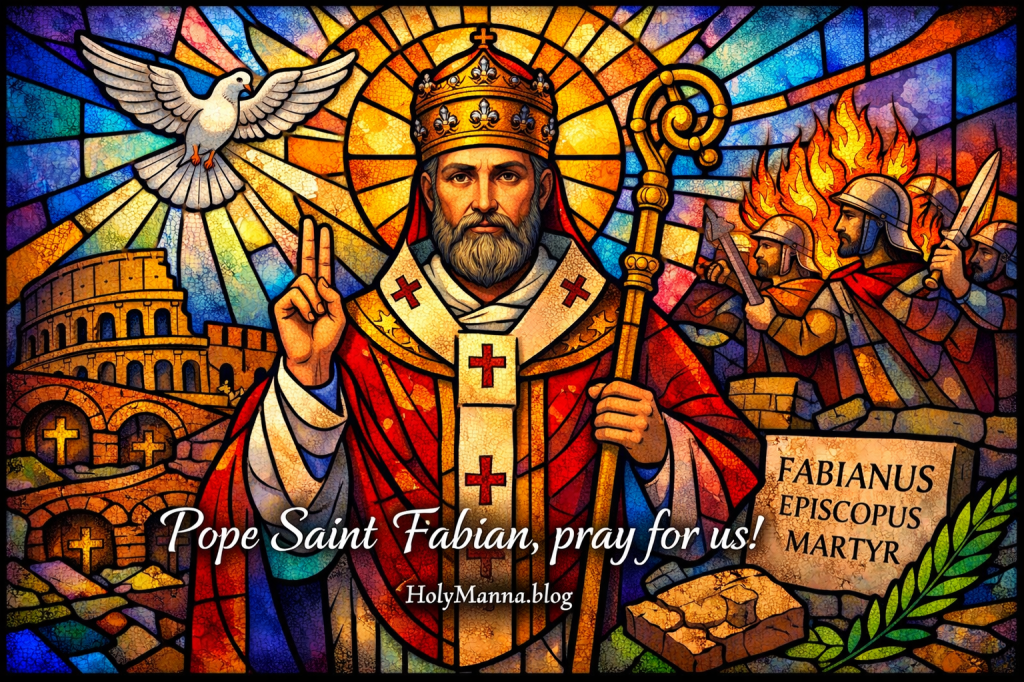
When the Dove Chose a Pope
Pope Saint Fabian is one of those early saints whose story feels simple at first, but the deeper you look, the more it teaches. He served as Bishop of Rome in the third century, when the Church was still illegal in the eyes of the empire and believers lived with the constant awareness that loyalty to Christ could cost everything. Fabian is revered not because he left behind long theological treatises, but because he carried the weight of the papacy with steady courage and genuine pastoral care. His legacy is the kind that holds the Church together from the inside, keeping worship reverent, keeping charity active, keeping the memory of the martyrs alive, and keeping the faithful ready to endure whatever comes.
He is also a saint who reminds Catholics that God often chooses leaders in ways that humble human assumptions. Fabian was not a famous candidate, and he was not known as a great public figure. Yet the Church recognized a sign of God’s choice, and Fabian proved through years of faithful service that the call was real.
A Sign from Heaven
Not much reliable information survives about Fabian’s childhood, family background, or early career. That lack of detail is normal for saints of this period, especially those who were not public figures before their election. What the Church does preserve is the unforgettable moment that changed his life. When Pope Anterus died, the clergy and faithful gathered to elect a successor, and Fabian was present at that gathering.
According to ancient tradition, a dove descended and rested on him during the election. The community interpreted this as a sign from the Holy Spirit, echoing the way the Spirit appeared like a dove at the baptism of Jesus in The Gospel of Matthew. In a single moment, the unknown man became the chosen shepherd, and the Church received him as a gift of Providence rather than a product of human ambition.
This story is not remembered as a cute detail. It endures because it captures something Catholics still believe, that God can guide His Church in surprising ways when the faithful seek His will with sincere hearts. The dove became one of Fabian’s lasting symbols in Catholic memory, not because Christians chase signs, but because this sign pointed to the Spirit’s quiet authority over the life of the Church.
Building Up the Church
Fabian governed for about fourteen years, which was a significant span in a time when popes could be killed or exiled without warning. His pontificate benefited from a relative lull in large-scale persecution, and he used that season well. He strengthened the internal life of the Church so that Christians could worship with stability, receive pastoral care, and practice charity with consistency in a growing city.
Roman tradition credits him with reorganizing the Church’s ministry in Rome, including strengthening service across different districts so that the needs of the faithful could be met more faithfully. Even when every administrative detail is not preserved with perfect historical clarity, the overall picture is consistent with the Church’s life in that era. The bishop of Rome depended on deacons and other clergy to care for souls, coordinate works of mercy, and keep the Church’s common life ordered in a way that served holiness.
Fabian is also remembered for honoring the martyrs and safeguarding their memory. In a persecuted Church, the martyrs were not treated like a tragic footnote. They were honored as witnesses who proved the truth of the faith with their blood. Preserving their names and resting places helped strengthen the faithful, formed new believers in courage, and taught the Church to see suffering through the lens of the Resurrection.
He is closely associated with the Roman cemeteries and catacombs, which were not merely burial sites but places of prayer, remembrance, and hope. Tradition also holds that he arranged for the return of Pope Saint Pontian’s remains to Rome, honoring a predecessor who had suffered for Christ and reminding the faithful that the communion of saints is not a slogan. It is a real bond of love in Jesus Christ that death cannot break.
As for miracles during Fabian’s lifetime, the Church does not preserve a clear catalog of healings or spectacular wonders definitively tied to him. The main extraordinary sign connected to Fabian remains the dove at his election. Fabian’s sanctity is seen more in the fruit of faithful governance than in stories of marvels, because steady service can be its own kind of miracle when it is sustained by grace.
The Empire Demanded Worship, Fabian Chose Christ
Fabian’s final chapter came when Emperor Decius launched one of the most severe persecutions the early Church had faced. This persecution was not merely local harassment or social pressure to keep religion private. It was built around forcing Christians to participate in pagan religious acts as a public sign of loyalty to the empire, and that demand was a direct violation of the First Commandment.
For a Christian, this was not a small compromise. It was a denial of the Lordship of Jesus Christ and a betrayal of the worship owed to God alone. In that pressure, Fabian did what a true shepherd does. He held the line, refusing to treat the faith like a private preference that could be adjusted for public comfort.
Fabian was martyred on January 20, 250. His death mattered not only because he was pope, but because it showed every ordinary Christian what fidelity looks like when the cost is real. When the shepherd goes first, the flock learns that the path of Christ is not a metaphor. It is a real road that sometimes runs straight through sacrifice and ends in glory.
A Tomb That Still Preaches
After Fabian’s death, the Church buried him in the Catacomb of Saint Callistus, in the Crypt of the Popes. That location matters because it ties him directly to the lived memory of the Roman Church, a community that believed in the Resurrection and honored the bodies of the faithful as temples of the Holy Spirit. The catacombs are not simply ancient tunnels. They are evidence of Catholic hope and the Church’s stubborn refusal to surrender to fear.
One of the most striking aspects of Fabian’s legacy is his ancient epitaph, which identifies him plainly as bishop and martyr. This short inscription teaches a powerful lesson, because holiness does not need hype. The Church remembered him for what mattered most, his pastoral office and his faithful death for Christ. The epitaph reads “Fabian, bishop and martyr.” and it remains a simple confession of faith carved into history.
Catholic tradition also holds that his relics were later honored in Rome in connection with the basilica of Saint Sebastian Outside the Walls, which helps explain why Saint Fabian and Saint Sebastian are often remembered together on January 20. The Church does not pair saints randomly. She pairs witnesses whose lives speak together, reminding the faithful that courage and fidelity can take different forms while sharing the same root, love for Christ that refuses to bend.
When it comes to miracles after his death, the tradition does not preserve a strong, detailed set of specific healings uniquely tied to Fabian. His posthumous legacy is more like the steady light of a lamp that does not go out, enduring veneration, a witness rooted in the catacombs, and a feast day that continues to call Catholics to bravery and reverence.
It is also worth remembering that later centuries sometimes attributed writings to Fabian that are not considered authentic. That does not weaken his sanctity. It strengthens the honesty of Catholic tradition, because the Church venerates saints without needing to pad their biography with borrowed words.
Bringing Saint Fabian’s Courage into Daily Life
Saint Fabian is a gift to anyone who feels ordinary, unknown, or unqualified. His life shows that God can take someone who is not seeking attention and place him exactly where he needs to be. That truth can be comforting and challenging at the same time, because it means a Catholic cannot hide behind the excuse of being small when God is calling for faithfulness.
Fabian also offers a practical lesson about what makes the Church strong. Strength is not only about big public battles or famous victories. It is also about order, discipline, and charity that runs consistently, week after week, through ordinary people. It is about showing up to Mass faithfully, serving the poor quietly, teaching children the faith patiently, and honoring the martyrs instead of forgetting them. Organization can be holy when it is aimed at love, and a parish that serves well, prays well, and stays united is already a quiet victory in a fractured world.
His martyrdom is a needed reminder for modern Catholics who live in a culture that pressures believers to keep faith private and harmless. The pressure today might not look like Decius, but it still demands compromise, just dressed in softer language. Fabian’s example teaches that worship is not negotiable and truth is not something to trade for comfort. Living like Fabian means choosing reverence over laziness, courage over people pleasing, and fidelity over fear.
Where is courage most needed right now, especially when the cost is social, professional, or personal? This is the kind of question Saint Fabian presses into the heart, because his life refuses to let courage remain theoretical. A good practical step is to pray intentionally for the pope, bishops, priests, and deacons, since Fabian’s life shows how much the Church depends on faithful shepherds. Another step is to cultivate devotion to the martyrs, because their witness resets the soul and helps the faithful see what matters when everything else falls away.
Engage with Us!
Share your thoughts and reflections in the comments below.
- Where does God seem to be calling for greater courage and clarity right now, even if it feels inconvenient?
- What is one practical way to strengthen your daily fidelity, especially when faith is misunderstood or mocked?
- How can devotion to the martyrs reshape the way you view suffering, sacrifice, and perseverance?
- Who in your life needs the steady, organized care that Saint Fabian modeled through service and leadership?
May Saint Fabian pray for the Church in every age, especially when leaders feel pressure to compromise and when ordinary believers feel pressure to stay silent. Keep walking in faith, keep trusting God’s Providence, and do everything with the love and mercy Jesus taught us.
Pope Saint Fabian, pray for us!
Follow us on YouTube, Instagram and Facebook for more insights and reflections on living a faith-filled life.

 Holy Manna!
Leave a comment