Tuesday of the Second Week in Ordinary Time – Lectionary: 312
When God Chooses, Mercy Reigns
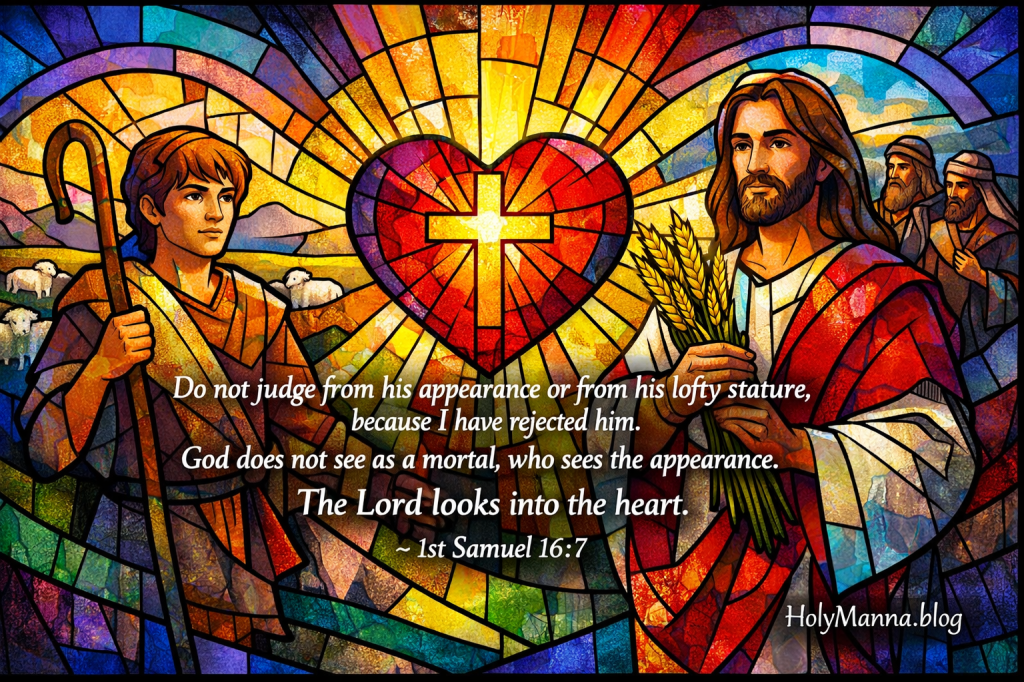
There is something quietly freeing about today’s readings, because they pull attention away from appearances, opinions, and pressure, and they place it where God always places it, on the heart. In 1 Samuel 16:1-13, the Lord sends Samuel to Bethlehem to anoint a king, and the entire scene becomes a lesson in spiritual vision. Samuel sees height and strength, but God sees what no one else is trained to notice, the interior life, the true desires, the hidden loyalties, the real character. The Lord’s words cut straight through the noise: “God does not see as a mortal, who sees the appearance. The Lord looks into the heart.” That is the foundation for everything else that follows today.
The Responsorial Psalm, Psalm 89:20-22, 27-28, takes that moment of anointing and frames it as covenant love. God does not merely select a leader for political stability. God raises up a servant, strengthens him with His own hand, and invites him into a relationship marked by trust and sonship. David can cry out, “You are my father, my God, the Rock of my salvation!” because God’s kingship is never detached from God’s fatherhood. The anointing is not cosmetic, and it is not a trophy. It is a mission given by the Lord, sustained by the Lord, and accountable to the Lord.
Then the Holy Gospel of Mark 2:23-28 shows what happens when religion forgets the heart and turns holiness into a scoreboard. The Pharisees watch the disciples pick grain on the sabbath and treat the law like a trap, but Christ reveals the law’s true purpose with calm authority: “The sabbath was made for man, not man for the sabbath.” In other words, God’s commands are not meant to crush the weak or shame the hungry. They are meant to order life toward worship, justice, mercy, and rest in God. That is why Jesus reaches back to David, not as a random reference, but because David’s story already teaches that God’s plan is bigger than rigid categories and human expectations.
A common thread runs through all of it: God chooses and forms His people from the inside out, and God’s law is always ordered to mercy. Today is an invitation to let the Lord correct spiritual eyesight, to let Him re-center the meaning of obedience, and to remember that the true King is not merely anointed with oil, but is Lord even of the sabbath. How might God be asking for less obsession over appearances and more attention to the condition of the heart today?
First Reading – 1 Samuel 16:1-13
The Shepherd King and the God Who Sees the Heart
Israel is living through a painful turning point. Saul has been rejected as king, not because the Lord is fickle, but because Saul’s heart hardened into self-will. Samuel, the prophet, is still grieving, and that grief is understandable. A leader’s failure always leaves collateral damage. Yet the Lord calls Samuel to move forward, because God’s plan does not stall when human beings falter. The setting is Bethlehem, a small town that seems ordinary, which is exactly the point. God often hides His greatest works inside places and people the world overlooks.
This reading fits today’s theme perfectly: God chooses by the heart, and His choices are ordered toward mercy and life. The Lord will not let Samuel anoint a man based on height, strength, or outward polish. Instead, God insists on something deeper. “The Lord looks into the heart.” That single line becomes a spiritual mirror, because it exposes how quickly people judge by appearances and how patiently God searches for interior truth. David’s anointing also prepares the way for the Gospel, where Jesus later defends His disciples by pointing to David and by revealing that God’s law is meant to serve the human person, not crush him.
1 Samuel 16:1-13 – New American Bible (Revised Edition)
Samuel Is Sent to Bethlehem. 1 The Lord said to Samuel: How long will you grieve for Saul, whom I have rejected as king of Israel? Fill your horn with oil, and be on your way. I am sending you to Jesse of Bethlehem, for from among his sons I have decided on a king. 2 But Samuel replied: “How can I go? Saul will hear of it and kill me.” To this the Lord answered: Take a heifer along and say, “I have come to sacrifice to the Lord.” 3 Invite Jesse to the sacrifice, and I myself will tell you what to do; you are to anoint for me the one I point out to you.
Samuel Anoints David. 4 Samuel did as the Lord had commanded him. When he entered Bethlehem, the elders of the city came trembling to meet him and asked, “Is your visit peaceful, O seer?” 5 He replied: “Yes! I have come to sacrifice to the Lord. So purify yourselves and celebrate with me today.” He also had Jesse and his sons purify themselves and invited them to the sacrifice. 6 As they came, he looked at Eliab and thought, “Surely the anointed is here before the Lord.” 7 But the Lord said to Samuel: Do not judge from his appearance or from his lofty stature, because I have rejected him. God does not see as a mortal, who sees the appearance. The Lord looks into the heart. 8 Then Jesse called Abinadab and presented him before Samuel, who said, “The Lord has not chosen him.” 9 Next Jesse presented Shammah, but Samuel said, “The Lord has not chosen this one either.” 10 In the same way Jesse presented seven sons before Samuel, but Samuel said to Jesse, “The Lord has not chosen any one of these.” 11 Then Samuel asked Jesse, “Are these all the sons you have?” Jesse replied, “There is still the youngest, but he is tending the sheep.” Samuel said to Jesse, “Send for him; we will not sit down to eat until he arrives here.” 12 Jesse had the young man brought to them. He was ruddy, a youth with beautiful eyes, and good looking. The Lord said: There—anoint him, for this is the one! 13 Then Samuel, with the horn of oil in hand, anointed him in the midst of his brothers, and from that day on, the spirit of the Lord rushed upon David. Then Samuel set out for Ramah.
Detailed Exegesis
Verse 1 – “The Lord said to Samuel: How long will you grieve for Saul, whom I have rejected as king of Israel? Fill your horn with oil, and be on your way. I am sending you to Jesse of Bethlehem, for from among his sons I have decided on a king.”
God addresses Samuel’s grief directly, not to shame him, but to free him. Holy sorrow can turn into unhealthy attachment when it becomes a refusal to trust God’s next step. The horn of oil signals consecration, because anointing in Israel marks a person set apart for God’s service. Bethlehem is introduced quietly, yet it will echo through salvation history as the city of David and, ultimately, the birthplace of the Messiah.
Verse 2 – “But Samuel replied: ‘How can I go? Saul will hear of it and kill me.’ To this the Lord answered: Take a heifer along and say, ‘I have come to sacrifice to the Lord.’”
Samuel’s fear is realistic. The spiritual life is not fantasy, and obedience is not the same as recklessness. The Lord provides a prudent path that allows Samuel to carry out the mission without needless provocation. Sacrifice and worship remain central, because God’s plans unfold within covenant worship, not apart from it.
Verse 3 – “Invite Jesse to the sacrifice, and I myself will tell you what to do; you are to anoint for me the one I point out to you.”
God keeps the initiative. Samuel is not asked to invent a plan, but to listen and obey. The phrase “the one I point out” teaches a lasting lesson: discernment is not guesswork, and it is not driven by personal preference. The Lord guides His Church and His people through obedience, prayer, and clarity given at the right time.
Verse 4 – “Samuel did as the Lord had commanded him. When he entered Bethlehem, the elders of the city came trembling to meet him and asked, ‘Is your visit peaceful, O seer?’”
The elders tremble because prophets often arrive with hard words of judgment. They have learned that God’s messenger is not a mascot for good vibes. Yet their question also shows a healthy fear of the Lord, because they know holiness is not casual.
Verse 5 – “He replied: ‘Yes! I have come to sacrifice to the Lord. So purify yourselves and celebrate with me today.’ He also had Jesse and his sons purify themselves and invited them to the sacrifice.”
Purification matters because worship is not a performance. Israel’s ritual preparation points toward a deeper truth: approaching God requires reverence and a clean heart. Even when God is about to do something new, He does it within the framework of true worship, not outside of it.
Verse 6 – “As they came, he looked at Eliab and thought, ‘Surely the anointed is here before the Lord.’”
Samuel’s instinct reveals how easily even spiritual people can be impressed by what the world calls impressive. Eliab looks like a king, and Samuel assumes appearance is destiny. This sets up God’s correction, which is aimed at every generation.
Verse 7 – “But the Lord said to Samuel: Do not judge from his appearance or from his lofty stature, because I have rejected him. God does not see as a mortal, who sees the appearance. The Lord looks into the heart.”
This is the theological center of the reading. God rejects the shallow metric of outward success and replaces it with the truth of interior reality. The heart in biblical language is not merely emotion. It is the core of a person’s will, desires, loyalties, and openness to God. This verse calls for repentance from harsh judgment and for a renewed focus on hidden fidelity.
Verse 8 – “Then Jesse called Abinadab and presented him before Samuel, who said, ‘The Lord has not chosen him.’”
The process continues, and it teaches patience. God’s choice is not forced by family expectations or human sequencing. The Lord is not obliged to follow the order that looks “reasonable” to everyone else.
Verse 9 – “Next Jesse presented Shammah, but Samuel said, ‘The Lord has not chosen this one either.’”
Repetition here is part of the lesson. God is training Samuel out of quick conclusions. The prophet must learn to wait for God’s “yes” rather than assuming it.
Verse 10 – “In the same way Jesse presented seven sons before Samuel, but Samuel said to Jesse, ‘The Lord has not chosen any one of these.’”
Seven sons suggests completeness, as if the whole lineup has been offered. Yet God shows that what looks complete to human eyes can still be missing the one person God intends. This is a quiet warning against thinking that God’s will is always obvious to the crowd.
Verse 11 – “Then Samuel asked Jesse, ‘Are these all the sons you have?’ Jesse replied, ‘There is still the youngest, but he is tending the sheep.’ Samuel said to Jesse, ‘Send for him; we will not sit down to eat until he arrives here.’”
The youngest is not even invited, which says a lot about human assumptions. David is doing humble work, the kind that rarely earns applause. Samuel’s refusal to sit and eat until David arrives shows that God’s choice deserves full attention. It also teaches that the “extra” person, the overlooked one, can be the key to God’s plan.
Verse 12 – “Jesse had the young man brought to them. He was ruddy, a youth with beautiful eyes, and good looking. The Lord said: There, anoint him, for this is the one!”
David is described as attractive, but the point is not that God finally found the best-looking son. The point is that God’s decision was never about height or stature in the first place. David’s outward description is secondary to God’s inward knowledge. God’s command is clear and direct: “This is the one.”
Verse 13 – “Then Samuel, with the horn of oil in hand, anointed him in the midst of his brothers, and from that day on, the spirit of the Lord rushed upon David. Then Samuel set out for Ramah.”
The anointing is public, and it is costly, because it places David on a path of mission and eventual suffering. The Spirit rushing upon David shows that vocation is never merely human talent. God equips the one He calls. This verse also prepares the Church to recognize the pattern: God anoints, God gives the Spirit, and God forms a servant-king whose life will point forward to Jesus Christ.
Teachings
This passage teaches that God’s election is personal and purposeful. David is chosen not because he is already perfect, but because God intends to shape him into the kind of king Israel needs. That matters, because it corrects a common lie: that holiness is only for people who already have it together. God chooses, anoints, and then forms. The Spirit’s presence does not remove the need for conversion, but it does make real conversion possible.
David’s anointing also opens a straight path to Christ. Israel’s kings are anointed with oil as a sign of being set apart for God, but Jesus is the true and final Anointed One. David is a real king with a real mission, yet he is also a signpost. The shepherd king anticipates the Good Shepherd. The anointed king anticipates the eternal King. Even Bethlehem becomes part of that thread, because God loves to begin great things in humble places.
There is also a sacramental echo worth noticing. The Church continues to anoint, not as empty symbolism, but as a sign of consecration and the gift of the Holy Spirit for mission and strengthening. That is why anointing shows up in the Church’s life at moments of vocation and healing. God does not only command from afar. God marks His people, strengthens them, and sends them.
One simple line from Saint Thomas Aquinas captures the tone of this whole reading: “Grace does not destroy nature but perfects it.” God does not erase David’s humanity and replace it with something artificial. God perfects, elevates, and purifies what is already there, and then uses it for His kingdom.
Reflection
This reading hits close to home because it exposes how easily people become stuck in grief, stuck in comparison, and stuck in judging by appearances. Samuel is grieving Saul, and many people live the same way spiritually. They grieve a season that failed, a relationship that broke, a version of themselves that did not become what they hoped. God’s first word today is a gentle push forward. The Lord is not denying the pain, but He is refusing to let pain become a permanent residence.
A practical step for today is to ask for a cleaner way of seeing. When someone seems unimpressive, unpolished, or overlooked, it is worth remembering that God often chooses the shepherd in the field while everyone else is auditioning at the table. Another practical step is to pay attention to the hidden duties that feel small. David was not doing glamorous work. He was being faithful in the quiet. The Lord noticed.
Where has the heart become more focused on appearance than on obedience and charity?
Who has been judged too quickly because of packaging, personality, or social status?
What humble responsibility has been treated like an interruption, when it might actually be the place God is shaping true greatness?
Responsorial Psalm – Psalm 89:20-22, 27-28
God’s Covenant Is Not a Vibe, It Is a Promise
Psalm 89 is a covenant psalm, which means it is not merely celebrating a good leader or a golden age. It is praising the Lord for binding Himself to His people with a real promise, especially through the line of David. In Israel’s spiritual memory, David is not important because he was impressive, but because God chose him, anointed him, strengthened him, and used him to shepherd the nation toward true worship.
That is why this psalm fits today’s theme so well. The First Reading shows the moment David is chosen and anointed. This psalm sings about what that anointing means in God’s plan: God gives strength, God gives protection, and God establishes a relationship that is meant to shape the king’s heart. When the Gospel later speaks about David and hunger and mercy, the Church has already reminded everyone that David’s story is fundamentally about God’s covenant fidelity, not human perfection.
Psalm 89:20-22, 27-28 – New American Bible (Revised Edition)
20 Then you spoke in vision;
to your faithful ones you said:
“I have set a leader over the warriors;
I have raised up a chosen one from the people.
21 I have chosen David, my servant;
with my holy oil I have anointed him.
22 My hand will be with him;
my arm will make him strong.27 He shall cry to me, ‘You are my father,
my God, the Rock of my salvation!’
28 I myself make him the firstborn,
Most High over the kings of the earth.
Detailed Exegesis
Verse 20 – “Then you spoke in vision; to your faithful ones you said: ‘I have set a leader over the warriors; I have raised up a chosen one from the people.’”
This verse grounds leadership in God’s initiative. The leader is not self-appointed, and he is not merely the result of popular opinion. God “raises up” a chosen one, which highlights vocation. In Catholic life, that idea remains essential because every authentic mission begins with God’s call, not with human branding.
Verse 21 – “I have chosen David, my servant; with my holy oil I have anointed him.”
David is called “servant” before he is celebrated as king. That order matters because biblical authority is meant to serve God’s people, not dominate them. The “holy oil” points to consecration. God sets David apart for a sacred task, and it quietly prepares the heart to recognize the deeper meaning of anointing in the life of the Church and in the identity of Christ.
Verse 22 – “My hand will be with him; my arm will make him strong.”
God does not merely assign a mission and walk away. God promises presence and strength. The “hand” and “arm” are biblical images of God’s active help, especially in the face of opposition. This corrects the temptation to treat vocation like a personality test. A calling is not validated by comfort, but by fidelity sustained by grace.
Verse 27 – “He shall cry to me, ‘You are my father, my God, the Rock of my salvation!’”
This verse reveals the heart God desires in His king: trust, dependence, and sonship. The king must know he is not the savior. The Lord is the Rock. This language also plants a seed that blossoms fully in Christ, who reveals the Father not as a distant concept but as the living source of salvation and communion.
Verse 28 – “I myself make him the firstborn, Most High over the kings of the earth.”
“Firstborn” here signals status and inheritance, not merely birth order. God is establishing David’s royal line with a unique dignity. In the Church’s reading of Scripture, this finds its ultimate fulfillment in Jesus Christ, the true Son of David, whose kingship is not limited by borders and whose authority is ordered to truth and mercy.
Teachings
This psalm teaches that God’s plan for leadership is covenantal, sacrificial, and relational. The Lord chooses David, anoints him, strengthens him, and calls him into a father-child relationship that reshapes how power is meant to be used. This is why the Church consistently resists the idea that authority is about image management. In biblical religion, the king is measured by fidelity, worship, and care for the people, especially the vulnerable.
This also opens directly into a Catholic understanding of Jesus as the Anointed One. The Church teaches the meaning of “Christ” with striking clarity: CCC 436 says, “Christ comes from the Greek translation of the Hebrew ‘Messiah,’ which means ‘anointed’.” That short line connects the holy oil of David to the fullness of anointing in Jesus, who is consecrated by the Holy Spirit and whose kingship is revealed most clearly through self-giving love.
There is also a deeply personal teaching hidden in verse 27. The king cries, “You are my father.” That is not sentimental language. It is covenant identity. Many Christians know the idea of God as Father, but this psalm insists on living like it is true, especially when life feels unstable. Saint Augustine captured that hunger for God with a line that has helped generations return to the Lord: “You have made us for yourself, O Lord, and our heart is restless until it rests in you.” When the heart rests in the Father, obedience becomes steadier, mercy becomes more natural, and fear loses some of its grip.
Reflection
This psalm is a good reality check because it reminds the heart where strength actually comes from. It is tempting to believe that a person becomes strong through control, reputation, or winning arguments. God says something far better: “My hand will be with him; my arm will make him strong.” A practical way to live this today is to stop treating prayer like an accessory and start treating it like the source. When responsibilities pile up, it is worth pausing long enough to ask the Father for strength, because God does not call people into mission without offering the grace to carry it.
This psalm also invites a healthier view of authority in daily life. Whether someone leads a family, manages a team, or simply influences others through example, the pattern is the same: servant first, then strength received from God, then fidelity expressed through mercy and truth.
Is the heart trying to be strong without God’s hand, relying more on personal grit than on grace?
Does the soul pray like a child who can say, “Father,” or does it pray like an employee trying to earn approval?
What would change today if every demanding moment was met with the simple confession, “You are my God, the Rock of my salvation”?
Holy Gospel – Mark 2:23-28
When Religion Forgets Mercy, Jesus Restores the Father’s Heart
By the time this scene unfolds, tension is already building between Jesus and the Pharisees. The sabbath was a precious gift in Israel, rooted in creation and the covenant, and guarded with serious devotion. Over time, many teachers developed detailed applications of sabbath rest to protect the commandment, and that instinct was not automatically bad. The problem appears when the fence around the law becomes more important than the law’s purpose, and when devotion turns into suspicion instead of love.
That is exactly what happens here. The disciples are hungry, and they pluck heads of grain as they walk. In the Old Testament, picking grain by hand was permitted for someone passing through a field, but doing it on the sabbath became controversial because it could be interpreted as a kind of harvesting. Jesus does not respond with panic or people pleasing. He responds like the true King, the Son of David, and more than that, like the Lord of the Law itself. He reaches back to David’s story to show that God’s commands are never meant to crush human need, and then He reveals the heart of sabbath holiness with a line that still corrects religious confusion in every generation: “The sabbath was made for man, not man for the sabbath.”
Mark 2:23-28 – New American Bible (Revised Edition)
23 As he was passing through a field of grain on the sabbath, his disciples began to make a path while picking the heads of grain. 24 At this the Pharisees said to him, “Look, why are they doing what is unlawful on the sabbath?” 25 He said to them, “Have you never read what David did when he was in need and he and his companions were hungry? 26 How he went into the house of God when Abiathar was high priest and ate the bread of offering that only the priests could lawfully eat, and shared it with his companions?” 27 Then he said to them, “The sabbath was made for man, not man for the sabbath. 28 That is why the Son of Man is lord even of the sabbath.”
Detailed Exegesis
Verse 23 – “As he was passing through a field of grain on the sabbath, his disciples began to make a path while picking the heads of grain.”
This looks simple, but it is loaded with meaning. The disciples are not stealing, and they are not staging a protest. They are hungry, and they are doing what ordinary poor people often did while traveling. The sabbath context raises the question: Is God’s rest a gift that sustains life, or is it a test designed to catch people failing?
Verse 24 – “At this the Pharisees said to him, ‘Look, why are they doing what is unlawful on the sabbath?’”
Notice who is being interrogated. The Pharisees do not speak to the disciples first. They accuse Jesus, because they see Him as responsible for the behavior of His followers. Their question also reveals a spiritual danger: when the heart is trained to police rather than to shepherd, it starts hunting violations instead of seeking truth.
Verse 25 – “He said to them, ‘Have you never read what David did when he was in need and he and his companions were hungry?’”
Jesus answers with Scripture, which is both wise and merciful. He does not dismiss the Old Testament. He opens it correctly. He brings up David at a moment of hunger, because necessity matters. He also brings up David because today’s First Reading has just reminded everyone that God chose David by the heart, and God’s plan moved through David toward the coming of the Messiah.
Verse 26 – “How he went into the house of God when Abiathar was high priest and ate the bread of offering that only the priests could lawfully eat, and shared it with his companions?”
Jesus points to the episode where David receives the holy bread in a moment of need. The point is not that God’s worship is unimportant. The point is that God’s worship is never meant to be weaponized against a starving man. This verse also shows Jesus reading Scripture with the Church’s instinct: the deeper meaning of God’s law is always consistent with God’s goodness. The mention of Abiathar can sound confusing because the Old Testament account names Ahimelech in that specific moment, yet Mark’s wording can be understood as referencing the period associated with Abiathar, who is the more prominent priestly figure in that broader narrative. The deeper message remains clear: the law serves life, and God does not delight in legalistic cruelty.
Verse 27 – “Then he said to them, ‘The sabbath was made for man, not man for the sabbath.’”
This is the core principle. The sabbath is a covenant gift meant to protect worship, rest, freedom from slavery, and a healthy ordering of life toward God. When religious interpretation ignores mercy, it denies the very reason God gave the commandment. The Catechism highlights this teaching and repeats Christ’s words as the authentic interpretation of sabbath holiness, because Jesus reveals that the commandment’s purpose is the good of the human person in communion with God, not the pride of the rule keeper. CCC 2173 quotes Christ directly: “The sabbath was made for man, not man for the sabbath.”
Verse 28 – “That is why the Son of Man is lord even of the sabbath.”
This is not only a moral lesson. It is a revelation of authority. Jesus is claiming lordship over the sabbath, which means He is claiming the right to interpret the commandment with divine authority. He is not merely one teacher among many. He is the Son of Man who brings the kingdom, and He speaks as the One who stands above the law because He is the Lawgiver.
Teachings
This Gospel teaches that God’s commandments are never opposed to love, because God Himself is love. The problem is not obedience. The problem is obedience that loses its soul. The Pharisees show how religion can be used to control, shame, and elevate the self. Jesus shows how holiness is meant to protect the human person and draw him into worship, mercy, and freedom.
The Catechism is clear that Jesus did not treat the sabbath lightly. He restored its meaning and exercised His authority over it. CCC 2173 emphasizes that Jesus gives the law its authoritative interpretation, and it anchors that interpretation in Christ’s own words: “The sabbath was made for man, not man for the sabbath.” That one line also guards against two opposite errors. It rejects legalism that crushes people, and it rejects the idea that God’s commandments are optional. God’s law is a gift, but a gift that must be received as God intends.
The Gospel also teaches something about Christ Himself. When Jesus says the Son of Man is Lord even of the sabbath, He is revealing that His authority is not borrowed. He does not ask permission from religious gatekeepers to define holiness. He is the measure of holiness because He is the Holy One. In the Church’s life, this becomes practical: worship and rest are not random human traditions. They belong to God’s design, and they are fulfilled in Christ, especially as the Church gathers on the Lord’s Day to worship, receive the Eucharist, and learn mercy from the Heart of Jesus.
Saints and Doctors of the Church often warn that a cold, rule obsessed religion can become a mask for pride. The tradition consistently teaches that authentic discipline produces humility, patience, and charity. When discipline produces contempt and constant accusation, something has gone spiritually wrong. Today’s Gospel is Jesus repairing that distortion, not by weakening God’s holiness, but by revealing that holiness without mercy is not holiness at all.
Reflection
This Gospel is practical because it touches ordinary life. It is easy to treat faith like a scoreboard, especially when stressed, tired, or angry. It is also easy to hide behind religious correctness when the heart does not want to be converted. Jesus does not allow that. He insists that the sabbath, and by extension every commandment, must lead to love of God and real care for the neighbor.
A good step today is to examine the way spiritual obligations are carried. When the heart is healthy, devotion produces peace, patience, and a stronger desire to serve. When the heart is sick, devotion becomes anxious, harsh, and eager to accuse. Jesus is inviting something better: a faith that is obedient and merciful at the same time.
This Gospel also invites a renewed love for true rest. God does not command rest because He enjoys restricting people. God commands rest because He loves His children, and because worship and rest keep the soul from becoming a slave again. That matters even outside of Sunday. A person can work hard and still live like a slave internally, always proving worth, always anxious, always controlling. Jesus offers a different way: rest that flows from trust, and obedience that flows from love.
Is the heart more quick to notice someone else’s failure than to notice someone else’s need?
Does religious practice tend to produce peace and charity, or does it tend to produce tension and judgment?
What would change this week if God’s commands were received as gifts meant to lead the soul into worship, mercy, and real freedom?
The Heart God Chooses and the Mercy God Commands
Today’s readings land like a single, steady message: God is not impressed by appearances, and God’s commands are never meant to suffocate the human person. In 1 Samuel 16:1-13, the Lord corrects Samuel’s instincts and teaches everyone how divine wisdom works. People naturally scan the surface, but God searches the heart. David is not chosen because he looks like a king, but because God sees what others miss and intends to form a shepherd into a servant king. Then Psalm 89:20-22, 27-28 turns that moment into praise, because the Lord’s anointing is not a temporary mood. It is a covenant promise. God strengthens the one He calls, and He invites His chosen servant to cry out in trust, “You are my father, my God, the Rock of my salvation!” Finally, Mark 2:23-28 shows the same God revealing His heart in the flesh. Jesus defends hungry disciples, recalls David in need, and restores the sabbath to its true meaning: “The sabbath was made for man, not man for the sabbath.” The law is holy, but it is holy in a way that heals, protects, and leads souls into worship and mercy.
A practical way to carry today into real life is simple and powerful. Choose to see people with more patience than suspicion. Choose to treat God’s commands like gifts that lead to freedom, not weapons that fuel pride. Choose to be faithful in the quiet places, like David in the field, because God does His best work in hidden obedience. Where is God inviting deeper interior conversion, so that the heart becomes more merciful, more truthful, and more focused on what actually matters? Ask the Lord for the grace to live from the inside out, because when God finds a heart that is humble and willing, He can anoint it for more than it ever imagined.
Engage with Us!
Share reflections in the comments below, because it is always encouraging to hear how the Lord is speaking through today’s Word, especially when the readings challenge the heart and strengthen faith at the same time.
- First Reading, 1 Samuel 16:1-13: Where has life been judging by appearances, whether in others or in the self, and what would change if God’s words were taken seriously: “The Lord looks into the heart”?
- Responsorial Psalm, Psalm 89:20-22, 27-28: What does it look like today to pray with real trust and say, “You are my father, my God, the Rock of my salvation”, especially in a moment of pressure or uncertainty?
- Holy Gospel, Mark 2:23-28: Where has faith been tempted to become harsh or suspicious, and how can Jesus’ teaching be lived more faithfully: “The sabbath was made for man, not man for the sabbath”?
Keep showing up for prayer, Scripture, and the sacraments with a sincere heart, and keep choosing mercy over judgment in everyday life. God does powerful work through quiet obedience, and everything becomes more fruitful when it is done with the love and mercy Jesus taught and lived.
Sacred Heart of Jesus, we trust in You!
Immaculate Heart of Mary, pray for us!
Saint Michael the Archangel, defend us in battle!
Follow us on YouTube, Instagram and Facebook for more insights and reflections on living a faith-filled life.

 Holy Manna!
Leave a comment