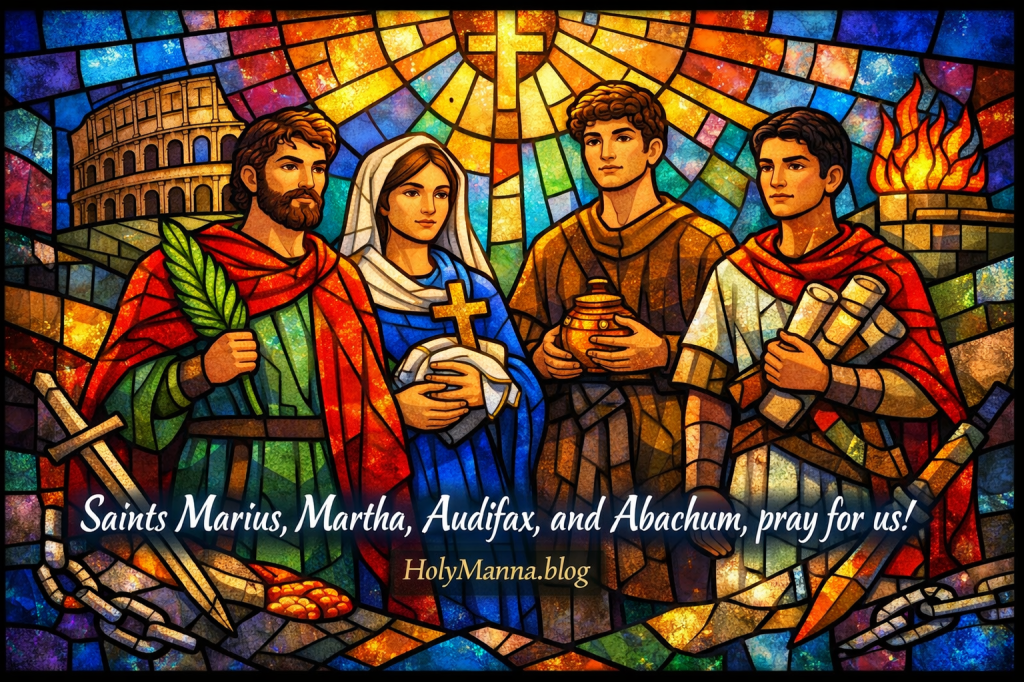
A Household of Martyrs
Saints Marius, Martha, Audifax, and Abachum are honored in the Roman Catholic tradition as martyrs connected to Rome and commemorated on January 19. They are usually remembered as a husband, wife, and two sons who chose fidelity to Jesus Christ over safety, status, and survival. Their story belongs to the early centuries when the Church was learning how to live in a world that demanded public loyalty to pagan worship, and their witness still confronts modern Christians who are tempted to keep faith quiet. They are not remembered for theological writings or public office, but for mercy, courage, and the refusal to bow to idols. The Church keeps their names together because their witness is meant to be received as one testimony. Christ is worth everything, and charity toward the suffering is never optional.
Pilgrims Drawn to the Tombs of the Martyrs
The Church does not preserve many verified details about their birthplace or early years, so the tradition should be approached with humility and honesty. Ancient Christian tradition commonly describes them as Christians from Persia who traveled to Rome, and that detail remains part of their long-standing story in Catholic memory. Whether every element of their origin story is historically precise is not the main point the Church protects, because the Church is guarding something deeper than trivia. The Church is guarding the spiritual meaning of a family or a group of believers who were willing to leave what was familiar in order to cling more closely to Christ and His suffering members.
In the traditional telling, their journey is tied to love for the martyrs and communion with the persecuted Church. They are remembered as pilgrims who sought out the places where Christians had suffered for Christ and who offered help where danger was real. That kind of pilgrimage is not tourism, because it is a confession of faith. It says that the saints are not distant heroes but family, and that the blood of martyrs is not forgotten in the Church. Their conversion is best understood as a conversion of the heart, the kind that moves from private belief to public sacrifice, because real faith always presses outward into action.
Mercy in a Violent World
The part of their lives the Catholic tradition highlights most is not a dramatic public miracle, but disciplined love that put skin in the game. They are remembered for aiding persecuted Christians and for honoring the dead, especially the bodies of those killed for Christ. That work was dangerous because it challenged the machinery of persecution, but it was also deeply Catholic because it treated the human body with reverence and treated the suffering Christian as Christ Himself. Their example is a living reminder that the works of mercy are not optional extras; they are a serious expression of the Gospel.
When it comes to specific miracle stories during their lifetime, the major Catholic summaries do not preserve a stable set of verified accounts like some saints have. Their “miracle” is the kind the Gospel praises again and again: courage that does not flinch, charity that does not calculate, and fidelity that does not negotiate. Scripture teaches that love is proven by action, and their lives embody that truth in a way that still challenges comfortable Christianity. Their holiness shines through ordinary obedience that became extraordinary when fear and violence closed in.
Refusing the Easy Way Out
Like so many early martyrs, their crisis point came when authorities demanded a public act of pagan sacrifice. That demand was not merely civic; it was spiritual because it required a Christian to perform an act that contradicted the First Commandment. The tradition says they were arrested and pressured to comply, with the promise of freedom if they would simply do what everyone else did. That is always the enemy’s strategy. He offers peace at the price of truth, and he tries to make betrayal feel practical.
Catholic tradition preserves that they endured harsh tortures and that their suffering was meant to break their will. Some accounts describe a sequence of brutal torments, emphasizing that their bodies were assaulted but their faith held steady. Across the Catholic telling, the core remains consistent: they refused to renounce Christ, and they were condemned for it. They are commonly remembered as being executed outside Rome near a major road and associated with a burial place known in Christian memory. Martha is also remembered as suffering death separately in some traditions, which underscores how persecution often targeted families piece by piece in an effort to force a collapse of courage.
Some Catholic sources acknowledge uncertainty about the exact persecution period, and that honesty matters because the Church distinguishes between what is essential and what is secondary. The essential truth is their martyrdom for Christ and the Church’s continuous veneration of their witness. Their deaths matter because martyrdom is the most complete imitation of the Lord’s self-gift, echoing the truth that Jesus spoke when He called His disciples to take up the cross. Their story is not a call to chase suffering, but it is a call to refuse idolatry and to trust that fidelity is never wasted.
A Memory the Church Guarded
The Church’s love for martyrs is never only sentimental. It becomes concrete in prayer, liturgy, and remembrance, and that is why the saints are placed before the faithful year after year. Catholic tradition holds that faithful Christians ensured their burial, and their resting place became part of the sacred geography of Rome. Early pilgrim tradition remembers a church connected to their memory, and this matters because it shows the devotion was lived and handed down. Their witness strengthened real communities, not just readers of a story.
Their relic tradition also became part of how the Church kept their witness close. Relics were translated to important Roman churches, which is one of the ways the Church honored martyrs and made their intercession more present to the faithful. Over time, portions of relics were also associated with devotion beyond Rome, reflecting how the memory of martyrs spread through Christian Europe. When it comes to miracles after death, major Catholic reference summaries do not preserve a consistent catalog of verified healings attached to their intercession. Their legacy after death is seen in the endurance of their cult, the preservation of their names in the Church’s liturgical memory, and the continued honor shown through pilgrimages and churches connected to them.
What a Martyr Family Teaches a Busy Soul
These saints land right in the middle of modern life because the pressure to compromise has not disappeared. The world still rewards those who keep faith private and punishes those who let faith shape choices, speech, and priorities. These martyrs answer with steady clarity. Fidelity is not a feeling; it is a decision repeated until it becomes a way of life. Their example also redeems the works of mercy from being treated like sentimental add-ons, because they show mercy as spiritual warfare. Showing up for the suffering, defending the vulnerable, and honoring the dead are acts of faith that announce human dignity in a culture that often forgets it.
A practical way to imitate them is to build habits of courage in small ways before the bigger tests come. That can mean refusing to laugh at what is sinful, refusing to normalize what God calls disordered, or refusing to stay silent when the faith is mocked. It also means practicing mercy in ways that cost time and attention. Visiting the lonely, bringing food to a family in crisis, and praying seriously for the dead all form the soul. Where is God asking for a clear, loving refusal to compromise this week? Who needs mercy that is practical, not just emotional? The martyrs teach that courage is cultivated long before it is demanded, and mercy is practiced long before it becomes costly.
Engage with Us!
Share thoughts and reflections in the comments below. What stands out most about these martyrs, their mercy, their courage, or the way the Church has remembered them?
- Where does modern life pressure believers to make small compromises with truth, even if it feels harmless?
- Which corporal work of mercy feels most neglected right now, and what would it look like to practice it this week?
- What practical habit could help build the kind of steady fidelity these saints showed under pressure?
- How does remembering the martyrs strengthen trust in Christ when faith feels inconvenient or costly?
Keep walking forward with confidence. A life of faith is built through daily obedience, steady prayer, and real charity. Do everything with the love and mercy Jesus taught, and trust that God multiplies every hidden act of fidelity.
Saints Marius, Martha, Audifax, and Abachum, pray for us!
Follow us on YouTube, Instagram and Facebook for more insights and reflections on living a faith-filled life.

 Holy Manna!
Leave a comment