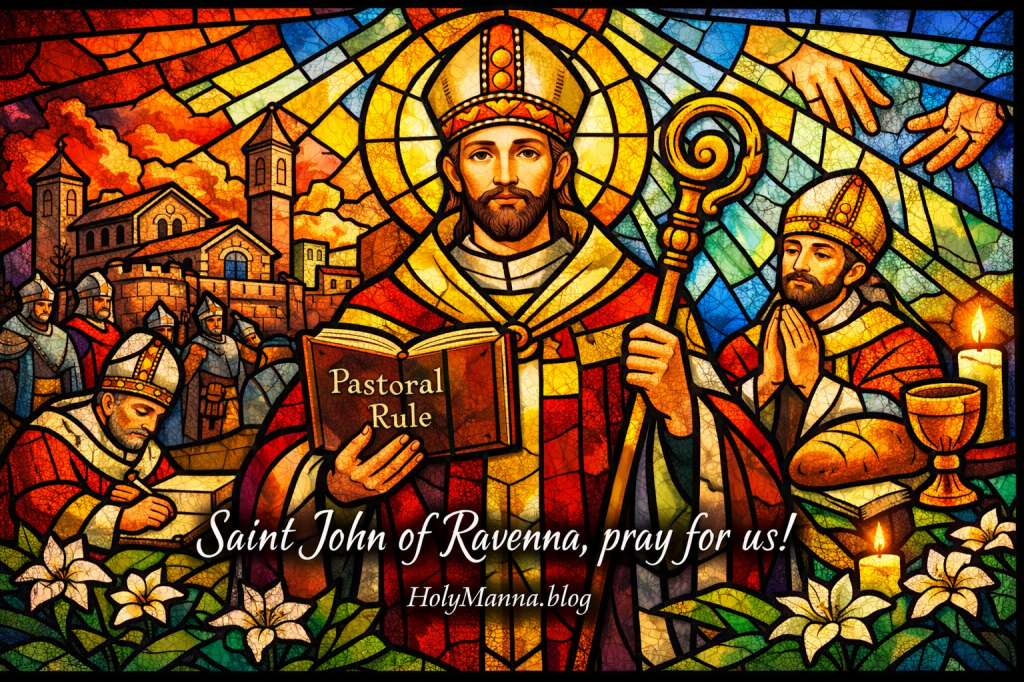
A Bishop Who Refused to Abandon His Flock
Saint John of Ravenna is the kind of saint who makes a strong point without needing dramatic legends to carry the story. He served the Church of Ravenna in the late sixth century and died in 595, which placed him right in the middle of an era marked by instability, violence, and fear. When Italy was being shaken by invasion and upheaval, a bishop’s job was not to cultivate a public image, but to keep the faith intact and the flock cared for. The Church remembers John as a pastor who provided for the needs of his people and his local Church when stability was hard to find. His significance stands out even more because he had a real, documented relationship with Pope Saint Gregory the Great, which included both support and firm correction.
Hidden Beginnings and a Public Mission
Catholic tradition preserves very little about Saint John’s early life, family background, or the specific events that formed him before he became a bishop. That silence can feel like a missing chapter, but it actually keeps the focus where the Church places it: on the holiness shown in responsibility, not on the kind of biography that reads like a hero’s origin story. John’s “conversion” is not recorded as a single dramatic moment, yet his life still reflects conversion in the Catholic sense, because conversion is often proven by fidelity over time. The Lord’s work in a soul is sometimes most visible in how a person handles duty, authority, and pressure, especially when nobody is clapping.
Ravenna itself was an important city with deep Christian roots, and leading that Church required steadiness and courage. John’s ministry unfolded during a season when people were tempted to panic, compromise, or turn harsh under stress. A bishop in that setting had to preserve discipline, protect unity, and sustain charity without losing sight of the Gospel. Scripture describes the heart of pastoral leadership clearly: “Tend the flock of God that is your charge, not by constraint but willingly, not for shameful gain but eagerly, not as domineering over those in your charge but being examples to the flock” (1 Peter 5:2 to 3). That is the kind of pastoral posture Saint John’s memory calls to mind, even when the details of his early years remain hidden.
A Bishop in a War-Torn World
Saint John’s episcopal life unfolded in a period when many communities were living close to the edge, facing insecurity and disruption. Pastoral charity in that kind of climate is not sentimental, because it demands clear judgment and steady action. It means keeping the sacramental life of the Church accessible, maintaining order among clergy, and ensuring that the vulnerable are not forgotten. It also means holding people together spiritually when fear tries to fracture families and communities into suspicion.
One reason John remains important is his connection to Pope Saint Gregory the Great’s Pastoral Rule, a classic work on the care of souls and the interior life of a shepherd. Gregory addressed this work to John, which permanently ties John’s name to a major stream of Catholic pastoral teaching. The Pastoral Rule insists that spiritual authority must be rooted in humility, self-knowledge, prayer, and moral seriousness. That is deeply Catholic, because the Church does not treat leadership as a platform, but as a responsibility that can save or endanger souls depending on how it is carried. A bishop’s holiness is measured less by charisma and more by whether he becomes a servant in the pattern of Christ, who came “not to be served but to serve.”
When it comes to miracles during John’s lifetime, the main Catholic notices for this saint do not preserve a specific catalogue of extraordinary wonders. That does not weaken his witness, because the Church venerates more than the miraculous. The Church also venerates the quieter miracle of fidelity, especially when a man keeps doing what is right in a season when doing right is costly. Holiness that holds steady in chaos can be a stronger sign than a story that only exists to impress.
The Cross of Leadership
Saint John was not martyred in the usual sense, but his life still carried real hardships, including the burden of leading during public turmoil. His story also includes a humbling element that many people do not expect to find in a saint’s biography: he received sharp correction from Pope Saint Gregory the Great. Gregory’s letters criticize John’s conduct and leadership in serious terms, including concerns about pride, speech that wounded, discipline that was not strong enough, and controversy surrounding the use of the pallium in ways Gregory considered inappropriate. This matters because it shows the Church acting like a mother, not an audience. The Church corrects because souls matter, and holiness cannot be built on ego.
John’s response is remembered for a line that captures what real correction feels like when it is spiritually serious. He described Gregory’s rebuke as “compounded of honey and of venom”, which is an honest admission that a true rebuke can comfort and sting at the same time. That phrase is unforgettable because it sounds like the Christian life. The Lord’s mercy often heals by first exposing what needs to change. Scripture warns about pride with a blunt clarity that fits this moment: “Whoever exalts himself will be humbled, and whoever humbles himself will be exalted” (Matthew 23:12). John’s story reminds every Catholic that correction can be a grace, especially when it calls a leader back to humility for the good of the flock.
A Legacy Stronger Than Legends
Saint John of Ravenna does not have a widely preserved set of posthumous miracle stories attached to his name in the principal Catholic notices. Instead, his legacy endures through the Church’s liturgical remembrance and through the pastoral tradition linked to Pastoral Rule. That is not a small legacy. A saint does not need dramatic legends to influence the Church if his life is tied to the Church’s real work of sanctifying souls.
The Pastoral Rule shaped how the Church thought about bishops and pastors for generations, emphasizing humility, interior discipline, wise correction, and responsibility before God. John’s name remains connected to that tradition because Gregory addressed the work to him, which places John inside a living stream of Catholic formation. In a world that often confuses leadership with branding, this legacy points back to a more demanding Catholic vision. Leadership is service, authority is accountability, and holiness is proven by humility.
The Kind of Holiness Needed Right Now
Saint John of Ravenna teaches that holiness does not require a dramatic origin story. It requires faithfulness, especially when life feels chaotic and responsibility feels heavy. He also teaches something that many modern Catholics need to recover: correction, when it is true and ordered toward charity, is not an insult. It can be mercy, and it can be a gift that prevents a larger fall. Catholic teaching calls believers to interpret others with charity and to resist rash judgment, which protects unity and peace in families and parishes (CCC 2478). At the same time, the Church also teaches the necessity of moral truth and discipline, because love without truth turns into confusion.
This saint’s example encourages practical habits that actually form the soul. Confession matters because it trains humility and restores grace, and the Church teaches that the sacrament strengthens the spiritual life and brings peace and strength (CCC 1468). Speech matters because words can either build a home or burn it down, and Scripture gives a warning that feels painfully modern: “The tongue is a small member, yet it boasts of great things” (James 3:5). Charity matters because faith that stays theoretical is not the Catholic life. When a believer chooses patience under pressure, refuses to enjoy sarcasm that wounds, and receives correction with humility, that believer is practicing the kind of sanctity Saint John’s story puts in front of the Church.
Engage With Us!
Share thoughts and reflections in the comments below, because saints like John of Ravenna hit close to home for anyone trying to live the faith in messy times. This story invites honest self-examination, especially about humility and how correction is handled. It also encourages a deeper love for the Church’s wisdom, because saints are shaped through obedience, not through stubborn independence.
- Where does humility need to grow most right now: in speech, in leadership, or in the willingness to be corrected?
- What practical duty is God asking to do faithfully, even if it feels ordinary and unnoticed?
- How can prayer, confession, and spiritual direction help keep pride from taking root?
- When correction comes, what would it look like to receive it as “honey and venom”, both mercy and medicine?
Saint John of Ravenna is a reminder that holiness is built in the daily grind of fidelity, not just in dramatic moments. Keep choosing prayer over pride, charity over comfort, and obedience over ego. Live a life of faith and do everything with the love and mercy Jesus taught us.
Saint John of Ravenna, pray for us!
Follow us on YouTube, Instagram and Facebook for more insights and reflections on living a faith-filled life.

 Holy Manna!
Leave a comment