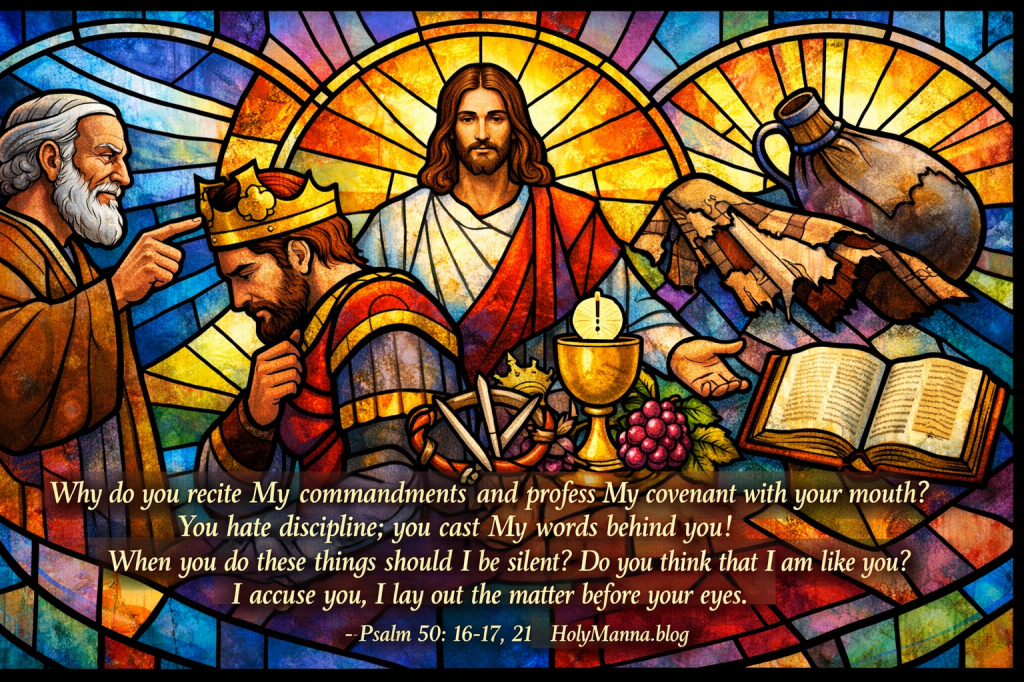
Monday of the Second Week in Ordinary Time – Lectionary: 311
The Listening Heart and the New Wine of Christ
There is something quietly challenging about today’s readings, because they expose the most common spiritual trap for religious people. The temptation is to keep the outward signs of faith while quietly negotiating obedience on the inside. In 1 Samuel 15:16-23, King Saul tries to cover disobedience with a pious explanation, but the prophet Samuel cuts straight to the point with the unforgettable line: “Obedience is better than sacrifice.” In Psalm 50:8-9, 16-17, 21, 23, the Lord doubles down on the same message by insisting that sacrifice without sincerity becomes empty noise, because a mouth can recite commandments while a heart throws God’s word behind its back. Then in Mark 2:18-22, Jesus reveals why this matters even more now, because the Bridegroom has arrived and His presence is not a patch stitched onto an old spiritual life. His grace is new wine, and it calls for new wineskins.
A bit of background helps the whole day snap into focus. Saul was not just any leader, because he was Israel’s anointed king, charged with guarding the people’s covenant fidelity in a violent and complicated period of salvation history. The command against Amalek is framed as a total devotion of what is conquered to the judgment of God, and that context makes Saul’s compromise especially revealing. He does not merely make a tactical decision. He acts as if he can adjust God’s word to fit his own reasoning, and then make it sound holy by talking about sacrifice. That is why Samuel calls rebellion and stubbornness what they really become when left unchecked, because they turn into a kind of spiritual counterfeit that looks religious but places the self on the throne.
This is where the Gospel completes the picture. In the world of Jesus, fasting was a respected act of penitence and preparation, practiced in different ways by different groups, including disciples of John and the Pharisees. Jesus does not insult fasting, because He openly says the day will come when His disciples will fast. Yet He refuses to let religious practice become a measuring stick that ignores the living reality of God in their midst. As long as the Bridegroom is present, it is time to receive Him with joy and faith, because the Kingdom is not merely an upgrade to old habits. It is a new life that requires a converted heart.
Is there any place where obedience is being replaced with excuses that sound spiritual, even if they feel reasonable?
First Reading – 1 Samuel 15:16-23
When Obedience Stops Being Optional
This passage drops the reader right into a painful moment in Israel’s early monarchy. Saul is not a private citizen making a personal mistake. Saul is the Lord’s anointed king, publicly entrusted with Israel’s covenant faithfulness, and accountable to God through the prophet Samuel. The conflict here is not about “trying harder” or “meaning well.” It is about whether a leader will treat God’s command as negotiable.
The background matters. The command concerning Amalek is framed in Scripture as a serious act of divine judgment within salvation history, carried out through Israel in a world where warfare was tragically common. The text describes a “ban of destruction,” which in the ancient Near Eastern context meant something devoted entirely to God, not held back for profit, reputation, or personal control. Saul’s sin, then, is not simply that he makes an error in tactics. Saul decides that partial obedience plus a religious excuse is good enough. That is exactly why this reading fits today’s theme so well. God is not impressed by worship used as camouflage. God wants a listening heart.
1 Samuel 15:16-23 – New American Bible (Revised Edition)
16 Samuel said to Saul: “Stop! Let me tell you what the Lord said to me last night.” “Speak!” he replied. 17 Samuel then said: “Though little in your own eyes, are you not chief of the tribes of Israel? The Lord anointed you king of Israel 18 and sent you on a mission, saying: Go and put the sinful Amalekites under a ban of destruction. Fight against them until you have exterminated them. 19 Why then have you disobeyed the Lord? You have pounced on the spoil, thus doing what was evil in the Lord’s sight.” 20 Saul explained to Samuel: “I did indeed obey the Lord and fulfill the mission on which the Lord sent me. I have brought back Agag, the king of Amalek, and, carrying out the ban, I have destroyed the Amalekites. 21 But from the spoil the army took sheep and oxen, the best of what had been banned, to sacrifice to the Lord your God in Gilgal.” 22 But Samuel said:
“Does the Lord delight in burnt offerings and sacrifices
as much as in obedience to the Lord’s command?
Obedience is better than sacrifice,
to listen, better than the fat of rams.
23 For a sin of divination is rebellion,
and arrogance, the crime of idolatry.
Because you have rejected the word of the Lord,
the Lord in turn has rejected you as king.”
Detailed Exegesis
Verse 16: Samuel said to Saul: “Stop! Let me tell you what the Lord said to me last night.” “Speak!” he replied.
Samuel’s “Stop” is not rude. It is merciful. It interrupts self-justification before it hardens into complete blindness. Saul’s “Speak” sounds open, but the rest of the passage shows a man who wants to control the narrative. A warning shows up here for every disciple: it is possible to invite God to speak while already planning the defense.
Verse 17: Samuel then said: “Though little in your own eyes, are you not chief of the tribes of Israel? The Lord anointed you king of Israel
Samuel reminds Saul of identity and grace. Saul did not seize the throne by personal greatness. Saul was anointed, which means Saul’s authority is a gift that depends on fidelity. This verse also exposes a common spiritual pattern. When a person forgets that everything is received, that person starts acting like God’s word is a suggestion.
Verse 18: and sent you on a mission, saying: Go and put the sinful Amalekites under a ban of destruction. Fight against them until you have exterminated them.
The mission is clearly defined, and the text emphasizes that it is God who sends. The mention of Amalek’s sin signals judgment, not personal revenge. Even so, this kind of text can feel heavy, and it should. Catholic reading never treats violence casually. It reads the Old Testament within the long arc that leads to Christ, who reveals the fullness of God’s mercy and commands love of enemies. Still, the immediate point in 1 Samuel is straightforward: Saul is not authorized to rewrite God’s command.
Verse 19: Why then have you disobeyed the Lord? You have pounced on the spoil, thus doing what was evil in the Lord’s sight.”
Samuel names the heart of the matter. Disobedience is not presented as a minor slip. It is portrayed as “pouncing on the spoil,” which means grasping, taking, and treating things as personal property. When the heart becomes grabby, it usually becomes rationalizing too.
Verse 20: Saul explained to Samuel: “I did indeed obey the Lord and fulfill the mission on which the Lord sent me. I have brought back Agag, the king of Amalek, and, carrying out the ban, I have destroyed the Amalekites.
Saul claims obedience while describing disobedience. Keeping Agag alive is not a small detail. It is evidence that Saul wants a trophy, leverage, and control. This is how self-deception works spiritually. A person can claim “obedience” and still protect the one thing that gives status, power, or security.
Verse 21: But from the spoil the army took sheep and oxen, the best of what had been banned, to sacrifice to the Lord your God in Gilgal.”
Now the defense turns religious. Saul shifts blame to “the army,” then frames the stolen “best” as worship. The detail “your God” is also telling. Saul speaks as if the Lord belongs more to Samuel than to Saul. That distancing often shows up when a person knows something is off inside. The “sacrifice” language is the cover story, but the deeper issue is that Saul reserves the right to decide what obedience should look like.
Verse 22: But Samuel said: “Does the Lord delight in burnt offerings and sacrifices as much as in obedience to the Lord’s command? Obedience is better than sacrifice, to listen, better than the fat of rams.”
This is one of the clearest statements in the Old Testament about the priority of interior fidelity over external ritual. It does not attack sacrifice itself. It attacks the lie that sacrifice can replace surrender. God wants worship that flows from listening. Real worship begins when the heart stops negotiating.
Verse 23: “For a sin of divination is rebellion, and arrogance, the crime of idolatry. Because you have rejected the word of the Lord, the Lord in turn has rejected you as king.”
Samuel compares rebellion to divination and arrogance to idolatry because both are ways of putting the self in God’s place. Divination is the attempt to control what belongs to God. Idolatry is treating something created, often the ego, as ultimate. Saul’s rejection is tragic, but it is not random. Leadership in God’s people is meant to be a living sign of covenant obedience. When that sign becomes a performance, it collapses.
Teachings
This reading delivers a Catholic truth that never expires: external religion without interior conversion becomes spiritual theater. The Church teaches that authentic worship must be rooted in a heart offered to God. The Catechism of the Catholic Church puts this in a way that matches Samuel’s words: “The outward sacrifice, to be genuine, must be the expression of spiritual sacrifice.” CCC 2100.
Samuel’s comparison to divination also connects directly to Catholic moral teaching. The Church is explicit about practices that attempt to manipulate hidden knowledge or control the future. The Catechism states: “All forms of divination are to be rejected.” CCC 2116. Samuel’s point is not that Saul used occult rituals. Samuel’s point is that rebellion acts like divination because it treats God’s will as something to manage instead of something to receive.
Saints and Doctors of the Church return to this same theme when they speak about obedience. Saint Thomas Aquinas teaches that obedience is not a minor virtue, because it trains the human will to submit to God’s order rather than the ego’s impulses. Aquinas describes obedience as especially connected to charity because it aligns a person’s choices with what God actually commands, not what the person prefers. A short line often attributed to this tradition captures the idea: “Obedience is the greatest of the moral virtues.” This is not because obedience is blind. It is because obedience is love that trusts God more than personal spin.
Historically, Saul’s failure becomes a turning point in Israel’s story. It sets the stage for a new kind of kingship, one that must be measured by covenant fidelity, not by image management. That prepares the heart for the Gospel, where the true King comes, not to negotiate with sin, but to destroy it at the root.
Reflection
Saul’s mistake is painfully relatable because it is easy to commit a modern version of it without noticing. A person can keep religious habits, defend them sincerely, and still quietly refuse the one concrete thing God is asking. The scary part is that the excuse can sound holy.
A disciple can apply this reading in a practical way by watching for the “spiritual cover story.” When the heart says, “This is fine because something good is being done,” it is worth pausing and asking whether that “good thing” is being used to avoid obedience. Prayer, service, giving, and even ministry can become hiding places if they are used to dodge repentance.
A simple step is to name the real command being resisted. God’s will is often revealed through duties of state in life, clear moral teaching, and the quiet conviction of conscience. Another step is to practice quick, concrete obedience in small things, because small obedience trains the soul for big obedience. A third step is to bring rationalizations into confession, because confession is where excuses die and freedom begins.
Where is God asking for listening instead of negotiating today? Is there a habit of explaining away sin with good intentions, spiritual language, or religious activity? What would change if obedience became the first offering, and everything else flowed from that?
Responsorial Psalm – Psalm 50:8-9, 16-17, 21, 23
When Worship Becomes Real Again
This psalm fits perfectly with the confrontation in 1 Samuel 15 and the challenge in The Gospel of Mark because it exposes a sneaky kind of religious hypocrisy. The Lord is not rejecting worship, sacrifice, or liturgical devotion. The Lord is rejecting the lie that external religion can replace interior conversion. Psalm 50 is written like a courtroom scene where God calls His people to account, not because He needs their offerings, but because they need truth. In ancient Israel, sacrifice was part of covenant life, and it mattered. Yet even then, the Lord repeatedly reminded His people that ritual without obedience turns worship into performance. This is the same central theme running through today’s readings. God wants a listening heart, and Christ’s new wine cannot be contained in an unchanged life.
Psalm 50:8-9, 16-17, 21, 23 – New American Bible (Revised Edition)
8 Not for your sacrifices do I rebuke you,
your burnt offerings are always before me.
9 I will not take a bullock from your house,
or he-goats from your folds.16 But to the wicked God says:
“Why do you recite my commandments
and profess my covenant with your mouth?
17 You hate discipline;
you cast my words behind you!21 When you do these things should I be silent?
Do you think that I am like you?
I accuse you, I lay out the matter before your eyes.23 Those who offer praise as a sacrifice honor me;
I will let him whose way is steadfast
look upon the salvation of God.”
Detailed Exegesis
Verse 8: “Not for your sacrifices do I rebuke you, your burnt offerings are always before me.”
God begins by clarifying the accusation. The issue is not that the people are failing to perform religious duties. The problem is deeper than attendance or ritual. The people are offering sacrifices, yet their lives are not being offered. This is a warning for any disciple who confuses “showing up” with surrendering the heart.
Verse 9: “I will not take a bullock from your house, or he-goats from your folds.”
This line is almost shocking until it is understood correctly. God is not a needy deity who depends on human donations. The Lord is teaching that material offerings do not add anything to God. They are meant to form the worshiper. When a person treats religious acts like a payment to keep God quiet, the whole meaning collapses.
Verse 16: “But to the wicked God says: ‘Why do you recite my commandments and profess my covenant with your mouth?’”
Now the psalm turns direct. The problem is not ignorance of God’s law, because the person can recite commandments and speak covenant language. The problem is a divided life. There is a public religious identity and a private rejection of God’s authority. This verse shines a light on performative religion, where the mouth is loud but the conscience is muted.
Verse 17: “You hate discipline; you cast my words behind you!”
This is the inner diagnosis. The “wicked” person is not necessarily someone with no religion. It is someone who rejects correction and throws God’s word away when it becomes inconvenient. Discipline here is not about harshness. It is about being teachable, being corrected, and being willing to change. That is why it ties into today’s theme so strongly. Saul cast God’s word behind him and tried to make sacrifice the headline.
Verse 21: “When you do these things should I be silent? Do you think that I am like you? I accuse you, I lay out the matter before your eyes.”
God refuses to be treated like a projection of human thinking. The line “Do you think that I am like you?” is a direct strike against self-made religion. The Lord is not a buddy who shrugs at sin, and the Lord is not a negotiator who can be bought off with religious gestures. God’s accusation is mercy, because it forces reality into the light where repentance becomes possible.
Verse 23: “Those who offer praise as a sacrifice honor me; I will let him whose way is steadfast look upon the salvation of God.”
The psalm ends with hope. God calls for praise as a true sacrifice, meaning worship that flows from a steadfast life. The word “steadfast” matters. It is not perfectionism, but fidelity. It means the worshiper is actually walking with God, not using God. The promise is striking: the steadfast person will “look upon the salvation of God,” which prepares the heart for the Gospel, where salvation is no longer an idea but a Person.
Teachings
This psalm helps clarify something essential in Catholic life. God does not reject sacrifice, because the Catholic faith is profoundly sacrificial, culminating in the Eucharist, the re-presentation of Christ’s sacrifice. What God rejects is worship that is detached from conversion.
The Catechism of the Catholic Church expresses the right ordering of sacrifice and heart with a line that fits this psalm perfectly: “The outward sacrifice, to be genuine, must be the expression of spiritual sacrifice.” CCC 2100. This means external devotion is meant to reveal an interior offering of the will.
The psalm also challenges the false idea that religious words can substitute for obedience. The Church teaches that faith is not merely intellectual assent, but a lived response that includes moral conversion. The Catechism describes conversion as a response to God’s merciful call, expressed concretely through acts of penance. It states: “Interior repentance is a radical reorientation of our whole life, a return, a conversion to God with all our heart.” CCC 1431. That is exactly what Psalm 50 is demanding, and it is exactly what Saul resisted.
Saint Augustine often preached that the psalms form the Church’s voice, training the heart to love what God loves and reject what God rejects. The psalms are not sentimental poems. They are medicine. Psalm 50 is the kind of medicine that stings, because it exposes the gap between what a person says and what a person chooses.
Historically, Israel’s prophets repeatedly made this point because sacrifice had become easy to ritualize. People could keep the calendar, show up at the altar, and still exploit neighbors or live in unrepentant sin. That prophetic critique did not destroy worship. It purified worship. That same purification is still needed in every age.
Reflection
This psalm invites an honest checkup on religious life. It challenges the habit of treating prayer like a way to manage God instead of a way to surrender to God. It also challenges the temptation to recite commandments while quietly choosing what will be followed and what will be ignored.
A practical way to respond is to match one act of worship with one act of obedience. If a person goes to Mass, then that person can choose one concrete act of fidelity that day, such as guarding the tongue from gossip, refusing a dishonest shortcut, or making peace with someone. Another way is to practice being teachable by welcoming correction instead of resenting it. Discipline becomes a gift when it trains the heart to listen.
This psalm also invites a deeper kind of praise. Praise is not just music or words. Praise becomes sacrifice when it costs something, like forgiving when it hurts, being patient when it is inconvenient, or staying faithful when nobody applauds.
Is there any place where God’s word is being cast behind the back while religious language stays on the lips? Is worship being treated like a substitute for repentance instead of the fuel for repentance? What would change if praise became a real sacrifice through a steadfast way of life today?
Holy Gospel – Mark 2:18-22
The Bridegroom Is Here, So the Heart Must Become New
This Gospel scene takes place in the early days of Jesus’ public ministry, when people are still trying to place Him into familiar religious categories. Fasting was a respected practice in first-century Judaism, tied to repentance, mourning, and preparation for God’s action. The Pharisees fasted as part of serious religious discipline, and the disciples of John fasted in a spirit of penitence as they awaited the Messiah. So the question sounds reasonable: why are Jesus’ disciples not doing the same?
Jesus answers in a way that ties perfectly into today’s theme. Just like Saul tried to cover disobedience with religious activity, people in the Gospel are tempted to treat religious practices as the main measure of holiness. Jesus does not reject fasting, but He refuses to let it become a mask or a scoreboard. He reveals something deeper: the Messiah has arrived, and His presence is like a wedding feast. That means everything is changing. The old ways of relating to God cannot simply be patched up. The Kingdom is new wine, and it requires a renewed heart.
Mark 2:18-22 – New American Bible (Revised Edition)
18 The disciples of John and of the Pharisees were accustomed to fast. People came to him and objected, “Why do the disciples of John and the disciples of the Pharisees fast, but your disciples do not fast?” 19 Jesus answered them, “Can the wedding guests fast while the bridegroom is with them? As long as they have the bridegroom with them they cannot fast. 20 But the days will come when the bridegroom is taken away from them, and then they will fast on that day. 21 No one sews a piece of unshrunken cloth on an old cloak. If he does, its fullness pulls away, the new from the old, and the tear gets worse. 22 Likewise, no one pours new wine into old wineskins. Otherwise, the wine will burst the skins, and both the wine and the skins are ruined. Rather, new wine is poured into fresh wineskins.”
Detailed Exegesis
Verse 18: “The disciples of John and of the Pharisees were accustomed to fast. People came to him and objected, ‘Why do the disciples of John and the disciples of the Pharisees fast, but your disciples do not fast?’”
The objection shows a mindset that measures holiness by visible practices. Fasting is good, but the question assumes that the external sign automatically reveals the interior reality. Jesus is about to correct that assumption. A practice can be holy, but it can also become performative if it is disconnected from the real presence and will of God.
Verse 19: Jesus answered them, “Can the wedding guests fast while the bridegroom is with them? As long as they have the bridegroom with them they cannot fast.”
Jesus uses wedding imagery that would have been instantly understood. Weddings were communal celebrations, lasting days, marked by joy. To fast at a wedding would signal mourning and insult the celebration. Jesus is claiming that His presence is not merely another religious movement. His presence is the arrival of the Bridegroom, which echoes Old Testament imagery where God speaks of Himself as the spouse of His people. Jesus is quietly revealing His divine identity and the new covenant joy He brings.
Verse 20: “But the days will come when the bridegroom is taken away from them, and then they will fast on that day.”
This verse introduces the Cross. The Bridegroom will be taken away, which points to suffering, rejection, and death. Jesus confirms that fasting will have a place in the life of His disciples, but it will be transformed. Christian fasting is not a desperate attempt to earn God’s love. It becomes a response of love, a way to share in the Bridegroom’s suffering, and a way to purify the heart for deeper communion.
Verse 21: “No one sews a piece of unshrunken cloth on an old cloak. If he does, its fullness pulls away, the new from the old, and the tear gets worse.”
This image confronts shallow religion. A patch on an old cloak is an attempt to preserve the old while borrowing something new. The result is damage, because the new cloth pulls and tears the old garment. Jesus is warning that the new life of the Kingdom cannot be treated as an accessory. If a person tries to add Christ on top of a life that refuses conversion, the tension does not resolve. It breaks things.
Verse 22: “Likewise, no one pours new wine into old wineskins. Otherwise, the wine will burst the skins, and both the wine and the skins are ruined. Rather, new wine is poured into fresh wineskins.”
Wineskins were made from animal hide, and fresh skins could stretch during fermentation. Old skins became brittle and would burst. The meaning is clear: the grace of Christ is living and powerful, and it requires receptivity, humility, and real interior renewal. The tragedy is not only losing the wineskin. The tragedy is losing the wine. Jesus is teaching that resisting conversion does not merely keep a person “the same.” It risks ruining what God is trying to pour into the soul.
Teachings
This Gospel clarifies the Catholic understanding of spiritual practices. Fasting matters, but it is not meant to replace obedience, charity, or conversion. The Church teaches that interior conversion expresses itself through visible acts, and it specifically names fasting as one of the classic expressions of penance. The Catechism of the Catholic Church states: “Interior repentance is a radical reorientation of our whole life, a return, a conversion to God with all our heart, an end of sin, a turning away from evil.” CCC 1431. Then it adds that this interior repentance is expressed through “fasting, prayer, and almsgiving,” which shows that external discipline is meant to reveal and strengthen an interior change.
The Bridegroom image also points toward the identity of Christ and the joy of the new covenant. Catholic tradition recognizes Christ as the Bridegroom of the Church, and the sacraments flow from this spousal mystery. The Eucharist is not a mere symbol of belonging. It is communion with the living Bridegroom who gives Himself completely. That is why the Gospel’s joy is not shallow happiness. It is the joy of God visiting His people.
The Fathers of the Church loved the “new wine and old wineskins” image because it describes what grace does to the soul. Saint Bede explains that trying to live the Gospel without becoming new is like forcing the new cloth onto old fabric, because the old life cannot hold the demands and beauty of the new. Grace calls for a heart made supple through humility, repentance, and teachability.
There is also a practical Church memory here. From the earliest centuries, Christians practiced fasting, especially in preparation for Easter, as a way of uniting themselves to Christ’s Passion and training the will to love God above comfort. Fasting, in Catholic life, is never meant to be gloomy performance. It is meant to be love that longs for the Bridegroom, and discipline that clears space for God.
Reflection
This Gospel invites a hard but freeing question. Is the spiritual life being treated like a patchwork project, where Christ is added without surrendering control? The “old cloak” can look respectable. The “old wineskins” can feel familiar. But Jesus is not offering a religious upgrade. Jesus is offering a new life.
A good place to start is to examine the motive behind spiritual practices. Fasting, prayer, and discipline are powerful when they are rooted in love. They become hollow when they are used to impress others, control outcomes, or avoid real obedience. Jesus wants the heart to be renewed so that the practices become honest and fruitful.
This reading also encourages a mature view of joy and penance. There is a time for celebration because Christ is present, and there is a time for fasting because the Bridegroom has been taken away through the Cross. A disciple does not choose one and reject the other. A disciple learns the rhythm of the Church, entering joy and penance as acts of love.
A practical step is to choose one small “new wineskin” habit that makes the heart more flexible. That could mean surrendering a cherished grudge, becoming faithful to a daily prayer time, making confession a regular habit, or practicing a weekly fast that is offered quietly and sincerely. The point is not to become intense. The point is to become receptive.
Is Christ being treated like an addition to an already settled life, or is the heart being made new to receive His grace? Where is fasting or discipline needed to clear space for the Bridegroom, not to impress anyone, but to love Him more sincerely? What part of the old cloak is being protected, even though it keeps tearing under the weight of the Gospel?
A New Wineskin Kind of Faith
Today’s readings land on one clear message that is both comforting and challenging. God does not want religious activity used as a substitute for obedience. God wants a heart that listens, repents, and becomes new. Saul tries to protect his pride and his preferences while sounding spiritual, but Samuel exposes the truth with “Obedience is better than sacrifice.” 1 Sm 15:22. The psalm presses the same point by showing how easy it is to speak covenant words while casting God’s word behind the back. Then Jesus takes everything deeper by revealing that the Kingdom is not a patch sewn onto an old life. The Bridegroom is present, and His grace is new wine that requires fresh wineskins.
The invitation is simple, but it is not shallow. Choose honesty with God over image management. Choose conversion over excuses that sound holy. Choose a spiritual life that is not built on appearances, but on a will that is willing to be taught. A disciple does not need to fear this kind of surrender, because God is not trying to take joy away. God is trying to make joy real, like a wedding feast that is not forced, not fake, and not fragile.
A strong way to respond today is to take one concrete step of obedience that has been delayed. That might mean returning to confession with humility, repairing a relationship with patience, refusing a hidden sin that keeps coming back, or finally committing to a daily rhythm of prayer that stops being optional. Then let worship become truthful again by offering God not only words, but the actual choices of the day.
What would change if God’s word became the first authority, rather than the last thing considered? What would happen if the heart stopped trying to patch Christ onto an old pattern, and instead let Him make everything new? This is the kind of faith that holds the new wine without bursting, because it is not stiff with pride. It is supple with trust.
Engage with Us!
Readers are invited to share reflections in the comments below, because hearing how God is working in different hearts can strengthen everyone’s faith. Take a moment with each reading and let the Holy Spirit bring one concrete takeaway into focus.
- First Reading, 1 Samuel 15:16-23: Where is obedience being replaced with a religious excuse that sounds good but avoids real surrender? What would it look like today to choose simple fidelity instead of trying to manage outcomes like Saul did?
- Responsorial Psalm, Psalm 50:8-9, 16-17, 21, 23: Are God’s commandments being spoken confidently while His word is being ignored in a specific area of life? What would change if worship became a true offering of a steadfast life and not only words?
- Holy Gospel, Mark 2:18-22: Is the spiritual life being treated like a patch on an old cloak, or is the heart becoming a fresh wineskin for Christ’s grace? What is one concrete “new wineskin” habit that would make the soul more receptive to the Bridegroom?
Keep walking forward with confidence, even if growth feels slow, because the Lord is patient and faithful. Choose a life of real faith, and let every prayer, sacrifice, decision, and relationship be marked by the love and mercy Jesus taught, so that the world can see His goodness through ordinary daily life.
Sacred Heart of Jesus, we trust in You!
Immaculate Heart of Mary, pray for us!
Saint Michael the Archangel, defend us in battle!
Follow us on YouTube, Instagram and Facebook for more insights and reflections on living a faith-filled life.

 Holy Manna!
Leave a comment