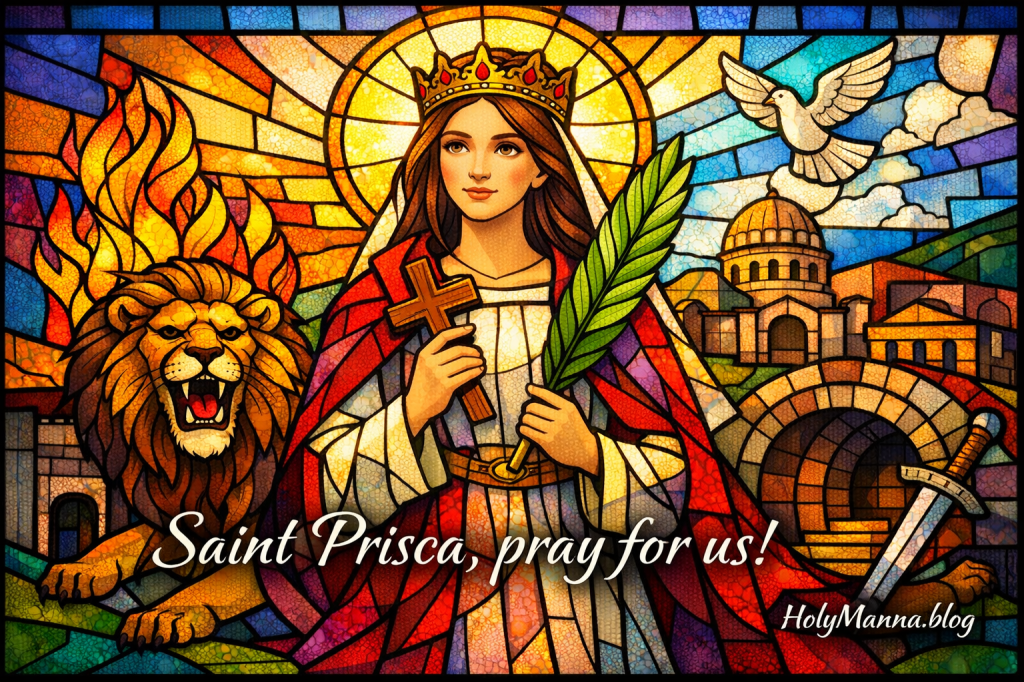
A Brave Light Under Rome’s Shadows
Saint Prisca, often called Priscilla in older Christian tradition, is one of those saints whose power comes from the Church’s memory more than from a detailed biography. The historical sources do not give a long narrative of her childhood, friendships, or daily routines, but they do give something just as telling: the early Christians of Rome held onto her name, honored her as a virgin and martyr, and preserved devotion at places associated with her memory. That matters because the Church does not keep saints on the calendar as a sentimental hobby. The Church keeps them because their witness points straight to Jesus Christ and strengthens the faithful across centuries.
Prisca’s significance is rooted in the heart of Catholic spirituality. She belongs to the ancient line of Roman martyrs who refused idolatry and refused to treat faith as a negotiable accessory. In a culture that demanded public conformity, her life proclaims a simple truth: Jesus is Lord, and no earthly power gets to rewrite that. Even when historians cannot verify every detail of later stories, the Church’s devotion still teaches that her fidelity was real, and that her witness was strong enough to be remembered and celebrated in Rome for generations.
Roots Hidden in the Early Church
The early record does not preserve a clear account of Prisca’s birthplace, her parents, or her social class. That is not a weakness in the faith; it is a reminder that holiness is not dependent on celebrity. The earliest layers of tradition focus on what the Church most wants to emphasize: her identity as a Christian and her death as a martyr. Rome, in those centuries, was a city where faith could cost everything, and many believers lived quietly, worshiped discreetly, and learned to rely on the sacraments and the courage God gives.
Later Roman tradition paints Prisca as very young, sometimes described as around thirteen, and ties her story to the earliest days of the Church in Rome. Some accounts even place her within the orbit of the apostles, presenting her as formed by apostolic preaching and baptized in that first generation of Roman Christians. Those details cannot be confirmed like a modern biography, but they reveal something important about Catholic memory. Christians in Rome saw her as a daughter of the apostolic Church, a pure witness who carried the same faith preached by Peter and Paul, and they loved her for it.
Her conversion, in the strict sense, is not recorded as a dramatic before and after scene. Still, her martyrdom implies the deepest conversion of all: the conversion of a heart that belongs entirely to Christ. How often does modern life tempt the heart to belong to everything except the Lord?
A Life of Fidelity
Saint Prisca is most known for steadfast loyalty to Christ in a world that treated the Christian faith as suspicious and subversive. She is remembered as a virgin and martyr, which in Catholic tradition points to a life of purity and total dedication to God. Virginity in the Church is not a rejection of love; it is a proclamation that Christ is the highest love and that the human body is meant for holiness, not for exploitation or compromise. In a culture that often confuses freedom with self indulgence, her witness still feels like a clear bell ringing in the night.
Her life also teaches something practical about discipleship. Faith is not mainly about collecting religious opinions or winning arguments. Faith is about worshiping God, rejecting idols, and living as if the Gospel is actually true. Prisca’s witness, even when the details remain spare, speaks to Catholics who feel the pressure to keep faith private and harmless. Her memory insists that Christ is not a private hobby, and His commandments are not optional.
Catholic life is never meant to be lived alone. When the Church remembers saints like Prisca, it also remembers the communion of saints as a living reality. The martyrs are older siblings in the faith, and their courage is an invitation to lean harder on grace in ordinary life.
Divine Protection in the Midst of Persecution
Catholic tradition describes striking moments of divine protection associated with Prisca during her persecution. These stories are preserved in later hagiographical tradition and repeated in Roman devotional memory. The tradition says she was condemned to die by wild beasts, yet the animals did not harm her. In some versions of the story, the beasts become unexpectedly gentle, as if creation itself recognizes innocence and refuses to become an instrument of injustice.
The same tradition also describes a sentence of death by fire, and yet she is said to have remained unharmed. Whether these accounts are read as literal historical events or as devotional testimonies shaped by centuries of Christian reflection, Catholics can still receive the spiritual message. God can sustain His servants in ways the world does not anticipate, and no act of persecution is ever the final word.
Miracles are not party tricks. In Catholic life, miracles serve a purpose, because they point to the Lord who saves, purifies, and strengthens His people. They also remind the faithful that even when God allows suffering, He never abandons His own, and His providence is never asleep.
The Crown of Martyrdom
The Roman world had no shortage of pressure tactics for Christians. At times the state demanded public sacrifice as a sign of loyalty, and refusal could be treated as rebellion. Tradition connects Prisca’s persecution with demands that she worship false gods, and it presents her as calm and unshakable in refusing idolatry. That refusal is not stubbornness; it is obedience to the First Commandment and love for God above all things.
Catholic tradition concludes that after multiple attempts to break her witness, she was ultimately executed by beheading. Martyrdom is not merely a tragic death. In Catholic theology it is the highest form of witness, a sharing in the Passion of Christ, and a declaration that eternal life is real. The martyr does not chase death, but the martyr refuses to buy safety at the cost of betraying Jesus.
There is also something deeply Catholic about how the Church holds her story. The Church honors her courage without pretending to know every detail. It honors her as a real person who suffered and feared as any human fears, and who still chose fidelity through grace. What would change if the fear of God became stronger than the fear of man?
When a Tomb Becomes a Teacher
Prisca’s legacy after death is unusually concrete for a saint with so little biographical detail. Her veneration is tied to the Catacomb of Priscilla on the Via Salaria, a major burial complex of early Christians. The preservation of her name in connection with this site shows that her memory was not invented late as a romantic tale. It was carried in the devotional life of Rome, the kind of memory that pilgrims visited, prayed over, and passed down.
The church of Santa Prisca on the Aventine also keeps her remembrance alive. This is not merely a monument; it is a living place of worship in the city that once persecuted Christians and later became a center of Catholic life. The existence of an ancient titulus church under her name points to the early Christian pattern of gathering in worship spaces connected to the faithful, and it reflects how the Church grows through quiet fidelity more than through public spectacle.
An especially fascinating layer of her legacy is how these holy places sit within the broader history of Rome. Beneath Santa Prisca there are remnants of earlier religious practice, including an ancient pagan sanctuary. This contrast becomes a silent sermon. The Church did not conquer Rome with violence; the Church conquered Rome through truth, charity, sacrifice, and the blood of martyrs. Prisca stands as part of that victory, because her witness helped transform the soil of a pagan empire into the ground of Christian sanctity.
There are no reliably preserved personal quotations from Prisca. That absence should not trouble the faithful. Many of the greatest saints did not leave writings, but they left something stronger. They left a life and a death that proclaim the Gospel with unmistakable clarity.
Faith That Still Works in Every Day Life
Saint Prisca is a friend for Catholics who feel pressured to compromise, especially in a world that treats strong conviction as a threat. Her life calls believers to resist the modern habit of compartmentalizing religion, as if faith belongs only inside private thoughts and not in public choices. The heart of her witness is simple: God deserves worship, and idols do not. This is the same lesson taught in The Gospel of Matthew when Jesus warns that no one can serve two masters, because the heart always ends up giving itself away.
A practical way to imitate her is to practice small acts of fidelity before the big tests arrive. This includes building a real prayer life even when it feels dry, guarding the eyes and imagination, being honest when dishonesty would be easier, and refusing to participate in speech that tears down human dignity. It also includes living sacramentally, because courage is not sustained by willpower alone. Confession is a school of humility and strength, and the Eucharist is the food that fortifies the soul for endurance and charity.
Her witness also encourages parents, teachers, and mentors to take young holiness seriously. The tradition of her youth, whether historically precise or not, still reflects a Catholic truth: grace can form a strong soul early. Young people are not merely future Catholics. They can be real saints now, and they need adults who treat holiness as possible and worth pursuing. Where is the Lord asking for firmer fidelity, even in something that seems small?
Engage with Us!
Readers are invited to share thoughts and reflections in the comments below, especially any ways Saint Prisca’s witness challenges or encourages perseverance in the faith today.
- Where is faith most tempted to become quiet or private in everyday life, and what would a gentle but firm witness look like there?
- What is one specific habit that can build courage, such as daily prayer, weekly confession, or guarding speech, and how can it be started this week?
- When facing pressure or fear, what helps the heart remember that Christ is worth more than comfort?
May Saint Prisca’s witness form steady Catholic courage that does not drift with the culture. May every day be lived with real faith, and may every word and action be done with the love and mercy Jesus taught us.
Saint Prisca, pray for us!
Follow us on YouTube, Instagram and Facebook for more insights and reflections on living a faith-filled life.

 Holy Manna!
Leave a comment