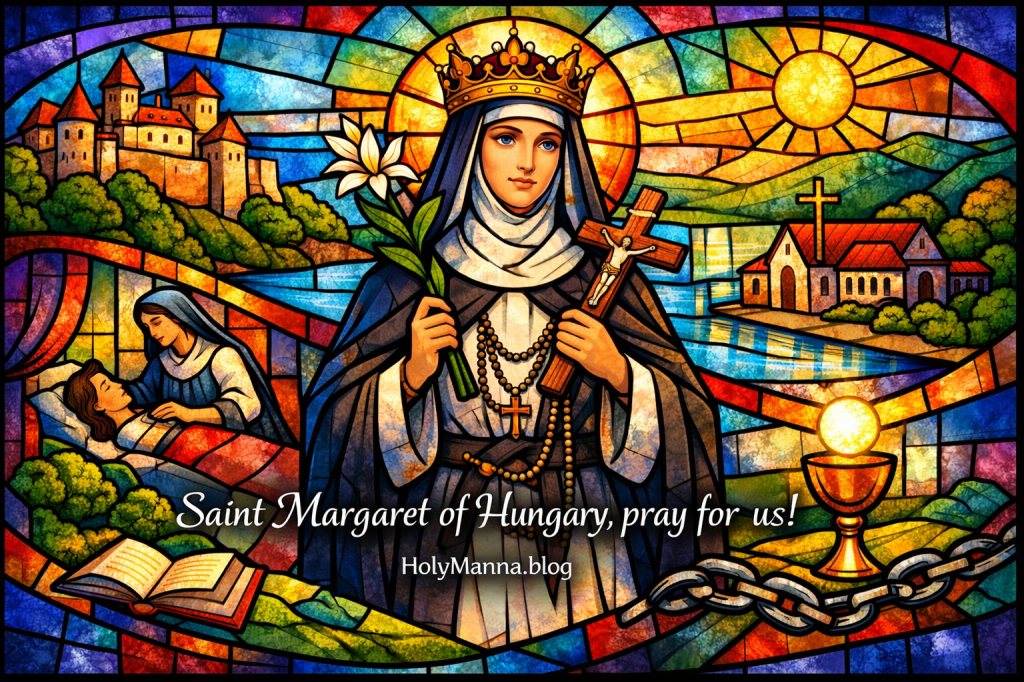
A Crown Laid at the Feet of Christ
Saint Margaret of Hungary shines because her holiness did not come from influence, travel, or public leadership. It came from choosing Christ when she had every worldly reason to choose comfort. Born into royalty, she could have lived in luxury and become a political power broker through marriage, but she embraced Dominican life with a seriousness that still feels bracing today. The Church remembers her for deep love of prayer and the Eucharist, fierce commitment to purity, and a humility so real it showed up in daily work, not just spiritual language. Her life is a reminder that sanctity is not mainly about being impressive, because sanctity is about being faithful, especially when nobody is clapping.
Her story also carries a distinctly Catholic lesson about vocation and sacrifice. When Christ calls a soul, the response is not supposed to be halfhearted or temporary. It is meant to be total, steady, and joyful, even when it is costly. Saint Margaret is revered because she lived like her vows mattered, and because she acted like heaven was more real than court politics.
A Life Offered in Love
Margaret was born in 1242 to King Béla IV of Hungary and Queen Maria. Catholic tradition places her birth in a time when Hungary was rebuilding after severe national turmoil, and her parents are remembered for making a vow to dedicate a child to God in gratitude and hope. That vow became Margaret’s path, and she was given to the Dominican sisters at a very young age. She was first formed at Veszprém, and later she was moved to a monastery founded by her parents on an island in the Danube near Buda, a place that would later carry her name and remain tied to her memory.
Her conversion was not a dramatic moment of turning from unbelief to belief. It was the steady deepening of a vocation that began early and became increasingly personal as she matured. She did not treat consecrated life as something merely chosen for her by others, because she embraced it as her own yes to God. Dominican tradition preserves the detail that she made profession in the presence of Blessed Humbert of Romans, a major leader of the Dominican Order in her century. That detail matters because it shows how seriously her vows were regarded, and it also shows that her vocation was not a private hobby. It was an ecclesial commitment made before the Church.
Holiness in the Laundry Room
Margaret’s daily life was the kind of holiness that makes sense to Catholics who understand that grace works through ordinary obedience. She was not chasing unusual experiences or spiritual novelty. She was building a life around prayer, the sacraments, and fidelity to her rule. Sources about her consistently highlight devotion to the Eucharist, long prayer, and a love for the hidden sacrifices of convent life. She chose tasks that humbled her, and she did not ask to be treated like a princess inside a monastery. She wanted to be treated like a sister, and more than that, she wanted to be treated like the least.
That humility was not performative, because it showed up in concrete choices that cost her something. Catholic accounts describe severe ascetic practices that modern readers can find intense, including wearing rough garments and embracing bodily disciplines meant to train the heart in detachment. Even if most Catholics are not called to imitate those practices literally, the spiritual principle is clear. Margaret wanted her love for Christ to be stronger than her love for comfort, and she wanted to unite her life to the Cross, not simply admire it from a distance. Her example fits the logic of The Gospel of Matthew, where Christ teaches that the disciple must deny himself and follow Him.
When it comes to miracles during her lifetime, the most careful Catholic accounts do not center on a list of dramatic signs she performed while living. Instead, they emphasize the steady miracle of virtue. A royal woman choosing humility, a young woman guarding her vows, and a consecrated virgin loving Christ with consistency are not small things. In a world that rewards ego, her hidden faithfulness becomes its own kind of sign.
She Chose the Crucified
Margaret carried a martyr’s spirit in the way she held her vows under pressure. Her hardest trials came from forces that would have crushed many people, especially a young woman living under royal expectations. Political leaders tried repeatedly to pull her out of the cloister and into dynastic marriage, because her royal status could have strengthened alliances and secured power. Margaret resisted firmly, and she understood her vows as belonging to Christ, not as a flexible arrangement that could be rewritten when politics demanded it.
Some Catholic retellings preserve vivid lines attributed to her refusal, expressing the strength of her resolve and her willingness to suffer rather than compromise. Even when such lines come through devotional tradition rather than personal writings, the point remains consistent across Catholic sources. She chose Christ with a seriousness that unsettled people who wanted to use her life for worldly gain. Dominican tradition also preserves a striking detail that helps explain how intense the pressure became. She received an ecclesiastical “Veiling of Virgins” specifically to end repeated attempts to marry her off, which was described as unusual and meant to make her consecration unmistakable.
Margaret’s hardships were also physical. She worked hard, embraced penance, and lived austerely, and the weight of those sacrifices can be felt in the way her story has been remembered. Catholic spirituality does not praise suffering for its own sake. It praises love that is willing to sacrifice, and Margaret’s love took the shape of endurance, obedience, and a steady refusal to trade heaven for comfort.
A Legacy That Would Not Fade
After Margaret’s death on January 18, devotion to her did not fade. It intensified. The most substantial miracle tradition connected to her is tied to posthumous healings reported through early canonical investigations. Catholic sources record that many miracles were attributed to her intercession shortly after her death, and that these reports were supported by witness testimony. Most of these miracles were described as healings, and the tradition even includes a case described as an awakening from death. This matters because it shows that devotion to her was not simply sentimental. It was linked to claims of answered prayer that the Church treated seriously.
Her relics became part of her legacy as well, and their history is both reverent and sobering. Over centuries of political upheaval and suppression of religious houses, her remains were moved, endangered, and in large part destroyed, though some portions were preserved in various places. That reality is painful, but it also teaches a deeply Catholic truth. A saint’s holiness does not depend on the safety of earthly remains, and devotion to the saints is not dependent on artifacts. The saint’s holiness depends on Christ, and the Church’s memory depends on truth and living faith.
Margaret’s veneration endured through centuries of delays and interruptions, including long gaps in formal recognition. Eventually, the Church’s official honor caught up to what the faithful already believed, and she was canonized in the twentieth century. Her cultural imprint remains especially visible in Hungary through the island long associated with her monastery, widely known today by her name. Even when people forget the details, the name itself continues to whisper that a hidden Dominican nun once left a mark strong enough to shape the map.
Learning to Choose the Better Part
Saint Margaret of Hungary challenges modern Catholics in a healthy way, because her life raises the uncomfortable question of whether faith is being treated like a lifestyle accessory or like the center of everything. She did not treat God as a weekend commitment. She organized her identity around belonging to Christ, and her humility was not soft. It was strong enough to endure pressure, temptation, and misunderstanding without breaking.
Her example does not mean every Catholic should imitate medieval ascetic practices. It does mean every Catholic should take seriously the spiritual logic behind them. The heart has to be trained, the will has to be strengthened, and virtue has to be chosen again and again, especially when nobody is watching. Margaret’s life offers a practical path for ordinary people. Keep commitments, guard purity of heart, embrace humble tasks without needing applause, and stay close to the Eucharist. When prayer feels dry, keep showing up anyway. When temptation feels loud, refuse to negotiate with it. When the world offers a better deal at the price of compromise, remember that Christ is not outbid by comfort.
How often does daily life ask for small compromises that slowly reshape the soul? Saint Margaret’s story pushes back with a steady Catholic answer. Fidelity is not a mood. Fidelity is a decision renewed in prayer, supported by grace, and strengthened by the sacraments. Her life shows that it is possible to be respectful without surrendering conviction, obedient without being weak, and gentle without being passive. Her fidelity was not rebellion. Her fidelity was worship.
Engage With Us!
Share your thoughts and reflections in the comments below. Saint Margaret’s life hits close to home because it forces a serious look at comfort, commitment, and courage in the spiritual life.
- Where does modern life apply pressure to compromise faith, purity, or integrity, and what would it look like to respond with Margaret’s firmness?
- What is one hidden duty or ordinary responsibility that could be offered to God with more humility this week?
- How can devotion to the Eucharist become more intentional, more reverent, and more central in daily life?
- What is one small sacrifice that can be embraced consistently as a way to train the heart to prefer God over comfort?
May Saint Margaret intercede for every heart tempted to settle for less than sainthood. Keep choosing faith over convenience, prayer over distraction, and purity over compromise. Live with courage, and do everything with the love and mercy Jesus taught us.
Saint Margaret of Hungary, pray for us!
Follow us on YouTube, Instagram and Facebook for more insights and reflections on living a faith-filled life.

 Holy Manna!
Leave a comment