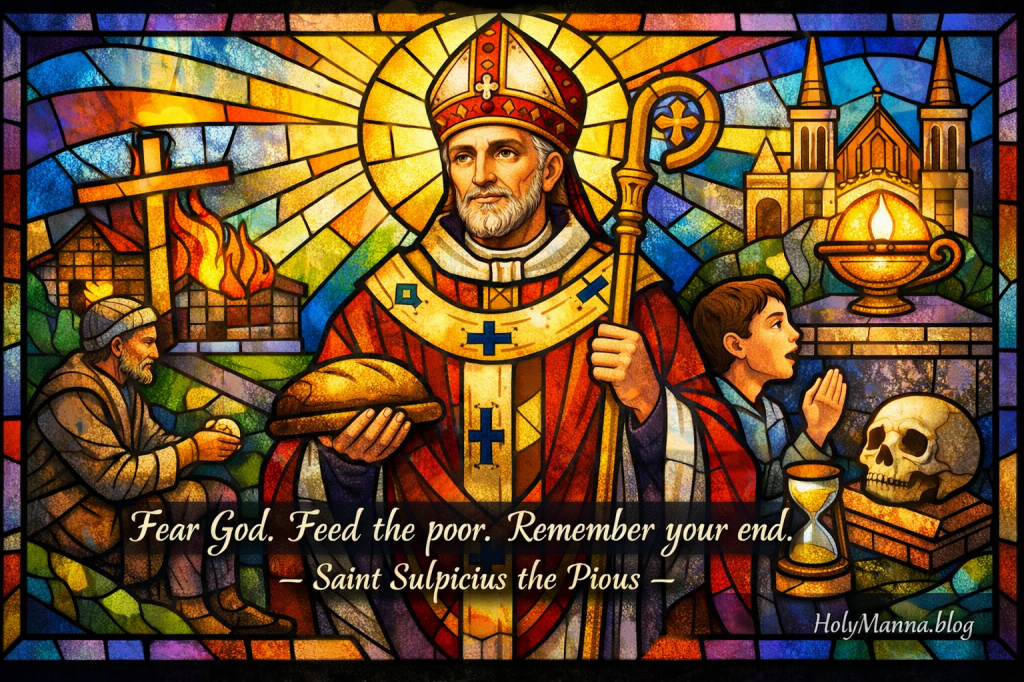
The Good Shepherd Who Fed the Poor
Saint Sulpicius the Pious, also remembered as Saint Sulpice the Good, served as bishop of Bourges in seventh century Gaul during the Merovingian era. He is honored because his holiness was steady, public, and deeply pastoral. Catholic memory holds him up as a true shepherd who protected the vulnerable, strengthened the Church’s life, and treated the poor as a sacred trust. His story matters because it shows that real reform often looks like ordinary fidelity that lasts for decades, especially when a culture is unstable and the Church needs leaders with backbone and tenderness.
His influence did not end with his death. Devotion to Saint Sulpice spread widely in France, and the name Saint Sulpice became woven into Catholic life through churches that honored him, including the great parish of Saint-Sulpice in Paris and later priestly formation associated with that parish. Even when later institutions developed long after his lifetime, the heart of his legacy stayed the same. A bishop who loved Christ learned to love Christ’s people with practical, sacrificial mercy.
A Noble Birth and a Deeper Calling
Catholic tradition places Sulpicius’s birth in Vatan, in the region of Berry, and describes him as coming from a noble family. That matters, because it means he likely had access to education and connections, and he could have chosen a comfortable path. Instead, he became known early for a disciplined spiritual life shaped by prayer, Scripture, and a serious Christian conscience. This is the kind of piety that is not just emotion but a habit of reverence that shapes decisions and steadies the soul.
His formation is linked to Bishop Austregisilus of Bourges, who ordained him and entrusted him with the training of clergy. That detail is important because it shows that Sulpicius was seen as the kind of man who could shape future priests through doctrine, prayer, and moral seriousness. He was also drawn into service close to the royal court, and Catholic tradition remembers him acting as chaplain under King Clotaire II, including service connected to the army. That environment can distort a man’s priorities if he loves influence more than truth, but Sulpicius’s reputation suggests the opposite happened. Being near power sharpened his sense that the Church’s job is to serve God and guard souls, not flatter rulers.
When Bishop Austregisilus died around 624, Sulpicius was recalled to Bourges and chosen to succeed him. Catholic memory treats this as providential, because a man trained in doctrine, shaped by prayer, and tested near the court was placed over a city that needed a pastor who would not sell his conscience. The bishop’s calling is to mirror Christ, the Good Shepherd, and to make that shepherding visible through service, truth, and mercy.
The Shepherd of Bourges
As bishop, Sulpicius worked to strengthen Christian life in his diocese and to uphold order in a time when society and Church discipline could be fragile. He participated in the broader life of the bishops, including attendance at the Council of Clichy in the seventh century, which is part of the Catholic historical memory of his public ministry. He also took seriously the duty of a bishop to defend his people, not only through preaching but through intervention when justice was threatened. Catholic sources remember an episode in which he interceded with King Dagobert when heavy burdens were placed on the people, including a severe tax. That is what a real shepherd does. He does not just speak about justice from a safe distance, and he does not treat the poor as an afterthought.
Sulpicius is also remembered for building up other holy leaders. He consecrated Saint Desiderius of Cahors as bishop, and a bond of correspondence is attributed to him through letters preserved in Catholic tradition. This matters because saints rarely grow alone. A healthy Church is built through holy friendships and mutual encouragement, especially among leaders who know they will answer to God for the souls they serve.
Catholic tradition associates miracles with his ministry, and these reports are preserved through early medieval hagiography and local memory. One account describes a dangerous fire that threatened a home during a winter visit. Sulpicius is said to have made the sign of the cross, and the threat of the flames stopped immediately. Another account speaks of a boy unable to speak, whose tongue had never formed words, and after prayer and a touch of the tongue he was suddenly able to speak. These stories are not about turning the saint into a magician. They remind the faithful that God sometimes consoles His people through signs, and that the sign of the cross is not decoration when it is made with faith in the Crucified and Risen Lord.
A saying tied to his memory captures the flavor of his life and gives a simple examination of conscience. “Fear God. Feed the poor. Remember your end.” It fits the Catholic picture of him because reverence, mercy, and sobriety about death are a strong foundation for holiness in any century. What would change this week if those three short commands were taken seriously and lived without excuses?
The Daily Cost of Holiness
Saint Sulpicius is not remembered as a martyr who died by violence, but his life included real hardship. A bishop in his era had to navigate political interference, social unrest, and spiritual conflict within the Church. He had to correct sin without crushing people, and he had to defend the weak without becoming a troublemaker for its own sake. He lived at a time when faith and politics were closely intertwined, and the Church’s witness could be compromised if leaders became too comfortable with worldly power.
Some older Catholic accounts include strong claims about his zeal for religious unity in the city, including sweeping language about conversion and the removal of false belief. Early medieval texts sometimes speak with urgency because they are praising zeal and stability, and they do not always describe the personal freedom and conscience of those involved in ways modern readers expect. The Church’s teaching is clear that faith must be a free response to grace, never forced. Still, the pastoral instinct underneath the tradition is recognizable. Sulpicius believed Christ is truth, and he carried a deep responsibility for the souls entrusted to him, which is precisely why bishops are called to be courageous, patient, and humble.
Late in life, Catholic sources say he appointed a coadjutor to assist him and withdrew to a monastery he had founded near Bourges, often linked in tradition to Notre-Dame de la Nef. That detail shows spiritual maturity, because he did not cling to office as if it were his identity. He prepared for succession, stepped back with humility, and returned to prayer. He died on January 17, around 646 or 647, and the Church continued to remember him as a shepherd who finished well.
The Lamp at the Tomb
After Sulpicius died, devotion at his tomb grew quickly. Catholic tradition speaks of pilgrims coming to pray and of healings granted through God’s mercy at the place where the saint was buried. Accounts of cures appear in the traditional memory of the Church, and they follow a familiar pattern seen with many saints. The faithful honor a holy pastor, ask for his intercession, and receive consolations that strengthen trust in Christ.
One of the most vivid traditions connected to him speaks of a lamp near his tomb and oil associated with that lamp being used as a sign of healing for the sick. The story is remembered as a striking moment that encouraged the faithful to pray with confidence, and the use of the oil became part of local devotional practice. Even when early reports are not modern documentation, the Catholic spiritual point remains clear. God sometimes uses simple signs to encourage His people, and the intercession of the saints is meant to draw hearts toward Jesus, not away from Him.
Over time the burial site developed and became associated with monastic life and ongoing pilgrimage. Relic histories across centuries can be disrupted through war, revolution, or neglect, and the history around his relics became complicated later on. Yet devotion to Saint Sulpice remained part of the Catholic memory of France, and his name lived on in churches dedicated to him and in the spiritual culture that grew around Saint-Sulpice in Paris, where priestly formation became closely associated with his patronage.
Holiness in Daily Struggles
Saint Sulpicius the Pious is an excellent saint for Catholics who want a faith that holds up under pressure. His life teaches that piety is not a private hobby. It is a public loyalty to Christ that shows up in how people are treated, especially the poor. It also teaches that the Church needs shepherds who are willing to risk discomfort to protect their people from injustice and spiritual harm.
His remembered maxim delivers a strong Catholic reality check. “Fear God. Feed the poor. Remember your end.” Reverence for God means worship is not casual and sin is not a joke, because the Lord is holy and the soul is not a toy. Feeding the poor means mercy should be concrete, not theoretical, because Christ receives what is offered to the least. Remembering the end means death is real, judgment is real, and heaven is worth arranging life around, not squeezing in when convenient. Where has comfort been allowed to silence generosity, and where has fear of conflict been allowed to silence truth?
A practical way to imitate Saint Sulpice is to commit to one steady work of mercy and keep it consistent, even when it is inconvenient. Another is to pray regularly for bishops and priests, because his life shows how much a community can be strengthened by faithful shepherds. Another is to practice a sober examination of conscience, guided by The Catechism and rooted in the Gospel, so that charity does not become vague and holiness does not become optional. Holiness often looks like doing the right thing for a long time, with patience and humility, trusting that God sees what the world ignores.
Engage with Us!
Share thoughts and reflections in the comments below. Questions for deeper reflection are below.
- What part of Saint Sulpicius the Pious’s life feels most needed in the Church right now, pastoral courage, care for the poor, or steady piety that does not bend to politics?
- How can a concrete work of mercy become a fixed habit in daily life, instead of a once in a while intention?
- What does “remember your end” look like in practice, especially in how time is used, how money is handled, and how prayer is prioritized?
- Who is one person in the community that tends to be overlooked, and what is one simple way to treat that person like Christ wants?
May Saint Sulpicius teach the faithful to live with reverence, to love the poor with real sacrifices, and to finish life with peace. Live a life of faith and do everything with the love and mercy Jesus taught, because nothing done in charity is ever wasted.
Saint Sulpicius the Pious, pray for us!
Follow us on YouTube, Instagram and Facebook for more insights and reflections on living a faith-filled life.

 Holy Manna!
Leave a comment