When the Desert Became a Cathedral
Saint Anthony the Great, also called Saint Anthony the Abbot, stands at the very beginning of the Church’s long tradition of monastic holiness. He is remembered as a father of monks, a teacher of prayer, and a living example of what happens when the Gospel is taken seriously without excuses or delay. His life matters because it shows that Christianity is not mainly an idea to admire. It is a way of life that reshapes everything, including money, time, desires, and identity, and it does so through grace.
Anthony’s legacy is deeply Catholic because it points straight to the heart of the faith. He lived the truth that grace is real, temptation is real, and the Word of God is not decoration. Even though he lived in the desert, his influence reached the whole Church because the desert purified his heart, and a purified heart speaks with a quiet authority. People did not seek him out because he had a brand. They sought him out because he had wisdom, peace, and a spiritual steadiness that only comes from long obedience.
Catholics honor him not as a strange antique figure from the past, but as a spiritual father for the present. When modern life is loud and restless, Saint Anthony reminds the faithful that silence is not emptiness. Silence can become a sanctuary where God trains the soul, heals it, and strengthens it for battle, especially when prayer is joined to humility and repentance.
The Gospel Line That Changed His Life
Anthony was born in Egypt in the third century, into a Christian household with real stability and enough wealth to live comfortably. He grew up around the ordinary rhythms of village life, and he learned the Scriptures through the worship and teaching available to Christians in that time. When he was still young, his parents died, and the weight of responsibility landed on him quickly. He had to manage an estate and care for his sister, and he could have easily chosen the safe path.
Instead, God used a moment of liturgy to press the Gospel into his conscience. Anthony heard Christ’s call to perfection in The Gospel of Matthew, and that word did not remain abstract. It became personal, and it demanded a response. The tradition remembers the turning point through the words of Jesus, “If you wish to be perfect, go, sell what you have, and give to the poor” (Mt 19:21). Anthony did not treat that line as poetry, and he did not postpone obedience until life felt easier. He provided for his sister, gave away his wealth, and stepped into a life of poverty, prayer, and self-denial.
This was not a rejection of ordinary goodness. It was a deeper yes to God, and it was a radical deepening of baptismal grace. Anthony chose to live as if eternity was real and as if the soul mattered more than comfort. What would change if Christ’s words were received as a command rather than an idea? Anthony’s life offers a clear answer, because he allowed one verse of Scripture to reorganize everything.
The Desert School of Holiness
Anthony did not become a saint overnight, and he did not pretend the spiritual life is simple. He began by learning from other ascetics and holy Christians, then withdrew into greater solitude as his desire for God grew stronger. He did not flee because he hated people. He withdrew because he understood that a divided heart cannot love God well, and he wanted his whole life to belong to Jesus Christ.
Catholic tradition remembers his desert years as a time of intense spiritual warfare. Stories describe attacks meant to frighten him, confuse him, and tempt him into despair. These accounts are not shared to feed curiosity. They are shared to teach a sober truth: the devil hates holiness, temptation is real, and the Christian life involves combat of the heart. Anthony endured by clinging to prayer, fasting, and the words of Scripture, and by refusing to bargain with sin. He learned to distrust pride, to reject spiritual shortcuts, and to remain faithful when prayer felt dry.
For many years he lived hidden away, including a long season in near-total seclusion. When he finally emerged, those who saw him were surprised by his steadiness and strength. The desert had not crushed him. It had clarified him, and it had formed a man whose interior life was no longer ruled by comfort or fear. As people began to gather around him, Anthony became a spiritual father. He did not become trusted because he was entertaining. He became trusted because his counsel was humble, practical, and rooted in truth.
Some sayings attributed to him have echoed through Catholic spirituality for centuries. One of the most bracing is “Expect temptation to your last breath”, because vigilance is part of love. Another that cuts straight into daily life is “Our life and our death is with our neighbour”, because holiness cannot be separated from charity. Where does charity need to become more concrete in the ordinary relationships of daily life? Saint Anthony teaches that prayer that never becomes love is not yet mature.
The Power of Persevering Prayer
The tradition surrounding Saint Anthony includes miracles and extraordinary events, especially healings and deliverance from demonic oppression. These stories consistently point away from Anthony as a magician and toward Christ as the healer and Lord. People came to Anthony burdened by sickness, fear, and spiritual torment, and he responded with prayer, compassion, and firm confidence in God’s mercy.
Accounts connected to his life describe healings after Anthony prayed and instructed the suffering to trust God rather than panic. These healings are presented as signs meant to strengthen faith and to remind believers that God is not distant from human pain. Anthony’s miracles also underline something Catholics know well: God often chooses humble servants to show His power, so that the faithful learn to hope and to turn toward Him with confidence. The spiritual fruit is the point, because a miracle that does not lead to deeper repentance and trust would miss the reason God gives signs at all.
Anthony’s authority also appeared in the way he calmed fear and corrected distorted thinking. He taught that fear is one of the enemy’s favorite tools, and that the Christian cannot live by fear without becoming spiritually weak. He urged people to cling to Christ, confess sins promptly, and practice humility, because pride can open the soul to confusion. Is the heart being led today by fear or by faith? Saint Anthony’s life pushes the faithful to name the difference and to choose courage rooted in grace.
The Hidden Cost of Holiness
Saint Anthony carried a heavy cross. He embraced a kind of long martyrdom through renunciation, hardship, and constant interior struggle. He endured loneliness, physical austerity, and relentless temptation, and he did it without seeking attention. That is not glamorous suffering, but it is the kind that slowly trains a soul to love God more than comfort.
He also stepped into public conflict when the Church needed him. Tradition holds that he went to Alexandria to encourage Christians during persecution, strengthening believers who faced imprisonment and death. Later, during the Arian crisis, he supported the orthodox confession of Christ, encouraging the faithful to remain firm in the truth. This matters because it shows a balanced Catholic spirit. Anthony loved solitude, but he did not treat the Church’s trials as someone else’s problem. He understood that fidelity to Christ includes fidelity to the Church’s teaching, especially when confusion spreads.
Another hardship he faced was the burden of being sought after. People wanted access to him, stories about him, and approval from him. Anthony repeatedly withdrew from public attention because he feared vanity and spiritual distraction. Holiness often attracts crowds, and crowds can become a temptation. Anthony’s refusal of celebrity is a sharp lesson for any age that confuses attention with authority. Does the heart seek approval more than it seeks purity? His example invites an honest examination and a quiet return to humility.
The Saint Who Kept Healing the World
When Saint Anthony died, he asked for a hidden burial. He did not want his body used as a spectacle, and he did not want devotion to drift into curiosity. He wanted people to seek Christ rather than chase religious souvenirs, and that request reveals a humility that is still rare. Even in death, he protected the faithful from distraction and called them back to what matters.
After his death, devotion to Saint Anthony spread across the Catholic world, and his memory shaped Christian life in surprising ways. His example and the writings about him helped ignite a desire for radical discipleship far beyond Egypt. Even those who never lived as monks were challenged by his witness, because he proved that the Gospel can be lived with full seriousness. His legacy also helped strengthen a tradition of mercy toward the suffering, especially as his name became associated in later centuries with care for those afflicted by painful illness sometimes called Saint Anthony’s fire.
Catholic charitable movements and hospital communities developed under his patronage, reflecting the Church’s commitment to unite prayer and works of mercy. His influence is still felt wherever Catholics take suffering seriously and respond with compassion rather than indifference. Pilgrimage and veneration also grew around places linked to his life and legacy, especially in Egypt where ancient monastic sites have long carried his memory. How can the faithful honor the saints in a way that stays focused on Christ and leads to conversion? Saint Anthony’s humility gives a strong answer by keeping devotion clean, simple, and Christ-centered.
Bringing the Desert into Daily Life
Saint Anthony can feel intimidating at first, because his life was so radical. Yet his lesson is not that every Catholic must move to the desert. His lesson is that every Catholic must make room for God and must practice discipline that protects the soul. The heart cannot serve two masters, and the Christian cannot grow without real decisions and real boundaries.
The first takeaway is silence and prayer. Modern life trains the mind to scroll and react, but the Christian needs stillness to hear God and examine conscience. A faithful daily rhythm of prayer, even if it starts small, can become a personal desert where God strengthens the soul. Consistency matters more than intensity because consistency forms character, and character shapes the future.
The second takeaway is vigilance. Anthony’s blunt wisdom is useful because it protects the faithful from surprise. Temptation does not vanish because someone is serious about faith. It often increases, especially when a person begins to grow. That is why humility matters so much, because humility keeps a Catholic close to confession, close to Scripture, and close to the truth that grace is the real source of victory. What pattern of temptation keeps returning, and what concrete guardrails would actually help? Saint Anthony’s life encourages honest answers and practical changes.
The third takeaway is charity. Anthony’s reminder, “Our life and our death is with our neighbour”, exposes a common trap. People can chase spiritual projects while staying impatient, harsh, or unforgiving at home. A truly Catholic spirituality makes a person more patient, more truthful, and more willing to serve. It builds peace in the home and integrity in the soul, and it teaches that love is not a feeling but a decision lived daily.
Engage with Us!
Share thoughts and reflections in the comments below. Saint Anthony’s life tends to wake people up in a good way, and it helps to hear how others are applying his example.
- What distraction most often steals prayer and peace, and what simple change could help create more silence for God?
- Where does spiritual pride sneak in most easily, and what act of humility could shut that door this week?
- What temptation tends to repeat in cycles, and what concrete plan would strengthen vigilance and accountability?
- How can charity become more practical at home, especially in speech, patience, and forgiveness?
- What is one small act of voluntary sacrifice that could be offered daily for love of Christ and the good of others?
May Saint Anthony intercede for every reader to love prayer, hate sin, and trust the mercy of Jesus Christ. Live a life of faith with courage and simplicity, and do everything with the love and mercy Jesus taught us.
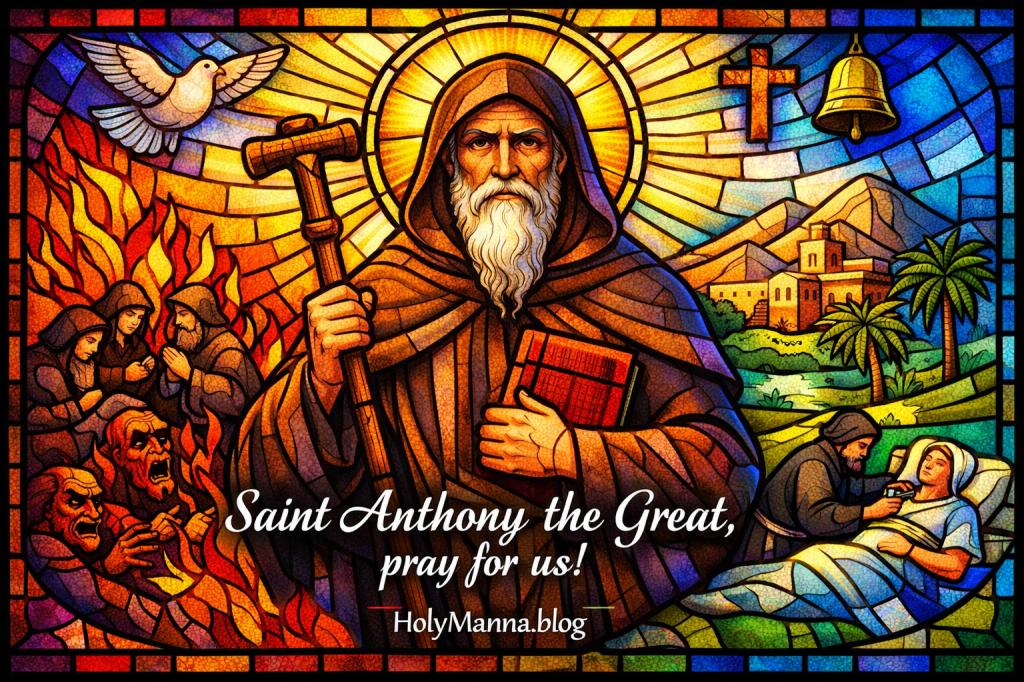
Saint Anthony the Great, pray for us!
Follow us on YouTube, Instagram and Facebook for more insights and reflections on living a faith-filled life.

 Holy Manna!
Leave a comment