Memorial of Saint Anthony, Abbot – Lectionary: 310
From the Donkey Trail to the Dinner Table
Some days in the spiritual life begin with something that feels small, even a little annoying, and then God quietly turns it into a crossroads. In 1 Sm 9:1-4, 17-19; 10:1, Saul goes looking for lost donkeys and ends up being anointed for leadership, which is a reminder that the Lord’s call often shows up in ordinary errands and unmet expectations. Then Ps 21:2-7 sings with the joy of a king who receives strength, victory, and blessing from God, making it clear that authority is never meant to be self-made or self-serving, because it is supposed to be received in humility and exercised in dependence on the Lord.
That royal theme does not stay in the palace, because in Mk 2:13-17 the true King walks along the sea, looks directly at a man the religious elite wrote off, and speaks a word that changes everything: “Follow me.” Levi’s call brings the conversation straight into the tension of first-century Jewish life under Roman rule, where tax collectors were widely seen as compromised, greedy, and ritually suspect because they worked with an occupying power. That is why the scandal is not only that Jesus calls Levi, but that He eats with Levi and his friends, because table fellowship signaled closeness, acceptance, and shared life. When the Pharisees protest, Jesus gives the heart of today’s theme with the clarity of a surgeon: “Those who are well do not need a physician, but the sick.”
Taken together, these readings reveal a single thread: God raises up leaders, but He does it to save, to heal, and to restore His people. Saul’s anointing hints that Israel’s longing for a king will never be satisfied by appearances alone, because what the Lord ultimately wants is a shepherd who serves under God’s authority. The psalm reinforces that a king’s glory is meant to be received as gift, not claimed as entitlement. The Gospel completes the picture by showing what godly authority looks like in the flesh: Christ reigns by seeking the lost and healing sinners, not by protecting an image of the “already righteous.” Where does the Lord seem to be calling someone out of the ordinary routine today? Is there a temptation to prefer looking respectable over being healed?
First Reading – 1 Samuel 9:1-4, 17-19; 10:1
God Turns Ordinary Errands into Holy Appointments
Israel is standing at a turning point. The people have demanded a king, and the Lord permits it, not because Israel’s future depends on charisma or height, but because God can work even through imperfect leaders to guide His people toward the true King who will one day save them completely. That is why this reading starts so quietly, with a young man chasing lost donkeys. In the ancient world, livestock meant livelihood, and a missing herd could threaten a family’s stability. Saul’s search looks like a simple responsibility, but it becomes the road God uses to bring him to Samuel. That is how the Lord often moves: He weaves calling and mission into ordinary life. This fits today’s theme because God’s call is never just a promotion. It is an anointing for service, and it points beyond Saul toward the kind of kingship that heals and restores, the kingship revealed perfectly in Christ who seeks the lost and calls sinners to follow Him.
1 Samuel 9:1-4, 17-19; 10:1 – New American Bible (Revised Edition)
Saul. 9:1 There was a powerful man from Benjamin named Kish, who was the son of Abiel, son of Zeror, son of Becorath, son of Aphiah, a Benjaminite. 2 He had a son named Saul, who was a handsome young man. There was no other Israelite more handsome than Saul; he stood head and shoulders above the people.
The Lost Donkeys. 3 Now the donkeys of Saul’s father, Kish, had wandered off. Kish said to his son Saul, “Take one of the servants with you and go out and hunt for the donkeys.” 4 So they went through the hill country of Ephraim, and through the land of Shalishah. Not finding them there, they continued through the land of Shaalim without success. They also went through the land of Benjamin, but they failed to find the animals.
17 When Samuel caught sight of Saul, the Lord assured him: This is the man I told you about; he shall govern my people. 18 Saul met Samuel in the gateway and said, “Please tell me where the seer lives.” 19 Samuel answered Saul: “I am the seer. Go up ahead of me to the high place and eat with me today. In the morning, before letting you go, I will tell you everything on your mind.
10:1 Then, from a flask he had with him, Samuel poured oil on Saul’s head and kissed him, saying: “The Lord anoints you ruler over his people Israel. You are the one who will govern the Lord’s people and save them from the power of their enemies all around them.
The Signs Foretold. “This will be the sign for you that the Lord has anointed you ruler over his heritage”
Detailed Exegesis
Verse 1 “There was a powerful man from Benjamin named Kish, who was the son of Abiel, son of Zeror, son of Becorath, son of Aphiah, a Benjaminite.”
This opening grounds the story in a real tribe, a real family, and a real history. Benjamin was the smallest tribe in Israel’s memory, and it carried painful associations after earlier conflicts in Israel’s past. God’s choice of a Benjamite king quietly signals that the Lord can raise up leadership from places people might overlook. The focus on lineage also reflects how Israel understood identity and responsibility as communal, not merely individual.
Verse 2 “He had a son named Saul, who was a handsome young man. There was no other Israelite more handsome than Saul; he stood head and shoulders above the people.”
Saul has the “resume” Israel wants. The description highlights outward impressiveness, which is important because it sets up a lesson the rest of 1 Samuel will develop: appearances can attract people, but they cannot sustain obedience. God can use natural gifts, but natural gifts do not automatically produce holiness. This verse invites an honest look at how easily people confuse presence with virtue.
Verse 3 “Now the donkeys of Saul’s father, Kish, had wandered off. Kish said to his son Saul, ‘Take one of the servants with you and go out and hunt for the donkeys.’”
The future king begins as a son under authority, doing a practical task for his father. That matters spiritually because God often trains leaders in hidden faithfulness before giving public responsibility. The servant going with Saul also hints that Saul’s journey is not about solo greatness. It is about providence guiding relationships, conversations, and choices.
Verse 4 “So they went through the hill country of Ephraim, and through the land of Shalishah. Not finding them there, they continued through the land of Shaalim without success. They also went through the land of Benjamin, but they failed to find the animals.”
The repeated “not finding” sets a tone of frustration and limitation. Saul is persistent, but he cannot solve the problem on his own. That is a spiritual pattern: God sometimes allows repeated dead ends so the heart becomes ready to listen. The geography also underscores that Saul is being led step by step. The path looks random, but it is not random to God.
Verse 17 “When Samuel caught sight of Saul, the Lord assured him: This is the man I told you about; he shall govern my people.”
This is the moment where human searching intersects with divine choosing. Saul did not arrive because he mapped out a destiny. He arrived because God spoke first. Vocation always begins with God’s initiative. The Lord identifies Saul to Samuel to show that true authority in Israel is meant to be received, not seized.
Verse 18 “Saul met Samuel in the gateway and said, ‘Please tell me where the seer lives.’”
Saul’s request is simple and respectful. The “seer” language reflects a period when prophetic guidance was commonly sought for decisions. Saul is still unaware of what is about to happen, which highlights how God can be closer than expected even when someone does not yet understand the moment.
Verse 19 “Samuel answered Saul: ‘I am the seer. Go up ahead of me to the high place and eat with me today. In the morning, before letting you go, I will tell you everything on your mind.’”
Samuel’s invitation to a meal signals welcome and honor. In Israel’s religious life, the “high place” often functioned as a site of sacrifice and communal worship before the Temple era was fully centralized. The promise to speak to “everything on your mind” shows God’s personal care. The Lord is not only arranging national leadership. He is also addressing the interior questions of an individual heart.
Verse 10:1 “Then, from a flask he had with him, Samuel poured oil on Saul’s head and kissed him, saying: ‘The Lord anoints you ruler over his people Israel. You are the one who will govern the Lord’s people and save them from the power of their enemies all around them.’”
The anointing with oil is a sacred sign of being set apart for God’s purposes. The kiss expresses recognition and covenantal acceptance. Most importantly, Samuel makes clear that Saul’s authority is not autonomous. Saul is anointed to govern the Lord’s people, meaning the king remains under God. The goal is protective and salvific in a real historical sense: deliverance from enemies. Still, this also prepares the heart for a deeper truth. Every imperfect deliverance in Israel trains the people to long for the perfect deliverance that only God can give, fulfilled in the Messiah, the Anointed One.
Teachings
This reading teaches that God’s call often arrives through ordinary responsibilities, and that leadership in God’s people is meant to be received as a mission of service. Saul’s anointing introduces a pattern that runs through Scripture: God sets apart someone for the sake of others, not for self-exaltation. Anointing is never a spiritual trophy. It is a burden of love.
The Catechism helps connect this Old Testament anointing to the heart of Christian faith by explaining the meaning of “Christ” as a title. CCC 436 teaches, “The word ‘Christ’ comes from the Greek translation of the Hebrew ‘Messiah,’ which means ‘anointed.’” This matters because Saul’s anointing is not an isolated ritual. It is part of a long preparation for Jesus Christ, whose kingship is not rooted in appearances but in obedience, mercy, and saving power.
The history of Saul also carries a sober lesson that belongs to today’s theme. God truly calls and truly gives grace, but the human response still matters. Saul begins with real favor and real promise, yet later failures in obedience show that a calling must be protected by humility, prayer, and docility. In other words, being chosen is not the same thing as being faithful. The Lord’s gifts are real, and the Lord’s standards are real.
Reflection
This reading invites a simple but challenging attitude: take ordinary responsibilities seriously, because God loves to hide His guidance inside them. A missed opportunity for holiness is often not some dramatic moral collapse. It is neglecting small duties, resenting interruptions, or refusing to listen when plans fall apart.
There is also a gentle warning about appearances. Saul looks like the kind of leader people want, and that is exactly why the story is worth praying with. God can use natural strengths, but holiness is built by obedience. The question is not whether someone seems impressive. The question is whether the heart remains under God.
What “lost donkey” situation is testing patience right now, and could it be the very path where God wants to speak? Is there a habit of chasing control instead of asking the Lord what He is arranging through the delays? A practical step is to begin the day by offering the schedule to God, then choosing one moment of frustration to become a moment of prayer. Another step is to ask for the grace to be faithful in hidden duties, because that is where God often forms the kind of leadership that serves rather than dominates.
Responsorial Psalm – Psalm 21:2-7
The Crown Comes From God, So Joy Must Stay With God
This psalm is a royal song of thanksgiving, the kind Israel would pray in connection with the king’s victories and public worship. In a culture where kings often claimed divine status or treated power as personal property, Israel’s faith stands out because the king is never supposed to be a god. The king is meant to be the Lord’s servant, receiving authority as a gift and exercising it under God’s law. That is why this psalm fits so naturally with Saul’s anointing in the first reading. It reinforces today’s theme by reminding everyone that leadership, strength, and blessing come from the Lord, and that the deepest joy of a ruler is not applause or dominance, but the favor and presence of God.
Psalm 21:2-7 – New American Bible (Revised Edition)
2 Lord, the king finds joy in your power;
in your victory how greatly he rejoices!
3 You have granted him his heart’s desire;
you did not refuse the request of his lips.
Selah
4 For you welcomed him with goodly blessings;
you placed on his head a crown of pure gold.
5 He asked life of you;
you gave it to him,
length of days forever.
6 Great is his glory in your victory;
majesty and splendor you confer upon him.
7 You make him the pattern of blessings forever,
you gladden him with the joy of your face.
Detailed Exegesis
Verse 2 “Lord, the king finds joy in your power; in your victory how greatly he rejoices!”
The psalm begins by putting the spotlight in the right place. The king’s joy is not in his own strength, but in God’s power. The victory belongs to the Lord first, and the king rejoices because he recognizes dependence. Spiritually, this verse challenges any temptation to treat success as self-made. It also prepares the heart for the Gospel, because Christ’s “victory” will look like mercy and healing more than worldly triumph.
Verse 3 “You have granted him his heart’s desire; you did not refuse the request of his lips. Selah”
This verse speaks of prayer being heard. Israel understood the king as someone who interceded for the people, and his petitions mattered because his role affected the whole nation. The word “Selah” is a pause, inviting reflection and reverence. It encourages a slow, grateful awareness: God listens, and God answers, even if the answer sometimes reshapes what the heart desires. This is also a good mirror for discipleship, because following God often means letting Him purify desires rather than merely fulfilling them.
Verse 4 “For you welcomed him with goodly blessings; you placed on his head a crown of pure gold.”
The crown is presented as a gift, not a trophy. The king does not grasp it as a personal achievement. He receives it through God’s providence, and the language of “welcomed” suggests favor and communion, not mere transaction. In the Old Testament pattern, the crown represents responsibility under God, and in the fullness of time it points to Christ the King, whose crown will include suffering and sacrificial love.
Verse 5 “He asked life of you; you gave it to him, length of days forever.”
In its original setting, this is a prayer for the king’s long life, because stability in leadership often meant stability for the people. The psalm’s language reaches beyond ordinary human limits, which is why the Church has long heard a deeper resonance here. No earthly king lives forever. Ultimately, only the Messiah truly receives “length of days forever,” because Christ’s kingship is everlasting. This verse quietly lifts the heart from temporary security to eternal hope.
Verse 6 “Great is his glory in your victory; majesty and splendor you confer upon him.”
Glory is described as something given, not something manufactured. The king’s honor is a reflection of God’s saving action. This is a spiritual corrective for pride. Any real dignity a person carries, whether in family, work, or ministry, is received and entrusted. It is not self-generated. That logic matches the Gospel, where Jesus restores dignity to sinners by calling them, not by flattering them.
Verse 7 “You make him the pattern of blessings forever, you gladden him with the joy of your face.”
The greatest gift is not the crown, the victory, or the public honor. The greatest gift is the “joy of your face,” meaning the joy of God’s presence. This is the peak of the psalm. It teaches that the deepest happiness is communion with God. It also fits today’s theme beautifully, because Christ reveals God’s face most clearly at the table with sinners, showing that divine presence is not reserved for the polished, but offered to the repentant.
Teachings
This psalm teaches that true authority is accountable to God and true joy is rooted in God’s presence. Even when the Church prays this psalm with Israel’s kings in mind, it also naturally points forward to Jesus Christ, the perfect King who receives everything from the Father and gives everything back in love. The royal imagery becomes a school of humility: blessings are gifts, not entitlements.
The Catechism teaches that the Psalms are not only ancient prayers but living prayer for the Church. CCC 2585 says, “From David on, the Spirit of the promise begins to inspire the prayer of the People of God.” That matters here because Psalm 21 forms a heart that knows how to receive, how to thank, and how to stay dependent. It trains a believer to see victories and blessings as reasons to worship, not reasons to boast.
The psalm also harmonizes with a classic spiritual teaching often echoed by saints and pastors: the human heart is restless when it chases glory apart from God, but it becomes steady when it seeks God’s face above every lesser reward. The king is “gladdened” not primarily by power, but by communion. That is the same medicine Jesus offers the Pharisees in the Gospel. The problem is not their desire to be righteous. The problem is that they want righteousness without mercy and without the Physician.
Reflection
This psalm is a practical guide for living with gratitude and humility in a world that constantly trains people to take credit. It invites a new habit of speech and thought: when something goes well, thank God before discussing personal effort. When something is received, acknowledge it as gift before treating it as deserved. When influence increases, remember that responsibility increases too.
It also invites a deeper kind of joy. The psalm does not deny crowns and victories, but it places them below the joy of God’s face. That is a direct challenge to modern restlessness, where people can gain more and still feel empty. The soul was made for communion, not constant validation.
Is the heart chasing a crown or chasing God’s face right now? When success happens, does gratitude rise first, or does self-congratulation take over? A concrete step is to choose one victory from the day, even a small one, and turn it into a short prayer of thanksgiving. Another step is to choose one desire that keeps returning, and place it honestly before God, asking that it be purified and ordered toward holiness. When the heart learns to rejoice in God’s presence, everything else finds its proper place.
Holy Gospel – Mark 2:13-17
The King Who Calls the Unclean and Heals the Wounded
In the world of first-century Galilee, a tax collector was not just “a guy with a job.” He was widely seen as a traitor, working within the Roman system and often associated with greed, betrayal, and ritual uncleanness. That is why today’s Gospel hits so hard. Jesus does not wait for Levi to clean up his reputation first. He calls him where he is, and then He sits at table with the very people polite religion preferred to keep at a distance. This fits today’s theme perfectly: God’s call is an act of mercy. Saul is found on an ordinary road and anointed for service. Levi is found at a customs post and summoned into discipleship. In both cases, God takes the initiative, and the purpose is not self-glory but the saving and healing of God’s people.
Mark 2:13-17 – New American Bible (Revised Edition)
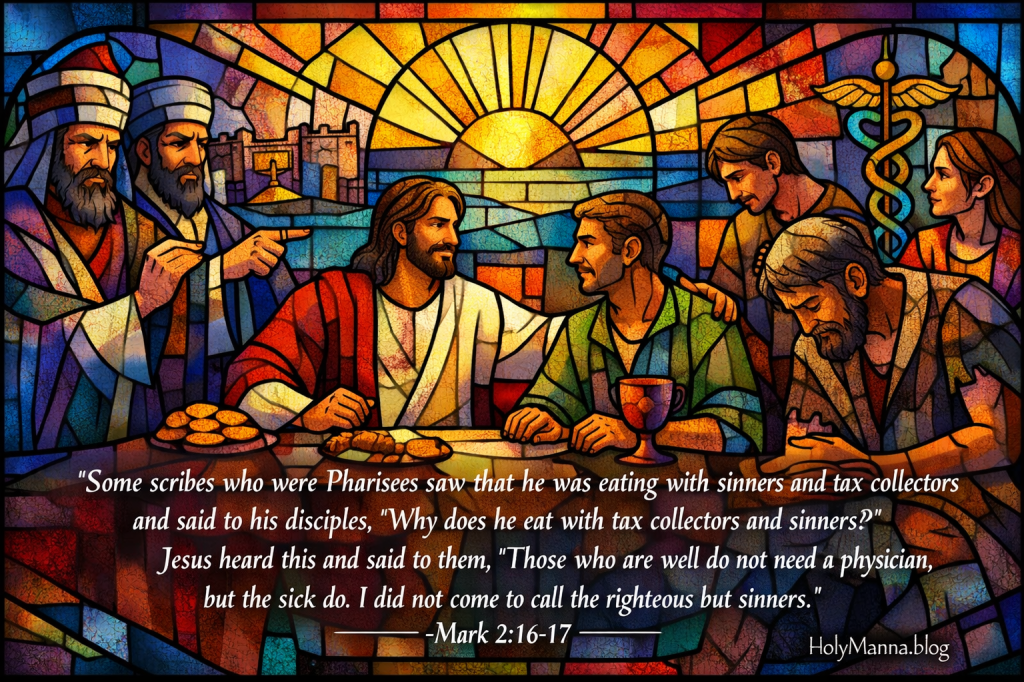
The Call of Levi. 13 Once again he went out along the sea. All the crowd came to him and he taught them. 14 As he passed by, he saw Levi, son of Alphaeus, sitting at the customs post. He said to him, “Follow me.” And he got up and followed him. 15 While he was at table in his house, many tax collectors and sinners sat with Jesus and his disciples; for there were many who followed him. 16 Some scribes who were Pharisees saw that he was eating with sinners and tax collectors and said to his disciples, “Why does he eat with tax collectors and sinners?” 17 Jesus heard this and said to them [that], “Those who are well do not need a physician, but the sick do. I did not come to call the righteous but sinners.”
Detailed Exegesis
Verse 13 “Once again he went out along the sea. All the crowd came to him and he taught them.”
Jesus returns to the shoreline, a familiar place of mission in Galilee. Mark shows a steady rhythm: Jesus goes, people gather, and He teaches. The Lord does not build discipleship on hype or personality alone. He forms minds and hearts with truth, because real conversion requires real teaching.
Verse 14 “As he passed by, he saw Levi, son of Alphaeus, sitting at the customs post. He said to him, ‘Follow me.’ And he got up and followed him.”
Jesus “sees” Levi, which is more than noticing him. It is the gaze of a Shepherd who claims what others dismiss. Levi is “sitting” at a place tied to suspicion and sin, yet Jesus speaks a direct invitation: “Follow me.” Levi’s response is immediate. That detail matters. Grace calls, but it also demands a decision. Discipleship is not a private admiration of Jesus. It is a concrete leaving behind of an old life.
Verse 15 “While he was at table in his house, many tax collectors and sinners sat with Jesus and his disciples; for there were many who followed him.”
The dinner table becomes the battlefield. In that culture, shared meals signaled communion and friendship. Jesus is not endorsing sin. He is extending mercy and opening a path to conversion, right in the place where outsiders can actually receive it. The line “there were many who followed him” shows something important: when mercy is real, it attracts sinners who are tired of pretending.
Verse 16 “Some scribes who were Pharisees saw that he was eating with sinners and tax collectors and said to his disciples, ‘Why does he eat with tax collectors and sinners?’”
The scribes and Pharisees are not asking an innocent question. They are accusing Jesus of crossing a boundary that, in their minds, protected holiness. Their mistake is not caring about holiness. Their mistake is treating separation as holiness, while ignoring the deeper work of mercy, conversion, and the restoration of the lost. They also aim their criticism at the disciples, a common tactic when someone wants to undermine a teacher by unsettling the students.
Verse 17 “Jesus heard this and said to them, ‘Those who are well do not need a physician, but the sick do. I did not come to call the righteous but sinners.’”
Jesus answers with a clear image: He is a physician. The problem is not that the Pharisees want righteousness. The problem is that they do not recognize their sickness. When someone thinks he is already “well,” mercy feels insulting and repentance feels unnecessary. Jesus reveals His mission without apology: He comes to call sinners, not to flatter the self-satisfied. This is not softness toward sin. It is the strongest possible hope for sinners, because it means the door is still open.
Teachings
This Gospel teaches that Christ’s mercy is personal, concrete, and ordered toward conversion. Jesus calls Levi with authority, and that call creates a new identity. The Church has always seen Levi’s response as a model of what grace can do when it is not resisted. Many saints highlight the speed of Levi’s obedience to show that conversion is not meant to be endlessly postponed. The longer the heart negotiates, the more it clings to the customs post.
This passage also corrects a common spiritual counterfeit: the appearance of holiness that refuses mercy. The Pharisees believed distance from sinners protected purity, but Jesus reveals that true holiness is not fragile. The Holy One steps into the mess to heal it. That is why the image of Christ as physician matters so much in Catholic spirituality. Sin is not merely “a bad habit.” It is a wound that requires healing, and grace is not merely “self-improvement.” It is a rescue.
There is also an important lesson about scandal and misunderstanding. Jesus will be criticized for being too close to the wrong people. The disciple should not be surprised when mercy is mocked as compromise. The Christian task is to hold both truths together without confusion: love the sinner, hate the sin, and never pretend the sickness is health.
Reflection
This Gospel invites an honest check of the soul. Levi is easy to judge from a distance, but the deeper question is whether the heart is acting like Levi or acting like the Pharisees. Levi knows he needs a new life, and he gets up. The Pharisees think they are fine, and they stay stuck. That contrast shows why humility is the front door of mercy.
A practical step is to practice fast obedience in small things. When God prompts prayer, do not delay. When conscience nudges toward reconciliation, do not negotiate. When the Church offers Confession, take it seriously, because the Physician still heals through the sacrament of mercy. Another step is to examine how people are treated who have messy reputations. Christ does not demand perfection before offering friendship. He offers friendship that leads to conversion.
Where does the heart most resist being called “sick,” and how might that resistance be blocking healing? Is there a habit of comparing sins instead of confessing them? Is there a person who seems “too far gone,” and is that judgment actually a way of avoiding the demanding mercy of Christ? Jesus still passes by, still sees, and still says “Follow me.” The only question is whether the soul will get up.
When God Calls, Get Up and Follow
Today’s readings come together like a single, steady message: God does not wait for perfect conditions before He calls, and He does not call in order to inflate ego. He calls to save, to heal, and to form a heart that lives under His authority. In 1 Samuel 9:1-4, 17-19; 10:1, Saul is not searching for a throne. He is searching for lost donkeys, and the Lord turns that ordinary errand into a holy appointment. Saul is anointed so that God’s people can be protected and guided, which reminds every soul that vocation is never about status. It is about service and responsibility before God. Then Psalm 21:2-7 teaches how to hold every blessing with open hands. The crown, the victory, the honor, and even the strength to lead are received gifts, and the deepest joy is not the spotlight but the joy of God’s face.
The Gospel brings the theme to its sharpest point. In Mark 2:13-17, Jesus walks straight into the places respectable religion avoids. He looks at Levi, speaks the simple command of mercy, and Levi gets up. The table becomes a sign of the Kingdom, not because sin is ignored, but because sinners are invited into healing. Jesus makes it plain that He is not an accessory for the self-satisfied. He is the Physician for the sick, and the only thing that blocks His cure is pretending there is no wound.
The call to action is simple and strong. Choose to be honest about need, because humility is where mercy begins. Choose fast obedience in the small promptings of grace, because delayed conversion usually becomes denied conversion. Choose a concrete step toward healing, especially through prayer, examination of conscience, and Confession, because the Physician still works through the gifts He has placed in His Church. What would change if the soul stopped defending itself and started following Christ with the simplicity of Levi? The Lord still passes by, still sees, and still calls. The best response is to get up and follow Him.
Engage with Us!
Readers are invited to share reflections in the comments below, because hearing how God speaks to different hearts helps everyone grow together in faith.
- First Reading 1 Samuel 9:1-4, 17-19; 10:1: Where might God be using an ordinary frustration or delay to guide the soul toward a deeper calling, and what concrete act of obedience can be offered today in response?
- Responsorial Psalm Psalm 21:2-7: What “crown” or success has been treated like a personal achievement instead of a gift from God, and how can gratitude become more intentional in daily prayer?
- Holy Gospel Mark 2:13-17: Where is there a temptation to act “well” instead of admitting the need for the Physician, and what step toward real healing, especially repentance and mercy, needs to happen next?
Keep choosing the path of faith, even when it starts in ordinary places, and keep doing everything with the love, humility, and mercy Jesus taught, because that is how the heart becomes truly free.
Sacred Heart of Jesus, we trust in You!
Immaculate Heart of Mary, pray for us!
Saint Michael the Archangel, defend us in battle!
Follow us on YouTube, Instagram and Facebook for more insights and reflections on living a faith-filled life.

 Holy Manna!
Leave a comment